eBook - ePub
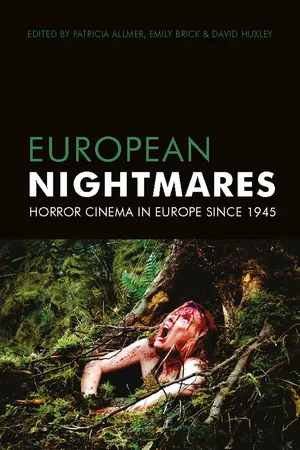
European Nightmares
Horror Cinema in Europe Since 1945
- English
- ePUB (mobile friendly)
- Available on iOS & Android
eBook - ePub
European Nightmares
Horror Cinema in Europe Since 1945
About this book
This volume is the first edited collection of essays focusing on European horror cinema from 1945 to the present. It features new contributions by distinguished international scholars exploring British, French, Spanish, Italian, German and Northern European and Eastern European horror cinema. The essays employ a variety of current critical methods of analysis, ranging from psychoanalysis and Deleuzean film theory to reception theory and historical analysis. The complete volume offers a major resource on post-war European horror cinema, with in-depth studies of such classic films as Seytan (Turkey, 1974), Suspiria (Italy, 1977), Switchblade Romance (France, 2003), and Taxidermia (Hungary, 2006).
Information
Subtopic
Film & VideoRECEPTION AND PERCEPTION OF EUROPEAN HORROR CINEMAS
RECEPTION AND PERCEPTION OF EUROPEAN HORROR CINEMAS
Horror fans tend to be treated differently from mainstream cinema audiences, or as Andrew Tudor puts it, ‘a taste for horror is a taste for something seemingly abnormal and is therefore deemed to require special attention’ (1997: 446). Matt Hills also argues that ‘work on the pleasures of horror seems to have unwittingly adopted media discourses surrounding horror via its willingness to view horror’s pleasures as a puzzle, conundrum or a “problem” which is in need for further study’ (2005: 3). Approaches to the field of horror reception generally form four broad groups: psychoanalytic models of spectatorship, empirical audience studies, critical reaction (media and academic) and institutional surveillance for the purposes of censorship. Psychoanalytic models are, by their nature, ahistorical, and ‘visual pleasure’, whether conscious or unconscious, is not the same thing as socialised horror viewing. The significance of the nationality and location of the audience or even the nationality of the films being consumed is not something that has been foregrounded in studies of horror reception. In order to establish the importance of place, the essays in this section focus on the empirical audience, critical reception and institutional surveillance in examining the reception of European horror films and the consumption of horror by European audiences.
Peter Hutchings’ chapter investigates the extent to which certain horror films, in particular Resident Evil (Paul W. S. Anderson, 2002) and Suspiria (Dario Argento, 1977), may be perceived by their audiences as being part of a European horror tradition, and thus addresses the complexities of defining European horror cinema. Resident Evil is a film not only co-produced by European companies, but also filmed in a Europe constructed in the film’s mise-en-scène as a fictitious American city, so the film is perceived as an American product. Hutchings suggests, by proposing ‘Eurohorror’ as an umbrella term, that the fascination of European horror consists not in a cohesive totality, but precisely in the absence of this totality; European horror consists instead, he argues, of a variety of different practices with ‘no geographical centre and no core identity’.
Resident Evil is a breed of horror film which also addresses the increasingly important market of video game players. Horror films now have a symbiotic relationship with video games, on the most obvious level through the adaptation of games such as Resident Evil but also at an aesthetic level through the development of CGI technology. European cinema has not embraced this aesthetic in the same way that American horror has, largely for reasons of cost. Increasingly, as different forms of media become more intertextual, film audiences cross over with video game players, and horror is the most prominent site of this intertext.1 Video games also have similarities with horror film in being the subject of moral panics over violent content and the effects upon audiences.
Psychoanalytic models of spectatorship concerned with gender and sexuality have dominated studies of horror film spectators. Brigid Cherry has addressed the absence of a socialised audience and examined the tastes and viewing pleasures of actual horror audiences (1999; 2007). Her chapter here, ‘Beyond Suspiria: The place of European Horror Cinema in the Fan Canon’, is based on empirical study and discourse analysis, and examines the reception of European horror films within online fan communities. She focuses on the fan discourses and reception of Suspiria as the most popular European film among her subjects. For these audiences (primarily British and American) European films and directors have a particular status because of their ‘exotic’ national origins. A knowledge of, and liking for, European horror cinema marks fans as having more ‘élite’ tastes within an overall fan canon and the sub-groups of this fan culture.
Horror consumption and reception are also heavily influenced by horror production and distribution. The institutional gaze on horror, along with pornography, affects its aesthetics perhaps more than any other genre. Each country in Europe has different forms of censorship, and in a genre which can rely on explicit violence and sex, this produces a fragmented aesthetic. What is freely available for one audience within Europe may be banned for another, and state control over the production and consumption of texts was obviously particularly acute in Eastern Europe during the Communist era. Even within individual countries distribution and access is not equal. In the UK what may be shown in one council borough may be banned in another.
Russ Hunter and Ernest Mathijs’s chapter on Belgian horror cinema looks at why Belgian film critics refuse to call horror films by that nomenclature although audiences outside Belgium will recognise these same texts as clearly belonging to the horror genre. The critical (rather than academic or fan) reception of a number of Belgian horror films discussed in this chapter highlights the fact that the notion of what constitutes a text as ‘horror’ is subjective and dependent on national and ideological constructions.
David Huxley’s chapter on moral panics in relation to British and mainland European horror cinema examines how this institutional gaze affects the aesthetics of the films and the relationship between reception and critical reaction. He examines the ways in which this critical reaction has varied substantially between different sources, and also how the reaction has changed quite dramatically during a comparatively short period of time. This highlights the way in which the groundwork for the critical recuperation, both of studios such as Hammer and of European ‘auteurs’ such as Mario Bava, was already in place very soon after the height of their critical opprobrium.
Overall the essays in this section demonstrate problems of definition not only of horror itself but also of national and European cinemas in the post-war period. In doing so they also highlight the sheer breadth and complexity of the reception of the films under consideration.
NOTE
1 Although the design, production and distribution of the games is primarily Japanese and American, European landscape and history is used as the setting in many survival horror games: Resident Evil 4 (2005, Capcom) is set in a Mediterranean village, Resistance: Fall of Man (1999, Insomniac Games) is set in Manchester Cathedral and the mise-en-scène of Half Life 2 (2004, Valve Corporation) was inspired by old and new Eastern European architecture.
BIBLIOGRAPHY
Cherry, B. (2007) ‘Subcultural Tastes, Genre Boundaries and Fan Canons’, in M. Jancovich and L. Geraghty (eds) Generic Canons: Genre, History, Memory. Jefferson, NC: McFarland, pp. 201–15.
———(1999) ‘Refusing to Refuse to Look: Female Viewers of the Horror Film’, in R. Maltby and M. Stokes (eds) Identifying Hollywood Audiences: Cultural Identity and the Movies. London: British Film Institute, 187–203.
Hills, M. (2005) The Pleasures of Horror. London: Continuum.
Tudor, A. (1997) ‘Why Horror?: The Peculiar Pleasures of a Popular Genre’, Cultural Studies, 11: 3, 443–63.
RESIDENT EVIL?
THE LIMITS OF EUROPEAN HORROR: RESIDENT EVIL VERSUS SUSPIRIA
What is a European horror film? The simple and obvious answer – simple and obvious to the point of banality – is that it is a horror film made in Europe. However, the reality of ‘Eurohorror’ as a distinct cinematic category turns out to be both more complex and more elusive than this apparently commonsensical definition might suggest.
Take Resident Evil (2002), for instance. This zombie-action thriller American-British-French-German co-production undoubtedly contained pronounced elements of horror and it was filmed mainly in Europe (in Germany to be precise, with a few scenes shot in Canada), and its cast and crew contained numerous Europeans. Yet it has not really been perceived or discussed as a European horror film by critics or by horror fans. For example, a recent article exploring the fan response to Resident Evil does not raise the film’s potential ‘European’ identity at all (Lay 2007). This might have something to do with its setting (a fictitious American city) or its source material (a Japanese computer game), or the way in which it can in various ways be placed within an American horror idiom (with noted American horror director George Romero providing an early – if ultimately rejected – screenplay for the film). It might also be connected with the fact that many of the key European creative figures involved in the film have international professional profiles. For example, Paul W. S. Anderson, Resident Evil’s writer-director, is British but associated mainly with Hollywood productions such as Event Horizon (1997), Soldier (1998) and AVP: Alien versus Predator (2004) (although, ironically, some of these had international financing and were shot partly or wholly in Europe). Bernd Eichinger, one of Resident Evil’s producers, has an extensive CV including both German- and English-language films, with the latter including what might appear to be the quintessentially American Fantastic Four (2005) and its sequel Fantastic Four: Rise of the Silver Surfer (2007), while Milla Jovovich, Resident Evil’s star, might be Ukrainian-born but, in career terms at least, is thoroughly international, with appearances in both American and European productions.
Perhaps more significant so far as Resident Evil’s apparent lack of Eurohorror credentials is concerned is its marked reliance on a type of narrative-driven cinema associated mainly with US genre product. (In this respect, the fact that Resident Evil’s two sequels were mainly filmed, respectively, in Canada and Mexico does seem to underline the original’s apparent lack of connection with its European production context.) As one might expect, Resident Evil contains plenty of moments of generically motivated excess involving violence and/or gore along with some of the martial arts action that was internationally fashionable at the time of its production, but this is all wrapped up in a fast-moving narrative in which the main protagonists repeatedly and dynamically make life or death decisions and act upon these.
By contrast, Suspiria (1977), an Italian supernatural drama dealing with witchcraft in a sinister ballet school, is often seen as an exemplar of Eurohorror. Like Resident Evil, it is excessive but here the excess seems to entail a more forceful retardation of a narrative drive, to the extent that the narrative periodically ceases to exist. It is certainly the case that Suspiria’s narrative is considerably more attenuated than that of Resident Evil and its characterisations more perfunctory; instead the film is structured around a series of spectacular set pieces that combine displays of extreme terror and violence with some truly virtuoso stylistics. The fact that Suspiria was directed by Dario Argento further underlines its status as a classic Eurohorror inasmuch as Argento himself has often been presented, by critics and devoted fans, as a filmmaker whose entire career has offered a sustained commitment to, and excellence within, this particular area of European culture. (For a discussion of this, see Hutchings 2003.)
Having noted this, Suspiria, like Resident Evil, has an international dimension to it, manifested most obviously in the presence of an American actor, Jessica Harper, in the leading role. But the international elements so successfully integrated into a seamless whole in Resident Evil are in Suspiria visibly and roughly hewn together. The dubbing of certain actors is all too obvious – and presumably this would also have been the case for the Italian-language version where Jessica Harper would have been dubbed – and the use of music too eccentric and the diminution of narrative too obtrusive, thereby rendering a potential pandering to the American market awkward and unconvincing, just as Argento’s career outside of his native Italy has exhibited an ungainly quality (although Suspiria did turn out to be the only one of Argento’s films to be commercially successful in the United States).
It might seem from this that the identity of Eurohorror resides precisely in its visible difference from what is perceived as the American commercial mainstream. The more a film looks American (as Resident Evil might look American), the less value it has as an example of Eurohorror. Such a strategy for finding both a distinctiveness and positive cultural value in a perceived distance from a Hollywood aesthetic and ethos has, of course, been deployed in relation to other sectors of European film production as well, with such sectors figured as characteristically or even uniquely European or more specifically as part of a particular national cinema within Europe. However, these critically valorised areas of cinema tend to be culturally up-market – heritage films, for example, or ‘art’ films – while horror as a genre is generally positioned lower down the cultural hierarchy. It is perhaps not surprising then that ‘Eurohorror’ actually exists both as a critical and as a specialised subcultural category, knowledge and discussion of which circulates among a relatively small (although growing) band of critics and fans, and that often underpinning its use is an attachment to a particular set of attitudes about cultural value that has its own distinct history.
It can in fact be argued that when a small band of Eurohorrorphiles (and I include myself here) speak of European horror cinema, we are not just referring to a group of films but also, with varying degrees of explicitness, referring to a history of our own fascination with these films, a history that to all intents and purposes begins in the 1980s. A case can be made that ‘European horror’ as a meaningful cinematic category does not really exist before then. Of course, I do not mean by this ...
Table of contents
- Cover
- Half title
- Title
- Copyright
- Contents
- List of Contributors
- Introduction
- Reception and Perception of European Horror Cinemas
- British Horror Cinema
- French Horror Cinema
- Spanish Horror Cinema
- Italian Horror Cinema
- German and Northern European Horror Cinema
- Eastern European Horror Cinema
- Filmography
- Index
Trusted by 375,005 students
Access to over 1.5 million titles for a fair monthly price.
Study more efficiently using our study tools.
Frequently asked questions
Yes, you can cancel anytime from the Subscription tab in your account settings on the Perlego website. Your subscription will stay active until the end of your current billing period. Learn how to cancel your subscription
No, books cannot be downloaded as external files, such as PDFs, for use outside of Perlego. However, you can download books within the Perlego app for offline reading on mobile or tablet. Learn how to download books offline
Perlego offers two plans: Essential and Complete
- Essential is ideal for learners and professionals who enjoy exploring a wide range of subjects. Access the Essential Library with 800,000+ trusted titles and best-sellers across business, personal growth, and the humanities. Includes unlimited reading time and Standard Read Aloud voice.
- Complete: Perfect for advanced learners and researchers needing full, unrestricted access. Unlock 1.5M+ books across hundreds of subjects, including academic and specialized titles. The Complete Plan also includes advanced features like Premium Read Aloud and Research Assistant.
We are an online textbook subscription service, where you can get access to an entire online library for less than the price of a single book per month. With over 1.5 million books across 990+ topics, we’ve got you covered! Learn about our mission
Look out for the read-aloud symbol on your next book to see if you can listen to it. The read-aloud tool reads text aloud for you, highlighting the text as it is being read. You can pause it, speed it up and slow it down. Learn more about Read Aloud
Yes! You can use the Perlego app on both iOS and Android devices to read anytime, anywhere — even offline. Perfect for commutes or when you’re on the go.
Please note we cannot support devices running on iOS 13 and Android 7 or earlier. Learn more about using the app
Please note we cannot support devices running on iOS 13 and Android 7 or earlier. Learn more about using the app
Yes, you can access European Nightmares by Patricia Allmer,David Huxley,Emily Brick, Patricia Allmer, David Huxley, Emily Brick in PDF and/or ePUB format, as well as other popular books in Media & Performing Arts & Film & Video. We have over 1.5 million books available in our catalogue for you to explore.