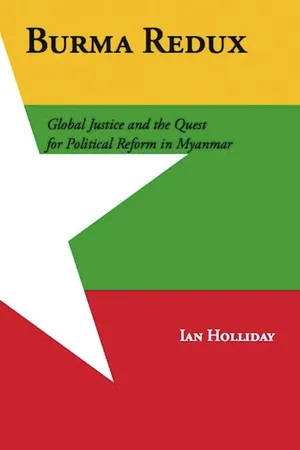
Contemporary Myanmar faces a number of political challenges, and it is unclear how other nations should act in relation to the country. Prioritizing the opinions of local citizens and reading them against the latest scholarship on this issue, Ian Holliday affirms the importance of foreign interests in Myanmar's democratic awakening, yet only through committed, grassroots strategies of engagement encompassing foreign states, international aid agencies, and global corporations.
Holliday supports his argument by using multiple sources and theories, particularly ones that take historical events, contemporary political and social investigations, and global justice literature into account, as well as studies that focus on the effects of democratic transition, the aid industry, and socially responsible corporate investing and sanctions. One of the only volumes to apply broad-ranging global justice theories to a real-world nation in flux, Burma Redux will appeal to professionals researching Burma/Myanmar; political advisers and advocacy groups; nonspecialists interested in Southeast Asian politics and society and the local and international problems posed by pariah states; general readers who seek a richer understanding of the country beyond journalistic accounts; and the Burmese people themselves—both within the country and in diaspora. Burma Redux is also the first book-length study on the nation to be completed after the contentious general elections of 2010.
- English
- ePUB (mobile friendly)
- Available on iOS & Android
eBook - ePub
About this book
Information
Subtopic
Asian Politics1
Dependence and disintegration
Contemporary Myanmar cannot be understood by focusing solely on a quarter-century of heightened global attention since pro-democracy protests were crushed by a brutal military machine and a landslide general election victory generated no perceptible change in domestic politics. Rather, the nationwide uprising and violent crackdown witnessed in the middle months of 1988 and the vacuous political contest staged in May 1990 need to be set in the context of what went before: not only 40 years of sovereign Burma from 1948 to 1988, but also the struggle against both imperialism and fascism that preceded independence, the experience of colonial rule under the British, and so on. At the same time, however, it is not necessary to reach all the way back into Burmese history. The decisive break registered by British colonialism makes examination of the past 150 years or so broadly sufficient. This chapter investigates the period of close to a century from the 1850s to 1948 when Britain first established pervasive sway over much of the territory and then asserted full imperial control, seeking ultimately to introduce the economic, political and social reforms required by a liberal power intent on opening its new possession to global markets. Starting with a brief overview of British Burma, it then looks inside the colonial experience at liberal imperialism and the nationalist reaction it provoked. The final section examines Burma in flux in the 1940s, tracing Japanese command from 1942 to 1945 and the dying embers of British Burma from 1945 to 1948. The twin themes, inspired above all by the work of Furnivall, are the political dependence to which Burma was subjected, and the social disintegration that resulted.
British Burma
Britain’s entanglement with Burma’s final Konbaung Dynasty, which governed land to the east of territory accumulated by the East India Company in the eighteenth and nineteenth centuries, initially took place through exploratory and often defensive moves on the part of company officials. Although a common frontier was established in 1784 when Burma secured control of Arakan and thereby confronted British rule in Chittagong, tensions did not arise until after 1811.1 Still the imperial preference was for some sort of informal control, rather than outright annexation. “In the eighteenth century, Britain had achieved supremacy in India by diplomacy where feasible, by war when necessary,” writes Trager. “During the nineteenth century, British rule was extended to Burma in the same way.”2
As in India, however, diplomacy eventually did fail and wars fought in 1824–26, 1852 and 1885 saw the full might of the imperial state incrementally gain total control of the territory. In the first engagement, coastal strips of Arakan to the west and Tenasserim to the south were taken. In the second, what the British called Lower Burma around the Irrawaddy Delta and Rangoon fell, placing the entire seaboard under colonial rule. In the third, Upper Burma, including Mandalay, historic heart of the territory and last regal capital, was seized.3 The expulsion of Burma’s final monarch, King Thibaw, and his two principal queens into the long Indian exile captured by Amitav Ghosh in The Glass Palace took place on November 29, 1885.4 On New Year’s Day 1886, Britain’s complete annexation of Burma was proclaimed by Lord Dufferin, Viceroy of India, acting through Secretary of State Lord Randolph Churchill and by command of Queen-Empress Victoria. Parliamentary delays consequent on the British general election of November-December 1885 meant that formal legislative ratification came in February 1886.
In the early years, Britain’s new imperial possessions were not only assembled but also governed piecemeal. At the start, in the mid-1820s, Burmese territory was administered from Penang in Britain’s Straits Settlements. Quickly, however, Burma was brought within British India, of which it remained part until 1937. Even then, though, Britain ran its initial holdings as “backwaters of the Bengal presidency” for which it had no particular vision or plan.5 In this period, Harvey writes, “Burma was governed by post from Calcutta.”6 More purposeful development set in only after the second round of conquest in 1852 and subsequent creation of a unified Indian province of Lower Burma in 1862.7 Then, particularly after the province filled out to its full extent in 1886, widespread administrative reform took place. For many years, however, this did little more than institutionalize a subordinate position within the British Raj. Rarely was Burma viewed by its imperial masters as anything other than a marginal colonial possession, and never did it wholly erase the stigma of the fateful decision to make it an appendage of British India.
One important consequence was that self-government came slowly to Burma. Only in 1897 was a Legislative Council created with nine nominated members. In 1909 the principle of election was established when the Rangoon Chamber of Commerce was allowed to vote one person on to the 15-member Council. Not until 1923, however, was anything resembling a popular poll introduced. Then under a system of dyarchy the Legislative Council was expanded to 103 members, of whom 79 were elected through household suffrage at age 18 with no gender discrimination, and some aspects of public policy were ceded to local control.8 Eventually, the Government of Burma Act 1935 provided for the territory to be separated from India on April 1, 1937, and given a distinct colonial status and identity. While ultimate authority in the British Crown Colony of Burma rested with the Governor and, through him, with the Secretary of State for India and Burma located in London, a measure of home rule could henceforth be exercised through a prime minister, cabinet and legislature.9 In the late 1940s, Furnivall’s assessment remained scathing: “the [Legislative] Council had no root among the people …; in reality it represented only the western superstructure divorced from national life.”10
British rule in Burma is often seen as a vintage case of liberal imperialism. Initially of interest to agents of the East India Company, Burma had a colonial experience driven throughout by a forceful commercial logic. In 1931, Furnivall echoed themes already explored more broadly by J. A. Hobson and V. I. Lenin in holding colonialism in Burma to be a machine driven by economic motives.11 In 2011, Neil A. Englehart qualified this interpretation by showing that in the first phase of imperialism after 1824 British engagement was so slight that local practices inevitably prevailed, and that in the second phase after 1852 officials drafted from India read that colonial model into Burma. Only after 1886 was a full market orientation imposed, and by then a considerable body of constraining precedent had built up. Furthermore, some globalization impacts registered in Burma in the nineteenth century were largely independent of British action.12 Indeed, as colonial administrator Maurice Collis wrote in 1956, “it can be argued that the Burmese did not learn anything from us which they could not have learned had they been lucky enough to remain independent.”13 Nevertheless, liberal imperialism did have lasting effects, and was certainly seen as momentous by the socialist officials and intellectuals who dominated Burmese public life for much of the twentieth century.14 While there were some positive sides, the eventual impact on the society was profoundly negative.
Liberal Burma
Colonialism started to reshape Burma in significant ways as soon as the delta region to the south was incorporated into the British Empire in 1852. Changes made from the 1850s onward built to a “high tide” that for Cady came within years of the imposition of full imperial control in 1886, and lasted for some three decades thereafter.15 Indeed, from 1890, when pacification was judged complete, to 1920, when the nationalist reaction developed in earnest, the British attained many of the objectives invigorating their colonial adventure.16 Five stand out. First, they secured a measure of order across the territory. Second, they mapped their new possession. Third, they rationalized administrative structures in its core. Fourth, they set it squarely on the path of economic development and growth. Fifth, they opened it up and located it firmly in global society. While every one of these achievements was ultimately to turn bad, the period from 1890 to 1920, prefigured by an equally successful interlude in Lower Burma from 1852, cast them chiefly in a good light.
Order was enforced in Burma through a series of pacification campaigns designed to impose passivity and security. In 1912 Sir Charles Crosthwaite, Chief Commissioner from March 1887 to December 1890, described “the methods by which a country of wide extent, destitute of roads and covered with dense jungle and forest, in which the only rule had become the misrule of brigands and the only order systematic disorder, was transformed in a few years into a quiet and prosperous State.”17 Formally concluded in 1890, pacification gave way to nothing other than a permanent military occupation that saw villagers especially in the Burman core subjected to an alien form of direct rule that could turn arbitrary and violent when necessary. Vested in the person of the colonial official was a striking amount of power.18 In a province widely reputed to be the most lawless part of a sprawling Empire, this generated sufficient order for the core purposes of liberal imperialism.
Mapping Burma was a large exercise undertaken through an extension of the Great Trigonometrical Survey of India to the new province.19 It involved not only negotiating external frontiers, notably with China and imperial France, but also establishing internal boundaries.20 In a territory containing a variety of ethnic and linguistic groups never before treated as a single political entity, the British solution was to carve out a Burman core and a patchwork periphery of minority groups. For years colonial officials termed the central plains Burma Proper, and the surrounding hill country the Excluded Areas. However, as political institutions were developed and a Legislative Council was established in Burma Proper, the additional designations Ministerial or Parliamentary Burma came into use. Similarly, to reflect their separate status and the schedule of the 1935 Act in which their distinct political arrangements were listed, the Excluded Areas took on the label Scheduled Areas. At the end of the colonial period they were often known as the Frontier Areas. From the start, the divisions created by the British were rough and ready. In Burma Proper lived most of the country’s Burman majority population, though some minority communities such as lowland Karens in the Irrawaddy Delta were also present and still others including Mons in the south were slowly being assimilated. In the Excluded Areas lived chiefly a complex mosaic of minority ethnic groups adapted in diverse ways to neighboring civilizations.21 However, so intermingled were individual and group identities even across lowland and highland areas that in many parts it was difficult to specify ethnic composition with any clarity.22 Of the two major mapping exercises, the external frontiers turned out to be more durable than the internal boundaries. Although contemporary Myanmar does not have precisely the same borders as were given to colonial Burma in 1886, the dif...
Table of contents
- Cover
- Half title
- Title
- Copyright
- Contents
- Acknowledgments
- Author’s Note
- List of Acronyms
- Map of Myanmar
- Introduction
- 1. Dependence and disintegration
- 2. Dominion and dissent
- 3. Dictatorship and deadlock
- 4. Democracy and deliberation
- 5. Inattention and involvement
- 6. Injustice and implication
- 7. Intervention and interaction
- 8. Intercession and investment
- Conclusion
- Notes
- Index
Trusted by 375,005 students
Access to over 1.5 million titles for a fair monthly price.
Study more efficiently using our study tools.
Frequently asked questions
Yes, you can cancel anytime from the Subscription tab in your account settings on the Perlego website. Your subscription will stay active until the end of your current billing period. Learn how to cancel your subscription
No, books cannot be downloaded as external files, such as PDFs, for use outside of Perlego. However, you can download books within the Perlego app for offline reading on mobile or tablet. Learn how to download books offline
Perlego offers two plans: Essential and Complete
- Essential is ideal for learners and professionals who enjoy exploring a wide range of subjects. Access the Essential Library with 800,000+ trusted titles and best-sellers across business, personal growth, and the humanities. Includes unlimited reading time and Standard Read Aloud voice.
- Complete: Perfect for advanced learners and researchers needing full, unrestricted access. Unlock 1.5M+ books across hundreds of subjects, including academic and specialized titles. The Complete Plan also includes advanced features like Premium Read Aloud and Research Assistant.
We are an online textbook subscription service, where you can get access to an entire online library for less than the price of a single book per month. With over 1.5 million books across 990+ topics, we’ve got you covered! Learn about our mission
Look out for the read-aloud symbol on your next book to see if you can listen to it. The read-aloud tool reads text aloud for you, highlighting the text as it is being read. You can pause it, speed it up and slow it down. Learn more about Read Aloud
Yes! You can use the Perlego app on both iOS and Android devices to read anytime, anywhere — even offline. Perfect for commutes or when you’re on the go.
Please note we cannot support devices running on iOS 13 and Android 7 or earlier. Learn more about using the app
Please note we cannot support devices running on iOS 13 and Android 7 or earlier. Learn more about using the app
Yes, you can access Burma Redux by Ian Holliday in PDF and/or ePUB format, as well as other popular books in Politics & International Relations & Asian Politics. We have over 1.5 million books available in our catalogue for you to explore.