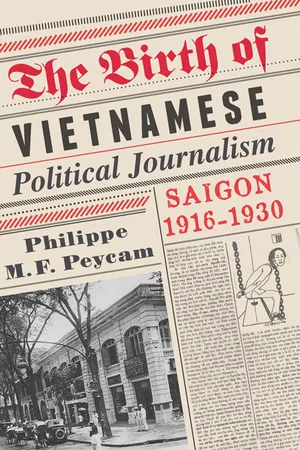
Philippe M. F. Peycam completes the first ever English-language study of Vietnam's emerging political press and its resistance to colonialism. Published in the decade that preceded the Communist Party's founding, this journalistic phenomenon established a space for public, political contestation that fundamentally changed Vietnamese attitudes and the outlook of Southeast Asia.
Peycam directly links Saigon's colonial urbanization to the creation of new modes of individual and collective political agency. To better justify their presence, French colonialists implemented a peculiar brand of republican imperialism to encourage the development of a highly controlled print capitalism. Yet the Vietnamese made clever use of this new form of political expression, subverting colonial discourse and putting French rulers on the defensive, while simultaneously stoking Vietnamese aspirations for autonomy. Peycam specifically considers the work of Western-educated Vietnamese journalists who, in their legal writings, called attention to the politics of French rule.
Peycam rejects the notion that Communist and nationalist ideologies changed the minds of "alienated" Vietnamese during this period. Rather, he credits colonial urban modernity with shaping the Vietnamese activist-journalist and the role of the French, even at their most coercive, along with the modern public Vietnamese intellectual and his responsibility toward the group. Countering common research on anticolonial nationalism and its assumptions of ethno-cultural homogeneity, Peycam follows the merging of French republican and anarchist traditions with neo-Confucian Vietnamese behavior, giving rise to modern Vietnamese public activism, its autonomy, and its contradictory aspirations. Interweaving biography with archival newspaper and French police sources, he writes from within these journalists' changing political consciousness and their shifting perception of social roles.
- English
- ePUB (mobile friendly)
- Available on iOS & Android
eBook - ePub
About this book
Information
Subtopic
Asian HistoryIndex
HistoryPart 1
The Origins of Saigon’s Public Sphere
CHAPTER 1
Social Order in the Colonial City
AS FRANCE AND ITS EMPIRE BECAME ENGULFED IN THE First World War, the colonial port city of Saigon found itself developing into, to paraphrase Henri Lefebvre, a “space of possibilities.”1 Within its boundaries, a complex process of imposed acculturation and social interactions led to new expressions of Vietnamese consciousness on both an individual and a collective level. Gottfried Korff has referred to this creative aspect of the colonial city as “internal” or “internalized urbanization,” which is concerned with mentalités “formed in the communicative relational system of the metropolis [that have the role of] acting, thinking and feeling in the process of urbanization.”2
For many Vietnamese internal urbanization meant new forms of social interaction and a dynamic with the hinterland that reconfigured social and cultural awareness, which brought important consequences for the shaping of a new imagined and experienced community.3 The kind of interactions experienced in the colonial city emphasized individual mobility, flexibility in dealing with changing modes of work and life, and accustoming oneself to a new praxis of time, new hierarchical categories, and a new set of values deemed under the colonial order to be “modern,” “rational,” and therefore legitimate. Internal colonial urbanization affected and involved different groups of the urbanized population at different times and in a variety of ways. It grew through a simultaneous dialogue between the city and the people, from the specific challenges of the urban environment to its inhabitants’ sociopolitical positions, and their responses and actions in turn influenced and even shaped the colonial and postcolonial urban environment. The history of the colonial metropolis shows how the experience of urbanization, with its heterogeneity and inherent contradictions, opened new spaces of freedom and pluralism.4
Historical Developments
Saigon5 was a typical Southeast Asian city.6 Before the arrival of the French in 1859, it belonged to the southern region of the Vietnamese empire, originally annexed from Cambodia in 1698. The port city was incorporated into a regional commercial seafaring network led by Chinese merchants who were in direct contact with other major maritime commercial centers like Malacca, Singapore, and Batavia (Jakarta), as well as Guangzhou and Hong Kong. With its Chinese component in Cholon (in Vietnamese Chợ Lớn, literally “large market”), the urban center was the region’s main commercial hub.7
A defining feature that survived into the colonial period was its position as a political, commercial, and cultural center. Prince Nguyễn Ánh, the future emperor Gia Long, founder of the Nguyễn dynasty in Huế, chose Saigon to be the cornerstone of his political strategy of reconquest of the country against the Tây Sơn insurgency.8 Despite—or thanks to—these events Saigon became closely integrated within the Vietnamese polity to develop into an official center in its own right, where, for instance, civil service examination sessions at the provincial level were held.9 The twin centers of Saigon and Cholon, six kilometers apart, already formed a major urban spatial system partially filled between them by a collection of more than forty hamlets. In the last decades before French occupation, this ensemble represented a population estimated at more than one hundred thousand inhabitants.10 In contrast to Hanoi, its northern rival, Saigon’s main characteristic was its extreme heterogeneity and fluidity. The port city was indeed the meeting point of economic and social refugees from rural Cochinchina and from the northern and central parts of Vietnam, and a large Chinese community had been settled there since the seventeenth century. Distributed into small centers within the Saigon-Cholon perimeter, the precolonial “Saigonese” population was not entirely cut off from its rural environment. Rice paddies, communal land, and hydraulic plans were still a distinct feature of the place, while land and water connections were bordered by small market centers, the xóm làng chợ.11 Of this population was born a distinct urban society with a culture different from that of the rural environment. Next to the country people of the delta area, the dân nông thôn, existed the city dwellers, the dân thành thị, more popularly called kẻ chợ (literally, “market individual”), who might be not only mandarin, military, businesspeople, artisans, coolies, workers, servants but also rice or vegetable croppers and wholesalers at the same time. This heterogeneous population was largely influenced by the important presence of the Chinese Minh Hương. In the precolonial period, the Minh Hươngs were those of Sino-Vietnamese extraction or those Chinese assimilated into the community of Vietnamese subjects under the Nguyễn kings. Chinese migrants freshly installed were called người Hoa Kiều. They were compelled to appear on registers kept according to their region of origin (this form of control was continued during the French period). Besides the Chinese, a number of foreign traders and travelers, Arabs, Malays, Indians, and Europeans, regularly visited the port city. In this heterogeneous urban environment in which individualism, pragmatism, and openness to strangers flourished, the character of the Saigonese kẻ chợ slowly forged itself. That character was revealed in the vocabulary, popular beliefs, and attitudes pervading everyday life best described by the southern writer Sơn Nam.12
After the fall of the city in 1859, Saigon became the cornerstone of the new French expansionism in the Far East. With the subsequent conquest of northern Vietnam in 1884 and the historical city of Hanoi becoming the new capital of the French Indochinese Federation a decade later, Saigon remained the capital of the old territory—legally a French colony—of Cochinchina, as well as Indochina’s main economic hub. With a population of 232,100 in 1918 and 324,000 in 1931, the urban complex of Saigon-Cholon was Indochina’s most populous center.
The City as Colonial Apparatus
In the political economy of early twentieth-century Western imperialism, three defining features shaped the character of a colonial city: the construction or imposition of a modern state apparatus, the introduction of the métropole’s system of education, and the integration of colonial possessions into the world economy. Nowhere was the conjunction of these factors more apparent in French Indochina than in its largest metropolis, Saigon.13
Through colonial rule, the French imposed modern forms of state control on the indigenous population. The administration and centralization of control itself was associated with the construction of the European model of the nation-state.14 One of the main functions of the colonial state apparatus was to enforce rational scrutiny of the local population through political administration and its legal framework and through the organization of official coercion. Confronted with the total withdrawal of imperial administrators to Huế after refusing to pay allegiance to the foreign invaders during the early years of the conquest of southern Vietnam or Cochinchina (from 1860 to 1867), the French had to set up their own direct administrative system. They recruited and trained natives and an unusual number of French staff, many from Corsica and the southern Indian French territory of Pondicherry who had settled in Saigon. Based in Saigon, Cochinchina’s colonial administration was headed by a governor and an elected assembly, the Colonial Council. A network of provincial French administrators was dispatched across the territory of Cochinchina, which remained divided into its original six provinces.15
Within a few years, the foundations of the metropolitan legal system were laid. The French code pénal was promulgated in 1880, and Napoleon’s code civil was enforced in 1883. A year earlier, quốc ngữ—the Roman transcription of Vietnamese that replaced the Chinese characters—was made the official form of writing in Cochinchina apart from French. By the turn of the century, the colonial administrative apparatus in southern Vietnam was firmly established, commanding most aspects of the organization of the indigenous population. By 1900, each European civil servant was in charge of an average of eight thousand Cochinchinese inhabitants.16
Originally established by violent means, the colonial regime, as a sovereign and disciplinary power, ultimately relied upon the “modern” modes of coercion described by Foucault.17 The French colonial army in Cochinchina was supplemented by forty-one posts of gendarmerie and a local garde civile. In 1917, in the context of the global conflict, this coercive machinery was completed with the creation of the Sûreté Générale de Police, which, owing to its modern capacity to centralize information about native individuals, assumed an increasing influence on government policy. In 1922 the Sûreté’s political section, whose Cochinchinese headquarters were in Saigon, was directly linked to the “direction of political affairs” of the government general.18 In a trend similar to that experienced in Dutch colonial Indonesia, the Sûreté asserted its ascendancy over “native policy” as a whole, making colonial administrators increasingly “dependent upon a system which provided only police types of information.”19 Legal discrimination vis-à-vis natives also served to control and coerce. The Régime de l’Indigénat (separate legal status for the indigènes—natives—and the French) and the creation of the much-feared criminal courts aimed at indigènes deemed politically subversive gave an expression of expeditious, repression-driven justice. In addition, a solid network of prisons was developed, from Saigon’s Maison Centrale to a penal colony on the island of Poulo-Condore. The colonial state was first and foremost a “police state.”20
Categorizing, classifying, and assigning the natives hierarchically was an obsession of the colonial administration. A direct consequence of colonial rule was the imposition of categories in a complex hierarchy based on the notion of racial and cultural inequality, as generally presented in official government documents. Cochinchina’s population was divided into three main categories: “French citizens,” “natives” (sujets protégés français), and “foreigners.” If in theory all French citizens enjoyed the same rights, in practice colonial society nurtured subtle distinctions between individuals of metropolitan origin, those originating from other colonial territories, the métis (Eurasians), “naturalized” Vietnamese, and the indigènes citoyens français (individuals from French territories in India who had been granted French citizenship on condition of renunciation of their caste—loi Crémieux, 1870). The indigènes/ “natives,” legally “French subjects,” were themselves differentiated according to ethnic origin.21 In Cochinchina, the categories included the ethnic Vietnamese (Kinh), the mixed Vietnamese—Chinese (Minh Hương),22 the Khmers from Cochinchina (Khmer Krôm), the Chams, and the hill tribes (Moïs). The third category was that of foreigner. It included the Chinese (by far the largest community of foreigners in Saigon), the Indians from British India (Malabar), and the subjects of other European colonies. Social categorization and racial discrimination prevailed throughout colonial Cochinchinese society, extending from differences in salary among employees with the same position and qualifications, to differences in educational curricula, to dual judiciaries and electorates, to de facto “whites only” clubs.23
Bureaucratic practices of the colonial administration contributed to social atomization and individualism. Much effort went into defining the legal status of individuals and to codify their social behavior. The état civil statute—the recognition of one’s existence as an “indigenous French subject,” introduced in Cochinchina in 1883, along with application of both the code civil and the code pénal—enforced the notion of personal responsibility. This trend was reinf...
Table of contents
- Cover
- Half title
- Title
- Copyright
- Contents
- Acknowledgments
- Maps
- Introduction
- Part 1. The Origins of Saigon’s Public Sphere
- Part 2. The “Newspaper Village” as a Political Force
- Conclusion
- Abbreviations
- Notes
- Bibliography
- Index
Trusted by 375,005 students
Access to over 1.5 million titles for a fair monthly price.
Study more efficiently using our study tools.
Frequently asked questions
Yes, you can cancel anytime from the Subscription tab in your account settings on the Perlego website. Your subscription will stay active until the end of your current billing period. Learn how to cancel your subscription
No, books cannot be downloaded as external files, such as PDFs, for use outside of Perlego. However, you can download books within the Perlego app for offline reading on mobile or tablet. Learn how to download books offline
Perlego offers two plans: Essential and Complete
- Essential is ideal for learners and professionals who enjoy exploring a wide range of subjects. Access the Essential Library with 800,000+ trusted titles and best-sellers across business, personal growth, and the humanities. Includes unlimited reading time and Standard Read Aloud voice.
- Complete: Perfect for advanced learners and researchers needing full, unrestricted access. Unlock 1.5M+ books across hundreds of subjects, including academic and specialized titles. The Complete Plan also includes advanced features like Premium Read Aloud and Research Assistant.
We are an online textbook subscription service, where you can get access to an entire online library for less than the price of a single book per month. With over 1.5 million books across 990+ topics, we’ve got you covered! Learn about our mission
Look out for the read-aloud symbol on your next book to see if you can listen to it. The read-aloud tool reads text aloud for you, highlighting the text as it is being read. You can pause it, speed it up and slow it down. Learn more about Read Aloud
Yes! You can use the Perlego app on both iOS and Android devices to read anytime, anywhere — even offline. Perfect for commutes or when you’re on the go.
Please note we cannot support devices running on iOS 13 and Android 7 or earlier. Learn more about using the app
Please note we cannot support devices running on iOS 13 and Android 7 or earlier. Learn more about using the app
Yes, you can access The Birth of Vietnamese Political Journalism by Philippe M.F. Peycam in PDF and/or ePUB format, as well as other popular books in History & Asian History. We have over 1.5 million books available in our catalogue for you to explore.