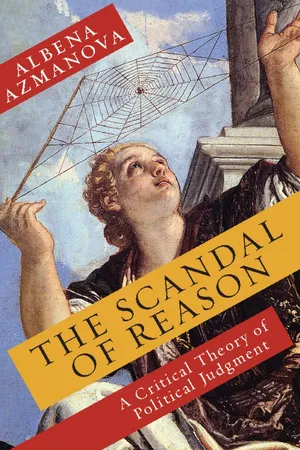
Theories of justice are haunted by a paradox: the more ambitious the theory of justice, the less applicable and useful the model is to political practice; yet the more politically realistic the theory, the weaker its moral ambition, rendering it unsound and equally useless. Brokering a resolution to this "judgment paradox," Albena Azmanova advances a "critical consensus model" of judgment that serves the normative ideals of a just society without the help of ideal theory.
Tracing the evolution of two major traditions in political philosophy—critical theory and philosophical liberalism—and the way they confront the judgment paradox, Azmanova critiques prevailing models of deliberative democracy and their preference for ideal theory over political applicability. Instead, she replaces the reliance on normative models of democracy with an account of the dynamics of reasoned judgment produced in democratic practices of open dialogues. Combining Hannah Arendt's study of judgment with Pierre Bourdieu's social critique of power relations, and incorporating elements of political epistemology from Kant, Wittgenstein, H. L. A. Hart, Max Weber, and American philosophical pragmatism, Azmanova centers her inquiry on the way participants in moral conflicts attribute meaning to their grievances of injustice. She then demonstrates the emancipatory potential of the model of critical deliberative judgment she forges and its capacity to guide policy making.
This model's critical force yields from its capacity to disclose the common structural sources of injustice behind conflicting claims to justice. Moving beyond the conflict between universalist and pluralist positions, Azmanova grounds the question of "what is justice?" in the empirical reality of "who suffers?" in order to discern attainable possibilities for a less unjust world.
- English
- ePUB (mobile friendly)
- Available on iOS & Android
eBook - ePub
About this book
Trusted by 375,005 students
Access to over 1.5 million titles for a fair monthly price.
Study more efficiently using our study tools.
Information
Table of contents
- Cover
- Half title
- Series Page
- Title
- Copyright
- Contents
- Preface
- Introduction: The Scandal of Reason and the Paradox of Judgment
- Chapter 1. Political Judgment and the Vocation of Critical Theory
- Chapter 2. Critical Theory: Political Judgment as Ideologiekritik
- Chapter 3. Philosophical Liberalism: Reasonable Judgment
- Chapter 4. Philosophical Liberalism and Critical Theory in Dispute
- Chapter 5. Judgment Unbound: Arendt
- Chapter 6. From Critique of Power to a Critical Theory of Judgment
- Chapter 7. The Political Epistemology of Judgment
- Chapter 8. The Critical Consensus Model
- Chapter 9. Judgment, Criticism, Innovation
- Conclusion: Letting Go of Ideal Theory
- Glossary
- Notes
- References
- Index
Frequently asked questions
Yes, you can cancel anytime from the Subscription tab in your account settings on the Perlego website. Your subscription will stay active until the end of your current billing period. Learn how to cancel your subscription
No, books cannot be downloaded as external files, such as PDFs, for use outside of Perlego. However, you can download books within the Perlego app for offline reading on mobile or tablet. Learn how to download books offline
Perlego offers two plans: Essential and Complete
- Essential is ideal for learners and professionals who enjoy exploring a wide range of subjects. Access the Essential Library with 800,000+ trusted titles and best-sellers across business, personal growth, and the humanities. Includes unlimited reading time and Standard Read Aloud voice.
- Complete: Perfect for advanced learners and researchers needing full, unrestricted access. Unlock 1.5M+ books across hundreds of subjects, including academic and specialized titles. The Complete Plan also includes advanced features like Premium Read Aloud and Research Assistant.
We are an online textbook subscription service, where you can get access to an entire online library for less than the price of a single book per month. With over 1.5 million books across 990+ topics, we’ve got you covered! Learn about our mission
Look out for the read-aloud symbol on your next book to see if you can listen to it. The read-aloud tool reads text aloud for you, highlighting the text as it is being read. You can pause it, speed it up and slow it down. Learn more about Read Aloud
Yes! You can use the Perlego app on both iOS and Android devices to read anytime, anywhere — even offline. Perfect for commutes or when you’re on the go.
Please note we cannot support devices running on iOS 13 and Android 7 or earlier. Learn more about using the app
Please note we cannot support devices running on iOS 13 and Android 7 or earlier. Learn more about using the app
Yes, you can access The Scandal of Reason by Albena Azmanova in PDF and/or ePUB format, as well as other popular books in Politics & International Relations & Political Philosophy. We have over 1.5 million books available in our catalogue for you to explore.