Since the early days of the American republic, political thinkers have maintained that a grossly unequal division of property, wealth, and power would lead to the erosion of democratic life. Yet over the past thirty-five years, neoconservatives and neoliberals alike have redrawn the tenets of American liberalism. Nowhere is this more evident than in our current mainstream political discourse, in which the politics of economic inequality are rarely discussed.
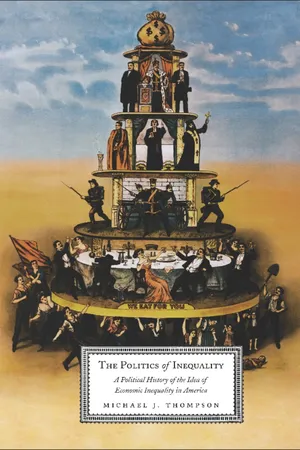
In this impassioned book, Michael J. Thompson reaches back into America's rich intellectual history to reclaim the politics of inequality from the distortion of recent American conservatism. He begins by tracing the development of the idea of economic inequality as it has been conceived by political thinkers throughout American history. Then he considers the change in ideas and values that have led to the acceptance and occasional legitimization of economic divisions. Thompson argues that American liberalism has made a profound departure from its original practice of egalitarian critique. It has all but abandoned its antihierarchical and antiaristocratic discourse. Only by resuscitating this tradition can democracy again become meaningful to Americans.
The intellectuals who pioneered egalitarian thinking in America believed political and social relations should be free from all forms of domination, servitude, and dependency. They wished to expose the antidemocratic character of economic life under capitalism and hoped to prevent the kind of inequalities that compromise human dignity and freedom-the core principles of early American politics. In their wisdom is a much broader, more compelling view of democratic life and community than we have today, and with this book, Thompson eloquently and adamantly fights to recover this crucial strand of political thought.
In this impassioned book, Michael J. Thompson reaches back into America's rich intellectual history to reclaim the politics of inequality from the distortion of recent American conservatism. He begins by tracing the development of the idea of economic inequality as it has been conceived by political thinkers throughout American history. Then he considers the change in ideas and values that have led to the acceptance and occasional legitimization of economic divisions. Thompson argues that American liberalism has made a profound departure from its original practice of egalitarian critique; it has all but abandoned its antihierarchical and antiaristocratic discourse. Only by resuscitating this tradition can democracy again become meaningful to Americans.
The intellectuals who pioneered egalitarian thinking in America believed political and social relations should be free from all forms of domination, servitude, and dependency. They wished to expose the antidemocratic character of economic life under capitalism and hoped to prevent the kind of inequalities that compromise human dignity and freedom—the core principles of early American politics. In their wisdom is a much broader, more compelling view of democratic life and community than we have today, and with this book, Thompson eloquently and adamantly fights to recover this crucial strand of political thought.
eBook - ePub
The Politics of Inequality
A Political History of the Idea of Economic Inequality in America
- English
- ePUB (mobile friendly)
- Available on iOS & Android
eBook - ePub
The Politics of Inequality
A Political History of the Idea of Economic Inequality in America
About this book
Information
Table of contents
- Cover
- Half title
- Title
- Copyright
- Dedication
- Epigraph
- Contents
- Preface
- Acknowledgments
- Introduction: The Political Dimensions of Economic Inequality
- 1. The Critique of Economic Inequality in Western Political Thought: The Continuity of an Idea
- 2. The Liberal Republic and the Emergence of Capitalism: The Political Theories of Optimism and Radicalism
- 3. The Transformation of American Capitalism: From Class Antagonism to Reconciliation
- 4. Embracing Inequality: The Reorientation of American Democracy
- Conclusion: Restating the Case for Economic Equality
- Notes
- Bibliography
- Index
Trusted by 375,005 students
Access to over 1.5 million titles for a fair monthly price.
Study more efficiently using our study tools.
Frequently asked questions
Yes, you can cancel anytime from the Subscription tab in your account settings on the Perlego website. Your subscription will stay active until the end of your current billing period. Learn how to cancel your subscription
No, books cannot be downloaded as external files, such as PDFs, for use outside of Perlego. However, you can download books within the Perlego app for offline reading on mobile or tablet. Learn how to download books offline
Perlego offers two plans: Essential and Complete
- Essential is ideal for learners and professionals who enjoy exploring a wide range of subjects. Access the Essential Library with 800,000+ trusted titles and best-sellers across business, personal growth, and the humanities. Includes unlimited reading time and Standard Read Aloud voice.
- Complete: Perfect for advanced learners and researchers needing full, unrestricted access. Unlock 1.5M+ books across hundreds of subjects, including academic and specialized titles. The Complete Plan also includes advanced features like Premium Read Aloud and Research Assistant.
We are an online textbook subscription service, where you can get access to an entire online library for less than the price of a single book per month. With over 1.5 million books across 990+ topics, we’ve got you covered! Learn about our mission
Look out for the read-aloud symbol on your next book to see if you can listen to it. The read-aloud tool reads text aloud for you, highlighting the text as it is being read. You can pause it, speed it up and slow it down. Learn more about Read Aloud
Yes! You can use the Perlego app on both iOS and Android devices to read anytime, anywhere — even offline. Perfect for commutes or when you’re on the go.
Please note we cannot support devices running on iOS 13 and Android 7 or earlier. Learn more about using the app
Please note we cannot support devices running on iOS 13 and Android 7 or earlier. Learn more about using the app
Yes, you can access The Politics of Inequality by Michael J Thompson in PDF and/or ePUB format, as well as other popular books in Politics & International Relations & North American History. We have over 1.5 million books available in our catalogue for you to explore.