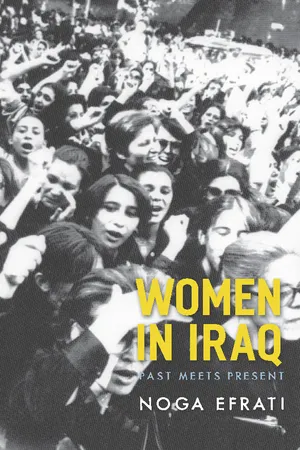
Noga Efrati outlines the first social and political history of women in Iraq during the periods of British occupation and the British-backed Hashimite monarchy (1917–1958). She traces the harsh and long-lasting implications of British state building on Iraqi women, particularly their legal and political enshrinement as second-class citizens, and the struggle by women's rights activists to counter this precedent. Efrati concludes with a discussion of post-Saddam Iraq and the women's associations now claiming their place in government. Finding common threads between these two generations of women, Efrati underscores the organic roots of the current fight for gender equality shaped by a memory of oppression under the monarchy.
Efrati revisits the British strategy of efficient rule, largely adopted by the Iraqi government they erected and the consequent gender policy that emerged. The attempt to control Iraq through "authentic leaders"—giving them legal and political powers—marginalized the interests of women and virtually sacrificed their well-being altogether. Iraqi women refused to resign themselves to this fate. From the state's early days, they drew attention to the biases of the Tribal Criminal and Civil Disputes Regulation (TCCDR) and the absence of state intervention in matters of personal status and resisted women's disenfranchisement. Following the coup of 1958, their criticism helped precipitate the dissolution of the TCCDR and the ratification of the Personal Status Law. A new government gender discourse shaped by these past battles arose, yet the U.S.-led invasion of 2003, rather than helping cement women's rights into law, reinstated the British approach. Pressured to secure order and reestablish a pro-Western Iraq, the Americans increasingly turned to the country's "authentic leaders" to maintain control while continuing to marginalize women. Efrati considers Iraqi women's efforts to preserve the progress they have made, utterly defeating the notion that they have been passive witnesses to history.
- English
- ePUB (mobile friendly)
- Available on iOS & Android
eBook - ePub
About this book
Trusted by 375,005 students
Access to over 1.5 million titles for a fair monthly price.
Study more efficiently using our study tools.
Information
Subtopic
Middle Eastern HistoryIndex
History
OCCUPATION, MONARCHY, AND CUSTOMARY LAW
TRIBALIZING WOMEN
Customary law, or “tribal custom” as British officials often called it, was a central component of the government gender discourse in Iraq. It became an integral part of this discourse through the Tribal Criminal and Civil Disputes Regulation. Introduced by British occupying forces during World War I and remaining in force until the overthrow of the monarchy, the TCCDR sanctioned settlement of disputes among the rural population in accordance with “tribal methods” and “tribal law.” Much has been written about the TCCDR, the way it eased British control over Iraq, and how it reflected the British occupiers’ perception of the social structure they found therein.1 But, interestingly, its implications for women, which stirred much controversy at the time, have received little scholarly attention. This chapter explains how and why this regulation that sanctioned customary law became part of the regime’s gender discourse. The discussion points to how British and Iraqi perceptions of state and society influenced implementation of the regulation and then focuses on the consequent ramifications for women. Because of it, rural women were constructed as tribal possessions rather than as citizens of the emerging state, and their welfare was knowingly sacrificed.
A BRIEF HISTORY OF THE TCCDR
At the beginning of the British occupation, the most immediate concerns were imposing order over the vast rural areas, preventing assistance to the Ottoman armies, and securing supplies for the British army. Toward this end and with their understanding of the rural areas as tribal, the British sought to enhance the authority of the shaikhs, whom they saw as the tribes’ natural leaders. Appointed shaikhs were given responsibility for maintaining order. Within a shaikh’s domain, it was expected that British property would be protected, revenue collected, and aid to Ottoman armies cut off. In return, the shaikhs were not only given support and, if necessary, arms but also awarded title to lands over which they claimed possession. Sizeable tracts of land were thus rendered the private property of British-designated shaikhs, thereby promoting the creation of a class of landlord-shaikhs loyal to the British.2 Yet many of these figures were, even by British admission, “small men of no account,”3 and in some places where there were no “shaikhs” or “tribes” they were artificially resurrected: “Petty village headmen were unearthed and discovered as leaders of long dead tribes. Disintegrated sedentary clans … were told to reunite and remember that they had been once tribesmen. Tribal chiefs were found for them. Revenue was to be paid on the estimate of this chief. Law was to be administered by this chief.”4
The TCCDR, issued in February 1916 and reissued in July 1918, was among the measures intended to bolster these shaikhs’ position by prescribing their judicial authority over their tribes. Sir Henry Dobbs, at the time revenue commissioner and later high commissioner, drew up the regulation along the lines of the colonial code used on the Indian North-West Frontier, where he had vast experience. In importing the idea of a separate tribal jurisdiction from India, Dobbs was inspired, as were many other colonial administrators, by the methods of Sir Robert Sandeman. When Sandeman in nineteenth-century Baluchistan began inaugurating the policy, which has since borne his name, he also faced what he described as a “tribal organization in a state of rapid decay and the power and influence of the tribal leaders much diminished.” To impose order, combat raiding, and settle disputes along the border, he sought to revive this system under “competent chiefs and headmen, advised, controlled, and supervised by experienced British Political Officers.”5 Official recognition was given to tribal chiefs, laws, and customs.
The TCCDR placed tribesmen in a separate system of law. It was designed to arrange for the speedy settlement of their civil and criminal disputes in accordance with tribal customs. The system as a whole, however, was supervised by and subordinate to the British administration. The regulation prescribed that when a British political officer—who was defined therein as an officer appointed to settle tribal affairs—was convinced that at least one of the parties involved in a dispute was a tribesman accustomed to settling his disputes “by tribal methods,” it was within his purview to appoint a special council (majlis), which would include one or more tribal arbitrators, mainly “chiefs and shaikhs.” After receiving the majlis’s findings, the officer had the authority to dismiss the case or to convict the accused in accordance with the majlis’s recommendations. He could also remand the case back to the majlis for a further finding or refer it to a second majlis. The scope of powers conferred by the regulation was extremely broad, as mandated by wartime conditions. Political officers could impose order in rural areas by meting out collective punishments, transferring any “tribal encampment” from one place to another, or expelling any person of “a dangerous character” from their districts. No appeals were allowed, although the civil commissioner or an officer appointed by him could revise decisions or sentences.6 It is important to note that political officers and later on the Iraqi state officials who replaced them often dispensed with the majlis and made the ruling themselves, which was their prerogative according to the regulation.7
After an exhausting world war, as it became necessary to devise a policy that would hasten the evacuation of troops from Iraq and reduce expenditures, the British clung to the TCCDR, which had facilitated the cheap, indirect administration of vast territories and the securing of order around the countryside. At the insistence of the mandate authorities, provision for a separate tribal jurisdiction was included in the Organic Law (embodying the Constitution), and in 1924 the TCCDR became state law. The fledgling state now recognized the powers initially conferred on British officials and later transferred to their Iraqi successors. The civil commissioner was replaced by the minister of the interior, and the political officers and their assistants by local government officials—the mutasarrifs and qa’imaqams.8 Citizens of the new Iraqi state were thus divided into two groups with two different legal systems. The rural population was subject to the TCCDR, but the urban population was subject to civil and criminal courts. Urban crime fell under the jurisdiction of the Baghdad Penal Code enacted by the British in 1918 and based primarily on the Ottoman and Egyptian penal codes, which in turn had been framed according to the French Penal Code.9
CUSTOMS “FOREIGN TO BRITISH JUDICIAL TRADITION”
The TCCDR, as noted, allowed “tribesmen” to settle their disputes according to “tribal custom,” but it did not elaborate on the term tribal custom per se. British officials presumed, however, to understand what it was.10 Many perceived it to be universal, age old, and unchanging. Arnold T. Wilson, acting civil commissioner to Iraq until June 1920, claimed that the regulation “helped us all to a better understanding of the principles underlying tribal customs: these principles varied little from district to district, though in detail there were many differences; they were all based not on Islamic law, but on something much older, human nature, and on local conventions, some of which, it would not be difficult to show, were probably codified by Khamurabi in 2000 B.C. or earlier.”11
As for customs concerning women, the British described them as particularly uncompromising and harsh. They found evidence for this callous treatment in numerous tenets: women could never inherit landed property; in the settlement of feuds, especially blood feuds, tribes required the guilty party, in addition to paying blood money, to hand over one or more women from his clan to the tribe or family of the victim for the purpose of marriage; a young woman was compelled to marry her paternal cousin or to receive his consent to marry another man—and if overlooked, the cousin was justified in killing the woman or the man she ultimately married; a girl or a married woman—indeed, any woman—who “lapsed from the strict path of virtue” brought a stain to the family honor that could be washed away only by her blood. Aberrations, when noted, were usually explained as exceptions to the rule or as deviation from tribal custom.12
British officials lamented that practices pertaining to women were “savage,” “barbaric,” and “a travesty of justice” and that their implementation through the TCCDR was “foreign to British judicial tradition” and “discreditable.”13 However, British actions were dissonant and often contradictory. Some political officers were reluctant to sanction marriages that involved the handing over of women in dispute settlements (fasl marriage) and instead encouraged alternative monetary settlements. But Gertrude Bell, Oriental secretary to the civil commissioner, advised that such interference was incompatible with the valued “local justice” that promoted good conduct and order.14 In 1927, a disturbing book written by a political officer and his wife (Stuart Edwin Hedgcock and Monica Grace Hedgcock) exposed the cruel fate of women given in dispute settlements: maltreated and enslaved, they had no recourse to divorce and were in fact bereft of any rights.15 In 1929, following a report that in al-‘Amara the settlement of sixty-two tribal cases involved handing over 125 women from one clan to another, the British president of the Court of Appeal and Cassation protested in his annual report that “it is most discreditable to find scores of women handed over in those disputes in the name of justice.”16 Seemingly in response to this situation but lacking in its resolve, the Ministry of the Interior later that year instructed its officials to “encourage” arbitrators in tribal cases to settle disputes with money rather than with women. This proposal, however, may not have even been a British initiative.17 In 1929, some limited measures were also taken to annul al-nahwa, men’s right to prevent the marriage of their female relatives, but here again it would appear that Iraqi officials initiated the move.18
Similar ambivalence in British attitudes and actions can be seen in response to the murder of women by their relatives. Some political officers ignored the tribal majlis and imposed punishments on perpetrators of such murders.19 However, the Office of the Civil Commissioner cautioned against such initiatives, basing itself on the opinion of “experienced authorities on the control of semi-civilised tribes on the frontier of India” that such intrusion “tends to undermine the force and the appeal of this method of settlement.”20 An amendment introduced into the 1918 revised TCCDR may have represented an effort aimed at tackling such crimes: section 34(1) imposed up to five years imprisonment or a fine or both on a married woman who had consensual sexual relations with a man who was not her husband (her accomplice went scot-free).21 If this clause indeed intended to protect such a woman by placing her punishment in the state’s hands, it nonetheless failed to ensure that she would not be killed after serving her sentence. In 1923, the Iraqi minister of justice Naji al-Suwaidi suggested a broad revision of the TCCDR. The amendment of section 34(1) stipulated that offences affecting sexual morals and honor be punishable under the Baghdad Penal Code. However, Henry Dobbs, now the high commissioner, strongly objected to the transference of tribal criminal cases to the civil courts. The proposed amendment to section 34(1) seemed inexplicable to him. As we shall see, both he and Kinahan Cornwallis, adviser to the Ministry of the Interior, would in 1926 object to a similar attempt to tamper with the regulation.22 At the same time, Edgar Bonham-Carter, the judicial secretary to the Iraqi government, and E. M. Drower, adviser to the Ministry of Justice, supported the referral of tribal criminal cases to the civil courts, there to be prosecuted under the penal code, an act that would have constituted de facto annulment of the TCCDR.23
BRITISH PERCEPTIONS: COMPETING OR COMPLETING?
These contradictions concerning the treatment of women may well be the expression of competing British perceptions of how best to govern an alien society. Toby Dodge identifies two conceptions of Iraqi society influencing British rulers in their attempt to create the modern Iraqi state: romantic collectivism and rational individualism. Those adhering to the ideas Dodge classifies as romantic collectivism saw Iraq as premodern and tribal. The “tribe,” not the individual, was the lens through which their interpretation of society gained its coherence. They romanticized the tribes as egalitarian and their shaikhs as natural leaders by force of personality. Thus, those upholding these views endeavored to rule Iraq on the basis of what they conceived to be the existing tribal system with its tribal leaders and its distinct tribal law and customs. Advocates of the ideas Dodge classifies as rational individualism, on the other hand, saw Iraq destined for modernization and viewed the individual as the fundamental unit of society. The tribal system was in decline and was no longer seen as an appropriate instrument to govern society. The rational individualists argued that as the tribes settled, they tended to break away from their shaikhs and relinquish their tribal customs, an ongoing process that was to be encouraged; modern Iraq was expected to engage its citizenry equally under the law, through a unified system.24
Dodge’s model is appealing in that it clarifies certain disparities regarding the treatment of women. Those who sought to rule utilizing the tribal system were convinced that tribal law and customs should be safeguarded. Thus, the Office of the Civil Commissioner warned political officers against imposing their own punishments on men who murder women relatives because such intrusion would undermine the force and the appeal of the tribal method of settlement.25 Gertrude Bell, although admitting that handing over a woman as part of a settlement in a blood dispute was “foreign to British judicial tradition,” accepted its value as a safeguard against the outbreak of tribal animosities. Her support of political officers’ noninterference in the decisions of tribal arbitrators encompassed honor murders.26 In a similar vein, High Commissioner Dobbs and the Interior Ministry adviser Cornwallis vehemently opposed tampering in any way with the TCCDR. In 1926, Dobbs threatened to invoke his powers under the Military Agreement should the Iraqi government attempt to “emasculate” so effective a system of maintaining order in tribal areas.27 Making offences related to sexual morals and honor punishable under penal law seemed to him inexplicable because “if there is any case in which tribal feeling is keen and tribal custom necessary to follow, it is the case of adultery and the like.”28
Those who perceived the tribal system in Iraq as in decay, however, felt that the TCCDR should be abolished and tribal law overruled. Iraq should gravitate toward one system of law, they held. Thus, political officers and their assistants, such as Major Hedgcock and Captain H. G. Rivett Carnac in al-‘Amara, imposed punishments on men who murdered their female relatives by intervening in decisions of the tribal majlis or by trying such cases under penal law.29 Hedgcock’s sympathies regarding the harsh treatment of women were well documented in his book Haji Rikkan. Legal experts such as Bonham-Carter and Drower favored the transference of tribal criminal cases to the civil courts, which would allow punishment of “crimes of honor” under the penal code. Such crimes, lamented Bonham-Carter in 1919, were regrettably common and would be difficult to eradicate.30 Rational individualists, according to Dodge’s model, thus seemed more inclined to perceive rural women as individuals whose welfare should be protected from infringement by their extended families. Romantic collectivists, in contrast, tended to see the tribal collective’s needs and customs as overriding a woman’s well-being.
British reluctance to intervene in practices pertaining to women, therefore, was to a large extent the result of the dominance of romantic collectivism over rational individualism. For collectivists, “the tribe” not “the individual” was the more relevant construct by which to view Iraqi society; thus, they sought to rule Iraq through its tribal system. Their subscription to the notion of distinct “tribal custom” was a major justification for deploying the TCCDR. Interference with...
Table of contents
- Cover
- Half title
- Title
- Copyright
- Dedication
- Contents
- Preface
- Acknowledgments
- Introduction: The Historical Setting
- 1. Occupation, Monarchy, and Customary Law: Tribalizing Women
- 2. Family Law as a Site of Struggle and Subordination
- 3. Politics, Election Law, and Exclusion
- 4. Gender Discourse and Discontent: Activism Unraveled
- 5. Challenging the Government’s Gender Discourse
- Epilogue: Past Meets Present
- Notes
- Bibliography
- Index
Frequently asked questions
Yes, you can cancel anytime from the Subscription tab in your account settings on the Perlego website. Your subscription will stay active until the end of your current billing period. Learn how to cancel your subscription
No, books cannot be downloaded as external files, such as PDFs, for use outside of Perlego. However, you can download books within the Perlego app for offline reading on mobile or tablet. Learn how to download books offline
Perlego offers two plans: Essential and Complete
- Essential is ideal for learners and professionals who enjoy exploring a wide range of subjects. Access the Essential Library with 800,000+ trusted titles and best-sellers across business, personal growth, and the humanities. Includes unlimited reading time and Standard Read Aloud voice.
- Complete: Perfect for advanced learners and researchers needing full, unrestricted access. Unlock 1.5M+ books across hundreds of subjects, including academic and specialized titles. The Complete Plan also includes advanced features like Premium Read Aloud and Research Assistant.
We are an online textbook subscription service, where you can get access to an entire online library for less than the price of a single book per month. With over 1.5 million books across 990+ topics, we’ve got you covered! Learn about our mission
Look out for the read-aloud symbol on your next book to see if you can listen to it. The read-aloud tool reads text aloud for you, highlighting the text as it is being read. You can pause it, speed it up and slow it down. Learn more about Read Aloud
Yes! You can use the Perlego app on both iOS and Android devices to read anytime, anywhere — even offline. Perfect for commutes or when you’re on the go.
Please note we cannot support devices running on iOS 13 and Android 7 or earlier. Learn more about using the app
Please note we cannot support devices running on iOS 13 and Android 7 or earlier. Learn more about using the app
Yes, you can access Women in Iraq by Noga Efrati in PDF and/or ePUB format, as well as other popular books in History & Middle Eastern History. We have over 1.5 million books available in our catalogue for you to explore.