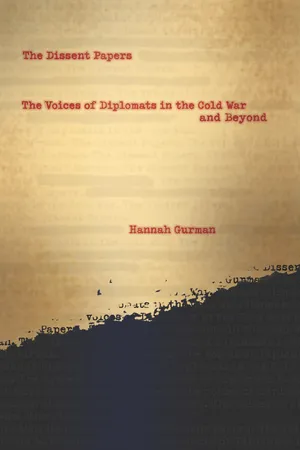
Beginning with the Cold War and concluding with the 2003 invasion of Iraq, Hannah Gurman explores the overlooked opposition of U.S. diplomats to American foreign policy in the latter half of the twentieth century. During America's reign as a dominant world power, U.S. presidents and senior foreign policy officials largely ignored or rejected their diplomats' reports, memos, and telegrams, especially when they challenged key policies relating to the Cold War, China, and the wars in Vietnam and Iraq. The Dissent Papers recovers these diplomats' invaluable perspective and their commitment to the transformative power of diplomatic writing.
Gurman showcases the work of diplomats whose opposition enjoyed some success. George Kennan, John Stewart Service, John Paton Davies, George Ball, and John Brady Kiesling all caught the attention of sitting presidents and policymakers, achieving temporary triumphs yet ultimately failing to change the status quo. Gurman follows the circulation of documents within the State Department, the National Security Council, the C.I.A., and the military, and she details the rationale behind "The Dissent Channel," instituted by the State Department in the 1970s, to both encourage and contain dissent. Advancing an alternative narrative of modern U.S. history, she connects the erosion of the diplomatic establishment and the weakening of the diplomatic writing tradition to larger political and ideological trends while, at the same time, foreshadowing the resurgent significance of diplomatic writing in the age of Wikileaks.
- English
- ePUB (mobile friendly)
- Available on iOS & Android
eBook - ePub
About this book
Information
one
THE PEN AS SWORD
George Kennan and the Politics of Authorship in the Early Cold War
IN 1943, JUST MONTHS after he had been released from a Nazi internment camp at Bad Nauheim near Frankfurt, George Kennan wrote a letter to the administrative office of the State Department. In the letter, he did not complain about the fact that the American government had contacted the internees only once during the five and half months of their imprisonment, nor did he register any dissatisfaction with the one telegram that was sent, which matter-of-factly informed the imprisoned State Department employees that they would not be paid for the term of their internment.1
While the State Department’s obvious lack of concern over the physical well-being of its officers troubled Kennan, he was more concerned about another matter. Upon returning to the United States, Kennan had submitted a memo he had written during his internment. “By a curious coincidence,” he now explained, that memo had been “referred down through the Department until, together with a number of other awkward dossiers, it reached my own temporary desk in the Personnel section; and I was for all that I could tell, the only person who read it.” Kennan saw this as a bad omen for the entire Foreign Service. “Our service is at present deteriorating,” he warned, “sinking back to a point where it will soon no longer present sufficient opportunities for constructive effort and self-expression to warrant the devotion of men who are anything more than bureaucrats.”2 Ironically, the communiqué had contained a proposal for strengthening the training of Foreign Service officers and enhancing the influence of the Foreign Service on policy.
What Kennan regarded as a problem for the State Department, many government reformers and foreign policy experts saw instead as progress. In 1924, Congress had passed the Rogers Act, which sought to “dearistocratize” the Foreign Service and officially transformed the State Department from an organization of elites to a meritocracy open to all capable Americans. This reform, which established an entrance exam and streamlined the Foreign and Consular services, coincided with tremendous growth in new recruits. In the first half of the twentieth century, the State Department exploded from an intimate organization of 82 people who informed and advised the president on foreign affairs to a modern bureaucracy of about 14,000, having expanded to meet the needs of America’s enhanced position in world affairs.3
This expansion and bureaucratization of the diplomatic apparatus was something of a double-edged sword for diplomats. In the past, those in charge of making policy had often, though not always, regarded the reports, telegrams, and memos of career diplomats as key sources of information. But their advice was not always heeded in a country whose policies were, at least as far as Europe was concerned, isolationist. On the one hand, the fact that the United States was now abandoning its isolationist stance on behalf of greater engagement offered the prospect of increased influence for the State Department. On the other hand, as the country expanded its role in international affairs, the potential role of individual State Department officials could also become increasingly diluted. It had become rare for senior officials to read the communiqués of rank-and-file Foreign Service officers in depth, if at all.4
During the Roosevelt administration, the ever-growing bureaucracy of the State Department did not constitute the only or even the most important barrier facing Kennan or anyone else who wanted to bolster the influence of the Foreign Service. Of the many things Kennan chose not to discuss in his letter, the most glaring was the thinly veiled hostility between the State Department and the White House. Succeeding a series of weak presidents, Harding, Coolidge, and Hoover, Roosevelt reinvigorated the office of the chief executive in large part by extending the powers of government and appropriating them into the executive branch. However, in presiding over the United States, FDR did not generally enlist the advice of the bureaucrats working under him in the various departments of the executive branch.5
Roosevelt employed a variety of tactics to minimize the State Department’s impact, including preemptive policy speeches, the creation of new foreign policy agencies, and the use of personal advisors and emissaries. Ranking high among the president’s personal advisors was a longtime friend and fellow graduate of Groton and Harvard, Sumner Welles, who served as undersecretary of state between 1937 and 1943. In 1940, Harry Hopkins, who had been the president’s right-hand man on domestic policy to that point, began to play the same role in foreign policy.6
Throughout his presidency, Roosevelt essentially functioned as his own secretary of state. Cordell Hull, who formally held that office from 1933 to 1944, had little sway with the president and was not even shown the Lend Lease bill before it was given to Congress. Hull had an ongoing rivalry with Welles, who reported directly to the president. While sympathetic to the frustrations of the Foreign Service, he did not want to embroil himself in any controversy that might further dilute his influence. William Bullitt, who also served as one of FDR’s personal advisors, had his own rivalry with Welles, which manifested in personal attacks and damaging rumors. Upon widespread rumors that Welles was a homosexual, rumors that Bullitt had helped to spread, Roosevelt reluctantly fired his undersecretary in 1943. The State Department fared no better after Welles’ departure or after Hull’s resignation in 1944. The president marginalized Hull’s successor, Edward Stettinius, rendering irrelevant his attempt to revitalize the State Department.7
Roosevelt especially disparaged the Foreign Service, whose members he mockingly referred to as “striped-pants boys.” His antagonism was not based on class alone, however. After all, the president also hailed from the ranks of the American aristocracy. More specifically, Roosevelt opposed the politics and worldview of the American aristocratic class that dominated the Foreign Service. At its core, the hostility between FDR and the State Department involved deep political disagreements on both domestic and foreign policy issues. Despite efforts to democratize the State Department, it still had a strong conservative and aristocratic outlook. Intent on clinging to their class privilege, many Foreign Service officers had opposed the New Deal. Some had also resisted recognition of the Soviet Union. In the years leading up to the Second World War, several of the division and station chiefs, including Robert Kelley, Ray Atherton, Wallace Murray, and Loy Henderson, considered the Soviet Union a greater threat than Nazism and fascism and were accused by critics of appeasing Hitler, Mussolini, and Franco. While Roosevelt was paving the way for a new and modern era in both domestic and international policy, the State Department, as he saw it, failed to recognize that the future rested with the United States and the Soviet Union and instead looked backward in history to a time when old Europe and old European culture reigned supreme. “You should go through the experience of trying to get any changes in the thinking, policy, and action of the career diplomats,” Roosevelt complained, “and then you’d know what a real problem was.” Of all the geographic divisions, the Russian specialists most embodied this outmoded worldview.8
George Kennan was such a Russian specialist. Like his colleagues, he had received special training from the State Department in the 1920s in Riga, Latvia. There, he had been schooled in the department’s premise that the Soviet Union had historically been and remained an aggressive, expansionist nation that posed a serious and enduring threat to the U.S. national interest.9 This education had confirmed and deepened Kennan’s existing views on the Soviet Union, views that had been shaped early on by his grandfather’s cousin, a scholar of czarist Russia, whose books exposed the viciousness of its political system. By 1933, Kennan had already concluded that the Soviet Union was not a “fit ally or associate” for the United States.10 Nevertheless, that same year, he had been among the first to serve at the U.S. embassy in Moscow under Ambassador William Bullitt. As with the rift between the United States and the Soviet Union, the eventual rift between Foreign Service officers and Stalin was gradual and contingent. For a brief period, Kennan and other Foreign Service officers stationed in Moscow enjoyed Stalin’s warm welcome, which included access to Russia’s opulent high culture and a steady stream of Russian ballerinas for the embassy’s personal enjoyment. The optimism of this period was dashed when this cordial relationship soured, partly in response to Stalin’s purges and the Nazi-Soviet pact. In 1937, Kennan had been among the Russian specialists removed from the Soviet Union, when the administration replaced Bullitt, who had become disillusioned by the prospects of friendship with the Soviets. The next year, Roosevelt folded the State Department’s Division of Eastern Europe into a single all-European division, further weakening the influence of the Russian specialists.11
Kennan did not return to the Soviet Union until 1944, when the department appointed him to serve as second secretary in Moscow under Averell Harriman, the inheritor of railroad wealth and also a personal friend of Roosevelt’s, who then shared the president’s basic stance of optimism toward Russia. In line with his pragmatic recognition of Russia’s indispensable role in the war effort and conviction that Stalin was a realist when it came to foreign policy, Roosevelt had begun the process of negotiating the end of the war and beginning of the peace with Stalin as well as with Churchill. Two years after Roosevelt’s original promise to the Soviets, the Allies had finally opened up a second front in the West. In turn, Stalin had agreed to wage war on Japan after the defeat of the Nazis. While FDR continued to hedge on the future of Poland, he nonetheless agreed to the basic premise that the Soviets would control areas of Eastern Europe that they liberated, just as the United States would control areas of southern and western Europe liberated by its forces. At the 1943 Tehran conference, which focused on war strategy and postwar planning, Roosevelt, Stalin, and Churchill promised to participate in the establishment of the United Nations, an organization whose purpose was to foster peace and international cooperation in the months and years ahead. “We express our determination that our nations shall work together in war and in the peace that will follow,” the leaders of the Big Three had jointly declared. This declaration embodied a more general optimism about U.S.-Soviet relations, as reflected in Life magazine’s special issue in March 1943 devoted to the people of the USSR.12
Absorbing these developments from Moscow, where he lamented the absence of his old colleagues, Kennan began to seethe over what he regarded as the president’s deluded understanding of Soviet foreign policies. He expressed this sentiment in his first full report from the post, titled “Russia—Seven Years Later.” It was no ordinary diplomatic dispatch, like the one- or two-page reports written in truncated prose containing generic daily updates or detailed analysis of a specific political development in a given region. Unraveled over the course of thirty pages, Kennan’s report portrayed the Soviet Union as a place of mystery and intrigue, “governed by laws of its own,” which the Roosevelt administration had been unable or unwilling to expose, but whose shroud of secrecy he had nonetheless removed.
“The essence of Russia,” Kennan concluded, “is contradiction.” To know the Soviet Union is to understand that it comprises a series of opposites, geographic—“West and East,” “Arctic and tropics”—and geopolitical—“violent xenophobia and uncontrollable yearning for contact with the foreign world,” “prolonged sloth and sudden feats of energy.” At any moment, it is difficult if not impossible, he wrote, to know which aspect of the Soviet national character will be expressed. Today, the Soviets may pay lip service to “Western conceptions of future collective security and international collaboration,” but tomorrow, they may recoil from such efforts. Trusting Russia thus posed a serious danger to the West. “At heart,” wrote Kennan, the foreign diplomat in Russia knows “that until the Chinese Wall of the spirit has been broken down … until new avenues of contact and of vision are opened up between the Kremlin and the world around it,” there will be “no guarantee that” the West’s “efforts will meet with success and that the vast creative abilities of Russia will not lead to tragedy, rather than to the rescue, of Western civilization.”13 In contrast to the administration, whose understanding of Russia he characterized as “naïve and unreal,” Kennan thus offered the realistic wisdom of the diplomat, who penetrated the depths of Russia’s nature.
Even as he underscored the diplomat’s expertise and authority, Kennan nonetheless characterized it as tragic. For he who knows and tells the truth about Russia “will not,” he concluded, “find his satisfaction in the achievement of anything practical for his people, still less in any official or public appreciation for his efforts. The best he can look forward to is the lonely pleasure of one who stands at long last alone on a chilly and inhospitable mountaintop where few have been before, where few can follow, and where few will consent to believe that he has been.”14 Like Moses, Kennan would never enter the Promised Land, where the diplomat’s covenant with foreign policy truths might be acknowledged by the nation’s leaders.
Kennan’s identity as an unappreciated rank-and-file diplomat was inextricably connected to his identity as a frustrated writer and alienated intellectual. As a solitary adolescent in Milwaukee and a shy undergraduate at Princeton, he read voraciously. Kennan was particularly influenced by the works of the great tragedian Anton Chekhov, whose dramas underscored the decay of Russia under the cultural domination of the bourgeoisie in the last years of tsardom. He identified with F. Scott Fitzgerald, whose Great Gatsby similarly lamented the culture of moneyed decadence in 1920s America. Kennan, like Fitzgerald and Nick Carraway, had been a middle-class Midwesterner self-consciously isolated among the East Coast elite. Edward Gibbon’s massive eighteenth-century tome, The Decline and Fall of the Roman Empire, had also been meaningful for Kennan, who applied its narrative of national entropy to the United States as well as the Soviet Union. “I have always thought of literature as a type of history,” he wrote in his diary in April 1934. “The portrayal of a given class at a given time, with all its problems, its suffering and its hopes.”15
Kennan’s taste in literature reflected his identity as an alienated outsider to both modern American society and modern American foreign policy. Uncomfortable in the twentieth century, Kennan always felt he belonged in the eighteenth century, the age of belles lettres and classical diplomacy in which diplomats and diplomatic writing played a more central role in world affairs.16 Eighteenth-century treatises on diplomacy advocated a world held together through a system of alliances forged and maintained by diplomats.
In the classical era, diplomatic writing was seen as key to the maintenance of a stable world order. Classical and classically inspired diplomats and theorists of diplomacy argued that the “success or failure” of a nation’s foreign policy depended upon the diplomat’s reports to his government, highlighted the diplomat’s “peculiar finesse and subtlety of mind,” and stressed diplomacy as a “written art.”17 Not surprisingly, the one course that interested Kennan during his seven months of formal training in Washington was the lesson in diplomatic writing that advanced the mutually reinforcing virtues of classical culture, diplomacy, and diplomatic writing.
Along with his preternatural literary bent, these lessons shaped Kennan’s lifelong conviction that the “appropriate and graceful use of language is one of the prime requirements of the diplomatic profession.” Kennan yearned for modern diplomatic writing to be less functionalist and more literary, for the diplomat to paint a picture of a place and its people as a novelist or playwright would. “If Chekhov could describe Russian small town folk with an appeal so universal that even the American reader gasps and says: ‘How perfectly true,’ why cannot the Moscow diplomatic folk be written up the same way?”18
By the 1930s, Kennan had become convinced that if Foreign Service officers could strengthen their knowledge of and writing about the Soviet Union in part...
Table of contents
- Cover
- Half title
- Title
- Copyright
- Contents
- Acknowledgments
- Introduction
- 1. The Pen as Sword: George Kennan and the Politics of Authorship in the Early Cold War
- 2. “Learn to Write Well”: The China Hands and the Communist-ification of Diplomatic Reporting
- 3. Revising the Vietnam Balance Sheet: The Rhetorical Logic of Escalation Versus George Ball’s Writerly Logic of Diplomacy
- 4. The Other Plumbers Unit: The Dissent Channel of the U.S. State Department
- Conclusion: The Life After: From Internal Dissenter to Public Prophet
- Notes
- Bibliography
- Index
Trusted by 375,005 students
Access to over 1.5 million titles for a fair monthly price.
Study more efficiently using our study tools.
Frequently asked questions
Yes, you can cancel anytime from the Subscription tab in your account settings on the Perlego website. Your subscription will stay active until the end of your current billing period. Learn how to cancel your subscription
No, books cannot be downloaded as external files, such as PDFs, for use outside of Perlego. However, you can download books within the Perlego app for offline reading on mobile or tablet. Learn how to download books offline
Perlego offers two plans: Essential and Complete
- Essential is ideal for learners and professionals who enjoy exploring a wide range of subjects. Access the Essential Library with 800,000+ trusted titles and best-sellers across business, personal growth, and the humanities. Includes unlimited reading time and Standard Read Aloud voice.
- Complete: Perfect for advanced learners and researchers needing full, unrestricted access. Unlock 1.5M+ books across hundreds of subjects, including academic and specialized titles. The Complete Plan also includes advanced features like Premium Read Aloud and Research Assistant.
We are an online textbook subscription service, where you can get access to an entire online library for less than the price of a single book per month. With over 1.5 million books across 990+ topics, we’ve got you covered! Learn about our mission
Look out for the read-aloud symbol on your next book to see if you can listen to it. The read-aloud tool reads text aloud for you, highlighting the text as it is being read. You can pause it, speed it up and slow it down. Learn more about Read Aloud
Yes! You can use the Perlego app on both iOS and Android devices to read anytime, anywhere — even offline. Perfect for commutes or when you’re on the go.
Please note we cannot support devices running on iOS 13 and Android 7 or earlier. Learn more about using the app
Please note we cannot support devices running on iOS 13 and Android 7 or earlier. Learn more about using the app
Yes, you can access The Dissent Papers by Hannah Gurman in PDF and/or ePUB format, as well as other popular books in Politics & International Relations & North American History. We have over 1.5 million books available in our catalogue for you to explore.