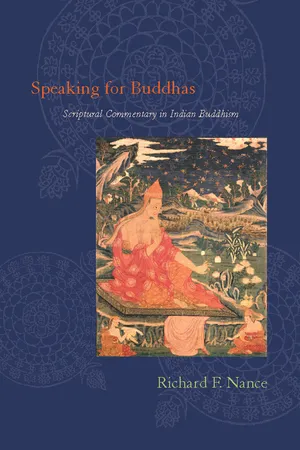
Buddhist intellectual discourse owes its development to a dynamic interplay between primary source materials and subsequent interpretation, yet scholarship on Indian Buddhism has long neglected to privilege one crucial series of texts. Commentaries on Buddhist scriptures, particularly the sutras, offer rich insights into the complex relationship between Buddhist intellectual practices and the norms that inform—and are informed by—them. Evaluating these commentaries in detail for the first time, Richard F. Nance revisits—and rewrites&mdashthe critical history of Buddhist thought, including its unique conception of doctrinal transmission.
Attributed to such luminaries as Nagarjuna, Vasubandhu, Dignaga, and Santideva, scriptural commentaries have long played an important role in the monastic and philosophical life of Indian Buddhism. Nance reads these texts against the social and cultural conditions of their making, establishing a solid historical basis for the interpretation of key beliefs and doctrines. He also underscores areas of contention, in which scholars debate what it means to speak for, and as, a Buddha.
Throughout these texts, Buddhist commentators struggle to deduce and characterize the speech of Buddhas and teach others how to convey and interpret its meaning. At the same time, they demonstrate the fundamental dilemma of trying to speak on behalf of Buddhas. Nance also investigates the notion of "right speech" as articulated by Buddhist texts and follows ideas about teaching as imagined through the common figure of a Buddhist preacher. He notes the use of epistemological concepts in scriptural interpretation and the protocols guiding the composition of scriptural commentary, and provides translations of three commentarial guides to better clarify the normative assumptions organizing these works.
- English
- ePUB (mobile friendly)
- Available on iOS & Android
eBook - ePub
About this book
Information
Topic
Theology & ReligionSubtopic
Eastern PhilosophyTable of contents
- Cover
- Title Page
- Copyright
- Contents
- Acknowledgments
- Introduction
- ONE Models of Speaking: Buddhas and Monks
- TWO Models of Instruction: Preachers Perfect and Imperfect
- THREE Models of Argument: Epistemology and Interpretation
- FOUR Models of Explication: Commentarial Guides
- Conclusion
- APPENDIX A The Vyākhyāyukti, Book I
- APPENDIX B The Abhidharmasamuccayabhāsya (Excerpt)
- APPENDIX C The *Vivaranasamgrahanī
- Notes
- Bibliography
- Index of Texts
- Index
Trusted by 375,005 students
Access to over 1.5 million titles for a fair monthly price.
Study more efficiently using our study tools.
Frequently asked questions
Yes, you can cancel anytime from the Subscription tab in your account settings on the Perlego website. Your subscription will stay active until the end of your current billing period. Learn how to cancel your subscription
No, books cannot be downloaded as external files, such as PDFs, for use outside of Perlego. However, you can download books within the Perlego app for offline reading on mobile or tablet. Learn how to download books offline
Perlego offers two plans: Essential and Complete
- Essential is ideal for learners and professionals who enjoy exploring a wide range of subjects. Access the Essential Library with 800,000+ trusted titles and best-sellers across business, personal growth, and the humanities. Includes unlimited reading time and Standard Read Aloud voice.
- Complete: Perfect for advanced learners and researchers needing full, unrestricted access. Unlock 1.5M+ books across hundreds of subjects, including academic and specialized titles. The Complete Plan also includes advanced features like Premium Read Aloud and Research Assistant.
We are an online textbook subscription service, where you can get access to an entire online library for less than the price of a single book per month. With over 1.5 million books across 990+ topics, we’ve got you covered! Learn about our mission
Look out for the read-aloud symbol on your next book to see if you can listen to it. The read-aloud tool reads text aloud for you, highlighting the text as it is being read. You can pause it, speed it up and slow it down. Learn more about Read Aloud
Yes! You can use the Perlego app on both iOS and Android devices to read anytime, anywhere — even offline. Perfect for commutes or when you’re on the go.
Please note we cannot support devices running on iOS 13 and Android 7 or earlier. Learn more about using the app
Please note we cannot support devices running on iOS 13 and Android 7 or earlier. Learn more about using the app
Yes, you can access Speaking for Buddhas by Richard F. Nance in PDF and/or ePUB format, as well as other popular books in Theology & Religion & Eastern Philosophy. We have over 1.5 million books available in our catalogue for you to explore.