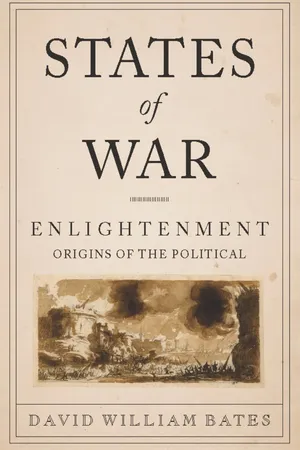
We fear that the growing threat of violent attack has upset the balance between existential concepts of political power, which emphasize security, and traditional notions of constitutional limits meant to protect civil liberties. We worry that constitutional states cannot, during a time of war, terror, and extreme crisis, maintain legality and preserve civil rights and freedoms. David Williams Bates allays these concerns by revisiting the theoretical origins of the modern constitutional state, which, he argues, recognized and made room for tensions among law, war, and the social order.
We traditionally associate the Enlightenment with the taming of absolutist sovereign power through the establishment of a legal state based on the rights of individuals. In his critical rereading, Bates shows instead that Enlightenment thinkers conceived of political autonomy in a systematic, theoretical way. Focusing on the nature of foundational violence, war, and existential crises, eighteenth-century thinkers understood law and constitutional order not as constraints on political power but as the logical implication of that primordial force. Returning to the origin stories that informed the beginnings of political community, Bates reclaims the idea of law, warfare, and the social order as intertwining elements subject to complex historical development. Following an analysis of seminal works by seventeenth-century natural-law theorists, Bates reviews the major canonical thinkers of constitutional theory (Locke, Montesquieu, and Rousseau) from the perspective of existential security and sovereign power. Countering Carl Schmitt's influential notion of the autonomy of the political, Bates demonstrates that Enlightenment thinkers understood the autonomous political sphere as a space of law protecting individuals according to their political status, not as mere members of a historically contingent social order.
- English
- ePUB (mobile friendly)
- Available on iOS & Android
eBook - ePub
About this book
Trusted by 375,005 students
Access to over 1.5 million titles for a fair monthly price.
Study more efficiently using our study tools.
Information
Table of contents
- Cover
- Title Page
- Copyright
- Dedication
- Contents
- Foreword by Dick Howard
- Preface
- Introduction: Constitutional Violence and Enlightenment Thought
- Chapter 1: The Autonomous State and the Origin of the Political
- Chapter 2: States of Reasoning: Modern Natural-Law Theory
- Chapter 3: Locke’s Natural History of the Political
- Chapter 4: Systems of Sovereignty in Montesquieu
- Chapter 5: Rousseau’s Cybernetic Political Body
- Conclusion: From the Concept of the Political to the Rule of Law
- Notes
- Index
Frequently asked questions
Yes, you can cancel anytime from the Subscription tab in your account settings on the Perlego website. Your subscription will stay active until the end of your current billing period. Learn how to cancel your subscription
No, books cannot be downloaded as external files, such as PDFs, for use outside of Perlego. However, you can download books within the Perlego app for offline reading on mobile or tablet. Learn how to download books offline
Perlego offers two plans: Essential and Complete
- Essential is ideal for learners and professionals who enjoy exploring a wide range of subjects. Access the Essential Library with 800,000+ trusted titles and best-sellers across business, personal growth, and the humanities. Includes unlimited reading time and Standard Read Aloud voice.
- Complete: Perfect for advanced learners and researchers needing full, unrestricted access. Unlock 1.5M+ books across hundreds of subjects, including academic and specialized titles. The Complete Plan also includes advanced features like Premium Read Aloud and Research Assistant.
We are an online textbook subscription service, where you can get access to an entire online library for less than the price of a single book per month. With over 1.5 million books across 990+ topics, we’ve got you covered! Learn about our mission
Look out for the read-aloud symbol on your next book to see if you can listen to it. The read-aloud tool reads text aloud for you, highlighting the text as it is being read. You can pause it, speed it up and slow it down. Learn more about Read Aloud
Yes! You can use the Perlego app on both iOS and Android devices to read anytime, anywhere — even offline. Perfect for commutes or when you’re on the go.
Please note we cannot support devices running on iOS 13 and Android 7 or earlier. Learn more about using the app
Please note we cannot support devices running on iOS 13 and Android 7 or earlier. Learn more about using the app
Yes, you can access States of War by David William Bates in PDF and/or ePUB format, as well as other popular books in Politics & International Relations & Political Philosophy. We have over 1.5 million books available in our catalogue for you to explore.