When we understand that something is a pot, is it because of one property that all pots share? This seems unlikely, but without this common essence, it is difficult to see how we could teach someone to use the word "pot" or to see something as a pot. The Buddhist apoha theory tries to resolve this dilemma, first, by rejecting properties such as "potness" and, then, by claiming that the element uniting all pots is their very difference from all non-pots. In other words, when we seek out a pot, we select an object that is not a non-pot, and we repeat this practice with all other items and expressions.
Writing from the vantage points of history, philosophy, and cognitive science, the contributors to this volume clarify the nominalist apoha theory and explore the relationship between apoha and the scientific study of human cognition. They engage throughout in a lively debate over the theory's legitimacy. Classical Indian philosophers challenged the apoha theory's legitimacy, believing instead in the existence of enduring essences. Seeking to settle this controversy, essays explore whether apoha offers new and workable solutions to problems in the scientific study of human cognition. They show that the work of generations of Indian philosophers can add much toward the resolution of persistent conundrums in analytic philosophy and cognitive science.
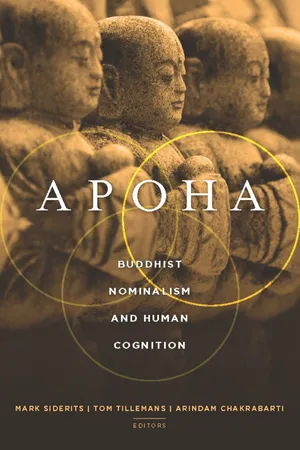
eBook - ePub
Apoha
Buddhist Nominalism and Human Cognition
- English
- ePUB (mobile friendly)
- Available on iOS & Android
eBook - ePub
Apoha
Buddhist Nominalism and Human Cognition
About this book
Information
Topic
PhilosophySubtopic
Indian & South Asian HistoryTable of contents
- Cover
- Half title
- Title
- Copyright
- Contents
- Preface
- Introduction
- 1. How to Talk About Ineffable Things: Dignaga and Dharmakirti on Apoha
- 2. Dignāga’s Apoha Theory: Its Presuppositions and Main Theoretical Implications
- 3. Key Features of Dharmakīrti’s Apoha Theory
- 4. Dharmakīrti’s Discussion of Circularity
- 5. Apoha Theory as an Approach to Understanding Human Cognition
- 6. The Apoha Theory as Referred to in the Nyāyamañjarī
- 7. Constructing the Content of Awareness Events
- 8. The Apoha Theory of Meaning: A Critical Account
- 9. Apoha as a Naturalized Account of Concept Formation
- 10. Apoha, Feature-Placing, and Sensory Content
- 11. Funes and Categorization in an Abstraction-Free World
- 12. Apoha Semantics: Some Simpleminded Questions and Doubts
- 13. Classical Semantics and Apoha Semantics
- 14. Śrughna by Dusk
- Bibliography
- List of Contributors
- Index
Trusted by 375,005 students
Access to over 1.5 million titles for a fair monthly price.
Study more efficiently using our study tools.
Frequently asked questions
Yes, you can cancel anytime from the Subscription tab in your account settings on the Perlego website. Your subscription will stay active until the end of your current billing period. Learn how to cancel your subscription
No, books cannot be downloaded as external files, such as PDFs, for use outside of Perlego. However, you can download books within the Perlego app for offline reading on mobile or tablet. Learn how to download books offline
Perlego offers two plans: Essential and Complete
- Essential is ideal for learners and professionals who enjoy exploring a wide range of subjects. Access the Essential Library with 800,000+ trusted titles and best-sellers across business, personal growth, and the humanities. Includes unlimited reading time and Standard Read Aloud voice.
- Complete: Perfect for advanced learners and researchers needing full, unrestricted access. Unlock 1.5M+ books across hundreds of subjects, including academic and specialized titles. The Complete Plan also includes advanced features like Premium Read Aloud and Research Assistant.
We are an online textbook subscription service, where you can get access to an entire online library for less than the price of a single book per month. With over 1.5 million books across 990+ topics, we’ve got you covered! Learn about our mission
Look out for the read-aloud symbol on your next book to see if you can listen to it. The read-aloud tool reads text aloud for you, highlighting the text as it is being read. You can pause it, speed it up and slow it down. Learn more about Read Aloud
Yes! You can use the Perlego app on both iOS and Android devices to read anytime, anywhere — even offline. Perfect for commutes or when you’re on the go.
Please note we cannot support devices running on iOS 13 and Android 7 or earlier. Learn more about using the app
Please note we cannot support devices running on iOS 13 and Android 7 or earlier. Learn more about using the app
Yes, you can access Apoha by Mark Siderits,Tom Tillemans,Arindam Chakrabarti, Mark Siderits, Tom Tillemans, Arindam Chakrabarti in PDF and/or ePUB format, as well as other popular books in Philosophy & Indian & South Asian History. We have over 1.5 million books available in our catalogue for you to explore.