Between the mid-sixteenth and early nineteenth century, the Mughal Empire was an Indo-Islamic dynasty that ruled as far as Bengal in the east and Kabul in the west, as high as Kashmir in the north and the Kaveri basin in the south. The Mughals constructed a sophisticated, complex system of government that facilitated an era of profound artistic and architectural achievement. They promoted the place of Persian culture in Indian society and set the groundwork for South Asia's future development.
In this volume, two leading historians of early modern South Asia present nine major joint essays on the Mughal Empire, framed by an essential introductory reflection. Making creative use of materials written in Persian, Indian vernacular languages, and a variety of European languages, their chapters accomplish the most significant innovations in Mughal historiography in decades, intertwining political, cultural, and commercial themes while exploring diplomacy, state-formation, history-writing, religious debate, and political thought.
Muzaffar Alam and Sanjay Subrahmanyam center on confrontations between different source materials that they then reconcile, enabling readers to participate in both the debate and resolution of competing claims. Their introduction discusses the comparative and historiographical approach of their work and its place within the literature on Mughal rule. Interdisciplinary and cutting-edge, this volume richly expands research on the Mughal state, early modern South Asia, and the comparative history of the Mughal, Ottoman, Safavid, and other early modern empires.
eBook - ePub
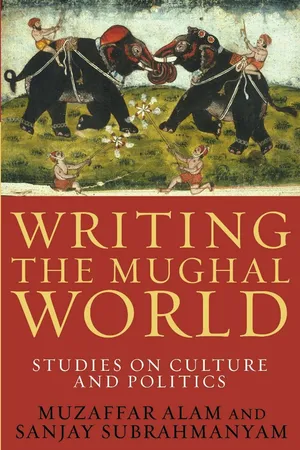
Writing the Mughal World
Studies on Culture and Politics
- English
- ePUB (mobile friendly)
- Available on iOS & Android
eBook - ePub
About this book
Information
Topic
StoriaSubtopic
Storia dell'Asia1

Letters from a Sinking Sultan
‘This [Sultan Bahadur] is naturally a conqueror, and of great heart, and the most indefatigable man that I’ve ever seen, and an extraordinarily great lord, save now that Fortune goes against him […]’—Martim Afonso de Sousa to Dom João III (1535)1
‘This Nuno da Cunha was a poltroon, a great coward with a poor spirit, and a traitor without a generous intention, a spiritual brother of the capon Baxá Soleimão [Hadim Süleyman Pasha]’—Anonymous sixteenth-century Portuguese commentator2
The Prelude
The study of diplomacy, while it played a crucial role in the development of the modern historical profession worldwide, has today fallen into a certain disfavour, being often viewed as excessively traditional and elitist in its orientation. The prolific nineteenth-century German historian Leopold von Ranke, for example, famously wrote at length regarding diplomatic relations, including those between the Spanish Habsburgs and the Ottomans in the early modern period.3The Austrian orientalist Joseph von Hammer-Purgstall, a short generation older than Ranke, was perhaps one of the first Europeans to address the question in a non-Western context in his well-known essay of 1830 on diplomatic dealings between the Mughals and the Ottomans.4 What these writings already made abundantly clear was that the Mughals as well as other contemporary Muslim dynasties in South Asia did not exist in a vacuum as singular states with a past, but rather in a web of inter-state and inter-imperial dealings, surrounded by rituals, conventions, and elaborate forms of cultural production which merit closer examination. While recent years have seen a call for the birth of a ‘new diplomatic history’, this project has largely remained confined to Europe, or at best the Mediterranean world,5 and the issue has remained relatively neglected with regard to early modern South Asia as well as the Islamic world at large.6 To be sure, there have been individual studies of European embassies to the Mughal court, as well as of dealings between Mughal India, Safavid Iran, and the Ottoman domains, but these usually remain somewhat narrowly focused.7
Relations between sixteenth-century Gujarat and West Asia are also a subject that has been touched on by a number of scholars over the years, amongst whom an important place is occupied by the late French savant Jean Aubin. Aubin’s first detailed forays into the history of the Gujarat Sultanate came out of his work on the chronicler Nimdihi, and they were renewed when he wrote his classic essay ‘Albuquerque et les négociations de Cambaye’ in 1971.8 The present chapter draws upon Persian and Portuguese materials either known to or actually collected by Aubin, but which he was unable to make full use of during his lifetime.9 It is thus partly conceived of as a tribute to his pioneering methodology, which combined global curiosity with local philology, and the careful sifting of contemporary documents and chronicles in a variety of languages; but it is also a useful point of reflection from which to embark upon the history of the Mughals in India, to ensure that they do not appear to act upon an empty stage or write as it were on a tabula rasa.
The chapter itself may appear to have a simple purpose. It largely focuses on a set of four Persian documents from the 1530s that are preserved in the the Cartas Orientais collection of the Torre do Tombo in Lisbon, and which had been examined by Aubin in 1952. The reader of the original documents even today finds their covers annotated in Aubin’s tiny and meticulous hand, with brief summaries and datings where possible. In 1973, Aubin published a valuable essay entitled ‘Les documents arabes, persans et turcs de la Torre do Tombo’, in which he introduced the entire collection, and presented transcriptions and translations into French of four letters, three from the celebrated Khwaja ‘Ata (Cojeatar) to the Portuguese governor Afonso de Albuquerque (of which one is in Arabic), and one letter, also in Arabic, from a certain Baba ‘Abdullah to the Portuguese king Dom Manuel.10 The letters that we publish here, in the original Persian with an English translation, were studied by Aubin in the context of his work on sixteenth-century Gujarat and the Portuguese, though he had not completed a transcription or translation of all of them.11
What was the context of these four letters, written by Bahadur Shah, the Sultan of Gujarat, to various Portuguese authorities in the 1530s? Some broad introductory reflections may not be out of place here. We may recall that after the Portuguese arrival at Calicut under Vasco da Gama in 1498, the Mamluk Sultanate of Egypt constructed and sent out a powerful fleet into the Indian Ocean in 1506, drawing on the help of the Ottomans for a part of its construction. It was commanded by Amir Husain al-Kurdi Bash al-‘Askar, but carried none of the prestigious Circassian Mamluks on board, and was instead largely manned by European renegades, blacks, and a number of others (both volunteers and forced recruits) described broadly as ‘Levantine’ in contemporary texts. There are unfortunately few contemporary Arabic sources that report on this expedition in any detail, and we are hence obliged to turn to Portuguese materials, which are much given to exaggerating the role of Venice and the Venetians in the whole matter.12 The best of these sources is the socalled Crónica Anónima in Portuguese, which seems to have been written during the reign of Dom Manuel; and it is indeed this source which affords us the closest look at the activities of Amir Husain and his fleet between 1506 and 1509.13 Amir Husain is described in this text as an elite Mamluk, and it is stated that his fleet initially consisted of 6 ships and 6 galleys, manned by 900 ‘Mamluks and Venetians, and Turks on pay’ at the time that it set out from the port of Suez in February 1506. The anonymous author insists that the Venetians played a significant hand in preparing the fleet, sending the necessary wood to Alexandria; but this is a claim that can be shown to be unsustainable, as is the impression that many Venetians were in fact on board. The first task of this fleet was, however, not to combat the Portuguese in the Indian Ocean; it was instead to impose some order on the increasingly chaotic conditions in the Red Sea. In this respect, Amir Husain was to anticipate the formula that would be used by the Ottomans time and again in the course of the sixteenth century; for instance, in 1538–9, Hadim Süleyman Pasha not only went out to Gujarat but also imposed a new order on the Red Sea and Aden.14
On leaving Suez in 1506, Amir Husain’s fleet seems to have made a brief supply-stop at Tur, close to the mouth of the Gulf of Suez, which was an important point of transhipment on the spice route to Egypt. From there, the next stage was Yanbu‘ al-Bahr, which it is noted was a rather significant way-station for the ‘pilgrims for the house of Mecca’. However, the ruler there had ceased to collaborate in the passage of pilgrims, and Amir Husain apparently carried a warning message from the Mamluk sultan for him. Since this warning had no effect, the fleet began to bombard the city, and the troops disembarked; an engagement ensued in which the Mamluk forces were victorious, although at some cost to themselves. A new ruler was installed, and the fleet now moved on to Jiddah, the principal port linked to Mecca. Here, nothing untoward was found, and the fleet was able to move on rapidly southwards to Jizan, described as a ‘town of a thousand households, unwalled, with a large and protected bay’.15 Here again, the local ruler, a certain Shaikh al-Darawi, was reprimanded for not having paid tribute (páreas) to the sultan; the town was pillaged, and the spoils were sent back to Cairo. Amir Husain then seems to have spent a long period, perhaps as much as a whole year, in Jiddah, which he left only in August or September 1507. The Portuguese chronicles are unclear on why he hesitated so long to enter the Indian Ocean, especially since the stay at Jiddah led to a near-mutiny amongst the crews of various ships, of which at least two abandoned him and sailed off independently towards India. There is a suggestion that he awaited further finances from Cairo, but it may also have been the case that the amir was anticipating fresh news from India. The Egyptian chronicler Ibn Iyas does however help to shed light on the matter. He notes that Amir Husain had been ‘asked to look after the construction of the fortification-walls and the towers of Jiddah; these were excellent works.’16 However, he adds that during this period (that is, 1506–7), the amir had assumed the ‘governorship (niyābat) of Jiddah, and at this time had shown himself to be full of vanity and arbitrariness. The merchants (tujjār) had a tax (‘ushr) of ten per cent imposed upon them and the population, which had greatly suffered from his injustice (zulm), had found him unbearable.’17 Elsewhere, the chronicler has already condemned the actions of Amir Husain in no uncertain terms: ‘Husain, the governor of Jiddah, levied a tax on the traders from India at the rate of one to ten, and so these traders abandoned the port of Jiddah, the situation of which slid in the direction of ruin; therefore, muslins, rice and leather became rare, and the port was abandoned.’ Even if this is exaggerated, we may imagine that Amir Husain’s rapacious reputation preceded him by the time he made his way into the heart of the Indian Ocean.
Amir Husain’s chief correspondents in India at this time were probably the Gujarat Sultan Mahmud Begarha (r. 1458–1511), and Malik Ayaz, the semi-independent ruler of the major port-city of Diu. It is clear that the sultan and the malik did not always perceive their interests as being exactly congruent. The latter was a former royal slave (ghulām-i khāss), whose origins have been variously stated as Dalmatian, Russian, Turkish, and Persian (Gilani), and rather less probably as Malay or Javanese. Once freed, he had accumulated territories and resources in the Kathiawar region, and, operating from a centre at Junagarh, used Diu as his maritime base. By 1507, when the Mamluk fleet entered the Indian Ocean, he had helped transform Diu from a port of second rank to the key centre linking West Asia and Southeast Asia. While declaring that he was no more than a ‘fiscal official of the king of Cambay’ (hum almoxarife del-rey de Cambaya), Malik Ayaz in fact had his own fleet of small vessels (atalaias), and a considerable personal guard, including numerous mercenaries. It was thus logical that the Mamluk fleet and its commander would seek out an alliance with him, and indeed the decision seems to have been made to use Diu as the centre of operations from the Mamluks, rather than any of the ports of the Konkan or Malabar coasts. It is probable that, in this matter, Amir Husain’s decision was influenced by the close relations that one may suspect existed between the Gujarat sultan and Cairo. We are unable to seize these directly, in the absence of the requisite diplomatic correspondence, but it is clear that the decline of the Delhi Sultanate from the late fourteenth century onwards had left a vacuum in terms of high politics in the area. In the 1440s, ‘Abdur Razzaq Samarqandi, envoy-at-large of the Timurid ruler Shahrukh, had attempted to make the claim that his own master in Herat occupied a position of tutelage with regard to the spaces formerly dominated by the Delhi Sultanate. But there is no indication that such an argument carried water in Gujarat. On the other hand, we are aware from the account of Ibn Iyas that at the death of Mahmud Begarha, his son—termed Malik Muzaffar Shah (r. 1511–25), and given no greater dignity than that of Sāhib Kanbāyat—sought a form of investiture for the rule over Khambayat from Cairo and the ceremonial Caliph al-Mutawakkil (min al-khalīfa taqlīd ba wilāyat ‘ala Kanbāyat).18
Whatever be the case, the initial reception of the fleet from the Red Sea at Diu appears to have been rather positive. Malik Ayaz agreed to send a fleet of his own small vessels to accompany them, and the fleet began to make its way down the Indian west coast, eventually encountering a Portuguese fleet commanded by Dom Lourenço de Almeida, son of the viceroy, in early March 1508, at the port of Chaul, in the Ahmadnagar Sultanate. In the ensuing engagement, the viceroy’s son was killed and the Portuguese fleet roundly defeated, with a number of Portuguese being taken prisoner. The victorious allies (who had also included some Muslim elements from Calicut, such as a certain ‘Maimame’, killed in the combat) then returned to Diu, but the alliance had already begun to fall apart. Malik Ayaz had begun to fear that Amir Husain had rather too draconian a way about him, signs of which had already been evident in Jiddah. Aubin has suggested that the presence in the Gujarat court of the interpreter Sidi ‘Ali al-Andalusi may have also been significant, since this Muslim from Granada was much given to exaggerating the power of the Iberian rulers. In any event, it is difficult to escape the conclusion that Aubin draws here: ‘Anxious to preserve the authority he had ably acquired, Malik Ayaz feared, rather more than the wrath of the viceroy, the military superiority of the Egyptians, their prestige and the fact that the importance that was given to them might encourage their temptation to dominate.’19 A similar scenario woul...
Table of contents
- Cover
- Half title
- Title
- Copyright
- Dedication
- Contents
- Preface
- Acknowledgements
- Abbreviations
- Maps
- Introduction: The Old and the New in Mughal Historiography
- 1: Letters from a Sinking Sultan
- 2: The Mughals Look Beyond the Winds
- 3: On the End of the Akbari Dispensation
- 4: The Deccan Frontier and Mughal Expansion, c.1600
- 5: Faizi’s Nal-Daman and Its Long Afterlife
- 6: Catholics and Muslims in the Court of Jahangir (1608–1611)
- 7: The Making of a Munshī
- 8: Trade and Politics in the Arcot Nizāmat (1700–1732)
- 9: Eighteenth-Century Historiography and the World of the Mughal Munshī
- 10: The Political Thought of a Late-Eighteenth-Century Mughal Prince
- Epilogue: Mughals in Exile
- Index
Trusted by 375,005 students
Access to over 1.5 million titles for a fair monthly price.
Study more efficiently using our study tools.
Frequently asked questions
Yes, you can cancel anytime from the Subscription tab in your account settings on the Perlego website. Your subscription will stay active until the end of your current billing period. Learn how to cancel your subscription
No, books cannot be downloaded as external files, such as PDFs, for use outside of Perlego. However, you can download books within the Perlego app for offline reading on mobile or tablet. Learn how to download books offline
Perlego offers two plans: Essential and Complete
- Essential is ideal for learners and professionals who enjoy exploring a wide range of subjects. Access the Essential Library with 800,000+ trusted titles and best-sellers across business, personal growth, and the humanities. Includes unlimited reading time and Standard Read Aloud voice.
- Complete: Perfect for advanced learners and researchers needing full, unrestricted access. Unlock 1.5M+ books across hundreds of subjects, including academic and specialized titles. The Complete Plan also includes advanced features like Premium Read Aloud and Research Assistant.
We are an online textbook subscription service, where you can get access to an entire online library for less than the price of a single book per month. With over 1.5 million books across 990+ topics, we’ve got you covered! Learn about our mission
Look out for the read-aloud symbol on your next book to see if you can listen to it. The read-aloud tool reads text aloud for you, highlighting the text as it is being read. You can pause it, speed it up and slow it down. Learn more about Read Aloud
Yes! You can use the Perlego app on both iOS and Android devices to read anytime, anywhere — even offline. Perfect for commutes or when you’re on the go.
Please note we cannot support devices running on iOS 13 and Android 7 or earlier. Learn more about using the app
Please note we cannot support devices running on iOS 13 and Android 7 or earlier. Learn more about using the app
Yes, you can access Writing the Mughal World by Muzaffar Alam,Sanjay Subrahmanyam in PDF and/or ePUB format, as well as other popular books in Storia & Storia dell'Asia. We have over 1.5 million books available in our catalogue for you to explore.