Dating from the early decades of the third century C.E., the Ainkurunuru is believed to be the world's earliest anthology of classical Tamil love poetry. Commissioned by a Cera-dynasty king and composed by five masterful poets, the anthology illustrates the five landscapes of reciprocal love: jealous quarreling, anxious waiting and lamentation, clandestine love before marriage, elopement and love in separation, and patient waiting after marriage.
Despite its centrality to literary and intellectual traditions, the Ainkurunuru remains relatively unknown beyond specialists. Martha Ann Selby, well-known translator of classical Indian poetry and literature, takes the bold step of opening this anthology to all readers, presenting crystalline translations of 500 poems dense with natural imagery and early examples of South Indian culture. Because of their form's short length, the anthology's five authors rely on double entendre and sophisticated techniques of suggestion, giving their poems an almost haikulike feel. Groups of verse center on one unique figure, in some cases an object or an animal, in others a line of direct address or a specific conversation or situation. Selby introduces each section with a biographical sketch of the poet and the conventions at work within the landscape. She then incorporates notes explaining shifting contexts.
Excerpt:
He has gone off all by himselfbeyond the wasteswhere tigers used to prowland the toothbrush trees grow tall,their trunks parched,on the flinty mountains,
while the lovely folds of your loins, wide as a chariot's seat, vanish as your circlet worked from gold grows far too large for you.
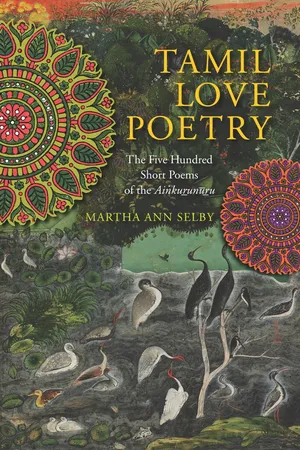
eBook - ePub
Tamil Love Poetry
The Five Hundred Short Poems of the Ainkurunuru
- English
- ePUB (mobile friendly)
- Available on iOS & Android
eBook - ePub
About this book
Information
Topic
Littérature
MARUTAM
ASIDE FROM the one hundred poems included in the Aiṅkuṟunūṟu, Ōrampōkiyār composed seven additional marutam poems (Akanāṉūṟu286 and 316; Kuṟuntokai 10, 127, and 384; Naṟṟiṇai 20 and 360). His most likely dates are 150–200. He was clearly a master of the ironic voice. He is also the author of Kuṟuntokai 70 (kuṟiñci) and 122 (neytal), and one Puṟanāṉūṟu poem, number 284. His strategic use of uḷḷuṟai (implied simile, the technique of employing a natural scene to describe actions, emotions, and characters) is a feature of nearly every one of his poems in the Aiṅkuṟunūṟu, and rightly so: the marutam landscape is largely that of the lovers’ triangle and the resulting secrecy, quarreling, and sulking (ūṭal); therefore oblique, indirect expression is called for.
The marutam poems are set on riverbanks and in cultivated fields. Convention tells us that all seasons are appropriate to this mood, and the preferred time is dawn (midnight is also allowed). The human cast of characters in these hundred poems include the hero (talaivaṉ), heroine (talaivi), her rival (parattai), the girlfriends of both women (tōḻi), and the bard (pāṉar), who acts as a mediator between the hero and his love interests. The native elements of the marutam landscape are exactly what we might expect to find in agricultural settings where rice is cultivated: the buffalo and the crab each have entire decads devoted to them. We also encounter cranes, water hens, freshwater fish, crocodiles, turtles, and other such animals, which are used by Ōrampōkiyār to great effect to illustrate human virtues and foibles. The women of these poems are most often represented by botanical elements (various types of lilies, reeds, and the scentless blossoms of the sugarcane are the most commonly employed).
Ten Poems on Wishing (Vēṭkai-p-pattu)
The first repeated element is vāḻi-y-ātaṉ vāli-y-aviṉi, which constitutes the first line of all ten poems in the set. Ātaṉ and Aviṉi were members of the Cēra dynastic line, and beginning the anthology with this blessing gives the entire Aiṅkuṟunūṟu its indelible Cēra stamp. All ten poems are spoken by the heroine’s girlfriend to the hero. The “mother” to whom she refers is her friend, the heroine. The context in the first five poems is marital infidelity. The heroine is married, and the girlfriend is reporting the blessings given by the heroine, who is conducting her life as usual even though her husband has taken a lover. The girlfriend’s wish is a veiled plea for reconciliation. In poem 2, the girlfriend refers to the woman and her rival in the line “where the water lily equals the many-petaled lotus,” an indirect criticism aimed at the hero: she is chastising him for regarding the rival woman and his wife as equals (here, the water lily is the rival, and the many-petaled lotus is the wife). In poem 3, the girlfriend indicates that something is amiss by blessing his “home life” amid all the abundance and flourishing. In poem 4, the wife is the ripening paddy full of fertile potential, while the rival is the blooming cane. Cane flowers have no scent, there is no “fruit” there, and therefore there is no real use for a relationship with her. The girlfriend additionally states that she does not want the hero’s chest to become a paḻaṉam, a paddy field; the sense is that his chest should be an exclusive place for his wife and not for any woman who happens by. The distinction being made is between private and public access, and I have inserted the word “public” in the penultimate line to bring this sense across. The reference to the husband in poem 5 should be clear: he is the “crocodile gorging on large fish”—in other words, recklessly feasting on other women. Poems 6 to 10 continue in the same poetic form, but the context has shifted to love prior to marriage. The girlfriend is expressing her wish to the hero that he make plans to marry the heroine quickly.
1. “May Ātaṉ live long, long life to Aviṉi!
Let the fields yield rich harvest;
let the gold pile up in heaps!”
So my mother wished.
Let the fields yield rich harvest;
let the gold pile up in heaps!”
So my mother wished.
“Let the man from the rich town
of budding portia and tiny fish heavy with eggs
live long, and long life to his bard, too!”
So did I wish.
of budding portia and tiny fish heavy with eggs
live long, and long life to his bard, too!”
So did I wish.
2. “May Ātaṉ live long, long life to Aviṉi!
Let the fields be bountiful;
let the beggars come!”
So my mother wished.
Let the fields be bountiful;
let the beggars come!”
So my mother wished.
“Let the love of that man from the cool riverbank
where the water lily equals the many-petaled lotus
grow as each day passes.”
So did I wish.
where the water lily equals the many-petaled lotus
grow as each day passes.”
So did I wish.
3. “May Ātaṉ live long, long life to Aviṉi!
Let the milk flow in streams;
let the bulls thrive!”
So my mother wished.
Let the milk flow in streams;
let the bulls thrive!”
So my mother wished.
“That man from the place crammed with flowers
where plowmen, having sown their paddy,
move on with their crop shares—
let his home life flourish!”
So did I wish.
where plowmen, having sown their paddy,
move on with their crop shares—
let his home life flourish!”
So did I wish.
4. “May Ātaṉ live long, long life to Aviṉi!
Let his enemies eat grass;
let the Brahmins chant their Vedas!”
So my mother wished.
Let his enemies eat grass;
let the Brahmins chant their Vedas!”
So my mother wished.
“That man of the place
with its fields of ripening paddy and blooming cane—
may his chest not become a public field!”
So did I wish.
with its fields of ripening paddy and blooming cane—
may his chest not become a public field!”
So did I wish.
5. “May Ātaṉ live long, long life to Aviṉi!
May there be no hunger;
let disease keep its distance!”
So my mother wished.
May there be no hunger;
let disease keep its distance!”
So my mother wished.
“That man from the cool riverbank
where a young crocodile gorges on large fish—
may his chariot stop before our gate!”
So did I wish.
where a young crocodile gorges on large fish—
may his chariot stop before our gate!”
So did I wish.
6. “May Ātaṉ live long, long life to Aviṉi!
May the king’s enemies be vanquished;
let his years increase!”
So my mother wished.
May the king’s enemies be vanquished;
let his years increase!”
So my mother wished.
“That man from the cool riverbank
where a lotus has bloomed in a wide pond—
may he marry her, and let our father give her to him!”
So did I wish.
where a lotus has bloomed in a wide pond—
may he marry her, and let our father give her to him!”
So did I wish.
7. “May Ātaṉ live long, long life to Aviṉi!
May virtue abundantly flourish;
let what is not virtue rot away!”
So my mother wished.
May virtue abundantly flourish;
let what is not virtue rot away!”
So my mother wished.
“That man from the cool ghats
where cranes nest in the branches
of the myrobalan tree with its bristling blossoms—
may he marry her fast and go on to his town!”
So did I wish.
where cranes nest in the branches
of the myrobalan tree with its bristling blossoms—
may he marry her fast and go on to his town!”
So did I wish.
8. “May Ātaṉ live long, long life to Aviṉi!
May the king maintain order;
let there be no fraud!”
So my mother wished.
May the king maintain order;
let there be no fraud!”
So my mother wished.
“The man from the place crammed with flowers
where a fine peacock perches on a swaying mango branch—
let his promises come true in this place!”
So did I wish.
where a fine peacock perches on a swaying mango branch—
let his promises come true in this place!”
So did I wish.
9. “May Ātaṉ live long, long life to Aviṉi!
May goodness abundantly flourish;
let there be no evil!”
So my mother wished.
May goodness abundantly flourish;
let there be no evil!”
So my mother wished.
“That man from the cool riverbank
where a crane nests in a straw-lined cleft
and feeds on carp—
let not his love be slandered!”
So did I wish.
where a crane nests in a straw-lined cleft
and feeds on carp—
let not his love be slandered!”
So did I wish.
10. “May Ātaṉ live long, long life to Aviṉi!
May the rains shower down;
let fertility abundantly flourish!”
So my mother wished.
May the rains shower down;
let fertility abundantly flourish!”
So my mother wished.
“That man from the cool riverbank
where tiny fish reeking of flesh
live alongside blooming mango trees—
let him take her along with him and go!”
So did I wish.
where tiny fish reeking of flesh
live alongside blooming mango trees—
let him take her along with him and go!”
So did I wish.
Ten Poems on Reeds (Vēḻa-p-pattu)
In this set, the common element is the vēḻam (reed or type of sugarcane). All ten poems are set in the time after marriage, and the speaker in ...
Table of contents
- Cover
- Half title
- Editorial Board
- Title
- Copyright
- Dedication
- Contents
- Acknowledgments
- Introduction
- 1. Marutam
- 2. Neytal
- 3. Kuriñci
- 4. Pālai
- 5. Mullai
- References
- Index
- Translations From The Asian Classics
Trusted by 375,005 students
Access to over 1.5 million titles for a fair monthly price.
Study more efficiently using our study tools.
Frequently asked questions
Yes, you can cancel anytime from the Subscription tab in your account settings on the Perlego website. Your subscription will stay active until the end of your current billing period. Learn how to cancel your subscription
No, books cannot be downloaded as external files, such as PDFs, for use outside of Perlego. However, you can download books within the Perlego app for offline reading on mobile or tablet. Learn how to download books offline
Perlego offers two plans: Essential and Complete
- Essential is ideal for learners and professionals who enjoy exploring a wide range of subjects. Access the Essential Library with 800,000+ trusted titles and best-sellers across business, personal growth, and the humanities. Includes unlimited reading time and Standard Read Aloud voice.
- Complete: Perfect for advanced learners and researchers needing full, unrestricted access. Unlock 1.5M+ books across hundreds of subjects, including academic and specialized titles. The Complete Plan also includes advanced features like Premium Read Aloud and Research Assistant.
We are an online textbook subscription service, where you can get access to an entire online library for less than the price of a single book per month. With over 1.5 million books across 990+ topics, we’ve got you covered! Learn about our mission
Look out for the read-aloud symbol on your next book to see if you can listen to it. The read-aloud tool reads text aloud for you, highlighting the text as it is being read. You can pause it, speed it up and slow it down. Learn more about Read Aloud
Yes! You can use the Perlego app on both iOS and Android devices to read anytime, anywhere — even offline. Perfect for commutes or when you’re on the go.
Please note we cannot support devices running on iOS 13 and Android 7 or earlier. Learn more about using the app
Please note we cannot support devices running on iOS 13 and Android 7 or earlier. Learn more about using the app
Yes, you can access Tamil Love Poetry by Martha Ann Selby, Martha Selby in PDF and/or ePUB format, as well as other popular books in Littérature & Histoire de l'Inde et de l'Asie du Sud. We have over 1.5 million books available in our catalogue for you to explore.