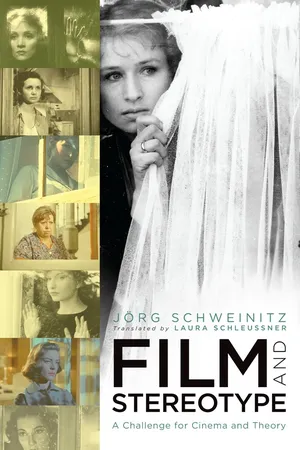
Since the early days of film, critics and theorists have contested the value of formula, cliché, conventional imagery, and recurring narrative patterns of reduced complexity in cinema. Whether it's the high-noon showdown or the last-minute rescue, a lonely woman standing in the window or two lovers saying goodbye in the rain, many films rely on scenes of stereotype, and audiences have come to expect them. Outlining a comprehensive theory of film stereotype, a device as functionally important as it is problematic to a film's narrative, Jörg Schweinitz constructs a fascinating though overlooked critical history from the 1920s to today.
Drawing on theories of stereotype in linguistics, literary analysis, art history, and psychology, Schweinitz identifies the major facets of film stereotype and articulates the positions of theorists in response to the challenges posed by stereotype. He reviews the writing of Susan Sontag, Roland Barthes, Theodor W. Adorno, Rudolf Arnheim, Robert Musil, Béla Balázs, Hugo Münsterberg, and Edgar Morin, and he revives the work of less-prominent writers, such as René Fülöp-Miller and Gilbert Cohen-Séat, tracing the evolution of the discourse into a postmodern celebration of the device. Through detailed readings of specific films, Schweinitz also maps the development of models for adapting and reflecting stereotype, from early irony (Alexander Granowski) and conscious rejection (Robert Rossellini) to critical deconstruction (Robert Altman in the 1970s) and celebratory transfiguration (Sergio Leone and the Coen brothers). Altogether a provocative spectacle, Schweinitz's history reveals the role of film stereotype in shaping processes of communication and recognition, as well as its function in growing media competence in audiences beyond cinema.
- English
- ePUB (mobile friendly)
- Available on iOS & Android
eBook - ePub
About this book
Information
Subtopic
Literary Criticism TheoryPART I
STEREOTYPE THEORY
Concepts, Perspectives, and Controversies
ONE
THE STEREOTYPE IN PSYCHOLOGY AND THE HUMANITIES
The systems of stereotypes may be … the defenses of our position in society…. No wonder, then, that any disturbance of the stereotypes seems like an attack upon the foundations of the universe.
—WALTER LIPPMANN, PUBLIC OPINION (1922)
The word “stereotype” is used in various theoretical disciplines. Upon closer examination, one finds that the term refers to quite heterogeneous phenomena in each respective field. In one, it signifies prejudiced and socially widespread ideas about foreigners. In another, stereotypes are associated with linguistic formulas that take the form of standardized expressions, and in still others they are considered standardized images and even naturalized recurrent patterns of narration. These kinds of semantic oscillations do not only occur along the dividing lines between disciplines. In many cases, they cut straight across specific discourses. In light of this and the tendency of “stereotype” to convey multifaceted meanings, the theoretical significance of the term and its historical development are worthy of some attention. This not only makes it possible to clarify different concepts of the stereotype, but it also simultaneously delineates a horizon of questions and positions that directly or indirectly shape the discourse on stereotypes in film. Films, after all, are complex phenomena, and as such they can be examined from the perspective of various disciplines. As a result, stereotype concepts from almost all fields have been applied to film and related audiovisual media. One can certainly study films as documents that reflect socially current conceptions about people (Menschenbilder), but one may also—more in the sense of film aesthetics or narratology—analyze stock formulas of images and sound design, or character and plot construction, and so on. The term “stereotype” may be applied in all of these different cases, in each instance with a shift in theoretical perspective, which is not always noticed. An examination of the different theoretical orientations of stereotype concepts promotes an awareness of these shifts and prevents the concepts from simply being lumped together—as the use of one and the same term might suggest. At the same time, this approach also offers the opportunity of a more generalized theoretical and conceptual reflection of “stereotypes,” which may also be of conceptual use for a theoretical approach to film.
CONCEPTS OF THE STEREOTYPE
IN SOCIOPSYCHOLOGICAL DISCOURSE
IN SOCIOPSYCHOLOGICAL DISCOURSE
Social psychology stood out in its ability to claim and circulate the term beyond a narrow circle of experts. Social-psychology studies—or, more generally speaking, those in the social sciences—dealing with the topic of the stereotype number in the thousands. However, a close look reveals that there is no clearly circumscribed, consistent, and generally shared concept even within this field. Given that different conceptual approaches offer quite disparate constructs of what is considered a stereotype, even within social psychology a lack of certainty predominates about the discursive object.
Sociological theories on the stereotype were inspired and strongly influenced by a book on public opinion by the American journalist Walter Lippmann, which was initially published in 1922.1 The term features prominently in the book. Even today there is hardly a relevant work that successfully avoids mentioning this book when proposing a specific use of the expression. Lippmann merely developed very broad ideas and generally investigated the nature of the stereotype in terms of the “pictures in our heads,”2 that is, our thoughts as contributing to “an ordered, more or less consistent picture of the world.”3 However, the concept was soon more narrowly defined: normative ideas, attitudes, or expectations concerning people and used to make judgments about them. This more limited definition still persists in the social sciences today. Studies published in the early 1930s by the American scholars Daniel Katz and Kenneth Braly4 on racial stereotypes proved to be very influential in terms of promoting this more restricted meaning of the term. For their studies, the two psychologists developed their famous attribute-list procedure.
To simplify and without going into the many conceptual differences among adherents to Katz and Braly’s line of research,5 stereotypes are standardized conceptions of people, primarily based on an individual’s belonging to a category (usually race, nation, professional role, social class, or gender) or the possession of characteristic traits symbolizing one of these categories. This concept focuses on belief patterns and emphasizes their guiding influence on attitudes and perceptions.
The different approaches within the social sciences attribute to these belief patterns an entire battery of optional characteristics weighing in differently on individual definitions. Stereotypes are thought to be (1) the relatively permanent mental fixtures of an individual (stability); (2) intersubjectively distributed within certain social formations, for which they assume the functions of consensus building and standardization (conformity); therefore, (3) they do not, or only seldom, rely on personal experience but are primarily socially communicated (second-hand nature); in addition, (4) they are limited to the simple combination of a few characteristics (reduction) and (5) accompanied by strong feelings (affective coloration). Finally, (6) functioning automatically, stereotypes are considered to substantially interfere with the processes of perception and judgment, which they influence and even determine (cliché effect). Regarding the function of stereotypes, the term is therefore generally associated with making judgments, and (7) stereotypes are often ascribed the status of inappropriate judgments (inadequacy).
Katz and Braly also laid the groundwork for this final point—merely by the nature of their experimental setup, which was clearly focused on judgments about people based on individual characteristics. Another contributing factor was their choice of subject matter, that is, their primary interest in negative attitudes toward other races. For the two psychologists a stereotype was therefore a firmly rooted impression of another person, “which conforms very little to the fact it pretends to represent, and results from our defining first and observing second.”6 The theoretical construct thus derived from Katz and Braly was targeted at investigating warped, malicious, and, to an extent, even pathological7 aspects of perceptions and judgments about people. It soon became an established reference for progressive concepts. Stereotypes were largely understood in the manner suggested by the title of a later study: “stereotypes as a substitute for thought.”8
“The masses” were considered particularly susceptible to stereotyping. According to theorists influenced by mass psychology, such as Adam Schaff, the masses seemed to consist of people who spontaneously “do not account for the role of prejudice in behavior. Given that these are the so-called masses, this phenomenon assumes special and often socially threatening significance.”9
It was thought that one could exert a positive influence on the social climate by didactically creating an awareness of the fallacy and irrationality of stereotypes. However, there was a conceptual turnaround in the 1950s, and the work of a number of theorists took on a pragmatic orientation.10 There was a greater inclination to raise questions about the possible benefits of stereotypes—still considered to be stabilized conceptions about people—and to consider their causation. A number of theorists now also emphasized the productive, regulatory functions of stereotypes for cognition, social orientation, and intersubjective behavior—functions that were only to be gained at the expense of deficient representations of reality.
Apart from the continuing thematic focus on the stereotype as conceptions about people, this conceptual shift was more in line with Lippmann’s original intentions. Close in this regard to the philosophy of pragmatism, Lippmann considered the existence of stereotypes, for all intents and purposes, an ambivalent phenomenon. He simultaneously emphasized both the deficient and the functional nature of stereotypes—and argued that they were contingent upon each other. In order to account for this ambivalence he made a number of now classic arguments, which are restated here in some detail, because Lippmann’s extraordinarily influential position is often presented in an oversimplified and sometimes biased manner.
Lippmann’s point of departure and first argument was the functionalism of stereotypes as stabilized cognitive systems of individuals. Citing John Dewey, Lippmann saw the world as “one great, blooming, buzzing confusion”11 that was too complex and dynamic for human perception and cognition. In order for things to take on meaning, he further quotes John Dewey, it is necessary to introduce “(1) definiteness and distinction and (2) consistency or stability of meaning into what is otherwise vague and wavering.”12 Stereotypes thus make a substantial contribution to introducing this kind of definiteness and consistency into the world of perception.
What cognitive psychologists would later address with terms like “cognitive structure” or “cognitive schema” is basically already implicit in Lippmann’s concept. He established the idea of stereotypes as structured mental concepts with a simplifying function, which, as deeply ingrained impressions, are particularly persistent and which guide and even enable perceptive, cognitive, and judgmental processes. On the one hand, they function like symbolic mechanisms. When a trait is recognized and perceived as a core attribute, this data is quickly allocated to a certain preexisting complex of ideas. Thus, “we pick recognizable signs out of the environment. The signs stand for ideas, and these ideas we fill out with our stock of images.”13 Afterward, we see “what our mind is already full of”14 in the thing just categorized. On the other hand, from this perspective stereotypes appear to be a kind of screening filter that provides cognitive relief. They organize one’s necessarily selective gaze, which tends to emphasize everything that repeats itself in similar form and satisfies the stereotype, while other things that do not correspond to the stereotype tend to be played down or even overlooked: “For when a system of stereotypes is well fixed, our attention is called to those facts which support it, and diverted from those which contradict.”15
One can certainly observe the complementary effect, in which discrepancies with firmly entrenched expectation patterns may heighten a sense of difference. Nevertheless, later theorists, for whom the word “stereotype” was synonymous with “prejudice,” primarily referred to the mechanism of blocking out differences.
Although in Lippmann’s work the idea ultimately predominated that stereotypes were to be understood as pragmatic reductions made from a selection of real invariants in the outside world,16 in his thinking about the principles of this kind of reduction he often likened the idea of stereotypes to actively formed subjective constructs, which were always dependent on the disposition and interests of the subject. This becomes particularly apparent when he links his concept—if only in passing—with ideas about objects that are not part of an individual’s immediate realm of experience and that cannot be observed with one’s “own eyes.”17 He considered stereotypical ideas about such phenomena to be constructs based on social projections. In light of actual experience, these constructs always proved to be a kind of pseudoknowledge or at least hazy knowledge.
This is where his second fundamental line of argument comes into play. For Lippmann, stereotypes function as intersubjective systems of integration. Despite their deficits, he believed them to be patterns of cognition coordinated with cognitive or behavioral expectations that society or a group places on the individual. As social “codes,”18 stereotypes are thus subject to cultural “standardization,”19 which they in turn support. As a result, “at the center of each [moral code] there is a pattern of stereotypes about psychology, sociology, and history.”20 As a consequence, stereotypes always also represent instances of intersubjective consensus and social orientation. For Lippmann this was essential to functioning interactions: “In the great blooming, buzzing confusion of the outer world we pick out what our culture has already defined for us, and we tend to perceive that which we have picked out in the form stereotyped for us by our culture.”21
Nonetheless, in his view stereotypes are not simply rubber stamps applied from without, but rather they adapt themselves to an individual’s inner disposition, upon which they also exert an influence. They are “loaded with preference, suffused with affection or dislike, attached to fears, lusts, strong wishes, pride, hope.”22
In this context Lippmann ultimately regarded the function of stereotypes as systems for creating and maintaining identity—thus he formulated his third, now classic argument on the value of stereotypes. The degree to which stereotypes are appropriated and habitualized by the individual parallels the extent to which they shape the latter’s personality. Stereotypes thus ultimately become part of an individual’s “defenses”:23 “A pattern of stereotypes … is the guarantee of our self-respect; it is the projection upon the world of our own sense of our own value, our own position and our own rights.”24 Lippmann adds: “There we find the charm of the familiar, the normal, the dependable…. No wonder, then, that any disturbance of the stereotypes seems like an attack upon the foundations of the universe.”25 For this reason, stereotypes are also deeply rooted in the emotions, and their confirmation is experienced as positive.
When one steps back to survey Lippmann’s overall concept, it becomes clear that he did not represent the stereotype as a clearly defined “object.” It is no coincidence that his basic formulations, such as “the pictures in our heads,” operate on the level of metaphor. Hence, at first glance there seem to be valid objections to the hazy and noncoherent aspects of his stereotype concept, whi...
Table of contents
- Cover
- Half title
- Title
- Copyright
- Contents
- List of Illustrations
- Introduction
- Part I. Stereotype Theory: Concepts, Perspectives, and Controversies
- Part II. A Discourse History: The Topic of the “Stereotype” Throughout Film Theory
- Part III. Film Analysis: Critique and Transfiguration–Three Case Studies
- Epilogue
- Notes
- Bibliography
- Filmography
- Index
- Series List
Trusted by 375,005 students
Access to over 1.5 million titles for a fair monthly price.
Study more efficiently using our study tools.
Frequently asked questions
Yes, you can cancel anytime from the Subscription tab in your account settings on the Perlego website. Your subscription will stay active until the end of your current billing period. Learn how to cancel your subscription
No, books cannot be downloaded as external files, such as PDFs, for use outside of Perlego. However, you can download books within the Perlego app for offline reading on mobile or tablet. Learn how to download books offline
Perlego offers two plans: Essential and Complete
- Essential is ideal for learners and professionals who enjoy exploring a wide range of subjects. Access the Essential Library with 800,000+ trusted titles and best-sellers across business, personal growth, and the humanities. Includes unlimited reading time and Standard Read Aloud voice.
- Complete: Perfect for advanced learners and researchers needing full, unrestricted access. Unlock 1.5M+ books across hundreds of subjects, including academic and specialized titles. The Complete Plan also includes advanced features like Premium Read Aloud and Research Assistant.
We are an online textbook subscription service, where you can get access to an entire online library for less than the price of a single book per month. With over 1.5 million books across 990+ topics, we’ve got you covered! Learn about our mission
Look out for the read-aloud symbol on your next book to see if you can listen to it. The read-aloud tool reads text aloud for you, highlighting the text as it is being read. You can pause it, speed it up and slow it down. Learn more about Read Aloud
Yes! You can use the Perlego app on both iOS and Android devices to read anytime, anywhere — even offline. Perfect for commutes or when you’re on the go.
Please note we cannot support devices running on iOS 13 and Android 7 or earlier. Learn more about using the app
Please note we cannot support devices running on iOS 13 and Android 7 or earlier. Learn more about using the app
Yes, you can access Film and Stereotype by Jörg Schweinitz, Laura Schleussner in PDF and/or ePUB format, as well as other popular books in Media & Performing Arts & Literary Criticism Theory. We have over 1.5 million books available in our catalogue for you to explore.