Philosophers debate the death of philosophy as much as they debate the death of God. Kant claimed responsibility for both philosophy's beginning and end, while Heidegger argued it concluded with Nietzsche. In the twentieth century, figures as diverse as John Austin and Richard Rorty have proclaimed philosophy's end, with some even calling for the advent of "postphilosophy." In an effort to make sense of these conflicting positions—which often say as much about the philosopher as his subject—Isabelle Thomas-Fogiel undertakes the first systematic treatment of "the end of philosophy," while also recasting the history of western thought itself.
Thomas-Fogiel begins with postphilosophical claims such as scientism, which she reveals to be self-refuting, for they subsume philosophy into the branches of the natural sciences. She discovers similar issues in Rorty's skepticism and strands of continental thought. Revisiting the work of late-nineteenth and early-twentieth-century philosophers, when the split between analytical and continental philosophy began, Thomas-Fogiel finds both traditions followed the same path—the road of reference—which ultimately led to self-contradiction. This phenomenon, whether valorized or condemned, has been understood as the death of philosophy. Tracing this pattern from Quine to Rorty, from Heidegger to Levinas and Habermas, Thomas-Fogiel reveals the self-contradiction at the core of their claims while also carving an alternative path through self-reference. Trained under the French philosopher Bernard Bourgeois, she remakes philosophy in exciting new ways for the twenty-first century.
eBook - ePub
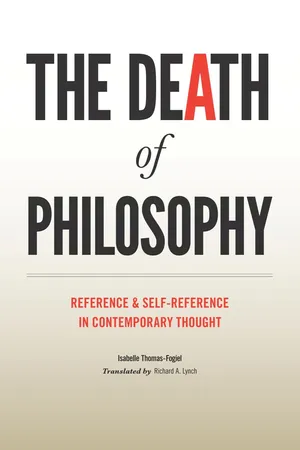
The Death of Philosophy
Reference and Self-reference in Contemporary Thought
- English
- ePUB (mobile friendly)
- Available on iOS & Android
eBook - ePub
The Death of Philosophy
Reference and Self-reference in Contemporary Thought
About this book
Information
Topic
PhilosophieSubtopic
Déconstruction en philosophieI | The End of Philosophy, or the Paradoxes of Speaking |
1 | Skeptical and Scientific “Post-philosophy” |
My analysis of the discourse pronouncing the death of philosophy shall begin with its most resounding assertions and end with its resigned, and even surreptitious, acceptances. Indeed, this theme, so common today, is inflected according to different variations whose nuances we must grasp so that their commonalities are more clearly illustrated at the end of our examination. This is why I will start my inquiry with the most radical antiphilosophers, those we can call, with Vincent Descombes, the “post-contemporary philosophers,”1 and I will show how their ideas, beneath their manifest differences (since they go from the most radical skepticism to the most accepted scientism), reveal the same invariant structure. The more loudly that the death of philosophy is proclaimed, the more that this structure appears as its trademark. Once this structure has been recognized, it will serve as a touchstone for our analysis of the various, more subtle, appearances of the theme in other figures of contemporary philosophy. From pragmatism, through an (admittedly failed) attempt to reestablish philosophy’s autonomy, to the most recent forms of phenomenology, I will trace, step-by-step, the various stages of current philosophy’s self-renunciation.2
The most resounding of all the requiem’s variations today are those of radical skepticism, on the one hand, and, on the other, avowed scientists. Both of these share their origins in analytic philosophy. So I will begin with one of the most prominent skeptical positions in the postanalytic movement of the last twenty years—that of Richard Rorty. Indeed, for Rorty, without the least ambiguity or nostalgic equivocation, “there is no longer any reason to defend philosophy as an autonomous discipline.”3 Rather, a “post-philosophical culture”4 must arise in which philosophy will no longer constitute a Fach, “an autonomous cultural zone,” which is to say that it would no longer be the discipline investigating truth (which the post-philosophical culture knows to be an empty, futile notion, a mere “compliment”5 paid to our colleagues’ assertions, “rhetorical pats on the back”6 still employed in the academic world but destined to disappear). Let’s try to more precisely characterize the moment that follows analytic philosophy.
The “Postanalytic” Moment
Its Three Characteristics
This moment, whose contours have been sketched by John Rajchman in his preface to Post-Analytic Philosophy,7 can be defined by a certain number of traits, the most immediately salient of which is a desire to break with analytic philosophy. This break, or rupture, is distinct in that it is carried out internally, starting from an effective practice of analytic philosophy, not externally, like a critique posed by a Continental phenomenologist or a Persian philosopher. If, as François Récanati says, analytic philosophy has had two waves—first, logical positivism (Russell and the Vienna Circle), and second, pragmatics (Austin and the later Wittgenstein) 8—then what we are witnessing now in the United States is not the emergence of a third wave but a movement whose watchword is the abandonment of the analytic paradigm.9
This break occurs through a reestablishment of or a return to the American tradition that existed before the massive emigration of philosophers fleeing Nazi persecution. This motif of “return” is the second characteristic trait of a movement meant to revolutionize10 thinking. It is simultaneously a break with analysis and a “return” to the fathers of “American pragmatism”—this is Rorty’s claim in his introduction to Consequences of Pragmatism.11 As Vincent Descombes notes, “His guiding idea is clearly to restore the pragmatic school, that is, the American philosophical school, to its initial splendor.”12 To anticipate readers’ legitimate worries upon hearing this vocabulary of a “restoration” of a “tradition” unspoiled by any foreign contamination, Rorty specifies that this return to American thought before the analytic emigration does not signify a desire to extol a healthy, pure, and authentic tradition, at least as far as he is concerned.13 Indeed, despite his political habitus, which does not at all tend to echo an American “restoration” that is “founded” on the most radical grounds, despite the slightly humorous character of a discourse that would portray American culture as colonized, annexed, and martyred by a dominating, hegemonic, and warlike European culture, in fact, Rorty has, further and better than anyone, studied “Continental” thought—putting Heidegger (unquestionably Continental) at the summit of philosophy alongside Dewey (American, before the Franco-German emigration) and Wittgenstein (Austrian, of Cambridge).
So if a restoration of American thought is needed, for Rorty, this is because thinkers like John Dewey or William James had wanted to be done with “all” philosophy, not to propose a different philosophy. The pragmatist “views science as one genre of literature—or, put the other way around, literature and the arts as inquiries, on the same footing as scientific inquiries,”14 and puts William Blake and Fichte in the same category.15 Putting disciplines into the same framework in this manner is not to be understood in the obvious way, in the sense that different domains of competence (Fächer) would be of equal intellectual dignity, but in a fundamental way as “eradication”16 of the very notion of truth. This notion of truth, which gives philosophy its structure and unites ideas as opposed as those of Plato, Kant, Frege, and Russell, must be forgotten in the post-philosophical era that Rorty calls for. This is why Rorty finds a connection between “Dewey and Foucault, James and Nietzsche,”17 in that all call for “the end of philosophy.” Like French deconstruction, but earlier, “Dewey [thought] of philosophy, as a discipline or even as a distinct human activity, as obsolete”18 and “found what he wanted [going beyond philosophy] in turning away from philosophy as a distinctive activity altogether, and towards the ordinary world.”19 The disappearance of any notion of truth is thus the third characteristic trait of this postanalytic thought. Pragmatism is both a total skepticism that “eradicates” any notion of truth and a historicism that recognizes its own thought is a convention accepted “by the standards of our culture.”20 This idea could clearly be different tomorrow, and we wouldn’t be able to say that a parallel situation will be better, because the notion of “good” has disappeared as well as that of truth, with which it has been so often correlated. To be sure, the terms “skepticism” or even “relativism”21 appear less frequently in Rorty’s texts than “historicism,” which he constantly proclaims.22 Instead, the syntagmas that clarify the term “pragmatism” are “antiphilosophical,” “post-philosophical,” and especially the three “antis”—“antiessentialism,” “antifoundationalism,” and “antirepresentationalism.” The absence of the term “skepticism” can be explained, I think, by the fact that the skeptic still finds himself in a universe where truth is a value, whereas in the “post-philosophical” universe of pragmatism, this problem will become just as obsolete as are “the problems about Patripassianism, Arianism, etc., discussed by certain Fathers of the Church”23 for us today. Nevertheless, I will use the phrase “total skepticism” to characterize Rorty’s thought in order to avoid a constant repetition of the overly long phrase “the one who refuses any notion of truth, whether absolute, regulatory, relative or partial.” Rorty’s stance is tantamount to saying that absolutely no proposition, argument, position, or idea is “true” anymore, nor is it “better” than another—as was also the case with Nietzsche and Derrida, this radicality renders futile the characterization of his position with any term that is still a part of the philosophical universe and with which distinctions could be drawn. The genuine pragmatist “refuses to make a move in any of the games in which he is invited to take part.”24 This is undoubtedly the reason why he most often puts his positions in negative terms, such as “antirepresentationalism,” “antiessentialism,” or “antifoundationalism,” negatives that constitute so many specifications of “pragmatism”25 in its refusal of any truth.
Negative Specifications: Antirepresentationalism, Antifoundationalism, Antiessentialism
By the term “representationalism,” which constitutes the framework of his first major work,26 Philosophy and the Mirror of Nature, Rorty means any perspective that holds that our propositions, or representations, correspond to an assignable exterior referent. Philosophy as a whole, and Western culture more generally, is haunted by this notion of representation, in which “to know is to represent accurately what is outside the mind.”27 This definition of representation and of the “mythic entity” that accompanies it—namely, truth—allows Rorty to comprehend within a single category both analytic philosophy and the Continental tradition, Platonism and “the Cartesian-Kantian tradition.”28 Beyond the more-or-less virulent29 criticisms that Rorty makes against the analytic trend, his most characteristic theme consists in showing that the “linguistic turn,”30 far from having broken with past philosophy and inaugurated a new way of thinking, has only refashioned the old notions of “the mirror of nature” and “correspondence-truth,” of which the semantic theory (“‘p’ is true if and only if p”) is the most refined expression and of which the doctrine of reference is the zenith. The second wave of analysis (if there is such a thing) cannot abandon this fantasy of truth, even if it claims to distance itself from classical “absolutism” with phrases like “redundancy theory of truth” or “simple ‘falsifiability’” or even with “Searle’s reformulations.”31 The “scientific” pretention or aim, so prevalent in analytic philosophy, is nothing but the expression of a myth that has structured the West and nourished its symptom, philosophy. It is perhaps in these theses of Rortyian pragmatism that we can most clearly see the nature of his break with the analytic schema, for if that schema is constituted by an idea, it is surely the idea of a “science” as an ensemble of true propositions.
The two other specifications—antiessentialism and antifoundationalism—follow logically from this “antirepresentationalism.” The Platonic question, “Ti esti?” becomes off-limits because there is no possible response. There is no human nature nor any essence of art that individuals (humans or artworks) would exemplify. Neither the good, nor the true, nor the beautiful are essences; nor are the common genera of which species are particularizations, nor even the general species of which individuals are the expression. In short, postanalyticism must simultaneously abandon Platonic essences (the Good, the True, the Beautiful, inscribed in the heaven of Forms) as well as Enlightenment abstractions such as “man,” “nature,” and “morality,” which are only unconfessed echoes of the former. The atomized individual no longer embodies anything if this is a historic moment destined to disappear, an ideology proper to the contingent society in which he finds himself by chance, a behavior that he shares with his “neighbors,” not because it would be better than another but because it forms a part of the “standards of the moment.” At the heart of this radicalism, antifoundationalism goes without saying, even if it is sometimes difficult to determine precisely what Rorty includes in this category. A study of his most recent texts shows that it is initially and quite clearly a question of foundations in the sense of a supreme being (God), the basis of classical onto-theology. In this sense, antifoundationalism is a position that can be claimed by any Enlightenment philosopher, from Diderot to Kant. In the same vein, the foundation as ego, the supposed authority for the theory of knowledge, is likewise stigmatized as fiction. But beyond these classic critiques, which can be found just as easily in Hume, Fichte, Hegel, or Heidegger, the foundation also designates a point of view that would allow us to speak of science and of knowledge in general. Apparently targeted here are not only neo-Kantian theoreticians of knowledge like Hermann Cohen and Paul Natorp but presumably also epistemologists like Karl Popper who indeed adopt a point of view considered to be, if not better, at the very least neutral, from which they can speak of “scientific knowledge.” Rorty’s antifoundationalism, thus defined, would connect with Quine’s, who denounced the very idea of a “theory of knowledge” in his famous article “Epistemology Naturalized.”32 Science must be done, not interpreted or explained from an exterior discourse. No reflexive point of view is possible, even in the minimal and first sense of “questions about.” The difference between this kind of antifoundationalism and Quine’s probably proceeds from the sources for their respective critiques of foundationalism: for Quine, critique of foundationalism is done in the name of nature (I shall return to this point); for Rorty, in the name of the course of history. Because no point of view can escape the limited, finite, situated perspective of a mortal individual, every position from which one could speak of science or knowledge, or morality, art, philosophy, etc., is, for Rorty, impossible. Antifoundationalism is thus not merely the critique of some traditional foundation (God, the ego, nature in a Spinozistic sense) but also the critique of every point of view that would be reflexive (as, for example, “to do the theory of such and such theory” or even “to say something about what we are saying”). This radical character makes it clear that the only viable solution would be to escape from philosophy. In this sense, Rorty is coherent, because antifoundationalism thus conceived leaves no room for an even minimal philosophical posture, even one understood as the possibility for reflection upon a given practice, usage, or discourse. Rorty goes very far in this direction because he recognizes that, despite his political engagement (he stands for democracy rather than dictatorship, courtesy rather than violence, conversation rather than force), no point of view permits him to justify this choice. “Pragmatism and Philosophy,” which introduces Consequences of Pragmatism, leaves no doubt on this question, even if numerous interpreters impute to him a less radical, but also less consistent position, one more in conformity with our belief in the intrinsic superiority of democracy.33 I shall cite a somewhat long passage, which nevertheless has the virtue of being unambiguous. With respect to post-philosophy, Rorty tells us that what is “most difficult to acknowledge” but which nonetheless must be admitted is that none of our attitudes, even political and practical ones, can be said to be better than any other:
The most powerful reason for thinking that no such culture is possible is that seeing all criteria as no more than temporary resting-places, constructed by a community to facilitate its inquiries, seems morally humiliating. Suppose that Socrates was wrong, that we have not once seen the Truth, and so will not, intuitively, recognize it when we see it again. This means that when the secret police come, when the torturers violate the innocent, there is nothing to be said to them of the form “There is something within you which you are betraying. Though you embody the practices of a totalitarian society which will endure forever, there is something beyond those practices which condemns you.” This thought is hard to live with, as is Sartre’s remark: “Tomorrow, after my death, certain people may decide to establish fascism, and the others may be cowardly or miserable enough to ...
Table of contents
- Cover
- Half title
- Title
- Copyright
- Contents
- Acknowledgments
- Translator’s Note
- Introduction
- Part I. The End of Philosophy, or the Paradoxes of Speaking
- Part II. Challenging the “Death of Philosophy”: The Reflexive a Priori
- Part III. The End of Philosophy in Perspective: The Source of the Reflexive Deficit
- Conclusion
- Bibliography
- Notes
Trusted by 375,005 students
Access to over 1.5 million titles for a fair monthly price.
Study more efficiently using our study tools.
Frequently asked questions
Yes, you can cancel anytime from the Subscription tab in your account settings on the Perlego website. Your subscription will stay active until the end of your current billing period. Learn how to cancel your subscription
No, books cannot be downloaded as external files, such as PDFs, for use outside of Perlego. However, you can download books within the Perlego app for offline reading on mobile or tablet. Learn how to download books offline
We are an online textbook subscription service, where you can get access to an entire online library for less than the price of a single book per month. With over 1.5 million books across 990+ topics, we’ve got you covered! Learn about our mission
Look out for the read-aloud symbol on your next book to see if you can listen to it. The read-aloud tool reads text aloud for you, highlighting the text as it is being read. You can pause it, speed it up and slow it down. Learn more about Read Aloud
Yes! You can use the Perlego app on both iOS and Android devices to read anytime, anywhere — even offline. Perfect for commutes or when you’re on the go.
Please note we cannot support devices running on iOS 13 and Android 7 or earlier. Learn more about using the app
Please note we cannot support devices running on iOS 13 and Android 7 or earlier. Learn more about using the app
Yes, you can access The Death of Philosophy by Isabelle Thomas-Fogiel, Richard A. Lynch in PDF and/or ePUB format, as well as other popular books in Philosophie & Déconstruction en philosophie. We have over 1.5 million books available in our catalogue for you to explore.