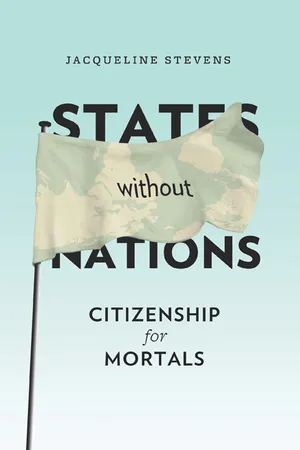
As citizens, we hold certain truths to be self-evident: that the rights to own land, marry, inherit property, and especially to assume birthright citizenship should be guaranteed by the state. The laws promoting these rights appear not only to preserve our liberty but to guarantee society remains just. Yet considering how much violence and inequality results from these legal mandates, Jacqueline Stevens asks whether we might be making the wrong assumptions. Would a world without such laws be more just?
Arguing that the core laws of the nation-state are more about a fear of death than a desire for freedom, Jacqueline Stevens imagines a world in which birthright citizenship, family inheritance, state-sanctioned marriage, and private land ownership are eliminated. Would chaos be the result? Drawing on political theory and history and incorporating contemporary social and economic data, she brilliantly critiques our sentimental attachments to birthright citizenship, inheritance, and marriage and highlights their harmful outcomes, including war, global apartheid, destitution, family misery, and environmental damage. It might be hard to imagine countries without the rules of membership and ownership that have come to define them, but as Stevens shows, conjuring new ways of reconciling our laws with the condition of mortality reveals the flaws of our present institutions and inspires hope for moving beyond them.
- English
- ePUB (mobile friendly)
- Available on iOS & Android
eBook - ePub
About this book
Trusted by 375,005 students
Access to over 1.5 million titles for a fair monthly price.
Study more efficiently using our study tools.
Information
Topic
PhilosophySubtopic
Political PhilosophyCHAPTER ONE
THE PERSISTENCE AND HARMS OF BIRTHRIGHT CITIZENSHIP IN SO-CALLED LIBERAL THEORY AND COUNTRIES
Even the super powers cannot ignore the reality of worldwide protests. The ongoing state of nature between bellicose states that have already forfeited their sovereignty has at least begun to appear obsolescent.
The conflict between Russia and the former Soviet republic of Georgia moved toward full-scale war on Saturday, as Russia sent warships to land ground troops in the disputed territory of Abkhazia and broadened its bombing campaign to the Georgian capital’s airport.
We shall not turn over any Kurdish man to Turkey, not even a Kurdish cat.
CITIZENSHIP RULES
Laws and Practices in So-called Liberal Societies
Those who believe so-called liberal societies embody the end of ideology,1 the end of history,2 and the end of legally mandated birthright-status relations3 must find the rules for citizenship in contemporary societies a bit confounding. Rules for political membership in the most enlightened countries of the European Union vary little from preliterate communities and the premodern states of antiquity. From Afghanistan to Zimbabwe, about 97 percent of us will have our prerogatives and burdens of citizenship determined by birth.4 In Afghanistan, the Republic of Congo, Honduras, Monaco, Senegal, and Zimbabwe, not to mention the United States, England, and Japan, indeed, in every single country in the world, citizenship is determined primarily by birth, either to one’s legal parents or from being born in a particular country.5
Not only does the birthright-citizenship criterion violate liberal norms at the level of the individual, but it is also at odds with classical liberal arguments for the “invisible hand” and free markets, including the free movement of labor. Restricting the supply of labor based on alienage is an artificial interference with economic laws of supply and demand that, the theory holds, will result in decreased productivity relative to a labor market that lacked such inhibitions. U.S. Secretary of Homeland Security Michael Chertoff admitted as much in 2007, when he explained that the measures he was implementing to expel undocumented residents would be bad for business: “There will be some unhappy consequences for the economy out of doing this.”6 A lobbyist for a business consortium opposing the Department of Homeland Security measures said, “It’s going to be awful; the harvest is going to be awful. People will feel it when they go grocery shopping, when they read in the newspaper that we’re importing our meat from China.”7 While it may seem counterintuitive to enact a policy that decreases the productivity of one’s own economy, birthright citizenship requires this.
In short, the rules for determining citizenship are not based on calculations that might advantage one’s own group but that sort the teams’ composition in the first place, so to speak. No one can say whether a practice is going to benefit “my” group until the rules for determining these groups have been established. The birthright criterion for citizenship is flawed, at least based on theories of classical economics and genuine liberal political theory, because it excludes potentially productive citizens. In 2004, 43 percent of lawful resident admissions to the United States were granted to immediate relatives, including spouses, children under twenty-one, and parents.8 There are no restrictions on the number of new residents in this category.9 Another 23 percent of legal resident admissions were given to nonimmediate relatives under “family-sponsored preference admissions.”10 In sum, 67 percent of newcomers to the United States were admitted because of kinship ties, and 16 percent were given legal residency because of their skills or wealth.11 (Foreigners may apply for a legal resident card if they are “willing to invest at least $1 million in businesses located in the United States,”12 but only 129 of the 155,300 legal resident cards issued in 2004 went to people in this category.)13 The United States waives the requirement of legal residency altogether if one has “performed active military duty during World War I, World War II, Korea, Vietnam, Persian Gulf, [or] on or after September 11, 2001”14 and provides an express lane for veterans interested in obtaining legal residency, but only a few thousand have become U.S. citizens via this route. This means that while the Department of Homeland Security is threatening fines and criminal sanctions against private employers whose workers lack documentation, the military will be cheerfully recruiting nonresident aliens. An immigrant can be hired by one branch of government security to kill Iraqis but will be imprisoned by another branch of government security for picking a tomato. These numbers seem to be increasing and will go up further if Congress passes pending legislation that would allow citizenship to undocumented immigrants who were in the United States since they were fifteen and have served just two years in the military. Offering citizenship to encourage aliens to join the army resembles the dynamic between war and slavery in antiquity, when regimes would use slaves captured in one place for colonizing adventures elsewhere.15
If countries really did behave like sports teams or businesses and wanted to recruit the most talented individuals, then state governments would both encourage the immigration of those who brought the most economic benefits and seek to expatriate the poor and unskilled, a drag on the national average. A country with membership rules adhering to the axioms of rational-choice theory and concerned with prosperity would prefer members who are skilled, wealthy, and fluent in its dominant language, for instance. Everyone would be expected to meet the minimum standards for any valued attributes, not just aspiring immigrants who now must memorize information about the country’s history and political institutions that natives ignore. Just as sports teams do not allow uncoordinated children of sports stars to join their teams, those not up to a country’s standards would have to leave, regardless of their place of birth or ancestry. The analysis here is not arguing for meritocratic standards of citizenship but highlighting the irrationality of arguments claiming that it is immigration and not birthright citizenship that lowers a country’s standard of living.
Birthright citizenship does not even guarantee a citizenry knowledgeable on its own political institutions. Most citizens, including students at top universities in the United States, are not minimally versed in the basic principles and institutions of this country. Columnist Rosa Brooks writes in the Los Angeles Times that a survey from 2006 “found that although 52% of Americans could name two or more of the characters from ‘The Simpsons,’ only 28% could identify two of the freedoms protected under the 1st Amendment. Another recent poll found that 77% of Americans could name at least two of the Seven Dwarfs from ‘Snow White,’ but only 24% could name two or more Supreme Court justices.”16 Brooks makes the case that those who fail should be deported, a tongue-in-cheek rebuke of the knowledge we require of immigrants taking the new citizenship test.17
The gatekeeping policies of the United States resemble those of the six countries randomly selected for analysis, many very poor, mentioned above. This is curious. The absence of variation in citizenship criteria is another indication of their independence from market mechanisms. Were countries using immigration policies in order to increase their revenues, then one would expect to see variation among their policies. Rich countries might be expected to do much more to exclude potential newcomers than would poor countries, as it would be more likely that a random newcomer would be poorer than the average current resident. Reciprocally, the opposite would be the case in poor countries. However, as we see from the chapter’s sample,18 wealthy and poor countries have similar rules for citizenship. The Republic of Congo, with an average GDP of $900 per person, and Monaco, with average GDP of $27,000 per person (2002 estimates), both restrict citizenship largely to those whose parents are citizens.19 An ad hoc example also illustrates this point: among the several hundred EU citizens who applied for Turkish citizenship between 1995 and 2003, none of them had their applications approved.20 During the same period, tens of thousands of Turkish immigrants were accorded EU citizenship, the plurality in Germany.21 To be clear, the point of these examples is to emphasize the inconsistency of these norms from the expectation on the Right and Left alike that government policies are largely influenced by crude market principles and the pressures of large corporations. While capitalism is not on its way out, it has met a fierce ideological and political foe in the guise of nationalism. Likewise, those who may not care about defending capitalism have ideological investments in equality and freedom that are also incompatible with birthright citizenship. Embraced by most on the left and right alike, the inclusions and exclusions relying on birthright citizenship call for further explanation.
So-called Liberal Political Theories of Citizenship
In the 1970s and 1980s, some feminists began exploring inconsistencies in so-called liberal thought indicative of the theorists’ sexism. The purpose was partly to suggest that the work of social contract thinkers was inherently masculinist and not liberal and partly to provoke rethinking relations between men and women that would be consistent with the liberal norms suggested for men’s relations among one another, although many feminists for various reasons rejected the liberal project altogether.22 Carole Pateman’s Sexual Contract points out that John Locke contemplated an enduring sphere of private, familial, sexed inequality as the basis for imagining a public realm that would put men on equal political footing.23 Susan Okin finds a very similar aporia in the work of John Rawls. His Theory of Justice sets aside the family from inquiry into norms of justice.24 Pateman, Okin, and many others show the blind spots of Enlightenment authors.
To account for the different standards Locke applied to the familial and political spheres, Pateman draws on psychoanalytic theory. Pateman suggests that the parallels between Freud’s story of the band of brothers overthrowing the father in order to be masters of their respective households25 and Locke’s incitement for English men to shake off the monarchy and dominate their families is evidence of history’s and Locke’s misogyny. Okin does not delve into deeper psychological motives but seems to attribute Rawls’s exclusion of family roles from the “original position” to old-fashioned sexism. Their inquiries initiated numerous other studies across many fields into the seemingly anachronistic resilience of the illiberal family and other hereditary groups, including the nation and empire, in work by a number of theorists who called themselves liberal. The postcolonial critiques of liberal theorists, discussed below, do not overtly connect the theorists’ views on kinship rules with the authors’ racism and imperialism, but the attachments of Locke, Jeremy Bentham, and John Stuart Mill, among many others, to family, nation, and racialized imperial power are rooted in their anxieties about mortality that did not give way to their otherwise individual-level, rational analyses. Sexism, the institutionalization of men’s legal dominance of intergenerationality they cannot obtain in nature, is also an artifact of these anxieties, and will be discussed in chapters 4 and 5. There are a handful of theorists whose work expresses consciousness of these attachments and rejects them.26 This is liberal theory; those theories that do not extend their deontological analyses to all people and all activities may call themselves liberal and may even provide the intellectual historical origins for the term,27 but if the concept is to have meaning, then self-declarations are not sufficient evidence.
In light of their opposition to feudal uses of heredity for resource allocation, as well as the incompatibility of birthright with market principles, one might expect those claiming liberal credentials to call for open borders. But prominent twentieth- and twenty-first-century so-called liberal democratic theorists have tended to endorse rather than repudiate birth criteria for citizenship.28 For instance, Isaiah Berlin defends the views of Johann Gottfried Herder, a late eighteenth-century philosopher and poet who believed people were born with national spirits (Volksgeist and Nationalgeist) particular to their ancestors.29 A staunch defender of “the individual” against totalitarian and fascist ideologies of the twentieth century,30 Berlin argues nonetheless that nationalism’s premises of common blood and culture are benign and fill a “profound natural need,”31 an assumption subsequent liberals have embellished to adduce an enclosed hereditary community’s self-determination as an individual right. For example, the 1948 United Nations Declaration of Human Rights includes the “right to a nationality.”
Rather than mount a critique of nationalism, so-called liberal theory works within ancestral paradigms of membership, a concession to “inevitability” not made in the case of other prevailing practices in earlier times. An article by the political philosophers Avishi Margalit and Joseph Raz makes this approach explicit, explaining that their method elevates common practices and intuitions to moral principles: “We assume that things are roughly as they are, especially that our world is a world of states and of a variety of ethnic, national, tribal, and other groups. We do not question the justification for this state of affairs. Rather, we ask whether, given that this is how things are and for as long as they remain the same, a moral case can be made in support of national self-determination.”32 The answer is “yes.” Margalit and Raz infer the characteristics of the groups providing a principled basis for the relevant units of self-determination, what they call encompassing groups, “membership of which is important to one’s self-identity.”33 Margalit and Raz observe that these communities do not depend on achievement but that one “belongs because of who one is,”34 meaning the experience of being born into a particular identity and not of having earned it.35
In a related project—establishing rules for distributive justice—the political theorist Michael Walzer36 also endorses birthright citizenship: “The distinctiveness of cultures and groups depends upon closure and, without it, membership cannot be conceived as a stable feature of human life.”37 The birthright-citizenship rule for closure holds even though Walzer also insists that society’s benefits be allocated on the basis of the skills appropriate to earn them and criticizes aristocracies and other birthright legal privileges. Closure for a specific political society should be based on birth, Walzer insists, because any other criterion risks endangering families. Jus soli, membership by birth in the territory, is also allowed, so as not to disadvantage those whose parents were born elsewhere.
Walzer’s assertions depend as much on the value he finds in such hereditary communities as on their inevitability: “If states ever became large neighborhoods, it is likely that neighborhoods will become little states. Their members will organize to defend the...
Table of contents
- Cover
- Half title
- Series Page
- Title
- Copyright
- Dedication
- Epigraph
- Contents
- Preface
- Introduction
- Chapter 1. The Persistence and Harms of Birthright Citizenship in So-Called Liberal Theory and Countries
- Chapter 2. Abolishing Birthright Citizenship
- Chapter 3. A Theory of Wealth for Mortals
- Chapter 4. Abolishing Inheritance
- Chapter 5. The Law of the Mother
- Chapter 6. Abolishing Marriage
- Chapter 7. Abolishing Private Land Rights: Toward a New Practice of Eminent Domain
- Chapter 8. Religion and the Nation-State
- Appendix: Methods for an Open Society
- Acknowledgments
- Notes
- Bibliography
- Index
Frequently asked questions
Yes, you can cancel anytime from the Subscription tab in your account settings on the Perlego website. Your subscription will stay active until the end of your current billing period. Learn how to cancel your subscription
No, books cannot be downloaded as external files, such as PDFs, for use outside of Perlego. However, you can download books within the Perlego app for offline reading on mobile or tablet. Learn how to download books offline
Perlego offers two plans: Essential and Complete
- Essential is ideal for learners and professionals who enjoy exploring a wide range of subjects. Access the Essential Library with 800,000+ trusted titles and best-sellers across business, personal growth, and the humanities. Includes unlimited reading time and Standard Read Aloud voice.
- Complete: Perfect for advanced learners and researchers needing full, unrestricted access. Unlock 1.5M+ books across hundreds of subjects, including academic and specialized titles. The Complete Plan also includes advanced features like Premium Read Aloud and Research Assistant.
We are an online textbook subscription service, where you can get access to an entire online library for less than the price of a single book per month. With over 1.5 million books across 990+ topics, we’ve got you covered! Learn about our mission
Look out for the read-aloud symbol on your next book to see if you can listen to it. The read-aloud tool reads text aloud for you, highlighting the text as it is being read. You can pause it, speed it up and slow it down. Learn more about Read Aloud
Yes! You can use the Perlego app on both iOS and Android devices to read anytime, anywhere — even offline. Perfect for commutes or when you’re on the go.
Please note we cannot support devices running on iOS 13 and Android 7 or earlier. Learn more about using the app
Please note we cannot support devices running on iOS 13 and Android 7 or earlier. Learn more about using the app
Yes, you can access States Without Nations by Jacqueline Stevens in PDF and/or ePUB format, as well as other popular books in Philosophy & Political Philosophy. We have over 1.5 million books available in our catalogue for you to explore.