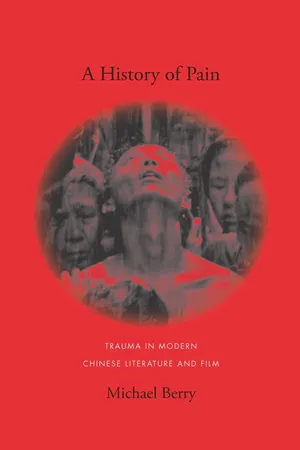
The portrayal of historical atrocity in fiction, film, and popular culture can reveal much about the function of individual memory and the shifting status of national identity. In the context of Chinese culture, films such as Hou Hsiao-hsien's City of Sadness and Lou Ye's Summer Palace and novels such as Ye Zhaoyan's Nanjing 1937: A Love Story and Wang Xiaobo's The Golden Age collectively reimagine past horrors and give rise to new historical narratives.
Michael Berry takes an innovative look at the representation of six specific historical traumas in modern Chinese history: the Musha Incident (1930); the Rape of Nanjing (1937-38); the February 28 Incident (1947); the Cultural Revolution (1966-76); Tiananmen Square (1989); and the Handover of Hong Kong (1997). He identifies two primary modes of restaging historical violence: centripetal trauma, or violence inflicted from the outside that inspires a reexamination of the Chinese nation, and centrifugal trauma, which, originating from within, inspires traumatic narratives that are projected out onto a transnational vision of global dreams and, sometimes, nightmares.
These modes allow Berry to connect portrayals of mass violence to ideas of modernity and the nation. He also illuminates the relationship between historical atrocity on a national scale and the pain experienced by the individual; the function of film and literature as historical testimony; the intersection between politics and art, history and memory; and the particular advantages of modern media, which have found new means of narrating the burden of historical violence.
As Chinese artists began to probe previously taboo aspects of their nation's history in the final decades of the twentieth century, they created texts that prefigured, echoed, or subverted social, political, and cultural trends. A History of Pain acknowledges the far-reaching influence of this art and addresses its profound role in shaping the public imagination and conception-as well as misconception-of modern Chinese history.
On Sakura Ridge at Musha Cherry blossoms crimson red Seem to be crying out for Ichirō and Jirō Again they bloom
October, 1930 Hanaoka Ichirō and Hanaoka Jirō The tribal leader Mona Rudao Resisted the Japanese empire’s aggression Bravely leading a revolt destined to fail Swallowing their regret in death
Under the wind and the sun Ichirō and Jirō’s freshly spilt blood stained with sorrow and rage Are like crimson sakura blowing in the wind Again they bloom in anger
—WU YONGFU (118–119)
Enter the Headhunt
Composed on March 17, 1982, this free-verse poem by Wu Yongfu
entitled “The Crimson Sakura of Musha” (Wushe feiying
) is but one in a long line of attempts to commemorate, reflect upon, and reconstruct the Musha Incident (
), one of the most violent events in modern Taiwan history. It happened during the height of the colonial period in Taiwan; after more than 35 years under the Japanese flag, virtually all forms of armed resistance had long been suppressed. But that changed one fall morning in Musha
, a small town nestled deep in the mountains of central Taiwan and occupied primarily by aborigine tribes. October 27, 1930 was the date set for the annual track meet to be held at Musha Elementary School. The event turned violent when Mona Rudao
(1882–1930) of the Atayal tribe (
) led approximately 300 tribesmen in an ambush resulting in the deaths of 134 Japanese, nearly all of those occupying Musha who had gathered that morning to observe the track meet. The Japanese responded with a massive deployment of 1,303 troops and state-of-the-art weaponry, including internationally banned poison gas, even going so far as to recruit other, pro-Japanese tribes to hunt down the perpetrators and suppress the uprising. Among the 6 tribes (originally numbering more than 1,200 people)1 that took part in the raid on the elementary school, 644 were dead by the end of the Japanese campaign, with nearly half of them taking their own lives, including the leader, Mona Rudao.2 The vast majority of the surviving Atayal, numbering only 561, were interred in 3 separate detention centers.
Six months later, there came a brutal footnote to this violent suppression when the pro-Japanese Toda subtribe (
) launched a coordinated attack on the detention centers on April 24, 1931. This Second Musha Incident (
), widely believed by most historians to have been orchestrated by the Japanese, culminated with the near extermination of the Atayal. In the raid, 216 of the detainees were killed, 101 of whom were decapitated by the Toda. The 293 survivors were forcibly exiled from their ancestral homeland of Musha to Chuanzhongdao (
, present-day Qingliu,
). On October 15 and 16, 1931 all survivors were summoned to Puli to take part in an “Allegiance Ceremony,” during which an additional 39 tribesmen suspected of involvement in the original attack on the school were arrested. They were sentenced to 1- to 3-year jail terms, but with the exception of 1 escapee, all died in custody. The harsh crackdown in the wake of the Musha Incident raised questions about the legitimacy of Japanese claims of trying to bring “civilization to the savages.” As Anupama Rao and Steven Pierce have noted, when colonial powers appropriate brutality as a means to achieve their goals, the legitimacy of the entire colonial project is called into question:
If colonialism was about the management of difference—the civilized ruling the uncivilized—the allegedly necessary violence of colonial government threatened to undermine the very distinction that justified it. Disciplining “uncivilized” people through the use of force could often seem the only way to correct their behavior, but this was a problem: Violence also appeared to be the antithesis of civilized government. (Pierce 4)
After Musha, this contradiction was deeply felt, and Japan began to reevaluate its entire colonial approach. Both the policy changes enacted in the wake of Musha and the modern weaponry employed first in the crackdown (including poison gas) would prove of critical importance just a year later, when Japan’s colonial reach extended to mainland China with the Mukden Incident.
Much has been written about the Musha Incident, especially about Mona Rudao, the mysterious and charismatic Atayal leader of the Mahebo tribe who led the insurrection and, since 1945, has often been hailed as a great hero in Taiwan’s struggle against colonialism. Two other figures whose role in the uprising is more ambiguous are Hanaoka Ichirō
and Hanaoka Jirō
, members of the Atayal tribe who were fostered and educated by the Japanese and praised as “model savages.” Originally named Dakkis Nobin
(Ichirō) and Dakkis Nawi
(Jirō), both were given Japanese names and sent to school in Puli. Eventually Ichirō graduated from a teaching institute in Taizhong—attaining the highest level of education among indigenous people in Taiwan at the time—and returned to Musha, where he worked for the Japanese, overseeing construction projects. Jirō also returned to Musha after graduation and worked as a police officer. Both were married to Atayal women with a similar Japanese background under a new policy to establish “model families” in the tribal mountain areas.
When the Musha Incident broke out, the Japanese initially believed that Ichirō and Jirō had had a role. But in the immediate aftermath of the slaughter, Ichirō and Jirō led all 21 members of their respective families in a mass suicide. Both donned traditional Japanese ceremonial dress; Ichirō committed seppuku in the Japanese tradition while Jirō hanged himself from a tree, the traditional Atayal method of suicide. A note was left explaining their decision:
The two Hanaokas We must take our leave of this world, The tribespeople have been overworked, which has led to their anger, We had been imprisoned by our tribespeople and had no recourse. October 27, the fifth year of Showa, 9:00 a.m. The savages were firmly entrenched in all positions, The county head and those officials under him all died at the school.3 (Deng 1998:84)
The deaths of Hanaoka Ichirō and Hanaoka Jirō left more questions than answers. Their chosen methods of ending their lives—seppuku and hanging—seem to hint at a cultural schizophrenia: even in death they were haunted by the tensions between loyalty to their Atayal tribe and loyalty to the colonial empire that reared them. And while most contemporary historians in Taiwan do not view Hanaoka Ichirō and Hanaoka Jirō as having played any major role in the uprising, over the past seventy-five years their story has been continually retold in a fashion that situates them alternately as traitors or heroes. The place of Ichirō and Jirō, or Nobin and Nawi, in the historical imagination of the Musha Incident has become emblematic of the complex cultural politics around and the challenges of revisiting this traumatic historical event, which raises deep questions about both national identity and historical narrative.
The Musha Incident (including the Japanese response) has become one of the most contested sites in modern Taiwan history, repeatedly reinterpreted and reframed over time. Even the circumstances that led to the initial uprising have been intensely debated, with contemporary historians tracing the origin to a complex combination of general discontent concerning prejudicial colonial policies, suppression of indigenous cultural rites, exploitation of labor, ill treatment of workers, abandonment of Atayal women by Japanese officers who had married them under the colonial “political marriage” policy, and various other incidents, including a conflict between a Japanese officer and a tribesman at a wedding ceremony just weeks before.4 Much of the English scholarship on the Musha Incident appeared only in the 2000s, and discussions of the event through literature have been primarily limited to Japanese sources, such as Leo Ching (2001) and Kimberly Kono (2006). While Ching has dealt with the dramatic shift in Japanese colonial policy that led tribes to make the change from mutineers to volunteers as displayed in a variety of literary sources, Kono has focused on a similar cultural division as seen through the lens of Sakaguchi Reiko’s 1943 novella Passionflower (Tokeiso), which traces the identity crisis of a mixed Japanese-aborigine character following the Musha Incident. One exception is David Der-wei Wang (2004), who has offered extended analysis of an important postmodern novel about the incident in the context of literary representations of decapitation in twentieth-century Chinese literature.5
The aim of this chapter is to present a critical history of how the Musha Incident has been portrayed in Chinese literature and popular culture in the decades since the uprising, with special attention to a series of key texts. Over the past seventy-five years, the image of Musha in popular culture has been radically transformed and repeatedly reinvented to serve different political, cultural, and historical agendas. My aim is to examine the Musha Incident through the cultural representations it has inspired, exploring how cultural politics have influenced, and often driven, the writing of national trauma. In a fascinating performance, what was initially a Japanese historical trauma that shook this new colonial power to its core is transformed into a Chinese historical trauma that would be claimed in the postwar period as an example of anticolonial struggle. Simultaneously, a very specific “tribal” uprising is transformed into a “national” uprising. The works discussed not only tra...
Table of contents
Cover
Half title
Series Page
Title
Copyright
Dedication
Contents
Acknowledgments
Introduction
Prelude: A History of Pain
PART ONE: CENTRIPETAL TRAUMA
PART TWO: CENTRIFUGAL TRAUMA
Coda: Hong Kong 1997
Bibliography
Filmography
Index
Trusted by 375,005 students
Access to over 1.5 million titles for a fair monthly price.
Study more efficiently using our study tools.
Frequently asked questions
Yes, you can cancel anytime from the Subscription tab in your account settings on the Perlego website. Your subscription will stay active until the end of your current billing period. Learn how to cancel your subscription
No, books cannot be downloaded as external files, such as PDFs, for use outside of Perlego. However, you can download books within the Perlego app for offline reading on mobile or tablet. Learn how to download books offline
Perlego offers two plans: Essential and Complete
Essential is ideal for learners and professionals who enjoy exploring a wide range of subjects. Access the Essential Library with 800,000+ trusted titles and best-sellers across business, personal growth, and the humanities. Includes unlimited reading time and Standard Read Aloud voice.
Complete: Perfect for advanced learners and researchers needing full, unrestricted access. Unlock 1.5M+ books across hundreds of subjects, including academic and specialized titles. The Complete Plan also includes advanced features like Premium Read Aloud and Research Assistant.
Both plans are available with monthly, semester, or annual billing cycles.
We are an online textbook subscription service, where you can get access to an entire online library for less than the price of a single book per month. With over 1.5 million books across 990+ topics, we’ve got you covered! Learn about our mission
Look out for the read-aloud symbol on your next book to see if you can listen to it. The read-aloud tool reads text aloud for you, highlighting the text as it is being read. You can pause it, speed it up and slow it down. Learn more about Read Aloud
Yes! You can use the Perlego app on both iOS and Android devices to read anytime, anywhere — even offline. Perfect for commutes or when you’re on the go. Please note we cannot support devices running on iOS 13 and Android 7 or earlier. Learn more about using the app
Yes, you can access A History of Pain by Michael Berry in PDF and/or ePUB format, as well as other popular books in Literatur & Asiatische Kunst. We have over 1.5 million books available in our catalogue for you to explore.