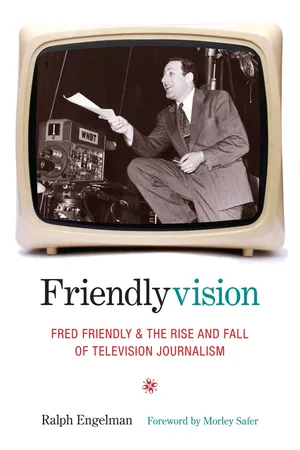
Fred Friendly (1915-1998) was the single most important personality in news and public affairs programming during the first four decades of American television. Portrayed by George Clooney in the film Good Night and Good Luck, Friendly, together with Edward R. Murrow, invented the television documentary format and subsequently oversaw the birth of public television. Juggling the roles of producer, policy maker, and teacher, Friendly had an unprecedented impact on the development of CBS in its heyday, wielded extensive influence at the Ford Foundation under the presidency of McGeorge Bundy, and trained a generation of journalists at Columbia University during a tumultuous period of student revolt.
Ralph Engelman's biography is the first comprehensive account of Friendly's life and work. Known as a "brilliant monster," Friendly stood at the center of television's unique response to McCarthyism, Watergate, and the Vietnam War, and the pitched battles he fought continue to resonate in the troubled world of television news. Engelman's fascinating psychological portrait explores the sources of Friendly's legendary rage and his extraordinary achievement. Drawing on private papers and interviews with colleagues, family members, and friends, Friendlyvision is the definitive story of broadcast journalism's infamous "wild man," providing a crucial perspective on the past and future character of American journalism.
eBook - ePub
Friendlyvision
Fred Friendly and the Rise and Fall of Television Journalism
- English
- ePUB (mobile friendly)
- Available on iOS & Android
eBook - ePub
About this book
Trusted by 375,005 students
Access to over 1.5 million titles for a fair monthly price.
Study more efficiently using our study tools.
Information
Subtopic
North American HistoryIndex
History1 Ferd
FRED W. FRIENDLY CAME from a line of German Jews who were salesmen and merchants. His formative years offered hints—significant hints in retrospect but still only hints—of the man he would become. And until his early twenties he was not yet even named Fred Friendly but Ferdinand F. Wachenheimer.
His father, Samuel Wachenheimer, was the son of a locksmith who had raised his family in the East Sixties in Manhattan when the neighborhood was home to many families of German origin. Samuel was the traveling salesman for Wachenheimer Brothers, a jewelry company he owned with his two brothers. The firm made Art Deco silver jewelry with semiprecious stones. The gregarious, cigar-smoking Samuel Wachenheimer, a member of the Far Western Traveling Men’s Association, journeyed widely in the United States. On one of his trips out west, he met Samson Hiram Friendly, a wealthy and influential entrepreneur in Eugene, Oregon, who invited Sam to dinner—presumably to meet his daughter Therese, who was then in her early thirties. A lengthy correspondence and courtship preceded their marriage.1 The announcement of their engagement in a local newspaper described Therese as “an attractive brunette,” noting that “her friends are legion in Portland, San Francisco and Los Angeles where she has passed much of her time since finishing school.” Rabbi Jonah B. Wise officiated at their marriage, which took place on October 14, 1913, at the Hotel Osburn in Eugene. The newspaper story referred to Therese as a “prominent society girl of Eugene.” Her wedding was attended by “a representative group of Eugene’s old families, with a goodly number of guests from Portland and elsewhere.” The paper reported that following their honeymoon, the couple would make a tour of the United States while traveling east and planned to establish their residence at 248 West 113th Street in Manhattan.2
Therese was the last of the three Friendly sisters to wed; her husband occupied a step below her on the social ladder. Friendly would later describe his father as a “lower middle-class businessman.” Samuel Wachenheimer and his bride lived in the Morningside Heights section of Manhattan, first at on 113th Street and then on 110th Street. Their only child, Ferdinand Friendly Wachenheimer—he was called Ferd or Ferdie as a child—was born on October 30, 1915. The physically diminutive mother—she was less than five feet tall—produced an imposing baby of nine pounds. According to an album she kept, when he was eight Ferd began attending the Social Motine School on 114th Street in Manhattan and Camp Winslow in the summer. Therese recorded that he adored camp life, especially sports, and won a prize for proficiency in track and basketball. She noted that ten-year-old Ferd broke a finger playing baseball in Riverside Park. He was an avid baseball fan and an admirer of the great Jewish slugger Hank Greenberg. David Schoenbrun, Friendly’s colleague at CBS, describes Friendly as “a product of the sidewalks of New York, a tough, ambitious, streetwise fighter.” Schoenbrun was born the year as Friendly and in the same neighborhood, which Schoenbrun describes as German-Jewish Harlem, on the border of Italian and Irish Harlem: “Just trying to get to school safely through roving street gangs was a daily adventure.”3
A happy childhood memory involved five-year-old Ferd’s first exposure to radio in the early days of broadcasting. He remembered that his father came home one day and said, “ ‘There is a new invention, Ferdinand. It’s called a radiator.’ He must have said a radio, but I thought a radiator because I have never heard the word before.”4 Samuel told his son they would build a radio receiver so that they could listen to a live ringside broadcast of the Jack Dempsey–Georges Carpentier heavyweight championship fight scheduled to take place on July 2, 1921. The broadcast was organized by the pioneering Westinghouse radio station KDKA in Pittsburgh together with the National Amateur Wireless Association.5 At the time no radio stations were broadcasting to the general public in the New York area, nor were any ready-to-use radio receivers on the market. The organizers of this highly publicized experiment encouraged amateur operators to build receivers and invite listeners into their homes or into public theaters and halls across the country. Samuel and Ferd assembled a crystal radio set with a copper coil known as a cat’s whisker and subsequently listened, each with one earphone, to the broadcast of the fight in which Dempsey knocked Carpentier out in the fourth round. It is estimated that 200,000 people heard the broadcast, significantly more than the approximately 1,000 people who eight months earlier had heard KDKA’s historic broadcast of the returns of the 1920 presidential election. The broadcast of the fight was a landmark in generating interest in radio. As the broadcast historian Susan Douglas has written, Ferd and his father had partaken of a special male ritual of the period: “It was men and boys who brought this device into the home, and tinkering with it allowed them to assert new forms of masculine mastery while entering a realm of invisibility where certain pressures about manhood could be avoided.”6
When Ferd was ten, in the fall of 1926, the Wachenheimer clan moved to Providence, Rhode Island, where the company’s jewelry factory was located. Less than a year after the move, Samuel Wachenheimer returned in apparent good health from a business trip out west but by nightfall was taken to a hospital with a severe case of meningitis. He died two days later, on June 6, 1927, at the age of forty-seven; Ferd was eleven. For a period afterward, Ferd imagined catching a glimpse of the back of his father’s head at train stations and other public places. Therese never remarried and raised Ferd on her own. When Ferd was three, Sam had written to Therese that, in case of his death, his brother Harry would look out for her interest and make sure she received his share of their business. “Have my darling Ferdinand . . . know that Daddy always loved him,” he continued. “If I have had any shortcomings please overlook them. I have always idolized you and may God bless you.”7
Therese’s father, Samson Hiram Friendly, a major figure in the early history of Eugene, Oregon, made an enduring impression on Ferd, although he was only six when his grandfather died. He was born Samson Hiram Freundlich in 1840, the offspring of Bavarian German Jews named Freundlich. In 1865 he settled in Eugene, then a backwater town. He made his mark on his adopted city as entrepreneur, public official, and philanthropist. The motto of this small, inordinately energetic man was “I lead but never follow.” By the end of his career, he was of one of Eugene’s leading citizens, a remarkable achievement for a Jew on the frontier in the decades following the Civil War. Friendly’s general store sold dry goods and clothing and shipped local products like hops, wool, and wheat to other regions. He also owned valuable real estate in Eugene and Portland, including timber and farmlands.8 He became involved in civic affairs as a Republican, serving as vice president of the Eugene board of trade and two terms as a city council member. In 1893 he was elected mayor of Eugene. He was a leader in the campaign to get a state university established in Eugene and served for twenty years as a member of its board of regents. His daughter Therese—Fred Friendly’s mother—became one of the school’s first female graduates. When S. H. Friendly died in 1921, fifteen hundred people attended a memorial service funeral on campus. The university named its first dormitory, Friendly Hall, in his memory.
S. H. Friendly was an exemplar of a successful, assimilated Jew in the American West in the late nineteenth and early twentieth century. While proud of his heritage, he relegated his participation in Jewish ritual to his private life. Lengthy obituaries in Oregon’s leading newspapers made scant, if any, mention of his religion. Friendly chose to be buried in his beloved Eugene rather than in the consecrated soil of the Portland synagogue. Nonetheless, in a letter to Therese, Rabbi Stephen S. Wise of the Free Synagogue of New York stressed “how much he did to bring honor to the name of his people in Eugene and throughout Oregon.”9 Fred Friendly would later pay tribute to the memory of his maternal grandfather in his home in the Riverdale section of the Bronx. An old top hat, exhibited under a glass dome, adorned a table visible from the living room. The label inside the hat read, “Moyere, Imported from Paris, S. H. Friendly, Eugene, Oregon.” Behind the display hung a photograph of the merchant in front of his general store.
Therese Wachenheimer, born in 1878 as the middle of three daughters, grew up in a Gentile milieu. The sisters learned no Yiddish and attended Christian Endeavor social meetings when they were young. As teenagers, Therese and her sisters, unlike the children of more observant Jewish families, also attended the Sweet Sixteen parties of their Gentile classmates. Therese was graduated in 1898 with a bachelor of science degree from the University of Oregon, where she studied Latin, Greek, German, economics, and philosophy. She excelled in calculus and chemistry and played on the women’s basketball team. By all accounts, Therese was an extremely confident and highly educated woman. Soon after her husband’s death, she and Ferd moved to a two-family home at 395 Lloyd Avenue; it was located in a middle-class neighborhood of Jews and Gentiles on the more affluent east side of Providence, not far from Brown University. The house was owned by the Fisher family, which also occupied the dwelling. Rent was several hundred dollars a month. Zelda Fisher, daughter of the owners, recalled that Therese “was not a wealthy woman, but she was financially comfortable. She lived well, she ate well, but she was careful, she wasn’t a spendthrift.”10 The Wachenheimer Brothers jewelry company went out of business during the Depression, but Therese received monthly checks from her sister Rosalie, who had married a successful stockbroker.11
Like her father, Therese was short—four feet, ten inches tall. Although she was hard of hearing and had a heart ailment, she was a highly energetic woman with an active life in community affairs. She maintained a high standard in her personal appearance and household. She dressed fashionably: a milliner, for example, designed her hats. A French-Canadian woman kept house during the day. Zelda, the landlord’s daughter, remembered Therese as a “very very proper lady.” If Therese Friendly Wachenheimer never had a paying job, “she was no hausfrau,” according to Ruth Harris, a boarder in the early 1940s who became part of the Wachenheimer extended family. Therese was a voracious reader with great interest in American history and national and international affairs; she retired every night with a Bible and a copy of the day’s New York Times. As a result of her activity in religious and civic organizations, Therese made a mark both within and beyond Jewish society in Providence.12
Therese belonged to a group of German-Jewish families for which the congregation of Temple Beth El functioned as a center of religious and especially social activity. The synagogue served the more prosperous and assimilated Jews of Providence, many of German origin, whereas the religiously conservative Temple Emmanuel had more members of Eastern European origin. In this period, Temple Beth El was the stridently Reform temple of Providence: its members referred to their rabbi as a minister, did not wear yarmulkes, and substituted confirmation for bar and bas mitzvahs. William Gordon Braude, a distinguished Talmudic scholar from Lithuania who in 1932 was named rabbi at Beth El, became a significant presence in Therese’s life and that of her son. Ferd was seventeen and sitting in the fifth row at Beth El during the High Holy Days, when he first laid eyes on the twenty-five-year-old Braude. He soon impressed the congregation—and Ferd—with his learning and his dramatic flair. The spirit of tolerance and cosmopolitanism that Braude brought to his Providence rabbinate was reflected in an address he gave in 1955 at the tercentenary service of the Rhode Island Council of Churches, held at the city’s First Baptist Church. He hailed the legacy of Roger Williams (who held the charter that created the colony of Rhode Island) and the multicultural makeup of Providence, detailing the contributions of the Yankees, Jews, Italians, Portuguese, Irish, and Armenians. “I love the people making up the many races of this city,” Braude said. “I love the promise of their vigor and imagination.”13
In addition to joining the Beth El Sisterhood, Therese participated in Jewish affairs on the state and national levels. She was actively involved with Hadassah as well as with the Rhode Island League of Jewish Women and the state section of the National Council of Jewish Women. She was a member of the Conference of Jews and Christians, and the American Hebrew named her in 1934 to an honor roll of 150 American Jews who had made a significant contribution to U.S. society. Therese did not limit her interests and activities to Jewish affairs. “She was a liberal Democrat, rabidly antiwar,” according to Ruth Harris.14 Therese was an active member of Rhode Island’s League of Women Voters, Federation of Women’s Clubs, and World Affairs Council. “It was unusual,” Harris emphasized, “for Jewish women of that day to be so outspoken and to participate so actively in non-Jewish organizations.”15 Therese worked closely with the legendary Rhode Island social reformer and pacifist Alice Hunt, a direct descendant of Roger Williams. Hunt was once described as “armed with an iron will and the money and status to support her endeavors.” As a result of her crusades, Rhode Island enacted the forty-eight-hour workweek and minimum wage laws, abolished child labor and sweatshops, and established a juvenile justice system and a division of women in the state department of labor. Hunt set up the Rhode Island chapter of the League of Women Voters and was one of the founders of the Rhode Island Committee on the Cause and Cure of War. Alice Hunt often met with Therese at her home on Lloyd Avenue.16
Therese’s support of the League of Nations and antiwar activity earned her the nickname “Peace Wachenheimer.” She became a driving force in the Committee on the Cause and Cure of War and organized the antiwar mass meetings held annually in Providence on Armistice Day during the early 1930s—a project she considered her greatest achievement. In recognition of her peace activity Therese received an invitation to attend the ratification of the Kellogg-Briand Pact of 1928, the agreement outlawing war as an instrument of foreign policy that was signed by sixty-two nations. “Ferd absorbed Therese’s concern for the world,” recalled Martha Kaplan, a childhood friend of Ferd’s.17 Therese Wachenheimer was a liberal, not a radical. Her reform activity was in keeping with her status as S. H. Friendly’s daughter, with her standing as a proper upper-middle-class Jewish woman of German origin. Secure in her Jewish identity yet at home in the Gentile world, she did not have the sensibility of an outsider in U.S. society. As such, Therese’s civic engagement—and subsequently that of her son—differed from that of the Jews of eastern European origin who grew up in the urban ghettos of America, which Irving Howe later evoked in World of Our Fathers. The political sensibility of these Jews was shaped to a greater degree by poverty, violent labor struggles and ideologies of radical social transformation. Ferd grew up observing and absorbing what Kaplan characterized as his mother’s ardent yet genteel activism.
In addition to her involvement in community affairs, Therese was a worried and overwhelmed single parent. According to Ferd’s cousin Carolene Wachenheimer, Therese the society woman “was left raising a son without a clear idea how to do so.” As a child, Ferd seemed bedeviled by a host of physical and learning problems. He did not have a father to ease the transition from adolescence to adulthood. Ferd was tall for his age and physically awkward. Once, during a visit to his grandparents in Oregon, he made two trips to buy a bottle of milk; each time, he dropped and broke the bottles and was chastised as a dummkopf. He also suffered from color blindness and developed a stutter. Moreover, he was dyslexic. Ferd’s difficulty in learning to read first became apparent in elementary school in New York City. Only later in life would Friendly understand that dyslexia caused the problems that plagued his formal education. In those days children with learning disabilities were misunderstood, usually chastised as slow and undisciplined—undoubtedly a source of great frustration for a bright child like Ferd. Friendly’s widow, Ruth Mark Friendly, suggested that “his dyslexia, to a large extent, made Fred the man he was”—in the sense that it propelled his legendary temper and ambition.18
Ferd also had difficulty with spelling and penmanship, important parts of the elementary school curriculum of the day. He could write only block letters. Math rem...
Table of contents
- Cover
- Half title
- Title
- Copyright
- Contents
- Foreword
- Acknowledgments
- Prologue: Salesman
- Introduction
- 1: Ferd
- 2: “My Rhodes Scholarship”
- 3: “Willing to Be Lucky”
- 4: See It Now
- 5: Friendly and Murrow
- 6: Encounter with McCarthyism
- 7: Aftermath
- 8: CBS Reports
- 9: Camelot
- 10: News President
- 11: At the Top of His Game
- 12: Vietnam
- Illustrations
- 13: Resignation
- 14: Policy Maker
- 15: Professor
- 16: PBL
- 17: PBS
- 18: The Press and the Bar
- 19: Seminar
- 20: Last Years
- 21: Friendlyvision
- Notes
- Index
Frequently asked questions
Yes, you can cancel anytime from the Subscription tab in your account settings on the Perlego website. Your subscription will stay active until the end of your current billing period. Learn how to cancel your subscription
No, books cannot be downloaded as external files, such as PDFs, for use outside of Perlego. However, you can download books within the Perlego app for offline reading on mobile or tablet. Learn how to download books offline
Perlego offers two plans: Essential and Complete
- Essential is ideal for learners and professionals who enjoy exploring a wide range of subjects. Access the Essential Library with 800,000+ trusted titles and best-sellers across business, personal growth, and the humanities. Includes unlimited reading time and Standard Read Aloud voice.
- Complete: Perfect for advanced learners and researchers needing full, unrestricted access. Unlock 1.5M+ books across hundreds of subjects, including academic and specialized titles. The Complete Plan also includes advanced features like Premium Read Aloud and Research Assistant.
We are an online textbook subscription service, where you can get access to an entire online library for less than the price of a single book per month. With over 1.5 million books across 990+ topics, we’ve got you covered! Learn about our mission
Look out for the read-aloud symbol on your next book to see if you can listen to it. The read-aloud tool reads text aloud for you, highlighting the text as it is being read. You can pause it, speed it up and slow it down. Learn more about Read Aloud
Yes! You can use the Perlego app on both iOS and Android devices to read anytime, anywhere — even offline. Perfect for commutes or when you’re on the go.
Please note we cannot support devices running on iOS 13 and Android 7 or earlier. Learn more about using the app
Please note we cannot support devices running on iOS 13 and Android 7 or earlier. Learn more about using the app
Yes, you can access Friendlyvision by Ralph Engelman in PDF and/or ePUB format, as well as other popular books in History & North American History. We have over 1.5 million books available in our catalogue for you to explore.