Religious concerns stand at the center of international politics, yet key paradigms in international relations, namely realism, liberalism, and constructivism, barely consider religion in their analysis of political subjects. The essays in this collection rectify this. Authored by leading scholars, they introduce models that integrate religion into the study of international politics and connect religion to a rising form of populist politics in the developing world.
Contributors identify religion as pervasive and distinctive, forcing a reframing of international relations theory that reinterprets traditional paradigms. One essay draws on both realism and constructivism in the examination of religious discourse and transnational networks. Another positions secularism not as the opposite of religion but as a comparable type of worldview drawing on and competing with religious ideas. With the secular state's perceived failure to address popular needs, religion has become a banner for movements that demand a more responsive government. The contributors to this volume recognize this trend and propose structural and theoretical innovations for future advances in the discipline.
- English
- ePUB (mobile friendly)
- Available on iOS & Android
eBook - ePub
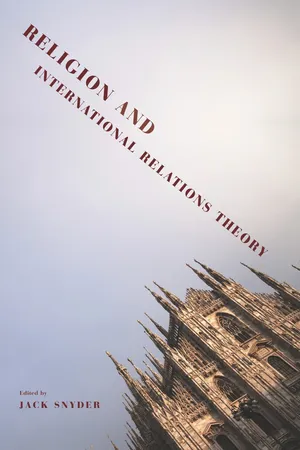
Religion and International Relations Theory
About this book
Trusted by 375,005 students
Access to over 1.5 million titles for a fair monthly price.
Study more efficiently using our study tools.
Information
1. INTRODUCTION
Since September 11, 2001, religion has become a central topic in discussions about international politics. Once Islamic terrorism put religion in the international spotlight, this realm suddenly seemed to teem with lively issues: the foreign policy predilections of the Christian Right for Israel and Southern Sudan, the complications of faith-based Western activism abroad, the Dalai Lama and Falun Gong as potential destabilizers of officially atheist but increasingly neo-Confucian Chin a, and the Myanmar military regime’s fear of a potential alliance of Burmese monks and international refugee organizations. Perhaps religious international politics had been there all along, but it suddenly became harder to ignore.
And yet the main canonical works of international relations theory, which continue to shape much empirical academic work, hardly mention religion. A handful of new works, most of them by the contributors to this volume, have begun to show how international relations scholarship can be turned to face this new issue, but most commentary about religion and international affairs remains in the realm of current events talk, area studies, or comparative domestic politics.1
One reason for this neglect is that mainstream international relations scholars find it difficult to integrate religious subject matter into their normal conceptual frameworks. The foundational statements of the three leading paradigms—by Kenneth Waltz for realism, Michael Doyle and Robert Keohane for liberalism, and Alexander Wendt for constructivism—offer no explicit guidance on how to do this, and in some cases imply that a role for religion may not be allowable within the logics of their paradigms. Realists ask, “How many divisions has the Pope?” Liberals tend to accept the secular modernist presumption that religion is an atavism to be superseded. Constructivism, with the central role it gives to identity, norms, and culture, has provided more natural intellectual terrain on which to integrate religion into international relations theory, and yet the index of Wendt’s field-defining book does not have a single entry for religion.2
How then should international relations scholars conceptualize the role of religion in their work? Four approaches merit particular consideration. The first involves working within the traditional paradigms, exploring the ways in which religion has sometimes decisively shaped the states system, defined its constitutive units, and animated their interests and outlooks. I elaborate on this approach below.
A second approach, most nearly represented by Samuel Huntington’s “clash of civilizations” thesis, holds that religion has become so central that it should supplant existing paradigms and become the main prism for thinking about international politics. None of the contributors to this volume take this view.3
However, they do argue that the role of religion in international politics has never been small and has been growing in recent decades as a form of populist politics in the developing world following the discrediting of secular political ideologies. Several contributors, especially Elizabeth Hurd, also argue that secularism can usefully be conceived not as the opposite of religion but as a comparable type of worldview that draws on and competes with religious views.4 Seen in this light, the subject of religion is sufficiently pervasive and distinctive that it requires adjusting our basic conceptual lenses to view international relations more broadly, while not abandoning insights from the traditional paradigms. An example of this third approach is Daniel Nexon’s call for a “relational-institutional” theory that draws on both realism and constructivism in thinking about the competitive interplay of discursive frames and transnational networks in an anarchical setting.5
Finally, a fourth approach sidesteps paradigmatic commitments to look at more focused hypotheses in which religion is a causal variable. For example, Monica Toft’s chapter in this volume examines how the characteristics of different religions affect the likelihood of war.
Whichever of these approaches is adopted, international relations specialists working on religion would do well to pay attention to the potential contributions of scholarship on comparative political development. Several of the contributors to this volume argue that the prime cause of the global resurgence of religion in politics is the rising demand for mass political participation. In the face of a perceived failure of the secular state to address popular needs, especially in the developing world, religion has become a banner for movements demanding more responsive government, whose effects have dramatically spilled over into international politics.
I will begin with a discussion of what is distinctive about religious subject matter in international relations and its implications for the kinds of theories and methods that are needed to study it. Then I will discuss the role that the paradigms, both traditional and innovative, might play in studying religion in international politics. Emily Bech and I will revisit the theme of rising demand for mass political participation in the concluding chapter.
RELIGION AND POLITICS: IMPLICATIONS FOR CONCEPTS AND METHODS
Religion is one of the basic forces of the social universe, not just an “omitted variable.” Religions have special potential for engendering system-wide change because they transcend unit boundaries, have implications for the full range of society’s institutions and ideas, and compellingly motivate individuals who are in their thrall. It is not an accident that the origin of the sovereign states system was catalyzed by a religious upheaval, the Protestant Reformation. This raises the possibility that comparable new upheavals could once again produce far-reaching changes in the international system.6
Religion has distinctive features that fit uncomfortably within the concepts that are conventionally deployed to study international politics. Monica Toft’s chapter usefully defines religion as a system of practices and beliefs that includes most of the following elements: belief in a supernatural being, prayers, transcendent realities such as heaven or enlightenment, a distinction between the sacred and the profane, a view of the world and humanity’s relation to it, a code of conduct, and “a temporal community bound by its adherence to these elements.”7 Daniel Philpott and Timothy Shah point out that religion is older than the state, and its aims encompass not just politics but all of life. Religious actors in politics may support the state, work for their own ends through the state, or radically challenge states and the state system. Religion is often transnational, they note, but its ambit is far broader than that of single-issue transnational activist networks.8 Like nationalism, Toft says, religion is an imagined community that rationalizes self-sacrifice across space and time, but unlike nationalism, religion holds out the prospect of individual salvation and is less tied to territory. Religious norms set standards of appropriate behavior, as do norms that originate from non-religious sources, but as Toft’s chapter on war shows, norms with divine authority may produce different kinds of commitment. For these reasons, a conventional theoretical tool kit that is limited to the mundane politics of states and nations may struggle to comprehend the role of religion in international relations.
Though broader than politics, let alone international politics, religion has implications for virtually every basic concept in those fields. Religion may affect, for example, who the actors in world politics are, what they want, what resources they bring to the tasks of mobilizing support and making allies, and what rules they follow. Religion may shore up the state-centered international order as it is conventionally understood and help to explain it, but it may also work at cross-purposes to that order. Religion helped to forge the system of sovereign states, yet cuts across it. Religion can help to legitimate state authority, yet may also undermine it. Religion may help to delimit the territorial boundaries of a state, yet also creates loyalties and networks that cross boundaries. Religion may reinforce ethnonational identity, bridge the gap between national identities, or divide a nation. Religion may facilitate otherwise improbable coalitions or wreck otherwise obvious ones. Religion may affect politics by shaping its organizational and network structures and by affecting its values and motives.
Some of these diverse and pervasive effects of religion might be grasped within conventional frameworks for studying international politics, but the contributors to this volume warn that a too literal application of routine methods can yield cartoonish, distorted interpretations. Religion straddles our usual methodological divides. It plays a role in constituting actors and systems of action, and it also constrains or enables actors’ behavior. Religious actors can be strategic and calculating, and at the same time influenced in politics by their conception of the divine and the sacred. Conventional power calculations and religious purpose may simultaneously play a role in judgments about alliance and enmity.9 Whichever approach a scholar chooses to conceptualize religion’s place in international politics, it needs to be fully sensitive to these distinctive characteristics.
RELIGION AND PARADIGMS OF INTERNATIONAL RELATIONS
Religion has unquestionably been among the most fundamental phenomena structuring human relations throughout history, so it is reasonable to ask whether religion itself might serve as a point of departure for a new paradigm of international relations. The category of religion, especially if it is defined to encompass the varieties of secularism (as some authors do in this volume), is more broadly applicable across time and space than liberalism. At the same time, it has more empirical content than the primarily ontological category of constructivism. Both points speak in favor of religion’s utility as a substantively interesting, wide-angle prism for theorizing about international relations. Despite this, religion per se cannot succeed as the core of such a paradigm.
The attempt that comes closest to enthroning religion as the central category for understanding international relations is Samuel Huntington’s thesis of a clash of civilizations.10 Huntington defines the fault lines of civilizations substantially in religious terms and argues that these boundaries will mark the main lines of contention in international relations in the coming era. Arguably, his views constitute a paradigm, one that is no more time-bound than liberalism.
The problem, though, is empirical. Huntington himself admits that lines of conflict and cleavage are typically more intense between political and cultural groups within civilizations (states and nations) than they are between civilizations. States, which are organizations that seek to monopolize violence and make public rules within a specific territory, have for some centuries shown themselves to be the indispensable units for organizing security and public administration. Recently, scholars and public commentators have debated whether globalization and other transnational processes, including religious ones, are altering the dominant position of the state in the international system. The predominant view in this debate is that, while transnational actors and processes may now loom larger in states’ calculations and in shaping the environment in which states act, states continue to “set the basic rules and define the environment within which transnationals must function,” as Stephen Krasner has argued.11 Most of our contributors proceed from this assumption.
Nations, whether based on ethnicity or on common historical and institutional experiences, are the cultural units that link people to states. Religions, in contrast, are cultural units that are typically mismatched with states because they are usually nonterritorial, often too large in scale, normally lacking congruity with the boundaries of a state, and ideologically aimed at goals other than state sovereignty. Religion may matter a great deal for some processes and outcomes in world politics, but as long as nation-states are the main units of territorial security and administration, religions will exert an effect on world politics mainly through the preferences, power, perceptions, and policies of states and state-seeking nations. Huntington’s clash of civilizations thesis, like any paradigm of world politics that centers on religion, is empirically unsatisfying for that reason.
A more productive approach would be to explore the ways in which religion may constitute and influence the state in world politics. Religion has shaped the formation of the state system, sometimes informing the cultural self-conception that makes a nation distinctive, influencing what nation-states want, and generating subnational and transnational actors that occupy part of the landscape in which states operate. In these ways, religion shapes processes that are close to the core of existing international relations paradigms that have the state as their basic unit.
Consequently, it will be worthwhile to consider how religion can be integrated into these existing paradigms without violating their essential assumptions. In developing scientific theories, there are moments when an effective strategy requires keeping the core assumptions of the theory few in number and ...
Table of contents
- Cover
- Half title
- Series Page
- Title
- Copyright
- Contents
- 1: Introduction
- 2: The Fall and Rise of Religion in International Relations: History and Theory
- 3: Secularism and International Relations Theory
- 4: Another Great Awakening? International Relations Theory and Religion
- 5: Religion, Rationality, and Violence
- 6: Religion and International Relations: No Leap of Faith Required
- 7: In the Service of State and Nation: Religion in East Asia
- 8: Conclusion: Religion’s Contribution to International Relations Theory
- List of Contributors
- Index
Frequently asked questions
Yes, you can cancel anytime from the Subscription tab in your account settings on the Perlego website. Your subscription will stay active until the end of your current billing period. Learn how to cancel your subscription
No, books cannot be downloaded as external files, such as PDFs, for use outside of Perlego. However, you can download books within the Perlego app for offline reading on mobile or tablet. Learn how to download books offline
Perlego offers two plans: Essential and Complete
- Essential is ideal for learners and professionals who enjoy exploring a wide range of subjects. Access the Essential Library with 800,000+ trusted titles and best-sellers across business, personal growth, and the humanities. Includes unlimited reading time and Standard Read Aloud voice.
- Complete: Perfect for advanced learners and researchers needing full, unrestricted access. Unlock 1.5M+ books across hundreds of subjects, including academic and specialized titles. The Complete Plan also includes advanced features like Premium Read Aloud and Research Assistant.
We are an online textbook subscription service, where you can get access to an entire online library for less than the price of a single book per month. With over 1.5 million books across 990+ topics, we’ve got you covered! Learn about our mission
Look out for the read-aloud symbol on your next book to see if you can listen to it. The read-aloud tool reads text aloud for you, highlighting the text as it is being read. You can pause it, speed it up and slow it down. Learn more about Read Aloud
Yes! You can use the Perlego app on both iOS and Android devices to read anytime, anywhere — even offline. Perfect for commutes or when you’re on the go.
Please note we cannot support devices running on iOS 13 and Android 7 or earlier. Learn more about using the app
Please note we cannot support devices running on iOS 13 and Android 7 or earlier. Learn more about using the app
Yes, you can access Religion and International Relations Theory by Jack Snyder in PDF and/or ePUB format, as well as other popular books in Politics & International Relations & International Relations. We have over 1.5 million books available in our catalogue for you to explore.