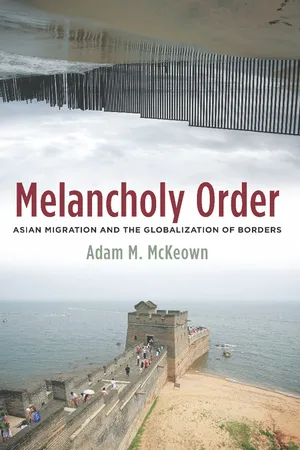
As Adam M. McKeown demonstrates, the push for increased border control and identity documentation is the continuation of more than 150 years of globalization. Not only are modern passports and national borders inseparable from the rise of global mobility, but they are also tied to the emergence of individuals and nations as the primary sites of global power and identity.
McKeown's detailed history traces how, rather than being a legacy of "traditional" forms of sovereignty, practices of border control historically rose from attempts to control Asian migration around the Pacific in the 1880s. New policies to control mobility had to be justified in the context of contemporary liberal ideas of freedom and mobility, generating principles that are taken for granted today, such as the belief that migration control is a sovereign right of receiving nations and that it should occur at a country's borders.
McKeown shows how the enforcement of these border controls required migrants to be extracted from social networks of identity and reconstructed as isolated individuals within centralized filing systems. Methods for excluding Asians from full participation in the "family of civilized nations" are now the norm between all nations. These practices also helped institutionalize global cultural and economic divisions, such as East/West and First and Third World designations, which continue to shape our understanding.
Many aver that the story confers no right on anyone to pass judgment on the doorkeeper. Whatever he may seem to us, he is yet a servant of the Law; that is, he belongs to the law and as such is beyond human judgment.
There also exists an interpretation which claims that the deluded person is really the doorkeeper.... The argument is that he does not know the law from inside, he knows only the way that leads to it, where he patrols up and down. His ideas of the interior are assumed to be childish, and it is supposed that he himself is afraid of the other guardians whom he holds up as bogies before the man. Indeed, he fears them more than the man does, since the man is determined to enter after hearing about the dreadful guardians of the interior.
He is deceived also about his relation to the man from the country, for he is inferior to the man and does not know it. In the first place, a bondman is always subject to a free man. Now the man from the country is really free, he can go where he likes, it is only the Law that is closed to him, and access to the Law is forbidden him only by one individual, the doorkeeper. When he sits down on the stool by the side of the door and stays there for the rest of his life, he does it of his own free will; in the story there is no mention of any compulsion. But the doorkeeper is bound to his post by his very office, he does not dare go out into the country, nor apparently may he go into the interior of the Law, even should he wish to.
—Kafka, The Trial
1 Consolidating Identities, Sixteenth to Nineteenth Centuries
Passports and the regulation of human mobility are nothing new in world history. State and nonstate institutions have compelled, promoted, and hindered movement on the basis of language, culture, occupation, status, wealth, family, property, race, religion, or any number of other qualities since at least the beginning of written records. Contemporary methods of control were built on these historical practices. But since the eighteenth century, the great heterogeneity of past techniques and identities has been distilled into two fundamental principles: the individual and the nation. Other categories of control have persisted, especially health, family, wealth, occupation, race, and political orientation. But unlike nationality and the individual, they are constantly challenged and debated, with critics and defenders alike appealing to individual rights and national interest as both the sources and the objects of better regulation.
Changes in the regulation of mobility are apparent in the very sources used to measure migration. Before the nineteenth century, regulations were designed, among other things, to protect trade and occupational privileges, control labor, collect taxes, limit access to local communal property, defend private property, distinguish between classes, and monitor vagrants, bandits, and other subversives. Knowledge of that migration comes from bills of lading, indenture contracts, trading licenses, town registration rolls, genealogies, shipping rosters, corvée rosters, deportation records, vagrancy arrests, safe-passages, and letters of recommendation. By the middle of the nineteenth century, migrants were counted almost entirely as a consequence of crossing state borders and encountering national governments. Migration statistics were generated by government officials at transportation hubs who counted individuals and fitted them to predetermined categories of nationality, health, occupation, and race. These statistics and files continued to serve many of the purposes of earlier controls, but access to rights and privileges increasingly revolved around the single issue of the conditions under which individuals crossed national borders and were recorded into these databases. The diverse and complex range of communal, relational, and networked identities were rendered increasingly irrelevant.
The simplification of mobility regulation after the mid-nineteenth century took place in the context of two developments: the centralization of state power and emergent ideals of free mobility. National states and the institutions of freedom found common cause in the attack on local powers, corporate privileges, and the private organization of labor through slavery, indenture, and master-servant laws. The liberation of the individual migrant firmly relocated the migrant under the jurisdiction of public rather than private institutions. Even as old forms of control were finally dismantled around the Atlantic by the 1860s, new ones were constructed, such as medical exams at the border, surveillance of transportation agents, the citizen-alien distinction, and racial exclusions, all of which had to be formulated and justified in the name of preserving freedoms. This gradual process is best described not in terms of intensification or reduction of surveillance but in terms of transformations in the methods of control and identification. Overlapping jurisdictions, corporate privileges, and the extension of personal protection were replaced by territorial borders and the citizen-alien distinction as the main sites of regulation, all grounded in the twin languages of individual freedom and national interest.
Migration in the Law of Nations
Before the nineteenth century, European writings on the law of nations grounded discussions of human mobility in concerns over the proper relationships between the rights of the free individual and the national community. Some of the strongest statements on the need for states to respect the natural right of free mobility were produced in the sixteenth century. Over time, these were qualified with more nuanced discussions of the exercise of natural rights made possible by the existence of a stable political community, and of the acceptable limits of policing that community against unconstrained mobility. By the end of the eighteenth century, the need for state self-preservation had largely superseded the rights of mobility and duties of hospitality. These principles, however, only had a tenuous relationship with actual practices of mobility and control. They were more an account of how things should be than of how they were. But many of the specific formulations that justified both free movement and control proved quite enduring, far beyond the context that produced them. By the mid-nineteenth century, the phraseology of the law of nations pervaded diplomatic and legal relations around the world, even as the original reasoning behind them was forgotten or rejected.
A burst of learned assertions about the natural rights of free movement and trade accompanied European expansion into Asia and the Americas in the sixteenth century. Francisco de Vitoria’s 1539 critique of Spanish conquests in the Americas contained one of the most influential assertions ever of a fundamental right of free movement and commerce that existed prior to the laws of man. He began by insisting that the Indians had true dominion over themselves much like any European nation, and that the Spanish had no right to make war on them merely because they were barbarians, unbelievers, and sinners. On the other hand, the Spanish did have a just cause for war if the Indians refused the Spaniards’ right to travel and dwell peacefully among them. These rights were an aspect of divine law, as Vitoria demonstrated through scriptural passages that enjoined men to treat strangers with hospitality. They also had precedents in human law and custom, as demonstrated by existing practices of free mobility between France and Spain and between barbarian nations. Vitoria framed the bulk of his argument, however, in terms of natural law. This meant that the right of free mobility was rooted in (1) reasoning about that which was of greatest benefit to all mankind, leading to the conclusion that it was “inhuman to treat strangers and travelers badly without some special cause”; (2) the fundamental idea that all things not harmful or detrimental to others are lawful; and (3) the natural freedom of man at the beginning of the world, from which it could be derived that, “When all things were held in common, everyone was allowed to visit and travel through any land he wished. This right was clearly not taken away by the division of property.” Any human enactment that barred the peaceful enjoyment of this natural right “would be inhumane and unreasonable, and therefore without force of law.”1
In his 1588 work, On Nature in the New World, Spanish scholar José de Acosta extended this same logic to China. He wrote that the Chinese death penalty for foreigners entering without royal orders was unfair and inhuman, adding that “nothing is more deeply engraved in human nature than the love for learning and the right to experience new things.”2 And in 1608 Dutch lawyer Hugo Grotius began his Freedom of the Seas, a polemic against Portuguese claims to exclusive rights over the Indian Ocean trade, with an assertion that the right of free trade and travel was a “most specific and unimpeachable axiom of the Law of Nations... the spirit of which is self-evident and immutable.” This axiom could be empirically observed in God’s work:
God Himself says this spellbind through the voice of nature; and inasmuch as it is not His will to have Nature supply every place with all the necessaries of life, He ordains that some nations excel in one art and others in another. Why is this his will, except it be that He wished human friendships to be engendered by mutual needs and resources, lest individuals deeming themselves entirely sufficient unto themselves should for that very reason be rendered unsociable.3
These declarations of the inalienable right of free mobility were mostly written as challenges from expansive new polities against previously established powers and claims. Over the next two centuries, as the law of nations grew more concerned with international relations in Europe, it focused more on the creation of a stable political community as the source of human wellbeing. Assertions of the natural rights of mobility were increasingly qualified by an overriding concern with allegiance and the mutual obligations of individuals and states. The prestige of the natural law tradition continued to grow, but the conditions found in a hypothetical state of nature became less relevant than the need for self-protection through civil society. The long-term interests of the individual were best achieved by restraining the wanton fulfillment of desires through the promotion of sociability and harmonious cooperation under the protection of a state. As Samuel Pufendorf explained in The Law of Nature and Nations in 1688, states were established for the safety of men and would be imperiled if men could come and go without recognizing this sovereignty. Thus, “it is understood as a common law of all states that, whoever has passed into the territory of any state, and all the more if he wishes to enjoy its advantages, is held to have given up his natural liberty, and to have subjected himself to the sovereignty of that state.”4 From there, the work of the law of nations was to discover the most rational ordering of harmony and stability between states.
Although strongly committed to the idea of natural law, Pufendorf explicitly disagreed with Vitoria on the need to admit all foreigners for trade and travel, saying that the duty of hospitality should be recognized as a free gift rather than an obligation. He admitted that it was a duty of humanity for a state to admit strangers and provide them with shelter and hospitality. But this duty was grounded more in the benefits that intercourse could bring to the state than in the inalienable right of mobility. States had a perfect right to exclude strangers who had “no honorable or necessary reason for being away from home,” were not upright, or were not able to pay for their own lodging (3:3,
9). He recognized man’s natural freedom to migrate at pleasure and be a “citizen of the world” like Socrates (8:11,
2). But he assumed that most individuals would not choose this path unless the state in which they resided did not adequately provide for their welfare. Moreover, if a nation did not desire to visit other nations, it was not obliged to receive strangers without good reason. In this vein, he disagreed with contemporaries who found China’s exclusive policies to be arrogant, inhospitable, and overcautious.5 China and Sparta were examples of nations that, “wishing to prevent the corruption and debasing of their ancient customs by contact with such sightseers,” legitimately doubted that hospitality was part of natural law (3:3,
9).
Writing in 1764, Christian Wolff developed this logic into a stronger and more clearly formulated stance in favor of a state’s right to exclude at will, again using China as a key example. A nation’s duty to foster commerce and migration was grounded entirely in the benefits and wealth that could accrue through such exchanges. The Chinese state was exemplary in its enlightened regard for the welfare of its people and had the resources to provide for its own needs. Thus it had little obligation to foster interactions and could devote its entire energies to self-protection:
The Chinese, when they wished to introduce the best form of a state, so far as they could, and therefore to perfect the same perpetually more and more, and to preserve the morals of their nation pure and uncorrupted, prohibited all commerce with other nations; nor did they allow access to their lands by foreigners, although they had an abundance of the things suitable for engaging in commerce with other nations. Nor can it be said that therein they violated the natural law of nations. For the obstacles had to be removed which could prevent them from perfecting themselves and their condition as it ought to be done.6
Swiss jurist Emerich de Vattel’s 1758 work The Law of Nations carried these ideas into the twentieth century through frequent citation by diplomats and lawyers. Vattel wrote with a practical clarity on migration, taking a middle path between the demands of free mobility and states’ rights. In the spirit of his contemporaries, he based his work on the fundamental principle that “The aim of civil society is to procure for its citizens the necessities, the comforts, and the pleasures of life, and in general their happiness; to secure to each the peaceful enjoyment of his property and a sure means of obtaining justice; and finally to defend the whole body against all external violence.” As such, it was morally “bound to preserve its corporate existence.”7 He admitted the premises of Vitoria and Grotius that nature “intended earth to be man’s dwelling-place,” but,
If in the abstract this right is a necessary and perfect one, it must be observed that it is only an imperfect one relative to each individual country; for, on the other hand, every Nation has the right to refuse to admit an alien into its territory when to do so would expose it to evident danger or cause it serious trouble. This right is based upon a care for its own security which it owes as a duty to itself. By reason of its natural liberty it is for each Nation to decide whether it is or is not in a position to receive an alien (1:
229–30).
Nineteenth-century proponents of immigration restriction frequently cited Vattel’s statement that “The owner of a territory can forbid entrance into it, or grant the privilege upon such conditions as he thinks fit to impose” (2:
135). But they rarely acknowledged Vattel’s subsequent discussion of the duties and “right in conscience” of the owner in the application of such restrictions. To forbid the entry and residence of foreigners without specific or important reasons was to abuse the right of exclusion. A nation also had a duty to provide inns, fair treatment, and hospitality to strangers. “In doing so each citizen will fulfill his duties towards mankind and will at the same time be of service to his country. Honor is the certain reward of virtue, and the good-will which is won by kindness often produces results which are of great importance to the State” (2:
139). He also insisted that to except one nati...
Table of contents
Cover
Half title
Series Page
Title
Copyright
Dedication
Contents
List of Tables and Figures
Acknowledgments
Epigraph
Introduction: The Globalization of Identities
Part I: Borders in Transformation
Part II: Imagining Borders
Part III: Enforcing Borders
Part IV: Disseminating Borders
Conclusion: A Melancholy Order
Primary Sources and Abbreviations Used in Notes
Notes
Index
Trusted by 375,005 students
Access to over 1.5 million titles for a fair monthly price.
Study more efficiently using our study tools.
Frequently asked questions
Yes, you can cancel anytime from the Subscription tab in your account settings on the Perlego website. Your subscription will stay active until the end of your current billing period. Learn how to cancel your subscription
No, books cannot be downloaded as external files, such as PDFs, for use outside of Perlego. However, you can download books within the Perlego app for offline reading on mobile or tablet. Learn how to download books offline
Perlego offers two plans: Essential and Complete
Essential is ideal for learners and professionals who enjoy exploring a wide range of subjects. Access the Essential Library with 800,000+ trusted titles and best-sellers across business, personal growth, and the humanities. Includes unlimited reading time and Standard Read Aloud voice.
Complete: Perfect for advanced learners and researchers needing full, unrestricted access. Unlock 1.5M+ books across hundreds of subjects, including academic and specialized titles. The Complete Plan also includes advanced features like Premium Read Aloud and Research Assistant.
Both plans are available with monthly, semester, or annual billing cycles.
We are an online textbook subscription service, where you can get access to an entire online library for less than the price of a single book per month. With over 1.5 million books across 990+ topics, we’ve got you covered! Learn about our mission
Look out for the read-aloud symbol on your next book to see if you can listen to it. The read-aloud tool reads text aloud for you, highlighting the text as it is being read. You can pause it, speed it up and slow it down. Learn more about Read Aloud
Yes! You can use the Perlego app on both iOS and Android devices to read anytime, anywhere — even offline. Perfect for commutes or when you’re on the go. Please note we cannot support devices running on iOS 13 and Android 7 or earlier. Learn more about using the app
Yes, you can access Melancholy Order by Adam M. McKeown in PDF and/or ePUB format, as well as other popular books in History & Asian History. We have over 1.5 million books available in our catalogue for you to explore.