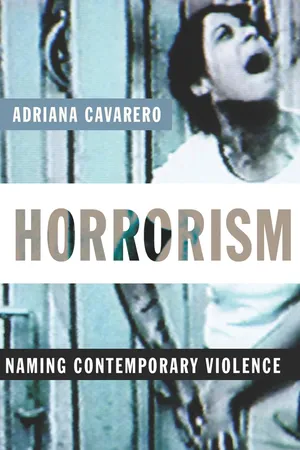
Words like "terrorism" and "war" no longer encompass the scope of contemporary violence. With this explosive book, Adriana Cavarero, one of the world's most provocative feminist theorists and political philosophers, effectively renders such terms obsolete. She introduces a new word—"horrorism"—to capture the experience of violence.
Unlike terror, horrorism is a form of violation grounded in the offense of disfiguration and massacre. Numerous outbursts of violence fall within Cavarero's category of horrorism, especially when the phenomenology of violence is considered from the perspective of the victim rather than that of the warrior. Cavarero locates horrorism in the philosophical, political, literary, and artistic representations of defenseless and vulnerable victims. She considers both terror and horror on the battlefields of the Iliad, in the decapitation of Medusa, and in the murder of Medea's children. In the modern arena, she forges a link between horror, extermination, and massacre, especially the Nazi death camps, and revisits the work of Primo Levi, Hannah Arendt's thesis on totalitarianism, and Arendt's debate with Georges Bataille on the estheticization of violence and cruelty.
In applying the horroristic paradigm to the current phenomena of suicide bombers, torturers, and hypertechnological warfare, Cavarero integrates Susan Sontag's views on photography and the eroticization of horror, as well as ideas on violence and the state advanced by Thomas Hobbes and Carl Schmitt. Through her searing analysis, Caverero proves that violence against the helpless claims a specific vocabulary, one that has been known for millennia, and not just to the Western tradition. Where common language fails to form a picture of atrocity, horrorism paints a brilliant portrait of its vivid reality.
- English
- ePUB (mobile friendly)
- Available on iOS & Android
eBook - ePub
About this book
Information
Topic
PhilosophieSubtopic
Déconstruction en philosophieTable of contents
- Cover
- Half title
- Series Page
- Title
- Copyright
- Contents
- Translator’s Note
- Acknowledgments
- Introduction: Scenes of a Massacre
- 1: Etymologies: “Terror” or, On Surviving
- 2: Etymologies: “Horror” or, On Dismembering
- 3: On War
- 4: The Howl of Medusa
- 5: The Vulnerability of the Helpless
- 6: The Crime of Medea
- 7: Horrorism; or, On Violence Against the Helpless
- 8: Those Who Have Seen the Gorgon
- 9: Auschwitz; or, On Extreme Horror
- 10: Erotic Carnages
- 11: So Mutilated that It Might Be the Body of a Pig
- 12: The Warrior’s Pleasure
- 13: Worldwide Aggressiveness
- 14: For a History of Terror
- 15: Suicidal Horrorism
- 16: When the Bomb Is a Woman’s Body
- 17: Female Torturers Grinning at the Camera
- Appendix: The Horror! The Horror! Rereading Conrad
- Notes
- Bibliography
Trusted by 375,005 students
Access to over 1.5 million titles for a fair monthly price.
Study more efficiently using our study tools.
Frequently asked questions
Yes, you can cancel anytime from the Subscription tab in your account settings on the Perlego website. Your subscription will stay active until the end of your current billing period. Learn how to cancel your subscription
No, books cannot be downloaded as external files, such as PDFs, for use outside of Perlego. However, you can download books within the Perlego app for offline reading on mobile or tablet. Learn how to download books offline
Perlego offers two plans: Essential and Complete
- Essential is ideal for learners and professionals who enjoy exploring a wide range of subjects. Access the Essential Library with 800,000+ trusted titles and best-sellers across business, personal growth, and the humanities. Includes unlimited reading time and Standard Read Aloud voice.
- Complete: Perfect for advanced learners and researchers needing full, unrestricted access. Unlock 1.5M+ books across hundreds of subjects, including academic and specialized titles. The Complete Plan also includes advanced features like Premium Read Aloud and Research Assistant.
We are an online textbook subscription service, where you can get access to an entire online library for less than the price of a single book per month. With over 1.5 million books across 990+ topics, we’ve got you covered! Learn about our mission
Look out for the read-aloud symbol on your next book to see if you can listen to it. The read-aloud tool reads text aloud for you, highlighting the text as it is being read. You can pause it, speed it up and slow it down. Learn more about Read Aloud
Yes! You can use the Perlego app on both iOS and Android devices to read anytime, anywhere — even offline. Perfect for commutes or when you’re on the go.
Please note we cannot support devices running on iOS 13 and Android 7 or earlier. Learn more about using the app
Please note we cannot support devices running on iOS 13 and Android 7 or earlier. Learn more about using the app
Yes, you can access Horrorism by Adriana Cavarero, William McCuaig in PDF and/or ePUB format, as well as other popular books in Philosophie & Déconstruction en philosophie. We have over 1.5 million books available in our catalogue for you to explore.