The 1954 Conference on Theory, sponsored by the Rockefeller Foundation, featured a who's who of scholars and practitioners debating the foundations of international relations theory. Assembling his own team of experts, all of whom have struggled with this legacy, Nicolas Guilhot revisits a seminal event and its odd rejection of scientific rationalism.
Far from being a spontaneous development, these essays argue, the emergence of a "realist" approach to international politics, later codified at the conference, was deliberately triggered by the Rockefeller Foundation. The organization was an early advocate of scholars who opposed the idea of a "science" of politics, pursuing, for the sake of disciplinary autonomy, a vision of politics as a prerational and existential dimension that could not be "solved" by scientific means. As a result, this nascent theory was more a rejection of behavioral social science than the birth of one of its specialized branches. The archived conversations reproduced here, along with unpublished papers by Hans Morgenthau, Reinhold Niebuhr, and Paul Nitze, speak to this defensive stance. International relations theory is critically linked to the context of postwar liberalism, and the contributors explore how these origins have played out in political thought and American foreign policy.
eBook - ePub
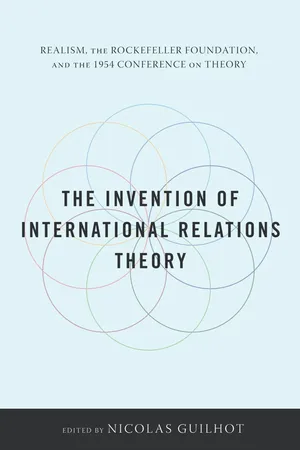
The Invention of International Relations Theory
Realism, the Rockefeller Foundation, and the 1954 Conference on Theory
- English
- ePUB (mobile friendly)
- Available on iOS & Android
eBook - ePub
The Invention of International Relations Theory
Realism, the Rockefeller Foundation, and the 1954 Conference on Theory
About this book
Trusted by 375,005 students
Access to over 1.5 million titles for a fair monthly price.
Study more efficiently using our study tools.
Information

1
MORALITY, POLICY, AND THEORY
Reflections on the 1954 Conference
ROBERT JERVIS
THE 1954 Conference on International Politics reveals a deep concern with the interrelations among international relations (IR) theory, the practice of foreign policy, and morality. The participants might be disappointed at how little progress we have made since they met, but they probably would not be surprised. These questions have concerned people from the time of Thucydides, and the fact that they remained pressing in 1954 indicates that they cannot be fully solved and that we should not be embarrassed to be still discussing them.1 This gives me humility about my own remarks but does not stop me from making them.
MORALITY
Although some versions of realism denied any role for morality, most realists have seen that statesmen did not and should not put it aside. This was obviously the case for E. H. Carr, John Herz, Hans Morgenthau, Reinhold Niebuhr, and Arnold Wolfers, to name only five of the most prominent realists, three of whom participated in the conference. Indeed, the conference opened with Wolfers asking that the “moral problem” be discussed first, and Niebuhr replied that he was delighted that most of the preparatory papers had talked about the relations between theory and practice.2 There were several reasons why they saw morality as the linchpin here. Perhaps most important was that the participants believed that understanding had to start with human nature.3 Most realists shared the common Western belief that humans were inherently evil or at least had the potential for evil within them. For some theorists like Niebuhr, this view can be traced to the Bible. For others, a simple look at history sufficed. For scholars today, evolutionary psychology can be deployed. In the mid-1950s, with the memory of Hitler still fresh, with Stalin just having died, and with the behavior of Joseph McCarthy looming large, it would have been hard to build coherent thoughts without this foundation.
This understanding meant that realists believed both that national survival at times required doing evil and that statesmen had to minimize this possibility and avoid becoming evil. Leaders had to fight some of the impulses they were sure to harbor, had to resist the easy rationalization that the requirements of national security always trumped other values, and had to avoid corrupting their personal or national souls. Furthermore, this struggle would never end, because politics, especially international politics, always contained multiple conflicts and posed multiple dangers. The utopia that for liberals would dawn with the universal reign of democracy and free trade and for Marxists would appear with the triumph of communism were for realists false hopes, ones that would bring disaster if they were pursued to the exclusion of other considerations. Morality then could only play a useful role if leaders were aware of their own immoral impulses and the concomitant danger of confusing narrower with broader interests. National egoism and self-righteousness were among the most disturbing and dangerous forces in international politics. It was all too easy for any country, perhaps especially a democracy, to universalize its own values and outlook, to think that it knows what is best for the entire world, and to disguise (to itself as much as to others) the selfish nature of its behavior.4 Leaders and nations that fell into these traps would behave immorally while simultaneously thinking that they were the most moral of actors. The very fact that many actors convince themselves that they are abiding by the highest moral standards gives realists reason for looking at the topic with great care.
To say that people have the capacity to do great evil implies that they can do good as well, although determining what is good and what behavior contributes to it is of course contentious and difficult. But while denying the perfectibility of human beings, one of the animating forces behind realism is the belief that states can minimize evil and make the world better or at least see that it does not degenerate into constant strife and injustice. Realists then would not be surprised by the modern findings from psychology and neuroscience that people have an inborn sense of morality. In an era in which the academic division of labor had not gone as far as it has today, realists were also deeply concerned with their state’s domestic regimes and societies. The point of politics, after all, was to make the lives of individuals and communities better. Since the external world influenced the internal one, it was hard to see how a good society could develop in a deeply malign environment. States had to survive, but the point of survival was to help the inhabitants thrive.
These concerns were particularly pressing in the mid-1950s, so much so that they hardly needed to be discussed. The participants in the conference saw the Soviet Union as evil, but they did not waste time explicating this. For them bipolarity, although important, was not the root of the matter. Evil was much of what the cold war was about. Had the Soviet Union been benign, there would have been much less international conflict and less reason to fear the limited expansion of Soviet power. During World War II, one reason for American wariness toward Great Britain was that the latter was fighting not only to defeat fascism but also to retain the British Empire. For most Americans, including realists, subjugating a large portion of the earth’s population was not something the United States wanted to uphold, and while combating it could not be done at the cost of losing the war, neither should the United States cooperate with this endeavor. Although realists certainly did not call for a crusade to end British imperialism—some shared the prevalent racism, and even if there had been no Soviet menace none of them favored crusades—neither were they insensible to the fundamental idea that states should serve people. Any inclination to view that relationship the other way around was banished by the Nazi example.
Realism sometimes is viewed as synonymous with cynicism, given its view that states seek power and care first, if not solely, about themselves and their citizens. There is something to this, but the common next step of viewing cynicism as being in conflict with morality is not warranted. In fact, for Niebuhr, Morgenthau, and their colleagues it was their cynicism that permitted them to see that moral dilemmas in politics could not be easily elided and that one of the gravest dangers in politics was the attempt to do so. Cynicism is compatible with morality, and is indeed necessary for it, because by acknowledging the primacy of the national interest it allows us to see that this can and often does conflict with other values and goals. In the interwar period and to a lesser extent in the years after 1945, realists believed (with some reason) that liberals and idealists were prone to make the world worse because of their mistaken belief that there were no conflicts between what was good for the country and what was best for the world. One of Carr’s major contributions was to point out that many people in Great Britain in the 1920s and 1930s assumed that the status quo had moral superiority (Carr 1946). Although Carr initially deployed this and other arguments to argue for appeasing Hitler,5 the general point is extremely important: states that have gained a favorable position in the international system tend to conclude that their country is uniquely wise and just and that those who are seeking to displace them are morally inferior.
Morgenthau similarly argues that what he calls nationalistic universalism is a terrible force in world politics in part because states so imbued believe that they are carrying out the will of God or its secular equivalent (Morgenthau 1978, chap. 20). This can be seen as simply a generalization from Napoleon, fascism, and communism. But one of his less familiar but parallel claims cuts closer to the bone. He argues that bourgeois liberalism is not universally valid but stems from particular historical circumstances, and that because Western leaders are generally unaware of this, they assume that their outlook and values are universal (Morgenthau 1946, 50–53).6 Leaders of these countries are not cynical, and that is a problem, because their lack of awareness of the roots of their beliefs leads them to consider their outlook and policies to be highly moral. Greater cynicism would have permitted a more accurate view of others and themselves; it would have led leaders and the public to see that their values were necessarily parochial and that they often faced difficult moral choices and judgments. People who understand this are better able to control themselves and act with moderation than those who think they are acting for the good of humankind.7
Four aspects of the 1950s heightened the realists’ concern with moral tensions. Most obviously, the cold war brought with it the perception of a sharp contrast between Soviet and Western standards and behavior. This involved a clash with an arguably evil state and also raised the danger of a gap widening between America’s principles and its actions. The cold war was a nasty struggle, and the sources of dispute and means of influence were principles as well as power. As Melvyn Leffler (2007) put it, the cold war was largely a struggle “for the soul of mankind.” This made it imperative that the West not mimic Soviet tactics, but the nature of the conflict required the United States to exercise power in a way that other states (and some moralists) would find objectionable.8 Second and relatedly, there was a real danger that the extreme competition would undermine democratic processes and values. Although by the early 1950s some of the fears that the United States would turn into a “garrison state” had dissipated, one of the main reasons why President Eisenhower was so set on reducing the defense budget was the belief that if he did not, much of what the United States was striving to protect would be lost. As he put it at one National Security Council meeting, “We could lick the whole world… if we were willing to adopt the system of Adolf Hitler…. [We are] engaged in defending a way of life as well as a territory, a population, or our dollar” (State 1984, 519, 521).9 Third, the emerging doctrine of nuclear deterrence involved making credible the immoral threat to kill tens of millions of innocent Soviet citizens. Even to people who accepted the destruction of German and Japanese cities during World War II, this was difficult to contemplate. The question of how these threats, let alone their implementation, might be squared with our consciences vied for attention with the challenge of whether we could make the threats credible enough that they would never have to be carried out.10 Finally, with the independence of India and Pakistan, France’s war to keep control of Indochina, and the stirrings in Africa, the future of colonialism was an obvious question. The immorality of foreign rule, however, clashed with the immoralities that could follow from early independence and with the need to support Britain and France. Policies in this area somehow had to balance and combine pragmatism and morality.11
THEORY AND POLICY
Questions such as these would not have been so pressing if the realists had been concerned only with developing theories. These could be entirely derived from and applied to the past, be highly abstract, and even seek to avoid questions of foreign policy entirely. This indeed is what Kenneth Waltz did with his neorealist Theory of International Politics (although as we will see, even this enterprise was influenced by policy concerns). But realists were traditionally involved with what their states should do, and those at the 1954 conference were no exception. Indeed, the participants included Robert Bowie, Dorothy Fosdick, and Paul Nitze, people who were more practitioners than theorists. Even for people such as Morgenthau and Wolfers, I think the notion of a theory that had few implications for how states in general should behave or for what the United States should do in its current situation would have had little value and perhaps little meaning.
Context and personal experiences played a large role here. The participants in the conference had just been through one of the most destructive wars in history, one that many people believed could have been avoided by appropriate statesmanship. The cold war had just started, and it had already witnessed a series of crises that had started a prolonged and surprising limited war in Korea and could have triggered another world war as well. In World War II, many scho...
Table of contents
- Cover
- Half title
- Title
- Copyright
- Contents
- Acknowledgments
- Introduction: One Discipline, Many Histories
- 1: Morality, Policy, and Theory: Reflections on the 1954 Conference
- 2: Tensions Within Realism: 1954 and After
- 3: The Rockefeller Foundation Conference and the Long Road to a Theory of International Politics
- 4: The Speech Act of Realism: The Move That Made IR
- 5: The Realist Gambit: Postwar American Political Science and the Birth of IR Theory
- 6: Kennan: Realism as Desire
- 7: American Hegemony, the Rockefeller Foundation, and the Rise of Academic International Relations in the United States
- 8: Realism and Neoliberalism: From Reactionary Modernism to Postwar Conservatism
- Appendix 1. Conference on International Politics
- Appendix 2. The Theoretical and Practical Importance of a Theory of International Relations
- Appendix 3. The Moral Issue in International Relations
- Appendix 4. International Relations Theory and Areas of Choice in Foreign Policy
- Appendix 5. The Implications of Theory for Practice in the Conduct of Foreign Affairs
- Appendix 6. Theory of International Politics: Its Merits and Advancement
- List of Contributors
- Index
Frequently asked questions
Yes, you can cancel anytime from the Subscription tab in your account settings on the Perlego website. Your subscription will stay active until the end of your current billing period. Learn how to cancel your subscription
No, books cannot be downloaded as external files, such as PDFs, for use outside of Perlego. However, you can download books within the Perlego app for offline reading on mobile or tablet. Learn how to download books offline
Perlego offers two plans: Essential and Complete
- Essential is ideal for learners and professionals who enjoy exploring a wide range of subjects. Access the Essential Library with 800,000+ trusted titles and best-sellers across business, personal growth, and the humanities. Includes unlimited reading time and Standard Read Aloud voice.
- Complete: Perfect for advanced learners and researchers needing full, unrestricted access. Unlock 1.5M+ books across hundreds of subjects, including academic and specialized titles. The Complete Plan also includes advanced features like Premium Read Aloud and Research Assistant.
We are an online textbook subscription service, where you can get access to an entire online library for less than the price of a single book per month. With over 1.5 million books across 990+ topics, we’ve got you covered! Learn about our mission
Look out for the read-aloud symbol on your next book to see if you can listen to it. The read-aloud tool reads text aloud for you, highlighting the text as it is being read. You can pause it, speed it up and slow it down. Learn more about Read Aloud
Yes! You can use the Perlego app on both iOS and Android devices to read anytime, anywhere — even offline. Perfect for commutes or when you’re on the go.
Please note we cannot support devices running on iOS 13 and Android 7 or earlier. Learn more about using the app
Please note we cannot support devices running on iOS 13 and Android 7 or earlier. Learn more about using the app
Yes, you can access The Invention of International Relations Theory by Nicolas Guilhot in PDF and/or ePUB format, as well as other popular books in Politics & International Relations & International Relations. We have over 1.5 million books available in our catalogue for you to explore.