- English
- ePUB (mobile friendly)
- Available on iOS & Android
eBook - ePub
About this book
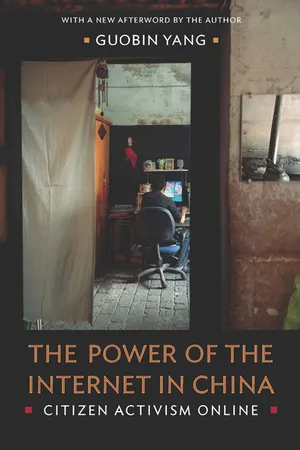
Since the mid-1990s, the Internet has revolutionized popular expression in China, enabling users to organize, protest, and influence public opinion in unprecedented ways. Guobin Yang's pioneering study maps an innovative range of contentious forms and practices linked to Chinese cyberspace, delineating a nuanced and dynamic image of the Chinese Internet as an arena for creativity, community, conflict, and control. Like many other contemporary protest forms in China and the world, Yang argues, Chinese online activism derives its methods and vitality from multiple and intersecting forces, and state efforts to constrain it have only led to more creative acts of subversion. Transnationalism and the tradition of protest in China's incipient civil society provide cultural and social resources to online activism. Even Internet businesses have encouraged contentious activities, generating an unusual synergy between commerce and activism. Yang's book weaves these strands together to create a vivid story of immense social change, indicating a new era of informational politics.
Information
Subtopic
Computer Science General| ∎ | 1 | ∎ |
ONLINE ACTIVISM IN AN AGE OF CONTENTION
The suppression of the prodemocracy movement in 1989 did not quell the spirit of contention. After a short hiatus, new waves of popular protests started to surge across China, beginning roughly in 1992. There were 8,700 “mass incidents” in 1993, according to China’s Ministry of Public Security. This number rose to 32,000 in 1999, 58,000 in 2003, and 87,000 in 2005.1 Accompanying the alarming ascendance of social conflicts in recent years is the appearance of an official rhetoric of building a “harmonious society.” Perhaps more than anything else, this new discourse indicates that Chinese society has entered an age of contention.
As popular contention increases in frequency, its forms have diversified. In the 1980s, protests centered on struggles for the Enlightenment ideals of freedom and democracy. This was true of the Democracy Wall movement in 1978 and 1979, the campus elections in 1980, and the student demonstrations in 1986 and 1989.2 These struggles have continued to the present day.3 Yet many new forms of contention have appeared, ranging from labor protests and villagers’ protests to environmental activism, consumer activism, women’s activism, HIV/AIDS activism, religious activism, activism of ethnic minorities, popular nationalism, and rights-protection activism (weiquan yundong).4 Online activism is one of these new types.
The appearance of new contentious forms since the 1990s represents a rupture with popular struggles in the previous decade. With the crushing of the 1989 student movement, the energies of popular struggles born out of the Cultural Revolution5 were drained. The century-long aspirations of a Chinese enlightenment project dating back to the May Fourth movement were exhausted. The student movement marked both the height of China’s enlightenment project and the beginning of its transformation. As Joseph Fewsmith puts it:
Never in the seven decades since then had intellectuals themselves come to see the May Fourth tradition as outdated or irrelevant to their concerns. That changed in the 1990s, and the turn away from the enlightenment project of the May Fourth movement marks a major, one is tempted to say fundamental, change in the way many intellectuals view China and its place in the world.6
The rise of online activism and other contentious forms and issues marks a new stage of popular contention in postenlightenment Chinese modernity.7 Much of this book will be devoted to illuminating these new forms of activism. This chapter analyzes the broader structural conditions underlying the emergence of the new citizen activism in China, using online activism as a strategic entry point. I argue that if popular contention has undergone a structural transformation, it is because Chinese society itself has experienced such a transformation. Online activism and popular contention in general are responses to the consequences of Chinese modernity.
Popular Contention Since the 1990s
To say that 1989 marked a historical rupture is not to ignore continuities. The wave of popular protests that ushered in the reform era has not subsided. The struggles for political freedom and reform have never stopped. The frequency of worker strikes and rural protests in recent years is well known. There were protests among workers and villagers in the 1980s as well,8 but they were little known and overshadowed by student activism. Such labor and rural protests have continued to the present day.
Yet there is change in continuity. Popular contention since the 1990s has new features significant enough to merit its name—China’s new citizen activism. The first feature of this new activism is the sheer frequency of contention, as I mentioned at the beginning of this chapter. The second feature is the proliferation of contentious issues. On the one hand, material grievances such as wages and living conditions continue to be central concerns in labor protests. Villagers have protested against tax burdens, corruption, and the diversion of public funds.9 On the other hand, many new issues have become salient. These range from protests about land loss to pension, property rights, consumer rights, popular nationalism, animal rights, pollution, migrant labor, HIV/AIDS, and discrimination against hepatitis-B carriers. Clearly, China’s new citizen activism includes some of the issues at the center of the European “new social movements.”
The third feature is the change in the social basis of contention. At various points in modern Chinese history, workers, peasants, and students were the dominant forces of popular contention. This remained true throughout the 1980s. Since the mid-1990s, however, the social basis of contention has broadened. Workers, peasants, and students are still restive. Yet other social groups have entered the scene. Homeowners, pensioners, migrants, hepatitis-B carriers, ant farmers, consumers, even computer gamers and pet owners—all have joined in. Particularly important are the rise of an urban middle class and the coming of age of the generation born after the beginning of the economic reform. The urban middle class is a heterogeneous category. Those elements with close ties to the political elite, such as the private entrepreneurs or “red capitalists” studied by Margaret Pearson and Bruce Dickson, may not be inclined toward political change.10 Other elements, however, may act differently. For example, urban homeowners, despite their moderate forms of action, are among the most contentious in China today.11 The new reform generation is among the most wired segments of the Chinese population.12
The fourth feature is the rise of new types of civic organizations. Compared with protests in earlier periods of PRC history, the various forms of issue-specific activism since the 1990s have an organizational basis, however fragile these organizations may be and however varied the organizational forms are. Whereas earlier studies of Chinese civil society focused on “social organizations,” the term “social organizations” is increasingly reserved for officially sponsored types. The new types of civil-society organizations try to distinguish themselves with new appellations, such as NGOs, minjian organizations, and grassroots (caogen) organizations.13
Fifth, popular contention since the 1990s often has more modest goals than it did in the 1980s. Protestors in the 1980s cherished grand if vague political ideals. With apocalyptic visions of or for the future, they believed in revolutionary change. Fighting for democracy and modernization were powerful rallying cries. These visions continue to inspire many activists, but since the 1990s, popular protests have articulated other, more modest goals. The defense of personal rights and interests and the expression and assertion of new identities are central concerns of the new citizen activism.
Sixth, although disruptive and confrontational protests have persisted, the new forms of contention since the 1990s are typically nondisruptive. The repertoires of collective action may best be characterized as collective civic action.14 Minxin Pei observes, for example, that “while the dissident movement in the 1980s favored direct and confrontational methods of resistance, the same movement in the late 1990s began to rely increasingly on indirect and legal means.”15 The “rightful resistance” studied by O’Brien and Li is a form of nonconfrontational contention. Much of the NGO-led activism in urban areas, such as women’s and environmental activism, adopts indirect forms of civic action such as media campaigns, public forums, exhibitions, and field trips.
The rise of China’s new citizen activism reflects the profound cultural, social, political, and economic transformations. Culturally, the repression of the student movement shattered the political idealism of the 1980s. The ensuing disillusionment and cynicism soon turned into passions for money making; even college professors quit their teaching positions to “jump into the sea” of pursuing business ventures. A culture of materialism and consumerism quickly prevailed. One consequence of the consumer revolution is the expansion of the spaces for communication. New urban social forms afforded new channels of socializing, expression, and identity exploration. There were revitalized food markets, dance halls, telephone hotlines, and even McDonald’s restaurants.16 Telephones became common household items after the mid-1990s. Then came the Internet and the cellphone. The economic transformations are self-evident. As I will discuss later in this chapter, much of the new citizen activism is a response to the negative social consequences of these economic transformations. Another important influence on the peculiar forms of the new citizen activism is the changing nature of state power, which I will examine in the next chapter. Suffice it to say here that since the 1990s, Chinese state power has become more decentralized and fragmented, on the one hand, and more disciplinary and capillary on the other. The new forms of citizen activism respond to the new forms of power.
The Rise of Online Activism in China
Online activism is an integral part of China’s new citizen activism, and its origins may be traced to the student movement in 1989. At that time, Chinese students and scholars overseas were already actively using e-mail and newsgroups.17 As protests escalated in China, an intricate web of communication emerged linking students inside China with the Chinese diaspora and the international community at large. Telephones, faxes, and the mass media played the most important role, but the Internet had a presence as well. Chinese students overseas used the Internet to raise funds for student protesters in China, issue statements of support, and organize demonstrations around the world. They would call up their friends in Chinese universities to get event updates and then report back to the popular newsgroup SCC (Social Culture China) or e-mail list ENCS (Electronic Newsletter for Chinese Students). For example, after the crackdown on June 4, there were numerous e-mail messages in these newsgroups calling on Chinese students overseas to contact their friends and families in China and inform them of the truth. One e-mail posted at 13:53:11 GMT, June 4, 1989, had “Message from Zhejiang University!” in the subject line and reported the following:
Hi, everybody!
I called a teacher in ZU last night in order to tell people the bloodshed had happened in Beijing. I was told that ZU students held a demonstration in Hangzhou as soon as they heard the event. They have telephone contacts with the students in Beijing, and also, they can know the truth from VOA.18
Of the hundreds of Usenet newsgroups at that time, SCC became the highest ranked in online traffic during the movement period. Launched in November 1987, SCC was relatively inactive until the beginning of the student-protest movement in the spring of 1989. Only nine messages were posted in the first two months of 1989. Reflecting the tempo of the student movement, the number of messages rose to 624 in March 1989, 833 in April, 2,198 in May, and 3,183 in June.19 By April 1990, SCC had become one of the twenty most active groups among the 1,473 newsgroups on Usenet, with an estimated readership of twenty thousand.20 SCC became a success story in the history of newsgroups in the United States.21
Inside China, however, the Internet was barely known. In 1989, only a select few Chinese scientists had e-mail connections with the outside world.22 China did not achieve full-function Internet connectivity until 1994. Even then, access was limited to small numbers. Only after 1996 did the Internet begin to become available to the average urban consumer. In the first few years of Internet development in China, there were only scattered reports of Internet protests, reflecting the limited diffusion of the technology. BBS forums were to become the central space for online activism, yet the first BBS in China did not appear until 1995. When it was set up in Tsinghua University, the event turned out to be a milestone. Named SMTH (short for Shuimu Tsinghua), this BBS would become one of the most influential in China. After the first BBS was set up, others quickly followed at Beijing University, Nanjing University, Zhejiang University, Fudan University, and Xi’an Jiaotong University, among others. Thus the first contingent of BBS forums appeared in universities and major research institutions, traditionally the hotbed for contention. It is not surprising that it was in these BBS forums that the earliest documented case of online activism happened: a nationalistic protest about the Diaoyu Islands, to which both China and Japan make territorial claims.23 There were other cases in the ensuing years, notably the worldwide protests against violence committed against ethnic Chinese in Indonesia.24
One of the defining cases of online activism in the earlier period was the protests in 1999 against the NATO bombing of the Chinese embassy in the former Yugoslavia. After the embassy bombing, People’s Daily Online set up a BBS named “Protest Forum” for Internet users to air discontent.25 Tens of thousands of comments were posted in the forum within days. The launching of the “Protest Forum” unintentionally popularized online protest activities at a time when the Internet was just beginning to catch on in China.
Since then, online activism has increased in frequency and diversified in form. BBS remains a hotbed for contention. As blogs, online videos, and text messaging become popular, they are also used for contention. Numerous “rights defense” Web sites are set up by individuals and voluntary groups, giving rise to a new term in Chinese: “online rights defense” (wangluo weiquan). As in other countries, citizen reporters (gongmin jizhe) ...
Table of contents
- Cover
- Half title
- Series Page
- Title
- Copyright
- Dedication
- Contents
- List of Figures
- List of Tables
- Acknowledgments
- Introduction
- 1: Online Activism in an Age of Contention
- 2: The Politics of Digital Contention
- 3: The Rituals and Genres of Contention
- 4: The Changing Style of Contention
- 5: The Business of Digital Contention
- 6: Civic Associations Online
- 7: Utopian Realism in Online Communities
- 8: Transnational Activism Online
- Conclusion: China’s Long Revolution
- Afterword to the Paperback Edition
- Notes
- Bibliography
- Index
Trusted by 375,005 students
Access to over 1.5 million titles for a fair monthly price.
Study more efficiently using our study tools.
Frequently asked questions
Yes, you can cancel anytime from the Subscription tab in your account settings on the Perlego website. Your subscription will stay active until the end of your current billing period. Learn how to cancel your subscription
No, books cannot be downloaded as external files, such as PDFs, for use outside of Perlego. However, you can download books within the Perlego app for offline reading on mobile or tablet. Learn how to download books offline
Perlego offers two plans: Essential and Complete
- Essential is ideal for learners and professionals who enjoy exploring a wide range of subjects. Access the Essential Library with 800,000+ trusted titles and best-sellers across business, personal growth, and the humanities. Includes unlimited reading time and Standard Read Aloud voice.
- Complete: Perfect for advanced learners and researchers needing full, unrestricted access. Unlock 1.5M+ books across hundreds of subjects, including academic and specialized titles. The Complete Plan also includes advanced features like Premium Read Aloud and Research Assistant.
We are an online textbook subscription service, where you can get access to an entire online library for less than the price of a single book per month. With over 1.5 million books across 990+ topics, we’ve got you covered! Learn about our mission
Look out for the read-aloud symbol on your next book to see if you can listen to it. The read-aloud tool reads text aloud for you, highlighting the text as it is being read. You can pause it, speed it up and slow it down. Learn more about Read Aloud
Yes! You can use the Perlego app on both iOS and Android devices to read anytime, anywhere — even offline. Perfect for commutes or when you’re on the go.
Please note we cannot support devices running on iOS 13 and Android 7 or earlier. Learn more about using the app
Please note we cannot support devices running on iOS 13 and Android 7 or earlier. Learn more about using the app
Yes, you can access The Power of the Internet in China by Guobin Yang in PDF and/or ePUB format, as well as other popular books in Technology & Engineering & Computer Science General. We have over 1.5 million books available in our catalogue for you to explore.