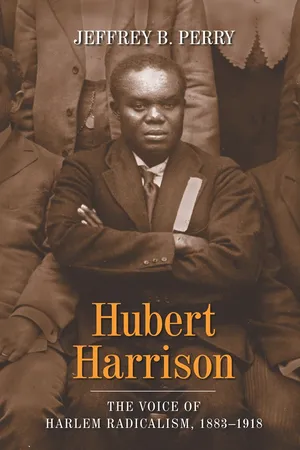
Hubert Harrison was an immensely skilled writer, orator, educator, critic, and political activist who, more than any other political leader of his era, combined class consciousness and anti-white-supremacist race consciousness into a coherent political radicalism. Harrison's ideas profoundly influenced "New Negro" militants, including A. Philip Randolph and Marcus Garvey, and his synthesis of class and race issues is a key unifying link between the two great trends of the Black Liberation Movement: the labor- and civil-rights-based work of Martin Luther King Jr. and the race and nationalist platform associated with Malcolm X.
The foremost Black organizer, agitator, and theoretician of the Socialist Party of New York, Harrison was also the founder of the "New Negro" movement, the editor of Negro World, and the principal radical influence on the Garvey movement. He was a highly praised journalist and critic (reportedly the first regular Black book reviewer), a freethinker and early proponent of birth control, a supporter of Black writers and artists, a leading public intellectual, and a bibliophile who helped transform the 135th Street Public Library into an international center for research in Black culture. His biography offers profound insights on race, class, religion, immigration, war, democracy, and social change in America.
- English
- ePUB (mobile friendly)
- Available on iOS & Android
eBook - ePub
About this book
Information
Subtopic
Political BiographiesIndex
HistoryPART
I
Intellectual Growth and Development
CHAPTER
1
Crucian Roots (1883–1900)
Hubert Harrison, the son of plantation-working, Afro-Caribbean parents—an unmarried Barbadian immigrant mother and a formerly enslaved, absentee Crucian father—lived his first seventeen years on the Caribbean island of St. Croix, a colony of Denmark, where he worked as a servant, knew poverty, and developed an empathy with the poor. He was also able to pursue opportunities for study and self-study; to receive a good basic education; to be influenced by an exemplary Black teacher; and to obtain work as an assistant teacher. As a youth, living among immigrant and native laboring people, he grew up with an identifiable drive and a breadth to his perspective. He also developed an awareness of his African roots and of the Crucian people’s rich history of direct-action mass struggle. Overall, it was a period in which, despite obstacles, he had a loving family life and he was able to cultivate a love of learning, nurture his dreams, and grow with the belief that he was the equal of any other.
When he moved to New York City at the turn of the twentieth century, Harrison brought a multicultural Crucian background, reading and writing skills, intellectual curiosity, and a feeling of oneness with the downtrodden—all of which would be important in his future work. In the United States, however, he confronted the harsh realities of class exploitation and racial oppression quite unlike anything he knew at home. While his U.S. experiences enabled him to pursue his intellectual interests in a manner that was not possible in St. Croix; they also increasingly pushed him in the direction of class and race radicalism.
His early years in the Caribbean set the stage for later developments. Unfortunately, biographical documentation from the island that Harrison and others referred to as “Santa Cruz” was, for most of the last century, extremely difficult to locate and to access. Vast quantities of historical documents and government records were removed from St. Croix to the national archives of Denmark and the United States after the American government purchased the Danish West Indies in 1917. Serious research efforts confronted the difficult problem of trying to locate and access materials that were widely scattered on two continents and in the Virgin Islands. This situation is now in the process of being addressed through digitization efforts by the national archives of Denmark and the United States, and also through the extraordinary research and documentation efforts of the internationally coordinated St. Croix African Roots Project.1
In Harrison’s case, the historical particulars that have been located come from his “diary” and family; from church, census, immigration, and other archival records; and from newspapers and other published sources. The published items, many of which Harrison undoubtedly influenced, were at times contradictory. This was likely because of occasional efforts to embellish in order to obtain employment and because for most of his life in America he was not a citizen of the United States2 and was possibly subject to arrest and deportation.3 It is reasonable to treat many of the published sources with caution.
Nevertheless, by selecting salient factors in the history, political economy, class structure, and social relations of St. Croix and combining these with the known particulars of Harrison’s family life and youth, a picture does emerge. We see how the colonial, class, race, and social relations on the island shaped his thinking; how he was nurtured in a caring support network; why he took the bold step of emigrating from the Virgin Islands to New York in 1900; and how he had developed, in embryo, the core characteristics—race and class consciousness, sensitivity to human suffering, and an independent and wide-ranging intellect—that so marked his later life.
The island of St. Croix offers a pleasant natural environment, which cloaks an identifiably violent history of human development. It occupies eighty-four square miles in the northern Leeward chain of the Lesser Antilles, about seventeen hundred miles south of New York and sixty-five miles southeast of Puerto Rico. Its diverse terrain includes broken ranges of hills rising to twelve hundred feet in the northwest corner and a well-watered flat coastal plain in the center and south. The coastline, for the most part, is low-lying, and there are good natural harbors. Temperatures average close to eighty degrees Fahrenheit, with little seasonal variation, and rainfall, chiefly comprising brief but heavy showers, averages slightly over forty inches a year. Despite occasional drought, a variety of food from both land and sea has traditionally been available. Commenting on the climate, with words that could apply more generally to the island’s natural environment, and perhaps with a touch of island pride, the historian Erik J. Lawaetz has claimed that, excluding hurricanes (which on occasion have been devastating), “the worst day in St. Croix . . . is better than the best days in most other places.”4
The island’s pre-Columbian inhabitants came from elsewhere in the Americas and found their new home hospitable. The first to arrive were small groups of hunters and gatherers around 300 to 400 B.C. They gave way to the agricultural Arawaks or Taino (who named the island “Ay-Ay”) around 100 to 200 A.D. The Arawaks were subsequently displaced by Carib migrants, from northern South America, who arrived between 1350 and 1400. All of these indigenous peoples lived relatively comfortably off the natural resources of the island.5
Estate Concordia, where Hubert was born, is located near the Salt River estuary—a focal point of St. Croix’s early history and the place where that Caribbean island’s subordination to European domination literally began. On November 14, 1493, the essentially self-sufficient social order of the island’s Carib inhabitants was jolted by the arrival of Christopher Columbus with seventeen ships, and twelve hundred armed men under the Spanish flag at the river’s mouth. Columbus’s men made a brief incursion onto land and seized some children and women (at least one of whom was raped), attempted to overtake a canoe at a place subsequently called Cabo de Fleches (“Cape of the Arrows”), and then met with resistance from the canoe’s Carib warriors. In the ensuing skirmish—the first recorded fight between Europeans and Caribs—one Carib warrior and one Spaniard were killed. Within hours Columbus and his fleet left for a chain of islands visible to the north, which would prove both less hostile and more suitable to their needs. Columbus named these islands “las Virgenes” (the Virgins) after St. Ursula and the eleven thousand martyred virgins alleged to have been murdered by the Huns at Cologne.6
During the ensuing sixteen years, the Spanish left the aggressive Caribs of Ay-Ay, which Columbus had renamed “Sancta Crux” (Latin for Holy Cross), largely untouched, while they concentrated on conquering the larger, Taino-occupied islands of Hispaniola and Puerto Rico (Borinquen). The calm on St. Croix was broken in 1509, when Spanish slave traders from Puerto Rico (acting in the spirit of a royal cedula that allowed for the enslavement of Caribs on the grounds that they were heathens and practiced cannibalism) raided the island and took 150 captives. In 1511, the enraged Crucian Caribs joined forces with the Borinquen Tainos in an attempt to drive the Spaniards from Puerto Rico. The Spanish then forcefully attacked St. Croix, driving those island Caribs who were not taken captive into the northern Virgin Islands and then eastward into the northern Leeward Islands.7
By 1515, European military might had depopulated St. Croix. The Spanish Empire showed little interest in the mineral-deprived island (which had little potential for use as a major colony or a military installation), and St. Croix remained essentially uninhabited for over a century. Then, in the 1630s, small groups of English, French, and Dutch settled at different locations on the island. These new occupants fought among themselves, and against the Spanish, and by 1650, the French emerged triumphant and began to colonize St. Croix. Small numbers of French planters, using European servants and enslaved Africans, established a precarious agricultural economy, which was supplemented by smuggling with the neighboring islands of St. Thomas and Puerto Rico. St. Croix was far from the center of French power in the region, and its new occupants were unruly, hard to govern, defiant of authority, and given to marronage. The cost of controlling and defending these recalcitrants outweighed any meager returns they generated for the mother country, and the French government consequently decided to shut down the colony. In January 1696 a French fleet removed the free and enslaved inhabitants (excepting some who went maroon) to the fledgling colony of St. Dominique (later Haiti).8
Between 1696 and 1733, St. Croix, though nominally French, was essentially free from colonial dominion. It was frequented by people marginalized by capitalistic development in the region including maroons, freebooters, debtors, and deserters. Developing capitalism would tolerate a vacuum in the region for only so long, however, and in 1733, Denmark, which had established colonies in nearby St. Thomas and St. John, purchased St. Croix from France with the expectation of turning it into a producer of sugar cane. The island, which contained 150 English settlers, 456 enslaved African inhabitants, and an unknown number of maroons, was then turned over to the Danish West India and Guinea Company, which began its colonization in 1734. The company imposed an ordered plan that divided the island into nine quarters, which were subdivided into estates that were sold at low cost to the already resident foreigners and to immigrant planters from the neighboring English, French, and Dutch sugar islands. As a result of these developments, St. Croix’s population was characterized by ethnic heterogeneity. While Danes took most jobs in government administration, few became planters. In 1755 company rule came to an end, and the Danish West Indies (comprising St. Croix, St. Thomas, St. John, and some inlets and cays) became a royal colony of Denmark with its capital at Christiansted, St. Croix’s main seaport.9
In an attempt to develop St. Croix’s sugar economy on a profitable basis, Denmark actively increased its participation in the transatlantic slave trade. Captured Africans were imported from four Danish forts maintained along the coast of modern day Ghana, from three factories in Africa, and from a wide trading area that stretched from Sierra Leone to Angola. Between 1755 and 1792, an estimated 22,000 Africans were sold into slavery on St. Croix. In that period, the island’s enslaved population, which because of harsh conditions could not sustain itself through natural reproduction, increased from 8,285 to 22,240. The Moravian missionary C. G. A. Oldendorp visited the Danish West Indies between 1767 and 1769 and reported interviews with Fulani, Mandigoes, Amina, Akims, Popos, Ibos, and Yorubas. Of these African peoples it is believed that Akan-Amina speakers of Twi were the most numerous. While most enslaved newcomers came from Africa, a large number (many of whom were Creoles), were also imported from neighboring Caribbean islands. By 1792 the diverse, enslaved population on St. Croix plantations was 54 percent Creole and 46 percent African.10
The oppressive slavery established on St. Croix was maintained by severe repression. Pursuant to laws passed under Governor Philip Gardelin in 1733 (called “Gardelin’s Code”) activities such as dancing, feasts, plays, and drumming were prohibited. Punishments included use of hot irons, severing of limbs, branding, whipping and torture, and their severity has led the Virgin Island social scientist Malik Sekou to conclude that the “Danish slave codes were among the most brutal.”11
Such repression led to various forms of resistance. In 1745 three hundred people escaped their slavery by fleeing to Puerto Rico. In 1746 and 1759 major conspiracies to organize mass rebellion were discovered and thwarted. Marronage, including mass desertions to Puerto Rico, persisted until slavery was ended by the collective action of those enslaved in 1848.12
In the three and a half decades before Hubert’s birth, Crucians undertook two major direct-action mass struggles—one an enslaved-led rebellion to end slavery and the other an armed rebellion followed by a general strike for better working conditions. Crucian working people referred to these two struggles as “the first free” and “the second free.”13
On July 3, 1848, several thousand “slaves,” reputedly led by the legendary Black liberator “Buddhoe” (born John Gottliff, aka “Buddho,” “Budhoe,” “Buddo,” “Burdeaux,” or “Moses Gottlieb”), staged an essentially nonviolent demonstration in Frederiksted (the island’s second-largest town) demanding their freedom. This determined collective action forced Governor Peter Karl Frederik von Scholten to decree an end to slavery in the Danish West Indies. This struggle, as the historian Neville Hall points out, was “the Caribbean’s second successful slave uprising” (after Haiti).14
Though some 17,000 people had won freedom from slavery in 1848, the ensuing repressive Labor Act of 1849 established year-long labor contracts, five-day sunrise-to-sunset workweeks, prohibitions against refusal of work (including refusals by children), requirements to give notice before termination of work, and fixed (nonnegotiable) wages for three classes of workers of five, ten, and fifteen cents a day. The emancipation victory and subsequent restrictive labor law led Crucian workers to seek to terminate their contracts and leave the plantations, resulted in a growing labor shortage, and prompted a postemancipation influx of immigrant laborers (some 5,000 arrived between 1859 and 1870). Many of these immigrants were unemployed, hungry, and desperate Barbadians who, lured by recruiting agents, began arriving in great numbers in the 1860s and were subsequently described by planters as “troublemakers.” By 1880 the census would list 1,023 Barbadians (329 women and 694 men) on St. Croix.15
Thirty years after the 1848 emancipation victory, workers of the island, chanting the watchword “our side”—and inspired by rebel leader “Queen Mary” Thomas (a thirty-year-old Antiguan immigrant and “canefield worker with a genius for leadership”), “Queen Agnes,” “Queen Matilda,” and others—conducted a week-long militant labor rebellion known as the “Fireburn.” It was the beginning of the second great labor struggle in island history. The 1878 struggle opposed the oppressive labor contracts, low wages, wage inequalities, unequal employment opportunities, vagrancy laws, lack of upward mobility, and reduced medical services. During that struggle laborers expressed “profound dissatisfaction” with their conditions, foreign-born and native-born workers demonstrated class solidarity, and immigrants “played a prominent, even decisive role.” Fifty-three sugar plantations and fifteen stock estates out of seventy-nine estates on the island were severely damaged. At least 84 Black laboring-class people (a...
Table of contents
- Cover
- Further praise for Hubert Harrison
- Title
- Dedication and Copyright
- Epigraph
- Contents
- List of Illustrations
- Preface and Acknowledgments
- A Note on Usage
- Half title
- Introduction
- Part I: Intellectual Growth and Development
- Part II: Socialist Radical
- Part III: The “New Negro Movement”
- Appendix: Harrison on His Character
- List of Abbreviations
- Notes
- Select Bibliography
- Index
Trusted by 375,005 students
Access to over 1.5 million titles for a fair monthly price.
Study more efficiently using our study tools.
Frequently asked questions
Yes, you can cancel anytime from the Subscription tab in your account settings on the Perlego website. Your subscription will stay active until the end of your current billing period. Learn how to cancel your subscription
No, books cannot be downloaded as external files, such as PDFs, for use outside of Perlego. However, you can download books within the Perlego app for offline reading on mobile or tablet. Learn how to download books offline
Perlego offers two plans: Essential and Complete
- Essential is ideal for learners and professionals who enjoy exploring a wide range of subjects. Access the Essential Library with 800,000+ trusted titles and best-sellers across business, personal growth, and the humanities. Includes unlimited reading time and Standard Read Aloud voice.
- Complete: Perfect for advanced learners and researchers needing full, unrestricted access. Unlock 1.5M+ books across hundreds of subjects, including academic and specialized titles. The Complete Plan also includes advanced features like Premium Read Aloud and Research Assistant.
We are an online textbook subscription service, where you can get access to an entire online library for less than the price of a single book per month. With over 1.5 million books across 990+ topics, we’ve got you covered! Learn about our mission
Look out for the read-aloud symbol on your next book to see if you can listen to it. The read-aloud tool reads text aloud for you, highlighting the text as it is being read. You can pause it, speed it up and slow it down. Learn more about Read Aloud
Yes! You can use the Perlego app on both iOS and Android devices to read anytime, anywhere — even offline. Perfect for commutes or when you’re on the go.
Please note we cannot support devices running on iOS 13 and Android 7 or earlier. Learn more about using the app
Please note we cannot support devices running on iOS 13 and Android 7 or earlier. Learn more about using the app
Yes, you can access Hubert Harrison by Jeffrey B. Perry in PDF and/or ePUB format, as well as other popular books in History & Political Biographies. We have over 1.5 million books available in our catalogue for you to explore.