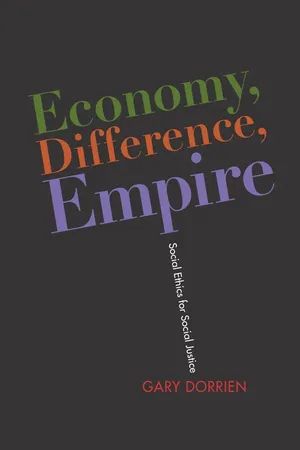
Sourcing the major traditions of progressive Christian social ethics—social gospel liberalism, Niebuhrian realism, and liberation theology—Gary Dorrien argues for the social-ethical necessity of social justice politics. In carefully reasoned essays, he focuses on three subjects: the ethics and politics of economic justice, racial and gender justice, and antimilitarism, making a constructive case for economic democracy, along with a liberationist understanding of racial and gender justice and an anti-imperial form of liberal internationalism.
In Dorrien's view, the three major discourse traditions of progressive Christian social ethics share a fundamental commitment to transform the structures of society in the direction of social justice. His reflections on these topics feature innovative analyses of major figures, such as Walter Rauschenbusch, Reinhold Niebuhr, James Burnham, Norman Thomas, and Michael Harrington, and an extensive engagement with contemporary intellectuals, such as Rosemary R. Ruether, Katie Cannon, Gregory Baum, and Cornel West. Dorrien also weaves his personal experiences into his narrative, especially his involvement in social justice movements. He includes a special chapter on the 2008 presidential campaign and the historic candidacy of Barack Obama.
- English
- ePUB (mobile friendly)
- Available on iOS & Android
eBook - ePub
About this book
Trusted by 375,005 students
Access to over 1.5 million titles for a fair monthly price.
Study more efficiently using our study tools.
Information
Topic
PhilosophySubtopic
Ethics & Moral PhilosophyPart I
The Social Gospel and Niebuhrian Realism
Chapter 1
Society as the Subject of Redemption
WASHINGTON GLADDEN, WALTER RAUSCHENBUSCH, AND THE SOCIAL GOSPEL
The idea that Christianity has a regenerative social mission is rooted in the biblical message of letting justice flow like a river, pouring yourself out for the poor and vulnerable, and attending to what Jesus called the “weightier matters of the law,” justice and mercy. But the idea that Christianity has a social mission to transform the structures of society in the direction of social justice is distinctly modern.
Early Christianity had a regenerative social ethic, but the early church was a marginalized eschatological community. The medieval church had a social ethic of the common good, but it was an ethic of authority and social control. Calvinism had a covenantal social ethic with transformational potential, but it was turned into an apologetic for commercial society. The Anabaptist churches had a radical-conservative social ethic of (usually pacifist) dissent, but the Anabaptists were ascetic or apocalyptic or both. Evangelical pietism had a postmillennial social ethic that fought against slavery and alcohol, but it fixated on personal conversion.
Only with the Christian Socialist movements that arose in England, Germany, France, and elsewhere in the late nineteenth century did the Christian church seek to transform society in the direction of freedom and equality. The North American version of this phenomenon was called the Social Gospel. In it, society became the subject of redemption. Social justice was intrinsic to salvation. If there were such a thing as social structure, redemption had to be reconceptualized to take account of it; salvation had to be personal and social to be saving. The nineteenth-century evangelical forerunners of the social gospel were rich in abolitionist and temperance convictions, but they had no theology of social salvation. Until the social gospel, no Christian movement did.
Notoriously, the social gospel movement had many faults and limitations. Much of it was sentimental, moralistic, idealistic, and politically naïve. Most of it preached a gospel of cultural optimism and a Jesus of middle-class idealism. It spoke the language of triumphal missionary religion, sometimes baptized the Anglo-Saxon ideology of Manifest Destiny, and usually claimed that American imperialism was not really imperialism because it had good intentions. The social gospel helped to build colleges and universities for African Americans, but only rarely did it demand justice for blacks. It supported suffrage for women, but that was the extent of its feminism. It created the ecumenical movement in the U.S., but it had a strongly Protestant, anti-Catholic idea of ecumenism, and the greatest social gospeler, Walter Rauschenbusch, was especially harsh on this topic.
Most social gospel leaders opposed World War I until a liberal Protestant president took the U.S. into the war, whereupon they promptly ditched their opposition to war, with the notable exceptions of Rauschenbusch and Jane Addams. After the war they overreacted by reducing the social gospel to pacifist idealism. In the 1930s, faced with a generation that did not believe the world was getting better, the social gospelers tried to make adjustments, but not very convincingly.
By then some of the movement’s key leaders had been erased from memory, out of embarrassment; later there were more embarrassments to forget. Josiah Strong was an irrepressible movement founder and activist, but his ardent defense of Anglo-American superiority belatedly embarrassed American liberal Protestants. George Herron preached a sensational gospel of national salvation by class, but American capitalists did not repent of being capitalists, and Herron’s scandalous divorce in 1901 put an embarrassing stop to his social gospel career. Harry F. Ward, the movement’s successor to Rauschenbusch, sought to renew the social gospel after it plunged into the ditch of World War I, but he became infatuated with Soviet Communism, the ultimate embarrassment.1
For decades the social gospel was ridiculed for all these factors, beginning with Reinhold Niebuhr’s frosty proto-Marxist polemic of 1932, Moral Man and Immoral Society. Two generations of seminarians learned about the social gospel by reading its Niebuhrian critics, not Rauschenbusch or Washington Gladden. Niebuhr taught, wrongly, that the social gospel had no doctrine of sin and, more justly, that it was too middle-class and idealistic to be a serious force in power politics. After Niebuhr’s generation had passed, liberationists judged that the social gospel and Christian realism were too middle-class, white, male-dominated, nationalistic, and socially privileged to be agents of liberation.
Yet the social gospel, for all its faults, had a greater progressive religious legacy than any other North American movement. Christian realism inspired no hymns and built no lasting institutions. It was not even a movement but rather a reaction to the social gospel centered on one person, Reinhold Niebuhr. The social gospel, by contrast, was a half-century movement and enduring perspective that paved the way for modern ecumenism, social Christianity, the Civil Rights movement, and the field of social ethics. It had a tradition in the black churches that was the wellspring of the Civil Rights movement through the ministries of Reverdy Ransom, Ida B. Wells-Barnett, Benjamin E. Mays, Mordecai Johnson, and Howard Thurman. It had anti-imperialist, socialist, and feminist advocates in addition to its liberal reformers. It created the ecumenical and social justice ministries that remain the heart of American social Christianity. And it espoused a vision of economic democracy that is as relevant today as it was a hundred years ago.2
For the movement’s two greatest figures, Washington Gladden and Walter Rauschenbusch, the social gospel was unapologetically political, with a progressive ideology, and vibrantly evangelical, in a theologically liberal fashion. Gladden developed the theology of social salvation and epitomized the progressive idealism of the social gospel movement. Rauschenbusch converted to social salvation theology and provided the movement’s most powerful case for it.
Good Theology and the Social Good: Washington Gladden
For nearly thirty years the social gospelers called their movement “applied Christianity” or “social Christianity.” Gladden, Strong, Herron, Richard Ely, Shailer Mathews, Francis Greenwood Peabody, and Graham Taylor were prominent among them; Rauschenbusch suddenly became prominent in 1907. By 1910 they usually called it the Social Gospel, though Rauschenbusch considered the name redundant; justly, Gladden was tagged as its father.
Born in 1833, Gladden began his career as an ill-prepared evangelical preacher. Barely a few months into his first pastorate in Brooklyn, New York, at the outset of the Civil War, he suffered a nervous breakdown. In a healing mode, in the quieter climes of Morrisania, New York, he read Horace Bushnell and converted to theological liberalism. Gladden ministered to several churches, took a journalistic stint at a major Congregational newspaper, the Independent, and acquired social ideas. In the mid-1870s he started writing books that expressed his theologically liberal and mildly social approach to Christianity. In 1885, while serving as a pastor in Columbus, Ohio, he worked with Strong and Ely to launch the founding social gospel organizations, the Inter-Denominational Congress and the American Economic Association.3
The social gospel began as a gloss on the Golden Rule. If all are commanded to love their neighbors as themselves, Gladden reasoned, employers and employees should practice cooperation, disagreements should be negotiated in a spirit of other-regarding fellowship, and society should be organized to serve human welfare rather than profits. In his early social gospel career Gladden opposed business corporations and corporate unionism, urging that the virtues of other-regarding cooperation were practicable only for individuals and small groups. All individuals combined traits of egotism and altruism, he judged, and both were essential to the creation of a good society. Moreover, there was such a thing as self-regarding virtue, for a society lacking competitive vigor would have no dynamism. The problem with American society was that its economy was based on competitive vigor alone. Gladden was a bit slow to see that this was a structural problem, not merely a moral one, but he was among the first to say that it mattered.4
The social gospel was a product of Home Missions evangelicalism, Gilded Age reformism, the rise of sociological consciousness, urbanization, the spectacle of Christian Socialist movements in England, and other causal factors that impacted one another. But above all it was a response to the clash between a rising corporate capitalism and a rising workers’ movement that demanded economic justice, not charity. Workers insisted on being treated as citizens with rights to decent wages and working conditions. For Gladden, the year 1886 was a watershed that revealed the structural essence of the social problem.
By that year the Knights of Labor, founded in 1869, had one million members. In March 1886 the Knights struck against Jay Gould’s Missouri-Pacific railroad system, tying up five thousand miles of track. In April President Grover Cleveland gave the first presidential address dealing with trade union and labor issues, suggesting that government serve as an arbitrator in labor-capital disputes. On May 1 the Knights joined with the Black International anarchists, the socialist unions, and other trade unions in massive demonstrations for an eight-hour day. This march, the first “May Day” demonstration, sent eighty thousand protesters down Michigan Avenue in Chicago. Two days later an attack on strikebreaking workers at the McCormick Reaper Manufacturing Company in Chicago led to a deadly police reaction that sparked a riot in Haymarket Square. On May 10 the Supreme Court ruled that a corporation was a legal person under the Fourteenth Amendment, giving corporations the privileges of citizenship. On June 8 anarchists were convicted of conspiracy to murder in the Haymarket riot, despite a weak case against them. Later that month Congress passed legal authorization for the incorporation of trade unions. In October the Supreme Court ruled that states could not regulate interstate commerce passing through their borders, annulling the legal power of states over numerous trusts, railroads, and holding companies. In December the American Federation of Labor was organized out of the former Federation of Trades and Labor Unions, comprising a major new force in unionism.5
These events inspired, goaded, and frightened middle-class Protestants to take the social gospelers seriously. Ely’s The Labor Movement in America (1886) counseled Americans not to dread the rising of the working class; his best-selling Aspects of Social Christianity (1889) encouraged readers to send money to the American Economic Association, “a real legitimate Christian institution.” Gladden charged that American capitalism amounted to a form of warfare, “a war in which the strongest will win,” which was the heart of the social problem. In Gladden’s view, the wage system was antisocial, immoral, and anti-Christian. There were three fundamental choices in political economy: relations of labor and capital could be based on slavery, wages, or cooperation. The wage system marked a sizable improvement over slavery, Gladden allowed, but it fell short of anything acceptable to Christian morality. The first stage of industrial progress featured the subjugation of labor by capital; the second stage was essentially a war between labor and capital; the third stage was the social and moral ideal, the cooperative commonwealth in which labor and capital shared a common interest and spirit.6
For a while Gladden tried to combine a structural view of the problem with an optimistic ethical solution to it. In the late 1880s he assured that the ideal was immanently attainable. “It is not a difficult problem,” he claimed, speaking of the class struggle. “The solution of it is quite within the power of the Christian employer. All he has to do is admit his laborers to an industrial partnership with himself by giving them a fixed share in the profits of production, to be divided among them, in proportion to their earnings, at the end of the year.” Profit sharing was the key to making the economy serve the cause of a good society. It rewarded productivity and cooperative action, channeled the virtues of self-regard and self-sacrifice, socialized the profit motive, abolished the wage system, and promoted mutuality, equality, and community. To the “Christian man,” Gladden contended, the strongest argument for cooperative economics was its simple justice:
Experience has shown him that the wage-receiving class is getting no fair share of the enormous increase of wealth; reason teaches that they never will receive an equitable proportion of it under a wage-system that is based on sheer competition; equity demands, therefore, that some modification of the wage-system be made in the interest of the laborer. If it is made, the employer must make it.7
To the respected Protestant pastor who preached every Sunday to the business class and very few workers, the crucial hearts and minds belonged to the employers. The ideal solution was to convince the capitalist class to set up profit-sharing enterprises, not to abolish capitalism from above or below. Gladden stressed that most employers were no less moral than the laborers they employed. It was not too late to create a decentralized, cooperative alternative to the wage system. Socialism was a poor alternative because it required an over-reaching bureaucracy that placed important freedoms in jeopardy. Socialists wanted to pull down the existing order. Gladden judged they were right to condemn the greed and predatory competitiveness of capitalism, but foolish to suppose that humanity would flourish “under a system which discards or cripples these self-regarding forces.” A better system would mobilize goodwill and channel self-interest to good ends. The reform that was needed was “the Christianization of the present order,” not its destruction. The principal remedy for the evils of the prevailing system was “the application by individuals of Christian principles and methods to the solution of the social problem.”8
Gladden appealed to the rationality and moral feelings of a capitalist class confronted by embittered workers; only gradually did he perceive the irony of his assurance that business executives were at least as moral as their employees. If that was true, the remedy had to deal with more than the morality of individuals. In 1893 he still focused on the moral feelings of the business class, arguing, in Tools and the Man, that the ideal was to create “industrial partnerships” based on profit sharing: “I would seek to commend this scheme to the captains of industry by appealing to their humanity and their justice; by asking them to consider the welfare of their workmen as well as their own. I believe that these leaders of business are not devoid of chivalry; that they are ready to respond to the summons of good-will.”9
But by then Gladden was struggling to believe it. He liked cooperative ownership, but doubted it would make much headway in individualistic America. He believed in profit sharing but realized, increasingly, that it had little chance without strong unions. The latter recognition pulled him gradually to the left in the 1890s, even as he deplored union violence and featherbedding and prized his capacity to mediate between labor and capital. Gladden’s insistent optimism on other subjects and his delight at the ascension of the social gospel did not prevent him from recognizing that his vision of a nonsocialist, decentralized economic democracy had less and less of a material basis in a society increasingly divided along class lines.
His critique of state socialism was sensible and prescient. Gladden charged that socialism, which he identified with centralized state ownership and cont...
Table of contents
- Cover
- Half title
- Series Page
- Title
- Copyright
- Dedication
- Contents
- Introduction
- Acknowledgments
- Part I: The Social Gospel and Niebuhrian Realism
- Part II: Economic Democracy in Question
- Part III: Neoconservatism and American Empire
- Part IV: Social Ethics and the Politics of Difference
- Notes
- Index
Frequently asked questions
Yes, you can cancel anytime from the Subscription tab in your account settings on the Perlego website. Your subscription will stay active until the end of your current billing period. Learn how to cancel your subscription
No, books cannot be downloaded as external files, such as PDFs, for use outside of Perlego. However, you can download books within the Perlego app for offline reading on mobile or tablet. Learn how to download books offline
Perlego offers two plans: Essential and Complete
- Essential is ideal for learners and professionals who enjoy exploring a wide range of subjects. Access the Essential Library with 800,000+ trusted titles and best-sellers across business, personal growth, and the humanities. Includes unlimited reading time and Standard Read Aloud voice.
- Complete: Perfect for advanced learners and researchers needing full, unrestricted access. Unlock 1.5M+ books across hundreds of subjects, including academic and specialized titles. The Complete Plan also includes advanced features like Premium Read Aloud and Research Assistant.
We are an online textbook subscription service, where you can get access to an entire online library for less than the price of a single book per month. With over 1.5 million books across 990+ topics, we’ve got you covered! Learn about our mission
Look out for the read-aloud symbol on your next book to see if you can listen to it. The read-aloud tool reads text aloud for you, highlighting the text as it is being read. You can pause it, speed it up and slow it down. Learn more about Read Aloud
Yes! You can use the Perlego app on both iOS and Android devices to read anytime, anywhere — even offline. Perfect for commutes or when you’re on the go.
Please note we cannot support devices running on iOS 13 and Android 7 or earlier. Learn more about using the app
Please note we cannot support devices running on iOS 13 and Android 7 or earlier. Learn more about using the app
Yes, you can access Economy, Difference, Empire by Gary Dorrien in PDF and/or ePUB format, as well as other popular books in Philosophy & Ethics & Moral Philosophy. We have over 1.5 million books available in our catalogue for you to explore.