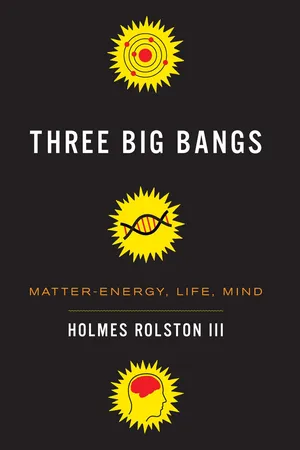
By dividing the creation of matter, energy, life, and mind into three big bangs, Holmes Rolston III brings into focus a history of the universe that respects both scientific discovery and the potential presence of an underlying intelligence. Matter-energy appears, initially in simpler forms but with a remarkable capacity for generating heavier elements. The size and expansion rate of the universe, the nature of electromagnetism, gravity, and nuclear forces enable the the explosion of life on Earth. DNA discovers, stores, and transfers information generating billions of species. Cognitive capacities escalate, and with neural sentience this results in human genius.
A massive singularity, the human mind gives birth to language and culture, increasing the brain's complexity and promoting the spread of ideas. Ideas generate ideals, which lead life to take on spirit. The nature of matter-energy, genes, and their genesis therefore encourages humans to wonder where they are, who they are, and what they should do.
- English
- ePUB (mobile friendly)
- Available on iOS & Android
eBook - ePub
About this book
Trusted by 375,005 students
Access to over 1.5 million titles for a fair monthly price.
Study more efficiently using our study tools.
Information
Topic
PhilosophySubtopic
Religion & ScienceCHAPTER I
The Primordial Big Bang
Matter-Energy
Scientists have been discovering astronomical deep space and deep time, as well as pushing “deep down” from molecular to micro nature. Time has expanded to almost forever, the universe expanded to staggering, inconceivable distances across intergalactic space. We now know of phenomena at structural levels from quarks to quasars. We measure distances from picometers to the extent of the visible universe in light-years. We measure time from picoseconds to the billions-of-years age of the universe. Putting such discoveries together, we have found dramatic interrelationships between astronomical and atomic scales that give us a startling picture of our physical universe. At some risk of vertigo, let’s explore the explosive startup and ongoing expansion of this lavish universe—the first big bang.
Do the macrophysics and the microphysics affect our metaphysics?
Explosive Startup and Ongoing Expansion
The universe is expanding through the stretching of space between galaxies, and if one runs the history rearward, it shrinks to a point of startup, a primordial hot big bang, now dated about 13.7 billion years ago. Cosmologists have made claims about the duration of the “early universe”—from about one microsecond after the initial “singularity” (as they may call it) to several hundred thousand years (400,000 years) as a superhot universe. They make further claims about an initial “inflation” when the originating universe, less than 10-35 seconds old, jumped in size by an enormous factor (about 1060), expanding faster than the speed of light (Guth 1997; Linde 1990). At that time all of the present universe was somehow packed into space smaller than that of a typical atom, and this at extremely high temperature.
Cosmologists can wonder if their capacities to describe what was going on under these conditions are credible, since most of the astrophysical and microphysical processes we otherwise know would there break down. Most rather doubt that we can know anything before what they call Planck time, when the universe was 10-43 seconds old (though see below on symmetry-breaking). Perhaps even time itself appears somehow in the startup out of an initially atemporal big bang, so that to think of some “time zero” is misleading. Nevertheless, scientists are at near consensus about an originating singular huge explosion.
This earliest point of the present universe was tagged “the big bang” by Fred Hoyle, first derisively, but the name stuck. So the first big bang is an explosion of matter-energy. The creation of something out of nothing at the beginning of time was clearly a remarkable occurrence. Or if there was something before, or if the “nothing” was some sort of creative vacuum, the explosion was still spectacular. There was explosion, inflation compounding explosion, and continuing explosion after that. That is superexplosion. The result is huge: if in some spaceship we could travel at the speed of light, it would take us billions and billions of years to cross it. This huge universe resulted from an explosion starting as a tiny speck. (Actually all this was silent. “If a tree falls in the forest, and there is no one to hear it….”)
Since the big bang, whether explosion continues is a matter of perspective. The universe is still expanding, though at a diminished rate. There is some evidence that the presently continuing expansion is speeding up. There was creativity at the primordial big bang, which launched ongoing creativity in the expansion. Here the expansion rate (the ongoing explosion rate, if you like) proves critical. If the expansion rate of the universe had been a little faster or slower, then the universe would already have recollapsed or the galaxies and stars would not have formed. This expansion rate figures into astronomical calculations such as those for the strengths of the four fundamental forces, or of the cosmological constant. We return to the often puzzling character of these astronomical facts below.
From one perspective, in the big bang, everything is flying apart in a universe continually expanding and generally uniform (isomorphic); but from another perspective, there are local departures from the overall smoothness. In these non-isomorphic regions, under the influence of gravity, matter clumps up into stars, into galaxies, the loci of ongoing creativity. The particulars of such stars and galaxies may depend on earlier random fluctuations, perhaps even quantum indeterminacies. Or they may depend on the intersections of previously unrelated causal lines (stars crashing into each other) or involve chaotic features. But the overall processes are nomothetic, lawlike (making celestial mechanics possible, or explaining stellar evolution).
This energetic matter not only clumps, it complexifies. Nature aggregates and builds. Across this long time span in the rapidly expanding universe, the stars are the furnaces in which all but the very lightest elements are forged, a process called nucleosynthesis (Clayton 1983). Further, the various heavier elements—carbon, oxygen, sulphur, nitrogen, silicon, all of the elements heavier than hydrogen and helium (also when the universe was still hot, some lithium)—are synthesized in proportions that make later planets and life possible. These elements, made of protons, neutrons, electrons, inner positive nuclei and outer negative shells, are forged with bonding capacities, almost like grappling hooks, making possible endless recombinations. The stars run their courses and some explode as supernovae, dispersing the heavier elements from their production sites throughout space. Such matter is condensed as planets, and life evolves out of such elements.
From our present human perspective, the cosmic big bang may still seem like a lot of waste—all those galaxies, stars, asteroids, cosmic dust, dark matter, dark energy. Do we really need a universe with a hundred billion galaxies, each with a hundred billion stars? Maybe we are lost out there in the stars. Explosions make a lot of noise (loud sound from the burst of power), a lot of “noise” (chaotic background disturbance confusing any signal). Well, maybe the first big bang did not make a sound, but is there any signal in the scattering of galaxies, stars, asteroids, black holes, and so on? Even if much of the bang was meaningless noise, from this “singular” universe, some of the results of the huge explosion continue as the Earth, the earth, the dirt under our feet, the flesh and blood of our bodies and brains. And we have no scientific theory as to how we might have obtained such bodies and brains without some remarkable elemental source, such as this singular big bang provides.
The universe is so huge that we can see only the parts of it in our light cone, the area within which the light has had time to get to us. The Hubble Space Telescope has imaged galaxies over 10 billion light-years distant. But if the scale of the universe were much reduced (to galaxy size for instance, 100,000 light-years across), there would not have been enough time for stars to form and generate the elements beyond hydrogen and helium, elements that later make life possible. John Barrow surveys the universe: “Many of its most striking features—its vast size and huge age, the loneliness and darkness of space—are all necessary conditions for there to be intelligent observers like ourselves” (Barrow 2002:113). There is, in fact, a lot that is quite singular resulting from this singularly huge explosion.
A Singular Universe: Unfolding Order
Explosions can be rather messy, often more disruptive than creative. Our exploding universe, however, settled into an expansion rapid enough to prevent collapse on itself and slow enough to continue for billions of years, permitting galaxies, stars, and planets to form. So, despite this explosive character of the infant universe, the result produces much order. The astronomical (and terrestrial) realms of matter-energy are lawlike—mechanistic, a clockwork universe. The initial conditions at the big bang were, presumably, idiographic, that is, unique to this universe. But those fermenting conditions produced a coherent universe that is physically nomothetic, lawlike, and ordered, whatever the chaotic elements.
Scientists typically claim that the laws of physics and chemistry are true and unchanging all over the universe, often in contrast with the biological sciences, where it may be claimed there are no universal laws at all, only generalizations in an earthbound natural history. Physicists may indeed brag that theirs is the most ordered of the sciences, with more mathematical and logical rigor than biology, psychology, sociology. Physicists can predict eclipses centuries hence; economists cannot predict the stock market tomorrow. Think of all the equations in physics, such as E=mc2, or the reactions in chemistry, based on the atomic table posted behind the lecture podium in every chemistry classroom. The impressive rigor of physics and chemistry is seen in their metric character, with accompanying predictability and testability.
All the mathematics underlying the discussions to which we soon turn regarding the “theory of everything” or the “fine-tuned” character of the pivotal processes in the formation of the stars, elements, and planets underscores this order. Einstein concluded, famously, that “the eternal mystery of the world is its comprehensibility” (Einstein 1970:61). Eugene P. Wigner, a physicist and mathematician, contends “that the enormous usefulness of mathematics in the natural sciences is something bordering on the mysterious and that there is no rational explanation for it…. The miracle of the appropriateness of the language of mathematics for the formulation of the laws of physics is a wonderful gift which we neither understand nor deserve” (Wigner 1960:2, 14).
John A. Wheeler exclaims, “This is a world of pure mathematics and when we penetrate to the bottom of it, that’s all it will be” (Wheeler, interviewed in Helitzer 1973:27). Is there nothing but order, captured by mathematical precision, a “matheomorphic” universe, as though the big bang was actually a mathematical explosion? Something is needed beyond the pure mathematics to compel it to exist in an actual world. There are worlds imaginable in pure mathematics that are never realized. Though Stephen Hawking delights in searching for a theory of everything, he goes on to ask:
Even if there is only one possible unified theory, it is just a set of rules and equations. What is it that breathes fire into the equations and makes a universe for them to describe? The usual approach of science of constructing a mathematical model cannot answer the question of why there should be a universe for the model to describe. (Hawking 1998:190)
The theoretical, matheomorphic universe exploded in an actual fireball, and the fire still burns after thirteen billion years.
The mathematical character of high-level physics, even after we can no longer picture what is going on, does suggest that the ordered intelligibility of this exploding, expanding universe vastly outruns our sensory capacities for perception and our local capacities for experience. The mathematics still seems to contact and correspond to physical nature. As far as our capacities for thought reach, whether in words or in mathematics, the universe seems unreasonably “reasonable,” intelligible, despite the fact that we can no longer visually represent, verbally model, or perceptively sense it. The math still works even in realms where sense and intuition do not easily serve. The explosive big bang produces a realm of exquisite, supersensory rationality that transcends but supports sense, space, and time. We are not yet prepared to consider the third big bang: mind. But perhaps there is already an intimation. Mathematics is, above all, mental; it is the logical creation of the human mind, and the fact that mathematics repeatedly helps us to understand the structure of the physical world corroborates the belief that the world we inhabit is the creation of mind. We might even need that encouragement when we plunge into the chaos of biology.
The big bang launched natural history. In the ongoing explosion, mathematics remains powerless to appreciate a world until it adds a narrative of events. Perhaps in advanced physics, there are only equations, with no pictures, but mathematics is useless without a text, without words—no matter how much it is also true that mathematics accomplishes what words cannot. The spacetime diagrams must have a caption, the equations an interpretation. Past this, complex nature is never fully described by mathematical models. To the contrary, very much is left out, and mathematics is to that extent stylized and crude as a description of rich natural processes. Its precision is bought with its incompleteness. Neither mathematics nor other forms of physics anywhere know the categories of life and death, nor mind and conscious experience, which, with the second and third big bangs, became the phenomena that most cry out to be explained. Even within physical cosmology, there are factual claims such as those involving the anthropic principle—observations about values of fundamental constants, forces, conditions that are prerequisites for the complex chemistries of life. These may be mathematical, based on values in equations, but the cosmological interpretation of these facts is not. The interpretation is historical, metaphysical, theological.
Nature has mathematical dimensions at every structural level. But we do not from this conclude that all the world’s cleverness and beauty lie in its mathematics. Even if we were to lay aside the upper levels that metricize less well, at the quantum levels our metricizing capacities, profound as they are, run to an end zone. We cannot completely metricize the individual quantum event; it defies mathematical specification in its concreteness. At this point, curiously, one of the most impressive of our mathematical theories tells us that nature permits no further mathematical specifiability.
Certainly the order is impressive, nowhere more so than in the mathematics that maps the big bang. But mathematics is not the only mode of thought competent for judging multidimensional nature. Physics and chemistry are the most abstractive of the sciences. To some extent they are abstracted out of a more messy real world: physical laws are not so much ultimate and absolute as they are approximations over statistical averages with margins of error. Impressive as such laws are in physics and chemistry, they leave out all the emergent eventfulness with which the other sciences and the humanities will want to deal. Physics and chemistry take no special subset of natural entities for their subject matter, while biology takes organisms, psychology takes behavior and mind, sociology takes societies, and even the special physical sciences—geomorphology or meteorology—have their restrictions. We need to stay alert to the paradox that these universal physical sciences, which seem so powerful in interpreting what has resulted from the primordial explosion, also drastically oversimplify (Ellis 2005).
There is yet another side to this emphasis on order unfolding from the primordial big bang, especially when we anticipate what kind and levels of order make possible the second and third big bangs. We do not find physically, nor do we want philosophically, any law that says: order, more order, more and more order. Logically and empirically, beyond mathematical order and predictability, there must be an interplay of order and disorder, certainty and openness if there is to be autonomy, freedom, adventure, success, achievement, emergents, surprise, and idiographic particularity.
Order is related to information, and we will in the next chapter be analyzing this in biology, where it is a central theme in genetics, after the second big bang. Today, with the exploding that has resulted in the third big bang and our ever-advancing human cognitive capacities, we may think we have entered the information age. Information theory began in electronics and computing, and physicists sometimes ask about the information content of the physical world. Hans Christian von Baeyer, a physicist, anticipates: “If we can understand the nature of information, and incorporate it into our model of the physical world… then physics will truly enter the information age” (von Baeyer 2003:17).
John Wheeler, following from his claims that the world is pure mathematics, has made a further famous claim, enigmatically epitomized in his aphorism “it from bit.” The world of objects, “its,” is rooted fundamentally in “bits,” information units, a term borrowed from computer memories. “It from bit symbolizes the idea that every item of the physical world has at bottom—at a very deep bottom, in most instances—an immaterial source and explanation… in short that all things physical are information-theoretic in origin and this is a participatory universe” (Wheeler 1994:296). “‘Getting its from bits’… refers to a vision of a world derived from pure logic and mathematics” (Wilczek 1999:303).
Wheeler speculates that order penetrates the universe as a sort of network or circuit loop, even involving backward causation, in which there is a Platonic demand for intelligibility. The physical world gives rise to the possibilities of communication; intelligent agents evolve, who analyze nature and find it rational, mathematical. But these agents, though coming later in time, are determinants of the physical characteristics of the universe. “The whole show is wired up together.” “Will we someday understand time and space and all the other features that distinguish physics—and existence itself—as… a self-synthesized information system?” (Wheeler 1999:316, 321). At this point, however, Wheeler goes beyond his “pure mathematics.” He does need, in his metaphor, to get existing “its” (actual physical objects) from his “bits” (mathematical forms). The “its” of the real world are interparticipatory with “bits” of significance, meaning.
In an...
Table of contents
- Cover
- Half title
- Title
- Copyright
- Contents
- List of Illustrations
- Preface
- 1: The Primordial Big Bang: Matter-Energy
- 2: Life: Earth’s Big Bang
- 3: Mind: The Human Big Bang
- References
- Index
Frequently asked questions
Yes, you can cancel anytime from the Subscription tab in your account settings on the Perlego website. Your subscription will stay active until the end of your current billing period. Learn how to cancel your subscription
No, books cannot be downloaded as external files, such as PDFs, for use outside of Perlego. However, you can download books within the Perlego app for offline reading on mobile or tablet. Learn how to download books offline
Perlego offers two plans: Essential and Complete
- Essential is ideal for learners and professionals who enjoy exploring a wide range of subjects. Access the Essential Library with 800,000+ trusted titles and best-sellers across business, personal growth, and the humanities. Includes unlimited reading time and Standard Read Aloud voice.
- Complete: Perfect for advanced learners and researchers needing full, unrestricted access. Unlock 1.5M+ books across hundreds of subjects, including academic and specialized titles. The Complete Plan also includes advanced features like Premium Read Aloud and Research Assistant.
We are an online textbook subscription service, where you can get access to an entire online library for less than the price of a single book per month. With over 1.5 million books across 990+ topics, we’ve got you covered! Learn about our mission
Look out for the read-aloud symbol on your next book to see if you can listen to it. The read-aloud tool reads text aloud for you, highlighting the text as it is being read. You can pause it, speed it up and slow it down. Learn more about Read Aloud
Yes! You can use the Perlego app on both iOS and Android devices to read anytime, anywhere — even offline. Perfect for commutes or when you’re on the go.
Please note we cannot support devices running on iOS 13 and Android 7 or earlier. Learn more about using the app
Please note we cannot support devices running on iOS 13 and Android 7 or earlier. Learn more about using the app
Yes, you can access Three Big Bangs by Holmes Rolston III in PDF and/or ePUB format, as well as other popular books in Philosophy & Religion & Science. We have over 1.5 million books available in our catalogue for you to explore.