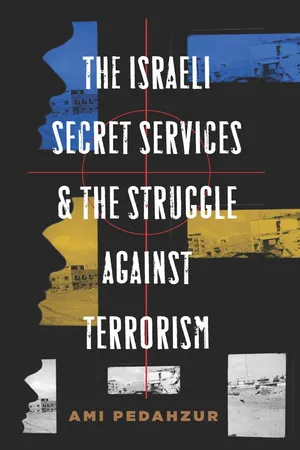
While Mossad is known as one of the world's most successful terrorist-fighting organizations, the state of Israel has, more than once and on many levels, risked the lives of its agents and soldiers through unwise intelligence-based intervention. The elimination of Palestinian leaders and militants has not decreased the incidence of Palestinian terrorism, for example. In fact, these incidents have become more lethal than ever, and ample evidence suggests that the actions of Israeli intelligence have fueled terrorist activities across the globe.
An expert on terror and political extremism, Ami Pedahzur argues that Israel's strict reliance on the elite units of the intelligence community is fundamentally flawed. A unique synthesis of memoir, academic research, and information gathered from print and online sources, Pedahzur's complex study explores this issue through Israel's past encounters with terrorists, specifically hostage rescue missions, the first and second wars in Lebanon, the challenges of the West Bank and Gaza, Palestinian terrorist groups, and Hezbollah. He brings a rare transparency to Israel's counterterrorist activities, highlighting their successes and failures and the factors that have contributed to these results. From the foundations of this analysis, Pedahzur ultimately builds a strategy for future confrontation that will be relevant not only to Israel but also to other countries that have adopted Israel's intelligence-based model.
- English
- ePUB (mobile friendly)
- Available on iOS & Android
eBook - ePub
The Israeli Secret Services and the Struggle Against Terrorism
About this book
Information
Subtopic
Middle Eastern HistoryIndex
HistoryCHAPTER ONE
THE EMERGENCE OF ISRAEL’S COUNTERTERRORISM DOCTRINE
THE COUNCIL OF DELEGATES (Vaad Hatzirim), led by Chaim Weizmann, was the board in charge of the daily affairs of the Jewish Yishuv before the establishment of Israel. As far back as 1918, thirty years before the State of Israel came into being, the Council of Delegates founded the Intelligence Bureau, the first Jewish Palestine-based information service. In charge of the Intelligence Bureau was Levi Yitzhak Schneorson, a former member of Nili, the Jewish underground movement that operated in Palestine and assisted the British military forces during World War I, mainly by providing intelligence on the status of the Ottoman Army. The organization first operated out of an office in Jaffa and later relocated to Jerusalem. Intelligence Bureau agents recruited Palestinian informants who, for a certain price, would disclose information on prominent Arab figures, Palestinian nationalist groups, and even plots of land that Arabs had put up for sale. One of the critical subjects was the collection of intelligence regarding groups whose members planned on harming Jews. The information was then passed on to the Council of Delegates and in certain cases to the secret police of the British Mandate authorities.
A short while after the Haganah was conceived in 1920, its commanders began to create an intelligence department that in due course formed the basis for the Shai (from the Hebrew acronym for Sherut Yediot, “information service”), which was officially established in 1933. The head of the organization was Shaul Avigur, who established a human-intelligence (HUMINT) infrastructure throughout the country. Shai intelligence handlers were appointed in charge of regional districts, and in each district, agents were planted who provided handlers with information. Avigur was responsible for collecting information items and disseminating them to Haganah commanders. However, despite the efforts of Avigur and his people, the Great Arab Revolt, which broke out in 1936, took the Shai and the Yishuv leadership by surprise.1
dp n="28" folio="15" ?THE RESPONSE TO THE 1936 REVOLT
The revolt began with attacks against Jews in mixed cities, but violence quickly spread to agricultural settlements and transportation routes throughout the country. Unlike previous violence waged against the Yishuv, this time the attacks were well planned. Up until the outbreak of the events, Shai officials assumed that the Arabs in Palestine lacked a central leadership and operated mainly on a regional and familial or clan (hamula) basis. The foremost reason for the failure to identify the development of a new kind of central leadership was that Shai local operatives gathered intelligence only on regional hamulas without crosschecking their items with each other, and they vehemently guarded their own information-collection areas. There was no main intelligence-processing center within the Shai organization, so local operatives worked almost independently. In 1921, Haj Amin al-Husseini was appointed mufti of Jerusalem, the highest-ranking religious ruler in Palestine, and in 1922 he became the head of the Muslim High Council of Palestine, which managed Muslim life there. Al-Husseini brought together the heads of the biggest and most important hamulas in Palestine, as well as intellectuals and political leaders, under the control of a new organization called the Supreme Arab Committee. The mufti’s ability to form and coordinate this committee, which was established in 1936 in order to manage the Great Arab Revolt, was a task unprecedented and hence overlooked.2
The committee led the events from the second day of the revolt and controlled the uprising for a period of three years. Eventually it forced the Shai to alter its basic assessments and improve its HUMINT network in Palestinian society. One of the lessons drawn from the intelligence failure of 1936 was the need to expand intelligence-gathering efforts among the Palestinian population by installing Shai intelligence handlers in Palestinian communities. This type of agent would have a good command of the nuances and codes of the Arabic language and a deep familiarity with the inner workings of Palestinian society. Ezra Danin, a citrus grower, founded the Shai Arab Department. Most of the handlers he was in charge of did not have a background in intelligence work; they were essentially watchmen and cattle dealers who knew the local language and culture of the residents. The Haganah also rebuilt its Nodedet detachment, a roving field-intelligence corps founded as a special unit of the Haganah during 1933—1935, which spread out into the countryside to locate pockets of organized Arab resistance and neutralize them before they could develop operational capabilities. Even so, the extensive efforts of the Jewish forces did not bear the anticipated results.3
The British Mandate authorities finally suppressed the revolt. The British forces were experienced in anticolonialist activity and imposed collective punishments on Arab neighborhoods and villages that sheltered the rebels. The British additionally conducted mass arrests and executed more than 150 men found guilty of illegal arms possession or of participating in or aiding violent activities. By the end of the revolt, in 1939, the Arab population was in a state of collapse. More than six thousand people had been killed during the uprising, and another six thousand were incarcerated. More than two thousand homes had been destroyed, and the agricultural infrastructure of most Arab villages had been critically damaged. In addition, commerce with the Yishuv was paralyzed, resulting in extensive unemployment. The mufti of Jerusalem fled in fear of the Mandate authorities; after a long period of wandering, he found refuge in Nazi Germany.4
In 1940, Shai underwent additional reforms, which included the establishment of a national headquarters whose function was to centralize the activities of the local branches as well as to initiate a counterespionage department. The purpose of this department, called Ran, was to track down Jews who were collaborating with the British Mandate authorities. Some two years later, under the leadership of Yisrael Zblodovsky (Amir), the Shai began to take shape as a bona fide intelligence organization. Its headquarters started out in an apartment on Melchett Street and later relocated to an ordinary-looking building at 85 Ben Yehuda Street in Tel Aviv. Above the entrance to the building hung a sign reading “Consulting Offices.” In practice, the apartment served as the nerve center of the regional and designated departments of the organization. The General Department functioned as the Yishuv’s secret police, its main job was the surveillance of Jewish offenders. The task of the other designated departments—the Jewish and the Communist—was to gather information on political factions from both right and left that refused to accept the Haganah’s authority. The Arab Department, which would later serve as the foundation for the Arab arm of the Shin Bet (the first letters of “security service” in Hebrew),was in charge of intelligence activities among Palestinian populations all over the country.5
In 1945, the Shai special forces broadened their range of activities. The organization began to gather intelligence from “open” (unrestricted) sources. At the top of its list were the media. It began conducting basic research on demographic and economic trends as well as the customs and conventions of the Palestinian populace. Equal importance was devoted to laying down the infrastructure for the development of signal intelligence (SIGINT) departments. Although Shai activities were still relatively limited, its technical department and the Haganah signal services engaged in the wiretapping of British and Palestinian communication networks. With the assistance of cryptographic experts, they intercepted British Army communications and decrypted its codes.6
THE UN PARTITION RESOLUTION
On November 30, 1947, one day after the United Nations General Assembly voted to approve the partition of Palestine between the Jews and the Arabs, three Palestinians ambushed a Jewish bus traveling from Netanya to Jerusalem. When the bus passed by the airport near Lod, it came under a hail of bullets, and five passengers were killed. During the following weeks, the attacks spread to Jewish neighborhoods in mixed towns and cities such as Jerusalem, Jaffa, and Haifa. The most notable attack in the port city of Haifa took place on December 30, 1947, when thirty-nine Jewish laborers were massacred at the city’s oil refineries. In Jerusalem the most prominent attack occurred four and a half months later, on April 13, 1948, when a medical convoy consisting of a military armored truck, ambulances, and several cars was attacked on its way to Mount Scopus in Jerusalem. As the convoy drove near the Sheikh Jarrah neighborhood, militants lying in ambush detonated electric mines that had been planted on the road. Some of the cars flipped over from the explosions, and immediately after, shots were fired and grenades were thrown at the convoy. Seven hours after the battle initially broke out, the gunfire finally ceased. Seventy-eight of the convoy passengers, including doctors, nurses, and employees of the Hebrew University were killed, many of them burned alive inside the cars.7
These larger-scale operations demonstrated to the Shai that while the Yishuv was improving its intelligence and operational faculties, the military capabilities of the Palestinians had also advanced dramatically. Even though local cells executed many of the attacks, once again there was evidence of an external guiding hand. This was in effect the Supreme Arab Committee, which was reorganizing under the leadership of the mufti who had returned from exile. The Supreme Committee opposed the UN decision on the partition and sought to undermine it by activating militias composed of local paramilitary units and led by the mufti’s cousin, Abdel-Kader al-Husseini. Another important organization was the Arab Salvation Army, which numbered more than three thousand volunteers from various Arab countries who were deployed to Palestine under the leadership of Fawzi Al-Qawuqji, a Lebanese-born Arab nationalist who had received his military training at the Military College in Istanbul. He participated in the Syrian rebellion against the French in 1932 and in 1948 was appointed commander of the Arab Salvation Army. The army was established by the Arab League in order to seize control of Palestine after the withdrawal of the British and thus prevent the Jews or the Supreme Arab Committee from taking command of the area.8
Despite severe attacks, the Yishuv intelligence units were much more prepared than they had been a decade earlier. Informant networks recruited by Shai from the various echelons of Palestinian society provided the intelligence agency with vital strategic information. For example, Shai recruited one of the senior clerks from the Supreme Arab Committee, who, when learning of the military actions planned by the committee in response to the UN partition decision, passed them on to his operators. In another example, a Shai agent relayed information about Arabs in Tsefat who were planning to dig a tunnel into the Jewish market center. This information was one of the leading factors in the state leadership’s decision to conquer the city. The Shai technical department exhibited impressive capabilities in intercepting transmissions between Palestinian forces and those of other Arab countries, as well as among the different arms of the Palestinians forces inside Palestine. Members of the unit discovered that Husseini’s people were using a telephone cable from Palestine to Cairo that was laid near the fields of the Jewish agriculture school Mikveh Israel. In a secret operation, they connected eavesdropping devices to the cable, enabling Shai to listen in on the talks between Husseini’s commanders and the Egyptian military command. In another case, Shai officer Tuvia Lishansky attached an eavesdropping device to the telephone cable that ran between Al-Qawuqji’s headquarters in Jaba village and his forces in northern Palestine. With this device, they discovered that an attack was planned for February 1948 on Kibbutz Tirat-Zvi. This information helped the Haganah repel the Palestinian attack.
Senior Shai officials who received information on the tension between the Supreme Arab Committee and the Salvation Army also engaged in attempts to divide and conquer. They negotiated with the heads of both organizations and took advantage of the rift to further the Yishuv’s interests. In a meeting on April 1, 1948, in the village of Nur A-Shams near Tulkarm, Yehoshua (Josh) Palmon, a senior Shai officer, met with Fawzi Al-Qawuqji and convinced him not to take part in the fighting that had broken out between the Haganah and Husseini’s army. The Shai also kept channels of communication open with the Mandate authorities. In February 27, 1948, the Shai received information that Abdel-Kader Husseini’s men had prepared huge explosive devices in Bir Zeit that were to be installed on two stolen military trucks and blown up on King George Street in Jerusalem. Chaim Herzog, the Shai liaison officer to the British forces in Jerusalem, communicated this information to the Mandate authorities. Two days later, Mandate intelligence agents returned his favor by informing him of the Palestinian intention to blow up a building at the Hebrew University of Jerusalem on Mount Scopus.9
Along with the intelligence-gathering divisions that they developed, the heads of Shai also took advantage of the Shahar Unit from the Palmach. Fighters from this elite undercover unit were trained to infiltrate and blend in completely with the Arab population—a process called histaarevut, a neologism made up of two Hebrew words meaning “to disguise oneself” and “to become Arab”—in order to collect information and engage in special clandestine operations. The members of this unit, known as mistaarvim, were the sons of families that had immigrated to Israel from North African or Middle Eastern countries and who had grown up near Arab neighborhoods and had a good command of the Palestinian dialect. Before seeing action, the recruits underwent a demanding preparation course. They were trained as commando fighters and were proficient in sabotage, sharpshooting, and communications. In addition, they would learn Islamic cultural codes, the lifestyles of Palestinians in the cities and villages, and the customs that set apart various Arab communities all over the country.
From their base, nestled in Kibbutz Alonim in the Jezreel Valley, small teams of fighters dressed up as Arabs would set out on missions in Jewish-Arab mixed cities such as Haifa and Jaffa, as well as remote villages and Palestinian cities in the West Bank, including Nablus and Hebron. The reputation gained by the Shahar troops among the Haganah and Palmach led the higher command of these organizations to dispatch them on special missions in neighboring Arab countries. Although most of these missions were devoted to gathering intelligence, in some cases they were also asked to carry out attacks on Arab leaders.
Sheikh Nimer Al-Hatib of Haifa was the target of one of these operations. In February 1948, a cell from the Shahar Unit was sent to execute this charismatic preacher. However, the protective shield around the sheikh called for a change of plans. One week later, members of the unit sat in a car waiting for the sheikh’s entourage, which was just returning from a visit in Damascus. In the neighborhood of Kiryat Motzkin, the convoy was identified, and a vehicle whose function was to slow down the preacher’s car shot after him. A few minutes later, another car joined the chase. The sheikh was able to observe the second car only when it pulled alongside his own car. Several seconds later, shots rang out from the same car, and four bullets struck his body, severely injuring the sheikh and putting him out of political action.10
THE FORMATION OF THE ISRAELI INTELLIGENCE ORGANIZATIONS
Immediately after Israel’s declaration as an independent state on May 14, 1948, Shai faced a new challenge. The combined attack of the Arab armies on the fledgling state made quality military intelligence an essential priority and sidelined the preoccupation with Palestinian attacks.11 The fighting between the Israel Defense Forces and the Arab armies continued for almost a year, concluding in the Rhodes Armistice of 1949. Israel and Jordan, Syria, Lebanon, Egypt, and Iraq signed this agreement, which established the borders of Israel.
On the basis of consultations in June 1948 with Reuven Shiloah, the prime minister’s advisor for intelligence affairs, who later also founded Mossad, and Chaim Herzog, former head of intelligence for the Haganah, Prime Minister David Ben-Gurion decided to create three intelligence institutions. Isser Beeri, who had been the chief of Shai, was assigned to head the military intelligence branch, known as Aman. The functions of this organization were to compile intelligence on the armies of Arab countries and maintain internal military security. Isser Harel, head of the Tel Aviv district of Shai, was appointed in charge of the Internal Security Services (later to become known as the Shin Bet), which dealt with gathering information within the sovereign territory of the State of Israel and counterespionage. These two institutions, with lieutenant colonels as their commanders, were subordinated to the IDF. Then, at the end of the 1948 war, the Political Department of the Ministry of Foreign Affairs was established. Its aim was to collect information outside Israel. Boris Guriel, the head of the political department of the Haganah, was appointed as head of the new Political Department, but he also continued to report to Shiloah.12
Toward the end of 1949, Ben-Gurion decided to institute the first structural reform of the Israeli intelligence community. One of the main reasons for this decision was the ongoing struggle for authority among its various arms. Reuven Shiloah understood that these tensions were detrimental to the effective functioning of the intelligence community and proposed that there be an overriding institution to coordinate intelligence services and security. In April 1949, the Varash—Committee of the Heads of Services—was formed. For its first convention on April 8, the heads of the variou...
Table of contents
- COLUMBIA STUDIES IN TERRORISM AND IRREGULAR WARFARE
- Title Page
- Table of Figures
- Acknowledgments
- Introduction
- CHAPTER ONE - THE EMERGENCE OF ISRAEL’S COUNTERTERRORISM DOCTRINE
- CHAPTER TWO - THE PATH TO THE DEFENSIVE MODEL AND BACK
- CHAPTER THREE - RESCUING HOSTAGES
- CHAPTER FOUR - THE LEBANESE PUZZLE
- CHAPTER FIVE - NEW CHALLENGES FROM THE WEST BANK AND GAZA
- CHAPTER SIX - THE GLOBAL CHALLENGE OF IRAN AND HEZBOLLAH
- CHAPTER SEVEN - NEW RIVALS, OLD RESPONSES
- CHAPTER EIGHT - A WAR AGAINST AN ELUSIVE ENEMY
- CHAPTER NINE - THE SECOND LEBANON WAR AND BEYOND
- CHAPTER TEN - FIGHTING THE TERRORISM PLAGUE
- NOTES
- GLOSSARY
- INDEX
- Copyright Page
Trusted by 375,005 students
Access to over 1.5 million titles for a fair monthly price.
Study more efficiently using our study tools.
Frequently asked questions
Yes, you can cancel anytime from the Subscription tab in your account settings on the Perlego website. Your subscription will stay active until the end of your current billing period. Learn how to cancel your subscription
No, books cannot be downloaded as external files, such as PDFs, for use outside of Perlego. However, you can download books within the Perlego app for offline reading on mobile or tablet. Learn how to download books offline
Perlego offers two plans: Essential and Complete
- Essential is ideal for learners and professionals who enjoy exploring a wide range of subjects. Access the Essential Library with 800,000+ trusted titles and best-sellers across business, personal growth, and the humanities. Includes unlimited reading time and Standard Read Aloud voice.
- Complete: Perfect for advanced learners and researchers needing full, unrestricted access. Unlock 1.5M+ books across hundreds of subjects, including academic and specialized titles. The Complete Plan also includes advanced features like Premium Read Aloud and Research Assistant.
We are an online textbook subscription service, where you can get access to an entire online library for less than the price of a single book per month. With over 1.5 million books across 990+ topics, we’ve got you covered! Learn about our mission
Look out for the read-aloud symbol on your next book to see if you can listen to it. The read-aloud tool reads text aloud for you, highlighting the text as it is being read. You can pause it, speed it up and slow it down. Learn more about Read Aloud
Yes! You can use the Perlego app on both iOS and Android devices to read anytime, anywhere — even offline. Perfect for commutes or when you’re on the go.
Please note we cannot support devices running on iOS 13 and Android 7 or earlier. Learn more about using the app
Please note we cannot support devices running on iOS 13 and Android 7 or earlier. Learn more about using the app
Yes, you can access The Israeli Secret Services and the Struggle Against Terrorism by Ami Pedahzur in PDF and/or ePUB format, as well as other popular books in History & Middle Eastern History. We have over 1.5 million books available in our catalogue for you to explore.