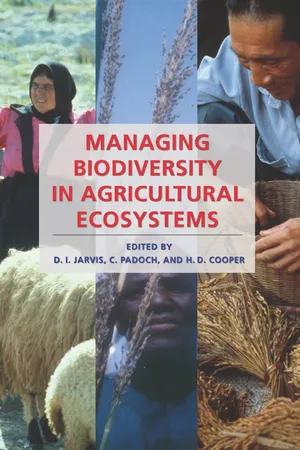
Published in three other languages and growing, Managing Biodiversity in Agricultural Ecosystems takes a look at how farmers manage, maintain, and benefit from biodiversity in agricultural production systems. The volume includes the most recent research and developments in the maintenance of local diversity at the genetic, species, and ecosystem levels. Chapters cover the assessment and farmer management practices for crop, livestock, aquatic, and associated diversity (such as pollinators and soil microorganisms) in agricultural ecosystems; examine the potential role of diversity in minimizing pest and disease pressures; and present studies that exemplify the potential nutritional, ecosystem service, and financial values of this diversity under changing economic and environmental conditions. The volume contains perspectives that combine the thinking of social and biological scientists.
Inappropriate or excessive use of inputs can cause damage to biodiversity within agricultural ecosystems and compromise future productivity. This book features numerous case studies that show how farmers have used alternative approaches to manage biodiversity to enhance the stability, resilience, and productivity of their farms, pointing the way toward improved biodiversity on a global scale. As custodians of the world's agricultural biodiversity, farmers are fully invested in ways to create, sustain, and assist in the evolution and adaptation of a variety of plant and animal species. Thus this text is mandatory reading for conservationists, environmentalists, botanists, zoologists, geneticists, and anyone interested in the health of our ecosystem.
Biodiversity in agricultural ecosystems provides our food and the means to produce it. The variety of plants and animals that constitute the food we eat are obvious parts of agricultural biodiversity. Less visible—but equally important—are the myriad of soil organisms, pollinators, and natural enemies of pests and diseases that provide essential regulating services that support agricultural production. Every day, farmers are managing these and other aspects of biological diversity in agricultural ecosystems in order to produce food and other products and to sustain their livelihoods. Biodiversity in agricultural ecosystems also contributes to generating other ecosystem services such as watershed protection and carbon sequestration. Besides having this functional significance, maintenance of biodiversity in agricultural ecosystems may be considered important in its own right. Indeed, the extent of agriculture is now so large, any strategy for biodiversity conservation must address biodiversity in these largely anthropogenic systems. Moreover, biodiversity in agricultural landscapes has powerful cultural significance, partly because of the interplay with historic landscapes associated with agriculture, and partly because many people come into contact with wild biodiversity in and around farmland.
This book examines these various aspects of agricultural biodiversity. A number of chapters examine crop genetic resources (chapters 1, 2, 3, 10, 11, and 16) and livestock genetic resources (chapters 4, 5, and 17). Other chapters examine aquatic biodiversity (chapter 6), pollinator diversity (chapter 7), and soil biodiversity (chapter 8). Three chapters (9, 10, and 11) examine various aspects of the relationship between diversity and the management of pests and diseases. Chapters 12 and 13 explore farmer management of diversity in the wider context of spatial complexity and environmental and economic change. Chapter 14 looks at the contribution of diversity to diet, nutrition, and human health. Chapters 15 through 17 explore the value of genetic resources and of the ecosystem services provided by biodiversity in agricultural ecosystems.
This introductory chapter sets the scene for the subsequent chapters. After reviewing recent efforts to address agricultural biodiversity in the academic community and international policy fora, the multiple dimensions of biodiversity in agricultural ecosystems are surveyed. Subsequent sections examine the value of ecosystems services provided by biodiversity, the functions of biodiversity, and how these are influenced by management. The chapter concludes with a brief consideration of the future of biodiversity in agricultural ecosystems.
Recent and Current Initiatives to Address Agricultural Biodiversity
The importance to agriculture of crop, livestock, and aquatic genetic resources has long been recognized, but only in the last decade or so has the global community acknowledged the significance of the full range of agricultural biodiversity in the functioning of agricultural ecosystems. In the international policy arena, agricultural biodiversity was addressed for the first time in a comprehensive manner by the Conference of the Parties of the Convention on Biological Diversity (CBD) in 1996. The CBD program of work on agricultural biodiversity, which was subsequently developed and adopted in 2000, recognizes the multiple dimensions of agricultural biodiversity and the range of goods and services provided. In adopting the program of work, the Conference of the Parties recognized the contribution of farmers and indigenous and local communities to the conservation and sustainable use of agricultural biodiversity and the importance of agricultural biodiversity to their livelihoods. Within the framework of the convention’s program of work on agricultural biodiversity, specific initiatives on pollinators, soil biodiversity, and biodiversity for food and nutrition have been launched.
This new spotlight on agricultural biodiversity is a response to a broad consensus that global rates of agricultural biodiversity loss are increasing. Estimates from the World Watch List of Domestic Animal Diversity note that 35% of mammalian breeds and 63% of avian breeds are at risk of extinction and that one breed is lost every week. The State of the World’s Plant Genetic Resources for Food and Agriculture (PGRFA) describes as “substantial” the loss in diversity of plant genetic resources for food and agriculture, including the disappearance of species, plant varieties, and gene complexes (FAO 1998). Every continent except Antarctica has reports of pollinator declines in at least one region or country. Numbers of honeybee colonies have plummeted in Europe and North America, and the related Himalayan cliff bee (Apis laboriosa) has experienced significant declines (Ingram et al. 1996). Other pollinator taxa are also the focus of monitoring concerns, with strong evidence of declines in mammalian and bird pollinators. Globally, at least 45 species of bats, 36 species of nonflying mammals, 26 species of hummingbirds, 7 species of sunbirds, and 70 species of passerine birds are considered threatened or extinct (Kearns et al. 1998).
The broad consensus on amplified rates of biodiversity loss in agricultural systems, with the need to have better quantification of these rates of change, has spurred an increasing number of international, national, and local actions on agricultural biodiversity management over the last few years. The International Plant Genetic Resources Institute (IPGRI) global on-farm conservation project (Jarvis and Hodgkin 2000; Jarvis et al. 2000); the People, Land Management and Environmental Change (PLEC) Project (Brookfield 2001; Brookfield et al. 2002); the Community Biodiversity Development and Conservation (CBDC) Programme; the Centro Internacional de Agricultura Tropical (CIAT), Tropical Soil Biology and Fertility Institute (TSBF), and Global Environmental Facility Below Ground Biodiversity (BGBD) Project; the Global Pollinator Project supported by FAO; and Operational Programme on Agricultural Biodiversity and projects supported under the Global Environment Facility (GEF) are a few prominent examples. Many case studies carried out under these and other initiatives were reviewed at the international symposium “Managing Biodiversity in Agricultural Ecosystems,” held in 2001 in Montreal on the margins of the meeting of the Scientific Subsidiary Body to the CBD.
This book builds on case studies presented at the Montreal symposium. Whereas conventional approaches to agricultural biodiversity focus on its components as static things, many of the chapters in this book emphasize instead the dynamic aspects of agricultural biodiversity and the interactions between its components. Researchers with back-grounds and interests in the social and environmental sciences have also brought new perspectives and approaches to the field. They seek to understand the processes and linkages, the dynamism and practices that are essential to the way biodiversity has long been and continues to be managed in farming systems, agricultural communities, and the broader societies.
Multiple Dimensions of Agricultural Biodiversity
Agricultural biodiversity includes all components of biological diversity relevant to the production of goods in agricultural systems: the variety and variability of plants, animals, and microorganisms at genetic, species, and ecosystem levels that are necessary to sustain key functions, structures, and processes in the agroecosystem. Thus it includes crops, trees, and other associated plants, fish and livestock, and interacting species of pollinators, symbionts, pests, parasites, predators, and competitors.
Cultivated systems contain planned biodiversity, that is, the diversity of plants sown as crops and animals raised as livestock. Together with crop wild relatives, this diversity comprises the genetic resources of food agriculture. However, agricultural biodiversity is a broader term that also encompasses the associated biodiversity that supports agricultural production through nutrient cycling, pest control, and pollination (Wood and Lenne 1999) and through multiple products. Biodiversity that provides broader ecosystem services such as watershed protection may also be considered part of agricultural biodiversity (Aarnink et al. 1999; CBD 2000; Cromwell et al. 2001).
This volume takes a broad and inclusive approach and attempts to point to emerging issues in research on biodiversity in agricultural ecosystems. Chapters 2 to 7 focus primarily on diversity among crops, livestock, and fish that constitute much of the planned biodiversity in agricultural systems. In addition to domesticated crops and livestock, managed and wild biodiversity provides a diverse range of useful plant and animal species, including leafy vegetables, fruits and nuts, fungi, wild game insects and other arthropods, and fish (including mollusks and crustaceans as well as finfish) (Pimbert 1999; Koziell and Saunders 2001; also see Halwart and Bartley, chapter 7). These sources of food remain particularly important for the poor and landless (Ahkter in box 13.2, chapter 13) and are especially important during times of famine and insecurity or conflict where normal food supplies are disrupted and local or displaced populations have limited access to other forms of nutrition (Scoones et al. 1992; Johns, chapter 15). Even at normal times such associated biodiversity—including “weeds”—often is important in complementing staple foods to provide a balanced diet. Some indigenous and traditional communities use 200 or more species for food (Kuhnlein et al. 2001; Johns and Sthapit 2004; Johns, chapter 15).
Diversity at species and genetic levels comprises the total variation present in a population or species in any given location. Genetic diversity can be manifested in different phenotypes and their different uses. It can be characterized by three different facets: the number of different entities (e.g., the number of varieties used per crop and the number of alleles at a given locus), the evenness of the distribution of these entities, and the extent of the difference between the entities. Crop genetic diversity can be measured at varying scales as well (from countries or large agroecosystems to local communities, farms, and plots), and indicators of genetic diversity are scale dependent. These issues are examined for crops by Brown and Hodgkin (chapter 2) and Sadiki et al. (chapter 3), for livestock by Gibson et al. (chapter 5), and for aquatic diversity in rice ecosystems by Halwart and Bartley (chapter 7). These chapters are complemented by case studies that illustrate how farmers name and manage units of diversity in their agricultural systems for crops (Sadiki et al., chapter 3; Hodgkin et al., chapter 4), animals (Hoffmann, chapter 6), and aquatic resources (Halwart and Bartley, chapter 7).
Chapters 8 to 10 focus on the essential role of associated biodiversity in supporting crop production (see also Swift et al. 1996; Pimbert 1999; Cromwell et al. 2001). Earthworms and other soil fauna and microorganisms, together with the roots of plants and trees, maintain soil structure and ensure nutrient cycling (Brown et al., chapter 9). Pests and diseases are kept in check by parasites, predators, and disease-control organisms and by genetic resistances in crop plants themselves (Wilby and Thomas, chapter 10; Jarvis et al., chapter 11; Zhu et al., chapter 12), and insect pollinators contribute to the cross-fertilization of outcrossing crop plants (Kevan and Wojcik, chapter 8). It is not only the organisms that directly provide services supporting agricultural production but also other components of food webs, such as alternative forage plants for pollinators (including those in small patches of uncultivated lands within agricultural landscapes) and alternative prey for natural enemies of agricultural pests. This has been shown in Javanese rice fields, where complex food webs ensure that the natural enemies of crop pests such as insects, spiders, and other arthropods have alternative food sources when pest populations are low, providing stability to this natural pest management system (Settle et al. 1996).
The multiple dimensions of biodiversity in cultivated systems make it difficult to categorize production systems as a whole into high or low biodiversity, especially when spatial and temporal scales are also included. In chapter 11, Jarvis et al. discuss whether crop genetic diversity is a benefit in reducing disease in time or whether it could be a hazard, given the potential emergence of pathogen super-races. They present case studies of resistant local genotypes used by farmers, use of resistance in intra-specific variety mixtures, and breeding programs that have selected for and used genotypes resistant to pests and pathogens to reduce crop vulnerability. The authors note the challenge of developing criteria that determine when and where genetic diversity can play or is playing a role in managing pest and disease.
Although academic research on agricultural biodiversity typically has focused on specific components...
Table of contents
Cover
Half title
Title
Copyright
Dedication
Contents
Acknowledgments
List of Contributors
1: Biodiversity, Agriculture, and Ecosystem Services
2: Measuring, Managing, and Maintaining Crop Genetic Diversity On Farm
3: Variety Names: An Entry Point to Crop Genetic Diversity and Distribution in Agroecosystems?
4: Seed Systems and Crop Genetic Diversity in Agroecosystems
5: Measures of Diversity as Inputs for Decisions in Conservation of Livestock Genetic Resources
6: Management of Farm Animal Genetic Resources: Change and Interaction
7: Aquatic Biodiversity in Rice-Based Ecosystems
8: Pollinator Services
9: Management of Soil Biodiversity in Agricultural Ecosystems
10: Diversity and Pest Management in Agroecosystems: Some Perspectives from Ecology
11: Managing Crop Disease in Traditional Agroecosystems: Benefits and Hazards of Genetic Diversity
12: Crop Variety Diversification for Disease Control
13: Managing Biodiversity in Spatially and Temporally Complex Agricultural Landscapes
14: Diversity and Innovation in Smallholder Systems in Response to Environmental and Economic Changes
15: Agrobiodiversity, Diet, and Human Health
16: Comparing the Choices of Farmers and Breeders: The Value of Rice Landraces in Nepal
17: Economics of Livestock Genetic Resources Conservation and Sustainable Use: State of the Art
18: Ecological and Economic Roles of Biodiversity in Agroecosystems
Index
Trusted by 375,005 students
Access to over 1.5 million titles for a fair monthly price.
Study more efficiently using our study tools.
Frequently asked questions
Yes, you can cancel anytime from the Subscription tab in your account settings on the Perlego website. Your subscription will stay active until the end of your current billing period. Learn how to cancel your subscription
No, books cannot be downloaded as external files, such as PDFs, for use outside of Perlego. However, you can download books within the Perlego app for offline reading on mobile or tablet. Learn how to download books offline
Perlego offers two plans: Essential and Complete
Essential is ideal for learners and professionals who enjoy exploring a wide range of subjects. Access the Essential Library with 800,000+ trusted titles and best-sellers across business, personal growth, and the humanities. Includes unlimited reading time and Standard Read Aloud voice.
Complete: Perfect for advanced learners and researchers needing full, unrestricted access. Unlock 1.5M+ books across hundreds of subjects, including academic and specialized titles. The Complete Plan also includes advanced features like Premium Read Aloud and Research Assistant.
Both plans are available with monthly, semester, or annual billing cycles.
We are an online textbook subscription service, where you can get access to an entire online library for less than the price of a single book per month. With over 1.5 million books across 990+ topics, we’ve got you covered! Learn about our mission
Look out for the read-aloud symbol on your next book to see if you can listen to it. The read-aloud tool reads text aloud for you, highlighting the text as it is being read. You can pause it, speed it up and slow it down. Learn more about Read Aloud
Yes! You can use the Perlego app on both iOS and Android devices to read anytime, anywhere — even offline. Perfect for commutes or when you’re on the go. Please note we cannot support devices running on iOS 13 and Android 7 or earlier. Learn more about using the app
Yes, you can access Managing Biodiversity in Agricultural Ecosystems by D. I. Jarvis,Christine Padoch,H. D. Cooper, D. I. Jarvis, Christine Padoch, H. D. Cooper in PDF and/or ePUB format, as well as other popular books in Biological Sciences & Ecology. We have over 1.5 million books available in our catalogue for you to explore.