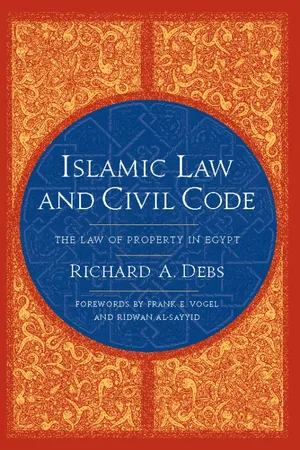
Richard A. Debs analyzes the classical Islamic law of property based on the Shari'ah, traces its historic development in Egypt, and describes its integration as a source of law within the modern format of a civil code. He focuses specifically on Egypt, a country in the Islamic world that drew upon its society's own vigorous legal system as it formed its modern laws. He also touches on issues that are common to all such societies that have adopted, either by choice or by necessity, Western legal systems.
Egypt's unique synthesis of Western and traditional elements is the outcome of an effort to respond to national goals and requirements. Its traditional law, the Shari'ah, is the fundamental law of all Islamic societies, and Debs's analysis of Egypt's experience demonstrates how Islamic jurisprudence can be sophisticated, coherent, rational, and effective, developed over centuries to serve the needs of societies that flourished under the rule of law.
- English
- ePUB (mobile friendly)
- Available on iOS & Android
eBook - ePub
About this book
Information
Subtopic
Middle Eastern HistoryIndex
History1

THE CLASSICAL ISLAMIC LAW OF PROPERTY
THERE IS NO GENERAL THEORY OF PROPERTY LAW in the Shariʿah. The rules constituting the Islamic law of property are contained in the law of contracts, in the various rules relating to the acquisition of property, in the tax and revenue laws, in the laws of conquest and of the division of spoils, and in many other rules of law covering a variety of subjects and dispersed throughout the legal texts. Nowhere were the property rights vesting in the owners or possessors of land systematically treated or classified; where land classifications were made, they were not made on the basis of property rights and did not clearly distinguish the different kinds of property interests attaching to landholdings or the different forms of land tenure existing under Islamic law.
Nevertheless, the Shariʿah rules of property law, taken together, clearly reveal three basic and distinct forms of land tenure: holdings of private property held in full ownership; holdings of waqf lands, being holdings in the nature of mortmain; and holdings of state-owned properties, held as different kinds of estates in land and subject to different conditions of tenure.
Private property clearly existed in Islamic law: indeed, the right of full ownership was the basic right, the norm, in Islamic property law. The enjoyment of private property was thus based on and governed by the Shariʿah. Property interests in waqf land were also defined and governed by the Shariʿah and constituted, both in theory and in practice, an estate in land clearly distinguishable from a holding of private property. The third form of land tenure, however, comprising holdings of state-owned land, was generally not defined or governed by the Shariʿah, but was, in effect, regulated by the administrative law of the state; yet this form of land tenure has been historically the most important in the Islamic world.
THE CLASSIFICATION OF LANDS IN THE SHARIʿAH
In the theoretical analysis of the subject of property in the early Islamic law books, not only was the distinction between personalty and realty a relatively unimportant analytical factor, but so were distinctions between the various forms of land tenure and between the property rights attaching to such tenure. In dealing with land, the early Islamic jurists appear to have been concerned primarily with fiscal considerations and therefore classified land on the basis of the revenues due from it to the state. Thus, almost all land in the possession of private individuals was classified either as ʿushri or kharaji land, depending on whether the land was charged with an ʿushr or kharaj, the two basic types of land taxes. Another category of lands explicitly recognized by the jurists comprised uncultivated wastelands that were not in the possession or ownership of any party. These were known as mawat, or dead lands, and the jurists prescribed rules providing for their vivification and consequent acquisition by individuals either as ʿushr lands or as kharaji lands.
Other categories of land were recognized by the jurists, but were not treated so systematically. These included lands that were in the direct control and ownership of the state and that may be described, for convenience only, as the private property or private domain of the state. It was not until recent centuries that these lands were explicitly recognized on a theoretical basis as a separate and distinct category of real property. In addition to the private domain, there were certain kinds of public property rights recognized by the jurists that in modern terms might be described as comprising the public domain. These were not treated as a separate category of land or property rights, but they will be so considered here, again, for convenience only.
Finally, there existed under the Shariʿah a distinct form of land tenure that, however, was not primarily regarded as such by the early jurists. This was the waqf, or mortmain, or trust of real property. Since the act of creating a waqf was considered a disposition of property, and a disposition ostensibly for religious purposes, the jurists focused upon the act of disposition rather than the form of land tenure created by such an act. Nevertheless, this form of tenure was implicitly recognized by the law and in fact constituted one of the major forms of real property holding in the Islamic world.
ʿUshri Lands
The ʿushr, literally, is a tithe: it is a religious tax, one of many such taxes incumbent upon Muslims, specifically applicable to land. The original ʿushri land of the Shariʿah was, accordingly, land owned by Muslims, who were bound to pay a tax on it as part of their general obligations with respect to almsgiving.1
The classification of lands as ʿushri in the law books depended upon their status when they were first brought under the jurisdiction of Islam. In general, if such land belonged to a Muslim at the time of his conversion, or if it was distributed to a Muslim soldier as his share of the spoils of war, the land was deemed to be ʿushri. Since the general policy in the early years of Islamic military operations within the Arabian Peninsula was to consider the enemy’s conversion to Islam as the only alternative to war, and since any such wars ultimately resulted in a Muslim victory and the subsequent distribution of land to Muslim soldiers, virtually all of the land in Arabia became ʿushri land, in the possession of Muslims.2
With the emergence of the Muslim armies from the confines of the Arabian Peninsula into the vast cultivated areas of the Fertile Crescent and Egypt, the earlier military policy of the Islamic state was modified, and the enemy was given a third alternative: if he agreed to accept Muslim sovereignty peacefully, he could retain possession of his land without converting to Islam. His retention of possession was subject to various conditions (either imposed by the Muslims or negotiated under the terms of a treaty), which included the rendering of periodic payments to the Islamic state. Furthermore, even if the enemy had to be subjected by force, the state could, and usually did, leave the indigenous population on its land, subject to whatever conditions it imposed, including payments to the state. These payments made by non-Muslims left in the possession of their lands could be characterized as tribute, as rent, or as a tax. In time they came to be uniformly known as the kharaj, levied and paid as a land tax; the lands upon which this tax was levied were thus designated kharaji lands.3
In these respects, kharaji lands were clearly distinguishable from ʿushri lands, which were charged with a tax (normally much lower than the kharaj) based in theory on a religious obligation and therefore incumbent upon Muslims only. Thus, ʿushri land was regarded as the normal landholding within the Muslim community, while kharaji lands were a somewhat special category of lands left in the possession of non-Muslims and subject to various conditions relating to their possession.
With respect to the nature of the property interest vesting in a holder of ʿushri land, that interest was described as milkiyah, or full ownership, and the land itself was described as the mulk, or the private property, of the landowner. Thus, the property interest in ʿushri land was comparable to the Common Law fee simple, the Roman plenum dominium, or the French propriété. While such a characterization of these property interests as private property has not been a matter of universal agreement,4 it appears quite clearly that ʿushri lands were mulk lands, and that mulk property, whether personalty or realty, was what is known as private property in modern terms. Aside from the theoretical definition of milkiyah, the nature of the property rights vesting in the owners of mulk property can lead to no other conclusion. These property rights will be treated in detail below, but to summarize here their nature and extent, the Shariʿah provided, basically, that an owner of mulk property could physically use or enjoy it to the fullest extent consistent with the public interest; furthermore, he could dispose of his property by means of a full range of legal dispositions, including sale, exchange, gift, lease, loan, pledge, and testament. Most important, he could constitute his property in waqf, which is a conclusive test of full ownership rights, since the creation of a waqf irrevocably immobilizes the property interest in perpetuity, making it forever inalienable. Such a power, which could be exercised in the sole discretion of the mulk owner, is clearly inconsistent with any theory holding that the mulk owner did not have complete rights of ownership in his property or that his property was subject to any other property rights but his own. On this basis, it is clear that mulk property was held in full ownership and that the rights of the mulk owner were of the same nature as (and perhaps, considering his powers of waqf, even more extensive than) the rights of a private property owner under modern, Western law.
Although all ʿushri lands were mulk property and held in full ownership, the right of milkiyah was not confined to ʿushri lands. Personal property was normally held as mulk, and, more significant, some types of kharaji lands were also held in this form of private property.
Kharaji Lands
According to the Shariʿah, there were two basic categories of kharaji lands: the first comprised lands in areas brought under Muslim sovereignty peacefully, pursuant to treaties or agreements with their inhabitants that permitted the original occupants of such lands to retain their possession. The second comprised those lands conquered by force of arms and left in the possession of their former inhabitants subject to conditions imposed by the state.5
With respect to property rights vesting in the non-Muslim occupants of kharaji lands, there is general agreement among the major schools of law that the occupants of the first category of lands held full ownership rights: the lands in their possession were mulk lands.6 As regards the second category of kharaji lands, however, there is some disagreement. The Hanafis maintained that all kharaji lands, including the lands conquered by force of arms, were mulk lands. In their view, the rights of all kharaji holders were the rights of owners; kharaji holders had full rights of disposition over their land, including the power to constitute it in waqf.7 The Maliki and Shafiʿi schools, on the other hand, did not regard the second category of kharaji holdings as mulk property. Rather, they described it as land held in “waqf” for the benefit of the Muslim community.8 In this context, however, such a description did not have the technical meaning usually ascribed to the term waqf, but connoted instead a relationship between the state and the Muslim community as a whole, wherein the state administered these lands as trustee, as it were, on behalf of the community. Furthermore, in so characterizing this relationship in terms of waqf, the two schools did not differ greatly from the Hanafi school, which also spoke of the “waqf” or immobilization of kharaji lands for the benefit of the Muslim community, even though it was clear that the Hanafis considered all kharaji land to be private property.9 What was meant by such language was that the revenue from these lands was permanently appropriated to the benefit of the Muslim community as a whole; aside from this, it implied no relationship to the Islamic institution of waqf as a form of land tenure.10
In terms of the property rights of the individual occupants of this second category of kharaji lands, however, there was a crucial difference between the Hanafi theory, on the one hand, and the Maliki and Shafiʿi theories, on the other. The latter schools did not deem the holders of such land to be vested with full rights of ownership and, accordingly, did not permit such holders full powers of disposition over their lands. Ownership was vested in the state, in its capacity as trustee for the Muslim community, and the property interest of th...
Table of contents
- Cover
- Half title
- Title
- Copyright
- Contents
- Foreword by Frank E. Vogel
- Foreword by Ridwan Al-Sayyid
- Preface
- Acknowledgments
- Transliterations and Abbreviations
- Introduction
- 1: The Classical Islamic Law of Property
- 2: Traditional Islamic Law in the Modern Era
- 3: The Introduction of a Western Civil Code System
- 4: Property Law under the First Civil Codes
- 5: The Development of a National Legal System
- 6: Property Law under the Civil Code of 1949
- Notes
- Appendix: Transliterations of Arabic and Turkish Terms
- Bibliography
- Index
Trusted by 375,005 students
Access to over 1.5 million titles for a fair monthly price.
Study more efficiently using our study tools.
Frequently asked questions
Yes, you can cancel anytime from the Subscription tab in your account settings on the Perlego website. Your subscription will stay active until the end of your current billing period. Learn how to cancel your subscription
No, books cannot be downloaded as external files, such as PDFs, for use outside of Perlego. However, you can download books within the Perlego app for offline reading on mobile or tablet. Learn how to download books offline
Perlego offers two plans: Essential and Complete
- Essential is ideal for learners and professionals who enjoy exploring a wide range of subjects. Access the Essential Library with 800,000+ trusted titles and best-sellers across business, personal growth, and the humanities. Includes unlimited reading time and Standard Read Aloud voice.
- Complete: Perfect for advanced learners and researchers needing full, unrestricted access. Unlock 1.5M+ books across hundreds of subjects, including academic and specialized titles. The Complete Plan also includes advanced features like Premium Read Aloud and Research Assistant.
We are an online textbook subscription service, where you can get access to an entire online library for less than the price of a single book per month. With over 1.5 million books across 990+ topics, we’ve got you covered! Learn about our mission
Look out for the read-aloud symbol on your next book to see if you can listen to it. The read-aloud tool reads text aloud for you, highlighting the text as it is being read. You can pause it, speed it up and slow it down. Learn more about Read Aloud
Yes! You can use the Perlego app on both iOS and Android devices to read anytime, anywhere — even offline. Perfect for commutes or when you’re on the go.
Please note we cannot support devices running on iOS 13 and Android 7 or earlier. Learn more about using the app
Please note we cannot support devices running on iOS 13 and Android 7 or earlier. Learn more about using the app
Yes, you can access Islamic Law and Civil Code by Richard A. Debs in PDF and/or ePUB format, as well as other popular books in History & Middle Eastern History. We have over 1.5 million books available in our catalogue for you to explore.