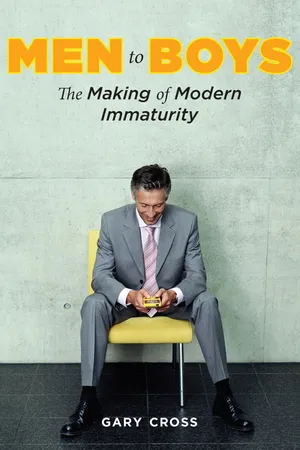
Adam Sandler movies, HBO's Entourage, and such magazines as Maxim and FHM all trade in and appeal to one character—the modern boy-man. Addicted to video games, comic books, extreme sports, and dressing down, the boy-man would rather devote an afternoon to Grand Theft Auto than plan his next career move. He would rather prolong the hedonistic pleasures of youth than embrace the self-sacrificing demands of adulthood.
When did maturity become the ultimate taboo? Men have gone from idolizing Cary Grant to aping Hugh Grant, shunning marriage and responsibility well into their twenties and thirties. Gary Cross, renowned cultural historian, identifies the boy-man and his habits, examining the attitudes and practices of three generations to make sense of this gradual but profound shift in American masculinity. Cross matches the rise of the American boy-man to trends in twentieth-century advertising, popular culture, and consumerism, and he locates the roots of our present crisis in the vague call for a new model of leadership that, ultimately, failed to offer a better concept of maturity.
Cross does not blame the young or glorify the past. He finds that men of the "Greatest Generation" might have embraced their role as providers but were confused by the contradictions and expectations of modern fatherhood. Their uncertainty gave birth to the Beats and men who indulged in childhood hobbies and boyish sports. Rather than fashion a new manhood, baby-boomers held onto their youth and, when that was gone, embraced Viagra. Without mature role models to emulate or rebel against, Generation X turned to cynicism and sensual intensity, and the media fed on this longing, transforming a life stage into a highly desirable lifestyle. Arguing that contemporary American culture undermines both conservative ideals of male maturity and the liberal values of community and responsibility, Cross concludes with a proposal for a modern marriage of personal desire and ethical adulthood.
- English
- ePUB (mobile friendly)
- Available on iOS & Android
eBook - ePub
About this book
Trusted by 375,005 students
Access to over 1.5 million titles for a fair monthly price.
Study more efficiently using our study tools.
Information
Subtopic
North American HistoryIndex
Social Scienceschapter 1.
When Fathers Knew Best
(or Did they?)
I begin this story with a search for “grown-up” men in the past. Looking back I found them in some of the classic images of maturity as I remember them from 1950s TV and especially old movies that I saw at ten years old in the cool of our basement on hot summer afternoons and on the late show on weekends. Of course, I'm thinking of leading men like Cary Grant, Spencer Tracy, Gary Cooper, and Clark Gable. I admired the decisiveness, seriousness, and dignity that they projected. They even looked older and more serious than their successors today. The postwar grown-up was more than a style or look. He was a man who came back from the war and adapted to civilian life. And, no one thought that this was to be easy. The Best Years of Our Lives (the most popular film of 1946 and indeed of the late 1940s) tells this story in the experience of three vets meeting on a B-17 bomber that carries them back to their typical hometown of Boonville and their trials of coping with civilian life and family again. The eldest, an army sergeant, has to reacquaint himself with his now teenage son, his wife of twenty years, and his grown-up daughter as well as with a desk job in a bank. The highest ranked (air force captain) has to face a war-bride wife who turns out to be unfaithful and a bleak future going back to his old job as a “soda jerk.” The youngest, a sailor, fears that his family and girlfriend will reject him or feel sorry for him, having lost both hands in the war. In the end, all make honorable, if uncertain decisions. The sergeant adapts despite a drinking problem; the sailor marries his girl and learns to accept his disability; the captain gets into the salvage business after his wife leaves him and makes himself acceptable for marrying the sergeant's daughter. We are left with a happy ending but also with a feeling that all three have their work cut out for them. The Best Years is about real people who have to make serious choices and will have to make adjustments.
When I saw these movies for the first time, I may have missed their maturity. There were certainly many men to look up to on rainy and cold Saturdays in front the set: Hopalong Cassidy, Gene Autry, Roy Rogers, and Sky King from the westerns each offered something a little different. Don Herbert, a science teacher, on Watch Mr. Wizard actually taught someone very much like us the mysteries of electricity and vacuums. And it was popular enough (or TV executives were supportive enough) to stay on the air from 1951 to 1965. Conductor Leonard Bernstein taught boomers music history and composition on his equally long running Young People's Concerts from 1958 to 1972. Both shows presented models of maturity. They were there for us kids, and early TV programmers were eager for our parents to know that the new gadget offered us models to aspire to.
I also watched adult clowns—from reruns of the Three Stooges with their very physical humor to the childlike incompetence of the pudgy Lou Costello, who was always manipulated by his sidekick Bud Abbott, and Jerry Lewis, whose high-pitched voice and awkward angularity seemed to disguise his real age. On TV, there was Pinky Lee, a frenetic fool dressed in a silly pink-striped suit, whose looks and manner Pee Wee Herman copied in the 1980s. Even the host on The Howdy Doody Show, Buffalo Bob Smith, though separate from the kids in the “Peanut Gallery” and the marionette “stars” of the show, was more like a member of the gang than a father figure. That was surely true of Jimmy and Roy on the Mickey Mouse Club. They were really just part of the revue of the kids singing and dancing, likewise festooned with those ridiculous mouse-ears caps, rather than paternal leaders. The grandfatherly Roy gave no advice that I recall; instead, he gently displayed his amateur skill in drawing cartoons. But these comic or childlike figures had a different role than did Hoppy and Mr. Wizard. They were there to make us kids comfortable in our childhood because they were as, and often more childish than we were. This was an appeal that was passed down through the years (today in the childish enthusiasm of the cartoon figure SpongeBob SquarePants and his sidekick, the innocent Patrick, who so much remind me of Howdy Doody characters). The difference was that in my 1950s youth there were lots of father figures on the screen as well.
Gunslingers for Kids
The most common grown-up man on the little screen, however, was generally not a father but the solitary figure of the cowboy. Still, the western had the biggest impact on both my and my father's generations' idea of the grown-up man. I have long regretted all the hours that I spent in front of the set watching the shootouts and galloping horses without being able now to recall a single plot, but I could have hardly avoided them at the time. By 1959, there were twenty-seven westerns on prime-time TV, not to mention the kiddy westerns on the weekends and after school.1 Looking back as a historian, I find this very strange. Why would an increasingly suburbanized American male, who spent five days a week in an office, often went to church on Sunday, and took the kids to Little League games and dancing classes on Saturdays, want to spend two or three hours every night watching men his own age largely without family responsibilities engage in shootouts on dusty streets? Why would boys brought up surrounded by the glories of new cars, the space program, and the promise of the “push-button” age spend endless hours practicing their “draw” with their Roy Rogers six-shooter and playing with their Fort Apache playsets?
To make a bit of sense of this, we need to recall that the western had long defined masculinity in America for men as well as boys. In the 1900s and through the 1920s, the western became popular across the generations, elevating it far above its early popularity in the cheap dime novel. It captured the imaginations of Americans of all ages through Buffalo Bill Cody's Wild West shows and the serials of the silent movies. Western writers like Zane Grey even published in such middle-class magazines as Colliers and Harpers' Monthly. Between 1930 and 1955, Hollywood produced 2,772 western movies, often filmed at company-owned ranches and featuring the best-known stars and directors.2 Westerns reached adult male audiences across social classes. Such men were attracted to a nostalgic “return” to the simplicity, excitement, and virtue of an age before cities, factories, and offices. The genre reflected and reinforced myths about rugged and unadorned Americans in heroic struggle with evil (far from the tawdry commercialism of the twentieth century) and destined to conquer a continent from wild men and unruly nature. The western hero was independent and daring. He challenged the greed of the empire builders on the frontier, but he also stood for law and order. “Though he lives intensely, he has a calm self-assurance, a knowledge that he can handle anything,” noted historian David Davis.3 A century ago, adult men whose real lives were increasingly regimented by factory or office work and who labored under the heel of the time-motion boss or fickle customer could identify with the rough, tough figures portrayed in the silent movies by William Hart. His Broadway role in The Squaw Man (1905) led to a twenty-year career playing unglamorous, hard-fighting, hard-drinking, and even melancholic cowboys in silent movies. These westerns showed a man's world where women were childlike and mostly dependent, upholders of religious values, shunned or used as heroic props by death-obsessed gunslingers.4
But there were also more playful cowboy characters who were more suitable models for kids. Tom Mix, who came from the Wild West shows and the circus, appealed to boys with his roping and shooting skills and offered far less somber images of the western hero's life. In the 1910s, parents associated the western with their own youth (having been raised on western dime novels and stories in pulp magazines), and they nostalgically passed this genre onto their own children in the form of cowboy suits and toy “six-shooters.” By the 1930s, westerns had become in large part a boy's genre. These included afternoon radio programs like Tom Mix and His Ralston Straight Shooters as well as western serials shown during children's Saturday matinees. Republic Studios made a hero of Gene Autry in 1935 and, when he demanded too high a salary in 1939, added Roy Rogers to their roster. Gene and Roy (along with Tex Ritter) sang love songs to girls but also crooned to the wide open spaces as they rode into town to rescue hard-working farmers and wimpy storekeepers, as well as, of course, their pretty daughters from the torments of greedy land grabbers or gangs of killers.5
The singing and rhinestone cowboy had an appeal across age and sex. But there was not much doubt as to who admired Hopalong Cassidy. Played by William Boyd, an aging leading man from the silent era, Hopalong of the Bar 20 Ranch clearly reached a juvenile audience with his clean-cut heroism in a series of sixty-six movies. Boyd's “Hoppy” had little in common with the grizzled, hard-drinking character (with a namesake limp) from Clarence Mulford's novel. On the screen, Boyd turned Hoppy into a black-and-white image (he in black and his horse Topper in white) who bristled with moral certainty. Made from 1935 and 1948, the movie series offered a formulaic appeal, complete with a young sidekick (with whom kids could identify) and “old” comical sidekicks like Gabby Hayes (who sometimes worked without his false teeth to appear older than he was and who seemed to be afraid of women). Stirring orchestral music enlivened the frequent chases on galloping horses when Hoppy vanquished sundry bad guys. Boyd was lean and powerful (unlike the grizzled sidekicks), but he didn't hide his silver hair and grown-up bearing. Boyd prudently bought the movie series and transferred it to TV in 1949, cutting down the feature-length films for a weekly series that aired until 1955 with additional made-for-TV episodes. Boyd naturally cashed in on his appeal to early baby boomer lads, peddling his name and image on lunchboxes and gun and holster sets and playing before sellout crowds on national tours. But he also founded “Hoppy's Troopers,” kids clubs with a code of conduct demanding that members be kind to the weak, be loyal to nation and friends, and work hard. Each TV episode ended with a little homily. I remember watching him in about 1954, not long after our family got its first TV set, admonishing us eight-year-olds to respect policemen and never to call them “coppers.”6
Hoppy's success on TV paralleled others. In fact, early TV westerns were usually copies of the (mostly juvenile) cowboy B movies from the 1930s and 1940s. Roy and Gene both had TV shows in the early 1950s, and others such as The Lone Ranger (1949–1957) and The Cisco Kid came “over” from radio.7 Each offered a child-friendly version of the Old West. One interesting exception was Sky King (1951–62), set in modern Arizona and replacing the horse with Song Bird, a small airplane. It featured Sky, a pilot and owner of the Flying Crown Ranch, his niece, Penny, and for a time his nephew, Clipper, both in their teens. The adventures revolved around the plane, which came in handy when Sky rescued the kids after they were captured by smugglers or enemy agents who took them to remote cabins. In addition to the excitement, there was almost always a gentle moral: the possibility, for example, for a bad boy who had escaped from reform school to be redeemed through the understanding and strength of Sky and his “family” at the Flying Crown and his learning to make the “right choice” in turning on his “evil family” of crooks. Sky taught Penny and Clipper that the “law of cooperation” between the Kings prevailed over the “law of the jungle” of selfish gang members. One episode that featured Penny even made the point that the woman's place is not necessarily in the home (as the chauvinist Clipper believed) but “where she is needed.”8 All of these characters and their stories were fun and often thrilling, but they also told us much about how our elders expected us to grow up.
Cowboy Loners and Suburban Dads
While these westerns presumably taught us kids to be responsible and courageous (as well as to be quick on the draw), there were other westerns, especially prominent after the war, that were more for adults, especially men. Though they were more realistic, they, too, had their moral lessons about being a grown-up man. While the B western migrated from the Saturday matinee to Saturday TV, the serious western saw something of a revival at the movie house after World War II. Carrying on the old tradition of William Hart was The Gunfighter (1950), where an aging hero faces the futility of his life of killing. John Wayne's formula westerns in the 1930s became serious psychological tales, as, for example, in The Searchers of 1956 and even more in his westerns of the 1960s and 1970s, such as True Grit and The Shootist. These westerns were not about good guys rescuing the helpless; nor were they mere confrontations between good and evil. Not the freedom of the frontier but its bareness and limitations dominated these films. Not daring choice but the pressures of obligation appealed to adult men who had long outgrown the romance of singing cowboys and the thrill of Tom Mix's rope tricks.9
More mature westerns came to the tube, moving the genre from the child's Saturday morning to the adult's prime time. Among the first was Death Valley Days (1952–1975), an anthology series of stories and fables of prospectors, gamblers, and other characters of the Old West that made this the third longest running TV program ever, with 452 episodes. Ronald Reagan served as host for several years before launching his political career as California governor. The longest running TV program was Gunsmoke (with an astonishing 633 episodes) seen for twenty years after its premier in 1955. It was the most popular program between 1957 and 1961 and near the top for years thereafter.10
Watching these westerns after decades of disparaging them made me see them in a new light and understand why adult men might have watched them a half century ago. If Hoppy and Roy gave boys heroes and adventure, Gunsmoke's Marshal Matt Dillon of Dodge City gave our fathers something, too. Dillon was more than the stolid six-foot, seven-inch figure played by James Arness gunning down the weekly villain in the ritual duel on the dusty street in front of Miss Kitty's saloon. This show didn't last for twenty years on such a childish principle. Rather than being about male bravado and the thrill of the final confrontation, Gunsmoke usually featured complex characters and plots. Dillon himself was flawed but only because the sin of pride sometimes distorted his virtue of courage and responsibility. In the first episode, he refused help from others in his multiround match with Dan the quick-drawing gunman, but he finally found Dan's weakness (he was a quick draw but a bad aimer), giving Matt the decisive advantage when he refused Dan's demand that they duel at close range. But Matt's prevailing strength was not mere steadfastness but moral maturity. He was able to see the difference between the law and justice when he protected a reformed man and community leader accused of being a former member of a murderous gang. Gunsmoke was as often about redemption as retribution. Although the show included unheroic characters (who contrasted with Matt), especially “Doc” and the deputy (the lame Chester followed by the hillbilly Festus), even this old gimmick (in the tradition of Gabby Hayes) was subtler than I had recalled it. Doc, even without a gun, could be courageous, as in his efforts to find a home for newborn triplet sons of a murderer. Despite fears of the townspeople that these boys had “bad blood,” Doc refused to give in to the demand that they be sent to an orphanage. With Matt, he knew that “nobody is a born criminal.” While the ending was certainly maudlin (a couple with ten children took in the triplets), the story elevates the “unmasculine” Doc, making him a hero by defending the infants in front of a judge who would have otherwise (and quite correctly) sent them to an institution. One of the most subtle episodes aired in 1973. In “Matt's Love Story,” a gambler wanted for murder ambushes the marshal, leaving him for dead. Though stricken with amnesia, Matt is nursed back to health by a very tough and independent widow rancher. This could have been a conventional story of Matt's recovery of strength and memory ending with the gambler's death and Matt's dutiful return to Dodge City (which, of course, happens). Still, the “love affair” with the tough widow, “Mike,” and the eventual confrontation with the gambler is amazingly subtle (not to mention its dialogue, saturated in similes and metaphors). The gambler, being taken back to be tried for murder, helps Matt confront truly bad guys (a gang who tried to seize Mike's land) and, when shot, the gambler dies in a philosophical exchange that a Shakespeare want-to-be would have been proud of. This is a far sight better than the old time shoot-outs. More that this, Gunsmoke was about responsible decision making in complex, even ambiguous situations. It was hard for Matt to go back to Dodge City, and the gambler made a choice that belied his past sociopathic behavior. But these weren't cynical tales of moral relativism; the moral lesson was seldom far from view. In another episode, the rational and mature Doc prevailed over the impetuous Festus, who wanted to call an inexperienced posse to chase down a gang that had shot Matt. Later Matt teaches a young man, who was quick on the draw but unwilling to kill even in defense, the need to protect the weak with deadly force. In both cases, age and wisdom won out. Doc knew that many would be killed in a poorly planned attack on the gang, and Matt offered the lad the hard but experienced truth: “thinking the worst is a good way to stay alive.”11
Dillon was always the grown-up, killing reluctantly and with a sense of responsibility. He was there for the nurturing if practical and seasoned Miss Kitty, but he always had his priorities straight, never giving in to lust, ever mindful of his duty. Of course, this was all romanticized and pretty unrealistic. Are we really to believe Matt and Kitty never had an affair? Are we to suppose that Kitty didn't have whores upstairs in the saloon? Today, all this would have been part of the story, but the Gunsmoke of 1955 to 1975 did not need any of that and still it was “adult.”
Other adult westerns were less mature as understood at the time (and did not last so long). The Life and Legend of Wyatt Earp (1955–1961) opened with a ballad celebrating the savior sheriff of Wichita, Kansas, and later Tombstone, Arizona, who reluctantly gave up a “normal” life as a settler to be “brave, courageous, and bold” in pursuit of justice. We are told in the theme song: “He cleaned up the country, t...
Table of contents
- Cover
- Half title
- Title
- Copyright
- Contents
- Introduction: Where Have All the Men Gone
- Chapter 1: When Fathers Knew Best (or Did They?)
- Chapter 2: Living Fast, (Sometimes) Dying Young
- Chapter 3: Talking About My Generation
- Chapter 4: My Generation Becomes the Pepsi Generation
- Chapter 5: New Stories, New Rebels
- Chapter 6: Endless Thrills
- Chapter 7: Life Beyond Pleasure Island
- Acknowledgments
- Notes
- Index
Frequently asked questions
Yes, you can cancel anytime from the Subscription tab in your account settings on the Perlego website. Your subscription will stay active until the end of your current billing period. Learn how to cancel your subscription
No, books cannot be downloaded as external files, such as PDFs, for use outside of Perlego. However, you can download books within the Perlego app for offline reading on mobile or tablet. Learn how to download books offline
Perlego offers two plans: Essential and Complete
- Essential is ideal for learners and professionals who enjoy exploring a wide range of subjects. Access the Essential Library with 800,000+ trusted titles and best-sellers across business, personal growth, and the humanities. Includes unlimited reading time and Standard Read Aloud voice.
- Complete: Perfect for advanced learners and researchers needing full, unrestricted access. Unlock 1.5M+ books across hundreds of subjects, including academic and specialized titles. The Complete Plan also includes advanced features like Premium Read Aloud and Research Assistant.
We are an online textbook subscription service, where you can get access to an entire online library for less than the price of a single book per month. With over 1.5 million books across 990+ topics, we’ve got you covered! Learn about our mission
Look out for the read-aloud symbol on your next book to see if you can listen to it. The read-aloud tool reads text aloud for you, highlighting the text as it is being read. You can pause it, speed it up and slow it down. Learn more about Read Aloud
Yes! You can use the Perlego app on both iOS and Android devices to read anytime, anywhere — even offline. Perfect for commutes or when you’re on the go.
Please note we cannot support devices running on iOS 13 and Android 7 or earlier. Learn more about using the app
Please note we cannot support devices running on iOS 13 and Android 7 or earlier. Learn more about using the app
Yes, you can access Men to Boys by Gary Cross in PDF and/or ePUB format, as well as other popular books in Social Sciences & North American History. We have over 1.5 million books available in our catalogue for you to explore.