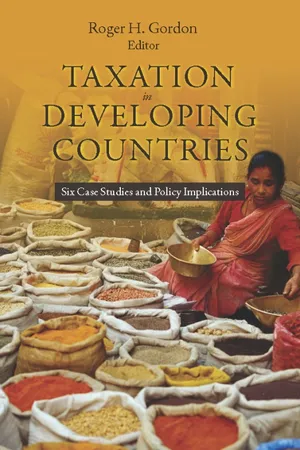
Taxes are a crucial policy issue, especially in developing countries. Just recently, proposals to raise middle-class taxes toppled the Bolivian government, and plans to extend or increase the value-added tax caused political unrest in Ecuador and Mexico. Despite the impact of tax policy on developing countries, a comprehensive study has yet to be written. Treating Argentina, Brazil, India, Kenya, Korea, and Russia as key case studies, this volume outlines the major aspects of current tax codes and explores their economic and political implications.
Examples of both the poorest and wealthiest developing countries, Argentina, Brazil, India, Kenya, Korea, and Russia uniquely demonstrate the diverse fiscal problems of tax reform. Each economy relies heavily on indirect and corporate income taxes, though recently some have reduced their tariff rates and have switched from excise to value-added taxes. There is a large, informal economy in most of these countries, and tax evasion by firms is a significant concern. As a result, tax revenue remains low, even though rates are as high as those in developed economies. Also, unconventional methods to collect revenue have been implemented, including bank debit taxes, state ownership of firms, and implicit taxes on individuals in the informal sector.
Exploring these and other concerns, as well as changes in tax law, administration, and fiscal pressures, this comprehensive anthology clarifies the current landscape of tax administration and the economic future of the world's poorer economies.
- English
- ePUB (mobile friendly)
- Available on iOS & Android
eBook - ePub
About this book
Information
Subtopic
Business GeneralCHAPTER 1

Development-Oriented Tax Policy
Joseph E. Stiglitz
INTRODUCTION
No public policy issue is more important than the structure and level of taxes. Governments have fallen because of tax reform. Proposals to extend the value-added tax (VAT) or increase its rates have caused political agitation in many countries, including Ecuador and Mexico. In many less-developed countries, a shortage of funds impedes development efforts, yet attempts to increase tax revenues not only meet enormous political resistance but are often futile. Simplistic recommendations to increase the power of the tax police often backfire, generating substantially more revenue for the tax collectors but very little extra for the public fisc.
Part of the problem lies in the fact that those providing advice on taxation to developing countries are insensitive to the differences in economic and political structures both among developing countries and between these countries and more developed ones, to the administrative difficulties faced by developing countries, or to their differing objectives. To take but one example: standard textbook expositions of the objectives of tax policy for developed countries, for instance, emphasize efficiency, and more recent expositions discuss problems of tax avoidance and evasion but seldom note corruption. But corruption has increasingly come to be recognized as one of the major challenges facing developing countries. Designing institutions and policies, including tax structures, that reduce the scope for corruption—what we call corruption-resistant tax structures—thus should be a central concern in tax design. While outside advisers often lecture moralistically on the need to improve tax administration and reduce corruption, they seldom address corruption as part of tax design. This illustrates how differences in the structure of the economy (where that term embraces institutional capacities—the ability to control corruption) and objectives (reducing corruption) dictate a difference in tax policy.
One important reason that differences in economic structures are important is that they affect compliance costs and the set of feasible taxes. Any particular tax can only be assessed relative to the set of feasible taxes and in the context of the totality of taxes imposed. Thus, although both developing and developed countries may view redistribution as an objective of tax policy, fewer instruments for redistribution may be available to developing countries. For instance, a well-known result holds that with an optimal income tax, there is (in a central case) no need to rely on commodity taxation for redistribution.1 For countries that can impose a progressive income tax, the design of commodity taxation need not, accordingly, pay much attention to distribution concerns; for developing countries, which often have difficulty in enforcing effective progressive income taxes, distributive concerns may be paramount.
Objectives also differ. It is quite possible that tax policy should be used to promote development, or at least be designed not to impede it. And differences in economic structure interact with differences in objectives.
The Value Added Tax (VAT) illustrates many of these issues. One of the theses of this chapter is that, regardless of the virtues of a VAT for developed countries, such a tax may be inappropriate for many developing ones. This is partly because it may undermine development (a difference in objectives) and partly because differences in economic structures make it less successful in achieving commonly shared distributive and efficiency objectives: (1) a VAT may have an adverse distributive impact; (2) it may be less conducive to economic efficiency than other taxes. In developed countries, one of the reasons that a VAT is “efficient” is that it is comprehensive. It can be part of an overall progressive tax system because it can be combined with a progressive income tax as part of an “optimal” tax structure, achieving distributive goals at low compliance costs. By contrast, in most developing countries, the VAT is typically collected from just a fraction (often less than 50 percent) of the economy. This means that it interferes with productive efficiency, encouraging movement of production into the informal economy. It is effectively a tax on the organized sector of the economy—a distortionary tax on development. And because most developing countries find it difficult to implement a comprehensive progressive income tax, not only is it potentially highly distortionary, but the VAT can also result in a regressive (or at least not highly progressive) overall tax structure.
Even the VAT’s alleged administrative advantages (low compliance costs) may not be true for developing countries. One of the virtues of the VAT in more-developed countries is its self-enforcing nature. Taxes paid at a lower level are refundable at the next level. Consequently, it would seem, the downstream firm has an incentive to report purchases, which are, of course, others’ sales. If both the upstream and downstream firms’ incomes are not easily observable (they are based on cash payments), however, the VAT may be difficult to collect at any stage of production. The so-called self-enforcing property of the VAT can easily unravel—and it often does in developing countries where farmers and small producers sell directly to consumers.
Similarly, if just some of the downstream firm’s sales are hard-to-detect cash transactions, then it can claim a rebate on the VAT paid by the upstream firm without fully reporting revenues received—with the result that they record negative value added. If firms reporting negative value added receive rebates, the net revenue collected by government may be seriously undermined. However, if the government does not grant rebates to firms reporting negative value added, it may discourage legitimate negative value-added activities, such as start-ups.
Both developed and less-developed countries typically provide rebates on exports under the VAT. This is supposed to ensure that the tax is on domestic consumption, not on domestic production. But one developing country after another has had problems in its rebate system. Sometimes rebates are paid only after a long lag. For firms facing a shortage of capital, this can be crippling. Even worse, the rebates have become a source of corruption, as fake documents have been used to secure large payments to corporations. (Kenya provided the most infamous example.2)
As we have noted, a key issue in evaluating alternative taxes is the set of feasible taxes. Advocates of the VAT often argue that it is better than the existing tax structures (e.g., that the VAT may be an improvement over a corruptly enforced set of tariffs). The question, though, is, “What is the relevant set of alternatives?” Could a VAT be improved upon by the imposition of a tax on luxury imports at a higher rate? (Because there may be no domestic production of the luxury good, such a tax is equivalent to an excise consumption tax.) In many developing countries, a tax on oligopoly profits would be better in terms of both efficiency and equity than an increase in the VAT tax.
In many developing countries, a VAT may be a part of a well-designed tax structure. In a sense, this chapter is a critique of the excess zeal of VAT advocates, who sometimes suggest that there should be just a uniform tax on all goods. This chapter argues that that is seldom the case. There should, in general, be differential taxation. It may also be wise to impose differential taxes on imports, including to promote development. It may be desirable to impose differential taxes on luxuries or oligopolies for a number of reasons, including that of promoting equity.
In the next two subsections, we take a closer look at two of the key differences between the structures of developed and developing countries: the fact that market failures are more pervasive in developing countries and information imperfections more widespread.
SECOND - BEST CONSIDERATIONS AND CORRECTIVE TAXATION
Taxation is quintessentially a problem of second best. With full information, there would be optimal lump-sum (nondistortive) taxation. Even distributive objectives could be achieved, because tax authorities could identify those with the capacity to earn higher income and impose higher lump-sum taxes on them.
But modern tax theory is based on the recognition that tax authorities never have the requisite information. They base taxes on observables (such as income). As a result, taxation is distortionary. All taxation is thus an exercise in the economics of the second best. One of Frank Ramsey’s (1927) great contributions was to show what this implies for the design of tax structures. His analysis demonstrated the falsity of the simplistic argument that an income tax (which taxes interest income and thus affects intertemporal trade-offs) is worse than a consumption tax (which only affects the consumption/leisure choice) because it involves an extra distortion. The conclusion may be right, but it must be based on a much more subtle and complete analysis. The modern theory of taxation is remarkable because, despite the complexity of second-best economics, it has been able to derive a number of precise results.
Much of modern tax theory, while recognizing the distortionary nature of taxation, has assumed that in the absence of taxation, markets would be perfectly efficient. But another important strand of research over the past quarter century has analyzed a large number of market imperfections, including those derived from imperfect and asymmetric information. Tax distortions may interact with market distortions in various ways. In particular, taxes may be used to correct market distortions: One distortion may, at least partly, undo the effects of the other.
Modern tax theory thus emphasizes the role of corrective taxation—taxes designed to correct market failures, such as those associated with externalities. If market failures are more pervasive in developing countries, it means that there may be more scope for corrective taxation.
Discussions of corrective taxation have, for the mos...
Table of contents
- Cover
- Half title
- Title
- Copyright
- Series Page
- Contents
- Acknowledgments
- Acronyms
- Introduction: Overview of Tax Policy in Developing Countries
- Chapter 1. Development-Oriented Tax Policy
- Chapter 2. Taxes and Development: Experiences of India vs. China, and Lessons for Other Developing Countries
- Chapter 3. Tax Policy in Argentina: Between Solvency and Emergency
- Chapter 4. Tax System Reform in India
- Chapter 5. History of Russian VAT
- Chapter 6. Tax Reform in Kenya: Policy and Administrative Issues
- Chapter 7. Korea’s Tax System: A Growth-Oriented Choice
- Chapter 8. Tax Structure and Tax Burden in Brazil: 1980–2004
- List of Contributors
- Index
Trusted by 375,005 students
Access to over 1.5 million titles for a fair monthly price.
Study more efficiently using our study tools.
Frequently asked questions
Yes, you can cancel anytime from the Subscription tab in your account settings on the Perlego website. Your subscription will stay active until the end of your current billing period. Learn how to cancel your subscription
No, books cannot be downloaded as external files, such as PDFs, for use outside of Perlego. However, you can download books within the Perlego app for offline reading on mobile or tablet. Learn how to download books offline
Perlego offers two plans: Essential and Complete
- Essential is ideal for learners and professionals who enjoy exploring a wide range of subjects. Access the Essential Library with 800,000+ trusted titles and best-sellers across business, personal growth, and the humanities. Includes unlimited reading time and Standard Read Aloud voice.
- Complete: Perfect for advanced learners and researchers needing full, unrestricted access. Unlock 1.5M+ books across hundreds of subjects, including academic and specialized titles. The Complete Plan also includes advanced features like Premium Read Aloud and Research Assistant.
We are an online textbook subscription service, where you can get access to an entire online library for less than the price of a single book per month. With over 1.5 million books across 990+ topics, we’ve got you covered! Learn about our mission
Look out for the read-aloud symbol on your next book to see if you can listen to it. The read-aloud tool reads text aloud for you, highlighting the text as it is being read. You can pause it, speed it up and slow it down. Learn more about Read Aloud
Yes! You can use the Perlego app on both iOS and Android devices to read anytime, anywhere — even offline. Perfect for commutes or when you’re on the go.
Please note we cannot support devices running on iOS 13 and Android 7 or earlier. Learn more about using the app
Please note we cannot support devices running on iOS 13 and Android 7 or earlier. Learn more about using the app
Yes, you can access Taxation in Developing Countries by Roger Gordon in PDF and/or ePUB format, as well as other popular books in Politics & International Relations & Business General. We have over 1.5 million books available in our catalogue for you to explore.