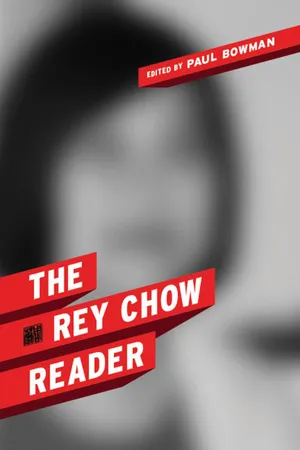
Rey Chow is arguably one of the most prominent intellectuals working in the humanities today. Characteristically confronting both entrenched and emergent issues in the interlocking fields of literature, film and visual studies, sexuality and gender, postcolonialism, ethnicity, and cross-cultural politics, her works produce surprising connections among divergent topics at the same time as they compel us to think through the ethical and political ramifications of our academic, epistemic, and cultural practices. This anthology - the first to collect key moments in Chow's engaging thought - provides readers with an ideal introduction to some of her most forceful theoretical explorations. Organized into two sections, each of which begins with a brief statement designed to establish linkages among various discursive fields through Chow's writings, the anthology also contains an extensive Editor's Introduction, which situates Chow's work in the context of contemporary critical debates. For all those pursuing transnational cultural theory and cultural studies, this book is an essential resource.
Praise for Rey Chow
"[Rey Chow is] methodologically situated in the contentious spaces between critical theory and cultural studies, and always attending to the implications of ethnicity."—Social Semiotics
"Rich and powerful work that provides both a dazzling synthesis of contemporary cultural theory and at the same time an exemplary critique of Chinese cinema."—China Information
"Should be read by all who are concerned with the future of human rights, liberalism, multiculturalism, identity politics, and feminism."—Dorothy Ko
"Wide-ranging, theoretically rich, and provocative... completely restructures the problem of ethnicity."—Fredric Jameson
- English
- ePUB (mobile friendly)
- Available on iOS & Android
eBook - ePub
The Rey Chow Reader
About this book
Trusted by 375,005 students
Access to over 1.5 million titles for a fair monthly price.
Study more efficiently using our study tools.
Information
Subtopic
Chinese HistoryIndex
Social SciencesPART 1
MODERNITY AND POSTCOLONIAL ETHNICITY
The establishment of knowledge, hierarchy, structure, and order is not a neutral or natural process, as it always involves the more or less conscious taking of decisions, decisions that have consequences. Likewise, part 1 also is about contexts, orientations, starting points, and the taking of decisions and their consequences. In the first chapter, “The Age of the World Target: Atomic Bombs, Alterity, Area Studies,” Chow analyzes the epochal (epistemic) significance of the instruments and rationality culminating in the decision to drop two atomic bombs on Japan in World War II, as well as the enormity and ongoing ramifications of these events. The second chapter, “The Postcolonial Difference: Lessons in Cultural Legitimation,” is an autobiographically organized account of Chow’s own orientations within (and vis-à-vis) the field of postcolonial studies. But this is not merely a personal narrative. Instead, Chow’s account emphasizes certain “lessons in cultural legitimation,” lessons about the lines of force and bias that structure and guide intellectual and cultural work. Such unacknowledged and unconsidered biases, assumptions, and prejudices are considered further in the third chapter, an excerpt from “Introduction: Leading Questions” (from Writing Diaspora). Here Chow tackles the persistence of orientalism and the processes by which scholars regularly “sanctify” and fetishize “the other,” before considering alternative tactics of intervention in postcolonial cultural studies.
The starting point of any cultural encounter always includes “facing,” in both the literal and metaphorical (catachrestic) senses; that is, individuals, groups, cultures, nations, and the like are said—at different times and in different ways—to “face” one another. They represent themselves and their others to themselves; they “look” and “contemplate” the other in ways that always entail both imaging and imagining. This relation is both inevitable and delicate. It also, of course, is highly consequential and is why Chow explores this relation in chapter 4, which faces up to what she calls “the inevitability of stereotypes.” This “inevitability” is a difficult proposition for progressive thought in studies of ethnicity and culture to countenance, as it implies that we all are in some sense “violent,” “reductive,” “simplistic,” and “unethical” in our first encounters with others. But Chow offers ways out of this impasse that do not require us to hide from the implications of the inevitability of stereotypes.
In a similar spirit, she engages with the implications of Frantz Fanon’s theoretical treatment of women in his influential work on postcolonial community building, in chapter 5, “The Politics of Admittance: Female Sexual Agency, Miscegenation, and the Formation of Community in Frantz Fanon.” The complex, deconstructive status of “woman” and “female agency” is explored again in chapter 6, which lays out the unstable status of “woman” in contemporary cultural criticism and clarifies some of the uncomfortable consequences of this constitutive instability for various schools of thought, from poststructuralist to Anglo-American feminism.
1
The Age of the World Target
ATOMIC BOMBS, ALTERITY, AREA STUDIES

THEY DID NOT WANT TO RISK WASTING THE PRECIOUS WEAPON, AND DECIDED THAT IT MUST BE DROPPED VISUALLY AND NOT BY RADAR .
Barton J. Bernstein, “The Atomic Bombings Reconsidered,” Foreign Affairs (January/February 1995): 140
THERE HAS NOT YET DEVELOPED A DISCOURSE IN THE AMERICAN PUBLIC SPACE THAT DOES ANYTHING MORE THAN IDENTIFY WITH POWER, DESPITE THE DANGERS OF THAT POWER IN A WORLD WHICH HAS SHRUNK SO SMALL AND HAS BECOME SO IMPRESSIVELY INTERCONNECTED .
Edward W. Said, Culture and Imperialism (New York, 1994), 300
For most people who know something about the United States’ intervention in the Second World War, one image seems to predominate and preempt the rest: the dropping of the atomic bombs on Hiroshima and Nagasaki, pictorialized in the now familiar image of the mushroom cloud, with effects of radiation and devastation of human life on a scale never before imaginable.1 Alternatively, we can also say that our knowledge about what happened to Hiroshima and Nagasaki is inseparable from the image of the mushroom cloud. As knowledge, “Hiroshima” and “Nagasaki” come to us inevitably as representation and, specifically, as a picture. Moreover, it is not a picture in the older sense of a mimetic replication of reality; rather, it has become in itself a sign of terror, a kind of gigantic demonstration with us, the spectators, as the potential target.
For someone such as myself, who grew up among survivors of Japan’s invasion of China in the period of 1937–53— banian kangzhan or the “Eight Year War of Resistance” as it is still called among the Chinese—the image of the atomic bomb has always stood as a signifier of another kind of violence, another type of erasure. As a child, I was far more accustomed to hearing about Japanese atrocities against Chinese men and women during the war than I was to hearing about U.S. atrocities against Japan. Among the stories of the war was how the arrival of the Americans brought relief, peace, and victory for China; however hard the times were, it was said to be a moment of “liberation.” As I grow older, this kind of knowledge gathered from oral narratives persists in my mind not as proof of historical accuracy but rather as a kind of emotional dissonance, a sense of something out-of-joint that becomes noticeable because it falls outside the articulations generated by the overpowering image of the mushroom cloud. It is as if the sheer magnitude of destruction unleashed by the bombs demolished not only entire populations but also the memories and histories of tragedies that had led up to that apocalyptic moment, the memories and histories of those who had been brutalized, kidnapped, raped, and slaughtered in the same war by other forces. As John W. Dower writes:
Hiroshima and Nagasaki became icons of Japanese suffering—perverse national treasures, of a sort, capable of fixating Japanese memory of the war on what had happened to Japan and simultaneously blotting out recollection of the Japanese victimization of others. Remembering Hiroshima and Nagasaki, that is, easily became a way of forgetting Nanjing, Bataan, the Burma-Siam railway, Manila, and the countless Japanese atrocities these and other place names signified to non-Japanese.2
Lisa Yoneyama sums up this situation succinctly: “Hiroshima memories have been predicated on the grave obfuscation of the prewar Japanese Empire, its colonial practices, and their consequences.”3 To this day many people in Japan still passionately deny the war crimes committed by the Japanese military in East and Southeast Asia, and the label “Japanese” is hardly ever as culturally stigmatized as, say, the label “German,” which for many is still a straightforward synonym for “Nazi” and “fascist.”4
But my aim in this chapter is not exactly that of reinstating historical, literary, or personal accounts of the innumerable instances of victimization during and after the war.5 Rather, I’d like to explore the significance of the atomic bomb as an epistemic event in a global culture in which everything has become (or is mediated by) visual representation and virtual reality. What are some of the consequences in knowledge production that were unleashed with the blasts in the summer of 1945? To respond to this question, I turn briefly to the civil, pedagogical apparatus known as area studies: whereas it is common knowledge that area studies programs in the United States are a postwar, cold war, government-funded phenomenon, I want to ask how rethinking the most notorious U.S. action in the Second World War— the dropping of two atomic bombs—can complicate and change our conventional understanding of such programs.
SEEING IS DESTROYING
As an anonymous journalist commented in 1995, the fiftieth anniversary of the catastrophes, the bombs that fell on the two Japanese cities in August 1945 ended any pre-tense of equality between the United States and Japan. It was, he writes, “as if a steel battleship had appeared at Trafalgar, effortlessly and ruthlessly destroying the wooden enemy fleet. There was absolutely no contest.”6 Passages such as this rightly point to the fundamental shift of the technological scale and definition of the war, but what remains to be articulated is the political and ideological significance of this shift.
From a purely scientific perspective, the atomic bomb was, of course, the most advanced invention of the time. Like all scientific inventions, it had to be tested in order to have its effectiveness verified. It was probably no accident that the United States chose as its laboratory, its site of experimentation, a civilian rather than military space, since the former, with a much higher population density, was far more susceptible to demonstrating the upper ranges of the bomb’s spectacular potential.7 The mundane civilian space in the early hours of the morning, with ordinary people beginning their daily routines, offered the promise of numerical satisfaction, of a destruction whose portent defied the imagination. Such civilian spaces had to have been previously untouched by U.S. weaponry so as to offer the highest possible accuracy for the postwar evaluations of the bombing experiments.8 And, destroying one city was not enough: since the United States had two bombs, one uranium (which was simple and gunlike, and nicknamed Little Boy) and the other plutonium (which worked with the complex and uncertain means or assembly known as the implosion design, and was nicknamed Fat Man),9 both had to be tested to see which one should continue to be produced in the future.10 After the more “primitive” uranium bomb was dropped on Hiroshima, the more elaborate plutonium one was dropped on Nagasaki a few days later. The fact that there were Christians and U.S. prisoners-of-war in such spaces, which were therefore not purely Japanese or “enemy” territories, did not seem to matter. As Evan Thomas writes:
If there was little debate over the moral rights and wrongs of atomizing Hiroshima, there was even less over Nagasaki; indeed, no debate at all. The operation was left to [General Leslie R.] Groves, who was eager to show that an implosion bomb, which cost $400 million to develop, could work as well as the trigger-type bomb that had destroyed Hiroshima. Exploding over the largest Roman Catholic cathedral in the Far East, the Nagasaki bomb killed an additional 70,000 people. The victims included as many Allied prisoners of war as Japanese soldiers—about 250.11
There are many ways in which the development of modern science, with its evermore refined criteria for conceptualization, calculation, objectification, and experimentation, led up to these moments of explosion in what Michael S. Sherry calls “technological fanaticism.”12 Yet what was remarkable in the incident of the nuclear blast was not merely the complexity of scientific understanding but the manner in which science—in this case, the sophisticated speculations about the relationships among energy, mass, speed, and light—was itself put at the service of a kind of representation whose power resides not in its difficulty but in its brevity and ready visibility. In a flash, the formula E = mc2, which summarizes Einstein’s theory of relativity and from which the bomb was derived, captured the magnitude of the bomb’s destructive potential: one plane plus one bomb = minus one Japanese city. Was the formula a metaphor for the blinding flash of the atomic explosion itself, or vice versa?
Precisely because the various units of measurement must be carefully selected for such a formula to be even approximately correct, and precisely because, at the same time, such exactitude is incomprehensible and irrelevant to the lay person, E= mc2 exists far more as an image and a slogan than as substance, and far more as a political than as a scientific act. If the scientific accuracy and verifiability of this formula remain uncertain to this day, it was nonetheless a supremely effective weapon of persuasion and propaganda. The speed of light is supposed to be a maximum, the fastest anything could possibly travel. The speed of light squared is thus clearly and easily perceived as a very large multiplier. Because of its simplicity and visual representability, the formula successfully conveyed the important messages that one bomb could create great terror and that one airplane was enough to destroy an entire nation’s willingness to resist. It seized the imagination, most crucially, of the non-scientist, such as the U.S. president who consented to dropping the bombs on Hiroshima and Nagasaki.13
With the gigantic impact of the explosion thus elegantly encapsulated—as if without effort—in a neat little formula that anyone could recall and invoke, an epochal destruction became, for the ordinary person, an instantly perceivable and graspable thing, like a control button at his or her command. In this manner, the most rarefied knowledge of science became conceptually democratized—that is, readily accessible, reproducible, and transmissible—as a weapon of attack.
I should make clear that what I am suggesting is not simply that hard science was replaced by a visual gimmick, that the “real thing” was replaced by a mere representation. Instead, it is that the dropping of the bombs marked the pivot of the progress of science, a pivot which was to continue its impact on all aspects of human life long after the Second World War was over. Science has, in modernity, reached the paradoxical point whereby it is simultaneously advanced and reduced. Having progressed far beyond the comprehension of nonspecialists and with complexities that challenge even the imagination of specialists, science is meanwhile experienced daily as the practically useful, in the form of minuscule, convenient, matter-of-fact operations that the lay person can manipulate at his or her fingertips. This is the situation to which Martin Heidegger refers in a passage such as this one from his well-known essay “The Age of the World Picture”:
Everywhere and in the most varied forms and disguises the gigantic is making its appearance. In so doing, it evidences itself simultaneously in the tendency toward the increasingly small. We have only to think of numbers in atomic physics. The gigantic presses forward in a form that actually seems to make it disappear—in the annihilation of great distances by the airplane, in the setting before us of foreign and remote worlds in their everydayness, which is produced at random through radio by a flick of the hand.14
Our daily uses of the light switch, the television, the computer, the cell phone, and other types of devices are all examples of this paradoxical situation of scientific advancement, in which the portentous—what Heidegger calls “the gigantic”— disappears into the mundane, the effortless, and the intangible. We perform these daily operations with ease, in forgetfulness of the theories and experiments that made them possible. Seldom do we need to think of the affinity between these daily operations and a disaster such as the atomic holocaust. To confront that affinity is to confront the terror that is the basis of our everyday life. For Heidegger, hence, the explosion of the atomic bomb is “the mere final emission of what has long since taken place, has already happened”15—a process of annihilation that began with the very arrival of modern science itself.
From a military perspective, the mushroom cloud of smoke and dust signals the summation of a history of military invention that has gone hand in hand with the development of representational technologies, in particular the technologies of seeing. As Paul Virilio asserts, “For men at war, the function of the weapon is the function of the eye.”16 Virilio argues time and again in his work that close affinities exist between war and vision. Because military fields were increasingly reconfigured as fields of visual perception, preparations for war were increasingly indistinguishable from preparations f...
Table of contents
- Cover
- Half title
- Title
- Copyright
- Contents
- Editor’s Introduction
- Acknowledgments
- Part 1. Modernity and Postcolonial Ethnicity
- Part 2. Filmic Visuality and Transcultural Politics
- Notes
- Index
Frequently asked questions
Yes, you can cancel anytime from the Subscription tab in your account settings on the Perlego website. Your subscription will stay active until the end of your current billing period. Learn how to cancel your subscription
No, books cannot be downloaded as external files, such as PDFs, for use outside of Perlego. However, you can download books within the Perlego app for offline reading on mobile or tablet. Learn how to download books offline
Perlego offers two plans: Essential and Complete
- Essential is ideal for learners and professionals who enjoy exploring a wide range of subjects. Access the Essential Library with 800,000+ trusted titles and best-sellers across business, personal growth, and the humanities. Includes unlimited reading time and Standard Read Aloud voice.
- Complete: Perfect for advanced learners and researchers needing full, unrestricted access. Unlock 1.5M+ books across hundreds of subjects, including academic and specialized titles. The Complete Plan also includes advanced features like Premium Read Aloud and Research Assistant.
We are an online textbook subscription service, where you can get access to an entire online library for less than the price of a single book per month. With over 1.5 million books across 990+ topics, we’ve got you covered! Learn about our mission
Look out for the read-aloud symbol on your next book to see if you can listen to it. The read-aloud tool reads text aloud for you, highlighting the text as it is being read. You can pause it, speed it up and slow it down. Learn more about Read Aloud
Yes! You can use the Perlego app on both iOS and Android devices to read anytime, anywhere — even offline. Perfect for commutes or when you’re on the go.
Please note we cannot support devices running on iOS 13 and Android 7 or earlier. Learn more about using the app
Please note we cannot support devices running on iOS 13 and Android 7 or earlier. Learn more about using the app
Yes, you can access The Rey Chow Reader by Rey Chow, Paul Bowman in PDF and/or ePUB format, as well as other popular books in Social Sciences & Chinese History. We have over 1.5 million books available in our catalogue for you to explore.