The discovery that a child is lesbian or gay can send shockwaves through a family. A mother will question how she's raised her son; a father will worry that his daughter will experience discrimination. From the child's perspective, gay and lesbian youth fear their families will reject them and that they will lose financial and emotional support. All in all, learning a child is gay challenges long-held views about sexuality and relationships, and the resulting uncertainty can produce feelings of anger, resentment, and concern.
Through a qualitative, multicultural study of sixty-five gay and lesbian children and their parents, Michael LaSala, a leading expert on this issue, outlines effective, practice-tested interventions for families in transition. His research reveals surprising outcomes, such as learning that a child is homosexual can improve familial relationships, including father-child relationships, even if a parent reacts strongly or negatively to the revelation. By confronting feelings of depression, anxiety, and grief head on, LaSala formulates the best approach for practitioners who hope to reestablish intimacy among family members and preserve family connections—as well as individual autonomy—well into the child's maturation. By restricting his study to parents and children of the same family, LaSala accurately captures the reciprocal effects of family interactions, identifying them as targets for effective treatment. Coming Out, Coming Home is also a valuable text for families, enabling adjustment through relatable scenarios and analyses.
eBook - ePub
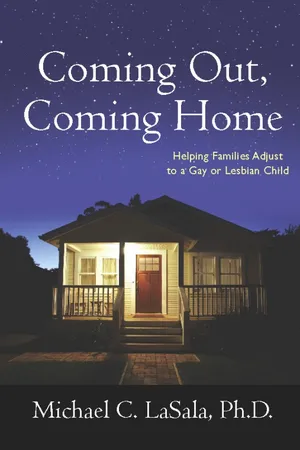
Coming Out, Coming Home
Helping Families Adjust to a Gay or Lesbian Child
- English
- ePUB (mobile friendly)
- Available on iOS & Android
eBook - ePub
About this book
Trusted by 375,005 students
Access to over 1.5 million titles for a fair monthly price.
Study more efficiently using our study tools.
Information
Subtopic
History & Theory in PsychologyIndex
Social SciencesCHAPTER 1
Family Sensitization
If the family were a fruit, it would be an orange, a circle of sections, held together but separable—each segment distinct.—LETTY COTTIN POGREBIN
FOR SOME GIRLS, IT MIGHT BEGIN WITH A CRUSH ON AN older sister’s best friend or a strange physical sensation that occurs while watching Xena, the Warrior Princess on television. For a boy, it might be a fantasy to take a bath with a buddy or a strong urge to run his hand across his gym teacher’s bearded cheek. At first, these children might not pay much attention to these early stirrings—when they first appear boys and girls are usually too young to know what they mean. However, at some point as they get older they come to realize to their horror that there is something wrong with these feelings—horribly wrong. These urges threatened to pull them away from everything and everyone they know, leaving them as lost and alone as an unmoored boat, bobbing and drifting on a cold, dark, dangerous sea.
Children with these feelings often want nothing more than to be like everyone else, to be accepted and well-liked by their peers. However, they soon realize that if they were found out they would be ridiculed as outcasts. They could lose everything: their friends, the respect of the teachers and classmates at school—and—perhaps the most frightening prospect of all, they could lose the love of their parents.
Now imagine you are a parent of one of these children. You noticed that your tomboy daughter does not seem to be developing interests in boys like her older sister did at her age and also seems to have a particularly intense friendship with the girl next door. Your sensitive son prefers to help his mom around the house rather than play ball outside with the other boys. Like a gentle summer breeze, the thought occurs to you. “Does this mean . . . could it mean . . . ?” but, before you could finish it, the notion, like that breeze, is gone. You push away any nagging worry the thought leaves behind and try to forget it.
During adolescence, a particularly difficult time for many families, children are testing their wings, sometimes pushing against ideas and values with which they were raised in an effort to develop their own identities. However, it is a mistake to view child development in isolation. Sociologists and family therapists have recognized family stages of development, which are evolving, reciprocal relationship patterns during each phase of the child’s growing maturity (Carter and McGoldrick 1999; Hill and Rodgers 1964). In families with teenagers, parent-child relationships must become more flexible than ever before in order to accommodate the adolescent’s growing needs for independence and exploration outside the family (Garcia-Preto 1999).
A major challenge for families at this time is for parents and children to establish and maintain relationships that allow children the freedom to develop their own identities but also keep them safe—no easy task. Children must figure out who they are while remaining connected to parents on whom they still must rely for physical and emotional support. Parents cope with a maelstrom of feelings during this phase. Certainly, they are anxious, knowing that their children will be spending more time away from the family, exposed to dangers such as drugs and alcohol, out of reach of supervising adults. Parents may project their fears onto their children who in turn react by either internalizing these anxieties or fighting their parents to avoid doing so. No wonder this is a difficult time for many families—and we haven’t even talked about sex yet.
The first stirrings of sexual feelings bring a confusing mix of awkwardness, anxiety, and pleasure. For most adolescents, when hormones begin to surge, the opposite sex once regarded neutrally, or even with scorn, becomes a fascinating source of fantasy, mystery, angst, and frustration as teenagers recognize their emerging sexual attractions and attempt to relate to each other. Observing parents may react with a combination of bemused pleasure, as they reminisce about their own puppy loves and pangs of regret that their “babies” are growing up too fast. As parents witness their children’s sexual maturation, they may dream of the day when their sons and daughters will marry and have children of their own continuing the family into the next generation. However, the emergence of their children’s sexuality may also inspire fears of teen pregnancy or HIV infection, leading parents to become excessively restrictive. In response, children may become fearful and avoidant or angry and combative, arguing “You worry too much!” “You never give me enough freedom!” “You treat me like a baby!”
Nevertheless, today’s families face the difficult task of coping with their children’s sexuality in a world that sanctions and celebrates these attractions. Whatever their romantic or sexual problems, heterosexual men and women and their families can find available guidance and potential solutions in art, the media, psychology, etc. Because they live in a society that endorses heterosexuality, parents and children can easily find resources to help them understand, adjust, and even celebrate these growing urges and attractions. There are opportunities within families, schools, and communities to openly discuss with young people the risks of heterosexual sex, such as pregnancy and sexually transmitted diseases, and how they can be avoided. Furthermore, heterosexual youth can look forward to love and legally and socially sanctioned marriage—ways to satisfy their longing for sexual fulfillment without risk or taboo.
However, about one in ten children do not have the luxury of living in a world that embraces their burgeoning sexual maturity. As recalled by Joelle,1 a young African American college student who felt a strong sense of alienation when she began to realize she was attracted to other girls: “I’d say like third grade, it would be like, I don’t feel like the rest of these kids. And for long periods of time, I’d just be sitting in class not doing work and just be like, ‘God, I feel so different.’” And this young student teacher, Mike, who, once he realized he was gay, attempted to commit suicide: “When I was twelve, I used to watch porn and I focused more on the penis and not the female . . . it was just something that I just thought about and no one knew but me. . . . [I realized this] very young, I guess, about ten or eleven. I know it felt fine to me on the inside, but I was very, very scared of anyone finding out.”
Many of the prevailing models of lesbian and gay identity development describe coming out as primarily an individual experience starting with a troubling emerging awareness that one is somehow different from her peers (Cass 1979; Coleman 1982; Troiden 1989). Troiden uses the term sensitization to describe this first stage of gay and lesbian identity development, and, as the sixty-five adolescents and young adults in this study recalled their early lives, this term resonated. However, as I interviewed the gay and lesbian young people and their parents, I found there was a family stage process that was related but also different from the family development stages identified by Carter and McGoldrick and others. To borrow from Troiden, the first of these stages is what I am calling the family sensitization phase. Like Troiden’s sensitization phase, the period for family sensitization occurs anywhere from the time when children realize something is different, often without knowing why—to the three months or so before they come out to their parents. However, what makes this a family phase is the interaction between the children’s awareness of stigma, their emotional distancing from their mothers and fathers, and their parents’ suspicions.
As these previous quotes suggest, facing the fear of shame, ostracism, and rejection is a central theme in the lives of the adolescents and young adults who were interviewed for this book. Once parents eventually knew that their children were lesbian or gay, they also feared the harsh judgment of those who would blame them for their children’s homosexuality. However shame and stigma are not the whole story. The recollections of these families also demonstrate the persistence and potential healing power of family connections that endure despite personal guilt, anxiety, and societal condemnation.
Stigma and Isolation
All stories have a beginning. For the families discussed in this book, their stories of coping and adjustment began long before children understood what their attractions meant and certainly well before parents knew about them. Most of the young respondents in this sample described the realization that they had same-sex attractions as a slow dawning coupled with a nagging realization that something was wrong—very wrong, with the way they felt. They understood that if their peers or their parents discovered their sexual feelings, they risked becoming objects of rejection and abuse.
Stigma has been defined as a personal quality or condition that is considered deviant and diminishes the bearer’s worth and status (Dovidio, Major, and Crocker 2000; Goffman 1963; Link and Phelan 2001). Goffman described stigma not as a personal attribute but as a function of relationships; a stigma exists because the individual with the deviant characteristic is considered tainted by others and is therefore marginalized and discredited. Despite slowly growing improvement in the public’s attitudes toward homosexuality (Avery et al. 2007; Brown and Henriquez 2008), in a Gallup poll close to half of the sample believed that homosexuality should not be “considered an acceptable alternative lifestyle” and 40 percent thought homosexual relations between two consenting adults should be illegal (Gallup Organization 2006). Thus, there still very much exists what Herek, Chopp, and Strohl (2007) call a homosexual stigma, defined as “society’s shared belief system through which homosexuality is denigrated, discredited, and constructed as invalid relative to heterosexuality” (171).
Children are taught that love and marriage between a man and a woman is the romantic ideal to which everyone is expected to aspire. Those growing up with same-sex attractions learn what is considered normal long before they discover, to their horror, that they themselves are abnormal. Shame, stigma’s evil handmaiden, is defined by Nichols (1995b) as the feeling of being looked down upon by others: of feeling worthless, weak, and dirty. As gays and lesbians begin to recognize their same-sex attractions, they are already aware that such feelings are shameful and must be denied, hidden, and repressed—at great cost to their own self-esteem.
Schulze and Angermeyer (2003) have identified interpersonal interaction as one of the primary domains where stigma manifests, and many of the young people in this study first learned that their homosexuality was wrong at the hands of their peers. Their classmates saw their cross-gendered or otherwise atypical behavior as justification for cruelty. Both of the following respondents recalled being physically assaulted by peers who believed them to be gay or lesbian long before they recognized their own same-sex attractions.
Once I hit middle school I think really other kids figured out before I did. I used to get picked on for being gay all the time and I didn’t know what it meant. . . . I wasn’t the most masculine kid (twenty-one-year-old gay man).I got beat up a lot. I didn’t have many friends, they were kind of put off. A lot of the guys would pick on me. . . . They would call me dyke and beat me up (twenty-year-old lesbian).
Schulze and Angermeyer (2003) also identify a structural dimension of stigma, namely, how discrimination is embedded in institutional policies and practices. Youth who were verbally and physically harassed by peers recalled how school employees who witnessed their abuse did nothing to stop it. The confusion and shame experienced by these youth was compounded by the indifference of adults who could have protected them but didn’t. One eighteen-year-old gay man, recalling abuse he experienced in high school, remembered feeling helpless and abandoned: “Yeah, no one else saw it. Which is pretty ironic considering there is a teacher at every doorway—every five feet—but no one ever heard it. No one ever saw it. So then I didn’t know what to do. I was completely clueless. I had no idea what to do.” Jay, a twenty-five-year-old gay male, recalled:
Well see the thing of it was I got colitis the summer after my sixth-grade year, which was my worst year in school ever. The kids beat me up with no mercy and my teacher did nothing about it, absolutely nothing. And he is the vice principal now! I am convinced, because of the stress of that year I developed colitis the summer following sixth grade and I was very sick. By the fall the doctors figured out what it was, gave me medicine and I was fine . . . but halfway through eighth grade the bullies started up again and this time it was girls, two white trash girls that were just angry and just hated me. . . . But it [also] seemed like every boy was just trying to get me—kick me in the hallway, push me over, push my books on the floor—crap like that. And I developed colitis again in the spring of that year.
The devastating emotional impact of peer abuse was compounded by the respondents’ helplessness and isolation. One way oppressed people protect themselves from the shame that can result from stigma is to form groups with others like themselves so they can learn effective coping methods such as externalization, which is when people place the blame for their stigma on its source where it belongs. (e.g., “It’s not us who are sick, it’s them!”) (Corrigan and Watson 2002; Frable, Wortmen, and Joseph 1997). However, for the most part, a resource such as a supportive group of gay peers was not available to the young men and women in this study. As stated by a sixteen-year-old young man: “As far as I knew I was the only person [who was gay].” And recalled by this twenty-three-year-old lesbian: “When I started thinking that I was gay, it was just really odd. There were no out gay people where I live, no out gay people on either side of my family. I know because I am the only one. But I didn’t know anybody.”
Such isolation and mistreatment (or fear of mistreatment) takes a toll on a gay or lesbian person’s physical and mental health, as reported by Jay who developed colitis and who also became school phobic as a result of the abuse he experienced. As lesbian and gay adolescents and young adults attempt to reconcile their sexual orientation with their status as stigmatized persons, they may develop a denigrated self-image that bodes poorly for their mental health and ability to maintain long-term intimate relationships (Corrigan and Watson 2002; Gallo 1994; Greenan and Tunnell 2003; Meyer 2003; Meyer and Dean 1998). Among samples of gay males and lesbians, reported incidents of discrimination and violence have been associated with psychiatric problems including suicidal thoughts and attempts (D’Augelli 2002; D’Augelli, Pilkington, and Hershberger 2002; Huebner 2002; Meyer 2003; Vives 2002), and the destructive effects of being stigmatized were found among the young respondents interviewed for this study, whereby most recalled experiencing symptoms of depression and anxiety before coming out.
Experts in the area of stigma describe the way in which people develop self-protective behavior once they become aware of their potential to be stigmatized (Herek, Chopp, and Strohl 2007; Scambler 1989). The young people in this sample learned painfully and powerfully that their burgeoning homosexuality was shameful and punishable by social exclusion and violence, so they attempted to hide their attractions in an effort to protect themselves from ostracism and rejection.
Peer Harassment and Parents
For those who haven’t experienced it, it is difficult to imagine how humiliating, lonely, and horrible it is to be terrorized on a daily basis and be afraid to tell anyone. Parents of children who were harassed by peers during family sensitization were sometimes (but not always) aware that their children were having problems with other kids in school. However, they were never aware that their sons and daughters attracted the ire of their peers because they appeared gay or lesbian.
Jay’s mother Adele knew that he was experiencing peer problems but was unaware that he was victimized becau...
Table of contents
- Cover
- Half title
- Title
- Copyright
- Dedication
- Contents
- Foreword
- Preface
- Acknowledgments
- 1: Family Sensitization
- 2: Family Discovery: Youth Come Out
- 3: Family Discovery: Parents React
- 4: Family Recovery
- 5: Family Renewal: The Gift of the Gay or Lesbian Child
- 6: Race and Ethnicity
- 7: Areas for Future Research and Concluding Thoughts
- Appendix: Research Methodology
- References
- Index
Frequently asked questions
Yes, you can cancel anytime from the Subscription tab in your account settings on the Perlego website. Your subscription will stay active until the end of your current billing period. Learn how to cancel your subscription
No, books cannot be downloaded as external files, such as PDFs, for use outside of Perlego. However, you can download books within the Perlego app for offline reading on mobile or tablet. Learn how to download books offline
Perlego offers two plans: Essential and Complete
- Essential is ideal for learners and professionals who enjoy exploring a wide range of subjects. Access the Essential Library with 800,000+ trusted titles and best-sellers across business, personal growth, and the humanities. Includes unlimited reading time and Standard Read Aloud voice.
- Complete: Perfect for advanced learners and researchers needing full, unrestricted access. Unlock 1.5M+ books across hundreds of subjects, including academic and specialized titles. The Complete Plan also includes advanced features like Premium Read Aloud and Research Assistant.
We are an online textbook subscription service, where you can get access to an entire online library for less than the price of a single book per month. With over 1.5 million books across 990+ topics, we’ve got you covered! Learn about our mission
Look out for the read-aloud symbol on your next book to see if you can listen to it. The read-aloud tool reads text aloud for you, highlighting the text as it is being read. You can pause it, speed it up and slow it down. Learn more about Read Aloud
Yes! You can use the Perlego app on both iOS and Android devices to read anytime, anywhere — even offline. Perfect for commutes or when you’re on the go.
Please note we cannot support devices running on iOS 13 and Android 7 or earlier. Learn more about using the app
Please note we cannot support devices running on iOS 13 and Android 7 or earlier. Learn more about using the app
Yes, you can access Coming Out, Coming Home by Michael C. LaSala in PDF and/or ePUB format, as well as other popular books in Social Sciences & History & Theory in Psychology. We have over 1.5 million books available in our catalogue for you to explore.