For Elisabeth Roudinesco, a historian of psychoanalysis and one of France's leading intellectuals, Canguilhem, Sartre, Foucault, Althusser, Deleuze, and Derrida represent a "great generation" of French philosophers who accomplished remarkable work and lived incredible lives. These troubled and innovative thinkers endured World War II and the cultural and political revolution of the 1960s, and their cultural horizon was dominated by Marxism and psychoanalysis, though they were by no means strict adherents to the doctrines of Marx and Freud.
Roudinesco knew many of these intellectuals personally, and she weaves an account of their thought through lived experience and reminiscences. Canguilhem, for example, was a distinguished philosopher of science who had a great influence on Foucault's exploration of sanity and madness-themes Althusser lived in a notorious personal drama. And in dramatizing the life of Freud for the screen, Sartre fundamentally altered his own philosophical approach to psychoanalysis.
Roudinesco launches a passionate defense of Canguilhem, Sartre, Foucault, Althusser, Deleuze, and Derrida against the "new philosophers" of the late 1970s and 1980s, who denounced the work-and sometimes the private lives-of this great generation. Roudinesco refutes attempts to tar them, as well as the Marxist and left-wing tradition in general, with the brush of Soviet-style communism. In Freudian theory and the philosophy of radical commitment, she sees a bulwark against the kind of manipulative, pill-prescribing, and normalizing psychology that aims to turn individuals into mindless consumers. Intense, clever, and persuasive, Philosophy in Turbulent Times captivates with the dynamism of French thought in the twentieth century.
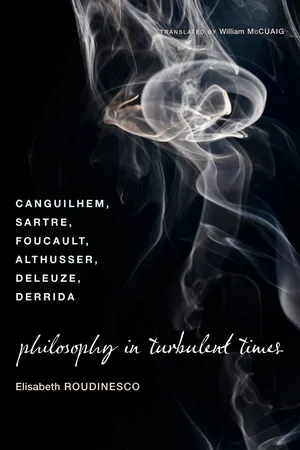
eBook - ePub
Philosophy in Turbulent Times
Canguilhem, Sartre, Foucault, Althusser, Deleuze, Derrida
- English
- ePUB (mobile friendly)
- Available on iOS & Android
eBook - ePub
Philosophy in Turbulent Times
Canguilhem, Sartre, Foucault, Althusser, Deleuze, Derrida
About this book
Information
Topic
FilosofiaSubtopic
Decostruzione in filosofia1. GEORGES CANGUILHEM
{A PHILOSOPHY OF HEROISM}
IN THE LAST ARTICLE HE APPROVED FOR PUBLICATION, TWO months before dying, Michel Foucault expressed his deep respect for Georges Canguilhem, emphasizing the position he had held in the history of philosophy in France:
This man, whose oeuvre was austere, narrowly bounded by choice, and carefully focused on a particular area within the history of science—which is not, in any case, regarded as a spectacular discipline—still found himself involved, to a certain extent, in debates in which he himself was careful never to intervene. But screen out Canguilhem and you will not be able to make much sense of a whole series of discussions among French Marxists; you will fail to grasp the specific factors that make sociologists like Bourdieu, Castel and Passeron so eminent in their field; and you will miss a whole aspect of the theoretical work done by psychoanalysts, particularly the Lacanians. More than that: across the spectrum of intellectual debate that preceded and followed the movement of 1968, it is easy to tell which participants had been formed, at firsthand or remotely, by Canguilhem.1
Foucault added that The Normal and the Pathological was without doubt his most significant book.2 It conveyed, he said, the essence of Canguilhem’s work: reflection on life and death; valorization of the status of “error” and rationality in the history of science; insistence on the notions of continuity and rupture, norm and anomaly; and a thoroughly modern view of the relationship between experimentation and conceptualization in the field of medicine.
Pursuing this theme, Foucault pointed to the fault line separating two main currents of contemporary thought in France: on one hand a philosophy of experience, of sense, and of the subject (the line running from Merleau-Ponty to Sartre), and on the other a philosophy of knowledge, rationality, and conceptuality (Cavaillès, Canguilhem, Koyré). The second of these, apparently more speculative and remote from any form of subjective and political commitment, was the one that had taken part in the struggle against the Nazis. No doubt the author of History of Madness had himself in mind in saluting the courage of a man who had been a hero of the Resistance before becoming Foucault’s own master.3 Was Foucault himself not also an austere historian of science engaged in a political struggle, not against fascism but against more subtle forms of oppression?
In truth, Canguilhem himself had already pointed out this fault line previously, once in 1943, when he defended his thesis on the normal and the pathological while risking his life as a resister; and again in 1976, when he composed a eulogy for his friend Jean Cavaillès, who had been killed by the Nazis: “His mathematical philosophy was not constructed with reference to any Subject that might momentarily and precariously be identified with Jean Cavaillès. This philosophy, from which Jean Cavaillès is radically absent, dictated a form of action that led him, along the narrow paths of logic, to that crossing from which none return. Jean Cavaillès was the logic of the Resistance lived out right up to death. Let the philosophers of existence and of the person do as well the next time around, if they can.”4 Canguilhem was pointing to a logical coherence, grounded in the primacy of the concept, between political commitment and intellectual activity. Foucault, nineteen years later, was emphasizing a caesura between a commitment in the service of liberty and the fact of defending a philosophy of the concept. Yet in 1983 he himself echoed Canguilhem’s idea of logical coherence: “One of the French philosophers who engaged in the Resistance during the war was Cavaillès, a historian of mathematics who worked on the development of its internal structure. No philosopher of political commitment, not Sartre, not Simone de Beauvoir, not Merleau-Ponty, made any effort at all.”5 If such a dialectic is present in the positing of a foundational relation between, on one hand, a philosophy of liberty and the subject, and on the other, a philosophy of concept and structure, that perhaps signifies that these are the two major paradigms that govern, in originary fashion, the relationship between a politics and a philosophy. But one might then maintain that only when the Freudian concept of the unconscious (irreducible as it is to any psychology of the person) is introduced does it become possible to resolve and overcome this contradiction.
Like many of his generation who studied at the École Normale Superieure (ENS), Canguilhem was a pure product of the educational system of the Third Republic. He was born on 4 June 1904 at Castelnaudary into a milieu of petit-bourgeois artisans; his father was the village tailor and his forebears were peasants from the south of France. Throughout his life he retained a local accent that gave his voice a particular resonance, at once blunt and determined. When he was ten he learned how to work the land on the farm his mother had inherited at Orgibet, on the border between the Aude and Ariège regions, land he himself managed during the period between the wars. He was a brilliant pupil in his native city before moving to Paris, where in 1921 he became a khâgneux at a distinguished upper secondary school, the lycée Henri-IV. Traditional student argot gave (and gives) the name khâgneux (= cagneux, or wretches) to students in the humanities division, technically known as the division of higher rhetoric, of the preparatory course (khâgne) for the ENS. The science students for their part got the nickname taupins, which suggests subterranean labor (taupe, literally “mole,” is a term for a mining engineer).6
The dominant figure at the lycée Henri-IV was Émile Chartier, better known under the pseudonym “Alain.” A student of Jules Lagneau, Alain succeeded Henri Bergson, Victor Delbos, and Léon Brunschvicg as a khâgne instructor. He had been a supporter of Dreyfus, and when the war came had volunteered for duty in the front lines, refusing to assume officer rank. Horrified by the mass slaughter of World War One, he had become convinced that philosophy must not stand apart from political thought. Hence he adopted a stance of radical pacifism, allied to a moderate humanism. A remarkable speaker, Alain was able to awaken the critical spirit of the youthful elite of the nation without claiming to impose any system of thought on them. For many years (until 1933) he passed on to them his ideal of a philosophy of action, deliberately Voltairean and grounded in the primacy of freedom, of the moral conscience, and of reason. In 1921 he began publishing Libres Propos with Gallimard. The weekly journal, some twenty pages in length to which many of his students contributed, served as a vehicle for his radicalism, his pacifism, and his hostility to the institutional military.
The young Canguilhem became a devotee of Alain. When he was admitted to the ENS in 1924, thus becoming a normalien, his classmates included Jean-Paul Sartre, Paul Nizan, Daniel Lagache, and Raymond Aron. Two years later, tutored by Célestin Bouglé, he took his diploma of higher studies at the Sorbonne for his work on “the theory of order and progress in Auguste Comte.” In 1927 he achieved the agrégation in philosophy, becoming a qualified instructor at the higher secondary and university levels. In the same year he began to publish articles in Libres Propos under the pseudonym C. G. Bernard.
In 1927 Canguilhem, an ardent pacifist, took a leading part in the student protest movement against the established order within the ENS. For the school’s annual revue, he and his friend Sylvain Broussaudier staged a show entitled Le désastre de Langson. In it, the name of the prestigious director of the ENS, Gustave Lanson, the author of a well-known manual of literary history, was linked with a rather inglorious episode of the French conquest of Indochina, the battle of Lang Son in the 1880s. In two numbers, part satire and part prank, the authors heaped scorn on the French army, especially on one article of a law passed by the French parliament the same year that stipulated that in time of war the government should take all necessary measures “ dans l’ordre intellectuel ” to maintain national morale. The most scandalous part came when the actors sang, to the tune of “La Marseillaise,” verses from the Complainte du capitaine Cambusat in which the military instructors of the ENS were severely ridiculed.
Vexed by these attacks, Gustave Lanson reprimanded the perpetrators of the prank and forwarded a file on them to the war ministry. Accused of revolutionary propaganda, the pacifist normaliens signed a petition the following year against the advanced military training they were compelled to receive. Canguilhem found a way to protest by letting the tripod of a machine gun fall and hit his instructor, thus choosing deliberately to fail as an officer-in-training. This earned him eighteen months of military service with the rank of corporal.7
From 1930 on, pacifism in the manner of Alain gradually became irrelevant. The former khâgne students of the lycée Henri-IV turned to new commitments. The economic crisis and the rise of fascism thrust them into an environment very different from that of their youth. Nevertheless, after being appointed to a teaching post at Charleville, Georges Canguilhem repeatedly demonstrated that he had kept faith with the teaching of Émile Chartier, especially in supporting the “integral pacifism” of Félicien Challaye, a professor at the lycée Condorcet and in declaring himself hostile to all forms of established power, in the name of Socratic citizenship.8 Starting in 1934, though, he realized that Hitler’s rise to power had rendered his former antimilitary revolt pointless. After having taught at Albi, Douai, and Valenciennes, he joined Paul Langevin and Paul Rivet on the Vigilance Committee of antifascist intellectuals, which Alain and Challaye had also joined.9
The nations had gone to war against one another in 1914 in order to safeguard the interests of the ruling classes and the empires, to the detriment of peoples and individuals who held to the Enlightenment ideal of a Europe without national homelands or borders. In the coming war, the forces of tolerance were ranging themselves against those of tyranny, and it was impossible to view the outcome in the same light, given that the nations were about to clash not as such but in the name of liberty against slavery. In this new context, support of pacifism could mean abdication in the face of the destructive power incarnated by Hitler and his allies. The choice of Canguilhem, and those who followed the same trajectory, was thus similar in nature to, and anticipated, their subsequent decision to reject first the Munich pact, and then the handshake between Marshal Pétain and Hitler at Montoire in October 1940.
In October 1936, after a year spent in Béziers, Canguilhem was appointed to Toulouse, and became in turn a professor in charge of a khâgne. Though he now assumed the mantle of his own former master, the new instructor could not have been more different from Alain in the classroom. Classical and severe, he soon adopted the bearing of a cavalry officer, incarnating to the point of ascesis all the virtues of republican schooling. His students at Toulouse were inculcated with a sense of order, logic, and discipline, as their teacher laid down a series of prohibitions in the classroom: no notebooks, no pencils, a refusal even to allow certain expressions to be uttered. The normal method was for the students to take lecture notes, thus fixing the knowledge transmitted in permanent form; Canguilhem preferred them to assemble flexible archives, grouped into thematic dossiers or adaptable modules.
Similarly, in order to exercise the critical faculty of his pupils and train them to develop an intelligent memory, he forced them to write down and submit summaries of what they had heard in class after an hour of attentive listening during which they took no notes. The summaries were neither returned nor commented upon. Canguilhem never advocated the sort of pedagogy that puts student and teacher on the same level, and he never yielded to the temptations of false freedom of speech: his preference was for dictating or mimeographing his courses.10 The man who had challenged authority in the most radical fashion was the same man who, in his classroom, required the greatest submission from his students, as he imparted knowledge to them in a manner seemingly remote from any practice of liberty. José Cabanis wrote: “For me, Canguilhem’s class in the lycée was not the discovery [of] a truth, but of a method, to which I don’t believe I have been unfaithful: a critical reflection that takes nothing for granted, takes its distance, and assesses the concrete evidence, while at the same time it intimately espouses, slips stealthily, to the heart of the matter to know it better: at once embrace, retreat, and vigilance.”11 From his years as a pacifist Canguilhem had thus retained not a love of revolt or opposition, but the very essence of their deep causality: a true spirit of resistance, grounded in the effectiveness of prohibition and authority. Every man ought, in his view, to be a rebel, but every rebellion ought to aim at the creation of an order higher than that of subjective liberty: an order of reason and conceptuality.
During this period Canguilhem decided to undertake the study of medicine. Philosophers who adopted a similar course usually did so because they were interested in psychopathology and the treatment of mental illness—Pierre Janet for example. Their purpose was to develop the field of clinical psychology and thus to transform psychiatric knowledge in a dynamic fashion, even to detach it completely from the medical profession. Canguilhem stood apart, for he never saw himself as belonging to this tradition. As a youth he had been exposed, like all the normaliens of his generation, to the famous presentations of mentally ill patients by Georges Dumas, but these had left him unimpressed.
So by choosing medicine Canguilhem did appear to be turning away from philosophy, but not down a well-trodden path. It may be that he was experiencing a certain disappointment with philosophy, as he himself said. The truth of the matter is no doubt more complex. He was a man of action, born to a rural family and responsive to manual gesticulation and to the work of farming the land, so much so that he took a keen interest in the agricultural crisis under the Nazi and fascist regimes. His choice was a way of confronting a concrete experience, a “terrain,” a discipline that, while not scientific, made it possible to give body and life to conceptual thought. Medicine had been left to its own devices a hundred years previously by philosophy, both because it had no place among the so-called noble sciences like mathematics and physics, and also because of its convergence with biology, likewise the object of philosophical disdain. So it offered the young philosopher the challenge of a new form of rationality.
As Michel Foucault points out, the history of science owed its dignity to the fact that, beginning in the eighteenth century, it had forced the high intellectual tradition to face the question of its own foundation, its rights, its powers, and the conditions of its own practice. And in the first quarter of the twentieth century this interrogation had acquired massive importance in philosophy with the publication of the works of Edmund Husserl.
The German philosopher’s theses began to become known in France starting in the 1920s, especially after February 1929, when he delivered the famous lectures entitled Cartesian Meditations before the French Philosophical Society.12 With Descartes’s cogito as its basis, Husserlian phenomenology affirmed that there is no certain knowledge outside of my existence as a thinking being. Hence the notion of phenomenological reduction, which posits the primacy of the ego and of thought, and goes beyond so-called natural experience to attain a vision of existence as consciousness of the world. The ego thus becomes transcendental and consciousness intentional, since it “aims at” something. Thus the sense of the other is formed in the ego, out of a series of experiences. Transcendental intersubjectivity is then defined as a reality against which the ego of every individual figures in relief.
In 1935, in The Crisis of European Sciences and Transcendental Phenomenology Husserl demonstrated that the quest for this intersubjectivity could preserve the human sciences from inhumanity.13 In other words, transcendental phenomenology, by shielding the ego from scientific formalism, was saving a potential science of man in which the ego could b...
Table of contents
- Cover
- Half title
- Title
- Copyright
- Dedication
- Contents
- Introduction: In Defense of Critical Thought
- Notes on the Text
- 1: George Canguilhem: A Philosphy of Heroism
- 2: Jean-Paul Sartre: Psychoanalysis on the Shadowy Banks of the Danube
- 3: Michel Foucault: Readings of History of Madness
- 4: Louis Althusser: The Murder Scene
- 5: Gilles Deleuze: Anti-Oedipal Variations
- 6: Jacques Derrida: The Moment of Death
- Notes
- Select Bibliography
Trusted by 375,005 students
Access to over 1.5 million titles for a fair monthly price.
Study more efficiently using our study tools.
Frequently asked questions
Yes, you can cancel anytime from the Subscription tab in your account settings on the Perlego website. Your subscription will stay active until the end of your current billing period. Learn how to cancel your subscription
No, books cannot be downloaded as external files, such as PDFs, for use outside of Perlego. However, you can download books within the Perlego app for offline reading on mobile or tablet. Learn how to download books offline
Perlego offers two plans: Essential and Complete
- Essential is ideal for learners and professionals who enjoy exploring a wide range of subjects. Access the Essential Library with 800,000+ trusted titles and best-sellers across business, personal growth, and the humanities. Includes unlimited reading time and Standard Read Aloud voice.
- Complete: Perfect for advanced learners and researchers needing full, unrestricted access. Unlock 1.5M+ books across hundreds of subjects, including academic and specialized titles. The Complete Plan also includes advanced features like Premium Read Aloud and Research Assistant.
We are an online textbook subscription service, where you can get access to an entire online library for less than the price of a single book per month. With over 1.5 million books across 990+ topics, we’ve got you covered! Learn about our mission
Look out for the read-aloud symbol on your next book to see if you can listen to it. The read-aloud tool reads text aloud for you, highlighting the text as it is being read. You can pause it, speed it up and slow it down. Learn more about Read Aloud
Yes! You can use the Perlego app on both iOS and Android devices to read anytime, anywhere — even offline. Perfect for commutes or when you’re on the go.
Please note we cannot support devices running on iOS 13 and Android 7 or earlier. Learn more about using the app
Please note we cannot support devices running on iOS 13 and Android 7 or earlier. Learn more about using the app
Yes, you can access Philosophy in Turbulent Times by Elisabeth Roudinesco, William McCuaig in PDF and/or ePUB format, as well as other popular books in Filosofia & Decostruzione in filosofia. We have over 1.5 million books available in our catalogue for you to explore.