Sexual violence and exploitation occur in many conflict zones, and the children born of such acts face discrimination, stigma, and infanticide. Yet the massive transnational network of organizations working to protect war-affected children has, for two decades, remained curiously silent on the needs of this vulnerable population.
Focusing specifically on the case of Bosnia-Herzegovina, R. Charli Carpenter questions the framing of atrocity by human rights organizations and the limitations these narratives impose on their response. She finds that human rights groups set their agendas according to certain grievances-the claims of female rape victims or the complaints of aggrieved minorities, for example-and that these concerns can overshadow the needs of others. Incorporating her research into a host of other conflict zones, Carpenter shows that the social construction of rights claims is contingent upon the social construction of wrongs. According to Carpenter, this pathology prevents the full protection of children born of war.
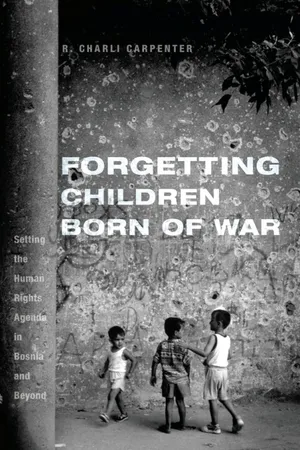
eBook - ePub
Forgetting Children Born of War
Setting the Human Rights Agenda in Bosnia and Beyond
- English
- ePUB (mobile friendly)
- Available on iOS & Android
eBook - ePub
Forgetting Children Born of War
Setting the Human Rights Agenda in Bosnia and Beyond
About this book
Trusted by 375,005 students
Access to over 1.5 million titles for a fair monthly price.
Study more efficiently using our study tools.
Information
Subtopic
European Politics1.
THEORIZING CHILD RIGHTS IN INTERNATIONAL RELATIONS
THEORIZING CHILD RIGHTS IN INTERNATIONAL RELATIONS
The birth of a child is a political event.
—Handwerker, Births and Power, 1.
—Handwerker, Births and Power, 1.
AFTER THE DISINTEGRATION of Yugoslavia in the early 1990s, an uncounted number of children, conceived as a result of wartime rape, were born to traumatized mothers.1 Many did not want them. Children of refugee mothers in neighboring Croatia were initially denied citizenship and education rights.2 Local and international actors contested the babies’ ethnic identities and citizenship rights. Inside Bosnia, there were reports of ostracism and abandonment; some were killed.3
At the time I began to gather research for this book, almost nothing was known outside the former Yugoslavia about what had become of these babies, how to protect their human rights, or how issues around their security and identity were being constructed and reconstructed in postwar Bosnia, Croatia, and Serbia and in the various diasporic communities spawned by the conflict. More interestingly to me, no one outside Bosnia seemed to be asking. What I learned on arriving in the region in early 2004 was that few people inside Bosnia were asking either. These children were invisible to the children’s rights network, overlooked by the government, and described by women’s rights and nationalist organizations in ways not necessarily conducive to securing much-needed attention to their needs as many of them entered puberty.
This book explores why children born of wartime rape have received so little systematic attention from the international actors charged with protecting and promoting children’s human rights in conflict situations, both in Bosnia and in similar contexts globally, despite widespread media attention, and it uses this single case as a jumping off point for asking bigger questions about the human rights regime. Aside from being of arguable normative importance for human rights scholars and practitioners, this policy and advocacy gap represents a fascinating puzzle theoretically for international relations (IR) scholars. The literature on transnational advocacy networks suggests that issue networks are most likely to mobilize around precisely populations such as these, where bodily harm or discrimination affects people traditionally seen as vulnerable or innocent,4 where the harms fall easily within existing human rights law or are easily grafted onto existing advocacy space,5 where the media and the political economy of activism exert agenda-setting effects,6 and where issue “entrepreneurs” push for the development of a robust response.7
If theory suggests that children born of war should be an obvious subject of human rights concern and they have not, this begs the question of what additional factors account for the shape of the human rights agenda in international society and why certain categories fall through the cracks. The answer to this puzzle can tell us something about advocacy networks in world affairs more broadly and about the social construction of children’s human rights as it relates to conceptions of international order and justice.
In the following pages, I draw attention to what both local and international human rights advocates in Bosnia-Herzegovina and in the broader transnational children’s rights network repeatedly call “the problematique” of addressing war babies as a focus of human rights concern.8 My overall argument is that the process of casting blame for one set of atrocities can draw attention away from other harms on which human rights advocates focus their attention. Blaming in one context affects framing in another. Although an interrelated set of factors accounts for the silence of the human rights community on this particular issue, central to all of them is the tension between this issue and other claims already pressed by the human rights community, particularly claims on behalf of female rape victims, claims on behalf of aggrieved minority groups, and broader claims about what constitutes civilized or barbaric international conduct. In short, in conflict zones the social construction of rights claims is contingent partly on the social construction of wrongs.
I will demonstrate how the advocacy network around children and armed conflict was conditioned in the 1990s to accept that children born of war are a side effect of war rape rather than a population of concern for children’s advocates in their own right. This understanding was constructed in part through specific narratives about war babies carried by the global media, by nationalist players in Bosnia-Herzegovina during and after the war, by international lawyers, and by the transnational women’s rights movement. These narratives interacted with an institutional culture within the child rights network that either precluded attention to children born of war altogether or posed obstacles to pursuing it for the political entrepreneurs who challenged the silence.
What this analysis teaches IR scholars more generally, particularly those optimistic about the role played by networks of normatively motivated policy practitioners in transnational civil society, is that the discourse of human rights is not a panacea for vulnerable populations. The case here confirms the findings of emerging scholarship in suggesting that the construction of specific categories of rights claims in international society does not follow a rational, linear process in which the most vulnerable populations receive attention on the basis of need and merit. Rather, attention to issues by human rights advocates is conditioned by myriad political, organizational, cultural, structural, coalitional, and economic factors; and some combination of these factors may draw attention away from certain individuals regardless of the merits of their case. At the turn of the twenty-first century, children born of wartime rape and exploitation constituted one such case. I conclude by suggesting that IR constructivists can learn much about human rights norms in world affairs by studying what does not get attention from human rights practitioners.
CHILDREN BORN OF WAR AND HUMAN RIGHTS
Children conceived as a result of violent or exploitive relations are living today in every corner of the globe. Born of conflicts and militarized sex relations, they face abuse, stigmatization, and discrimination. Although many are conceived in rape campaigns, others are born out of less overtly coercive exploitive relationships between soldiers and local women: prostitutes around military bases, aid recipients encouraged to trade sex for additional supplies, and young girls genuinely in love who believed they would be one day be wed to their foreign boyfriend, only to be abandoned when the soldier returned home, often to a wife and family there. When children result from such unions and are raised alone or abandoned by single women in postwar zones, they are often stigmatized as a result.
To date, no international organization concerned with children’s human rights has published a systematic study estimating the number of such children worldwide. However, a group of Norwegian activists produced a report in 2001 synthesizing the anecdotal material available on the subject. This group, the War and Children Identity Project (WCIP), was formed on the heels of a successful campaign by Norwegian krigsbarn (war children) whose mothers were impregnated by German men during the World War II occupation of Norway. These adult war children won a suit against the Norwegian government for compensation for failing to protect them from discrimination in the war’s aftermath. Interested in situating Norway’s krigsbarn in their broader context and perhaps exporting their model abroad, WCIP became the first organization to focus on war children as a global constituency. Its initial global report, authored by anthropologist Kai Grieg, estimated the total number of living war children at approximately 500,000.9
If these numbers are anywhere close to correct, children born as a result of wartime rape or sexual exploitation constitute a massive global underclass. Even looking solely at children brought to term as a result of deliberate impregnation as a tool of armed conflict, the list of potential cases is staggering, including those in Bosnia, Bangladesh, East Timor, Rwanda, Sierra Leone, and Darfur. Anecdotal evidence and press reports have demonstrated for almost fifteen years that such children born of war are at risk of infanticide, abandonment, abuse, neglect, discrimination, and social exclusion in conflict and postconflict settings specifically as a result of their biological origins.10 Oral histories of adult war children from earlier conflicts corroborate such evidence.11
What is remarkable is that so little attention has been paid to this population by the network around children’s human rights, particularly the organizations engaged in advocacy and programming for children in armed conflict. By “children’s human rights network” I mean the transnational community of citizens, journalists, protection organizations, and statespersons who, believing that children possess certain fundamental rights as human beings, aim at the more widespread implementation of international child rights standards through persuasion or purposeful action. The network consists of the actors who promote the implementation of the principles, norms, and rules associated with the international regime for children’s human rights.12
This network of organizations and understandings is embedded in the broader human rights regime about which much has been written.13 A subset of organizations concerned broadly with human rights are those engaged particularly with children and armed conflict as a specific issue area. The principled belief at the core of this network’s efforts is that children should be better protected from the effects of armed conflict. As the UN Web portal on this issue states, “International and local standards of conduct should be resurrected and respected, in order to prevent the abuse and brutalization of children.”14
Given that such organizations claim to champion the human rights of all children and to be particularly concerned with “children in especially difficult circumstances,” the “particularly vulnerable,” or “children affected by armed conflict,” one might expect the protection of children conceived through war to be a focus of concern for them. Yet despite consistent media and donor concern for this category of war-affected child, awareness of their particular vulnerabilities by gender-based violence specialists, and the presence of a few organizations such as WCIP lobbying specifically for their rights, major organizations in the growing advocacy network around children and armed conflict and the broader human rights regime have not openly defined children born to sexual violence survivors in conflict zones as a specific category of concern or sought to address the insecurities they face in postconflict zones. In 2004, while attention to other categories of war-affected child burgeoned in transnational civil society, a child protection official stated, “I can’t think of any organization that has dealt with [children born of wartime rape] specifically.” This continued to be true through early 2009, despite the widespread publicity regarding stigma and maltreatment of children born of rape in places such as Darfur and the increasing attention in transnational civil society to children and armed conflict generally.15 Why?
This project uses a single case study, Bosnia-Herzegovina, as a lens through which to interrogate the broader silence on this issue from the global children’s human rights regime and in turn to ask broader questions about the meaning and practice of human rights advocacy in world politics. Broadly speaking, human rights are a set of international standards said to govern relationships between sovereign governments and the citizens over which they have authority. What counts as a rights violation may be contested; these contests may be resolved in transnational space through the interaction between issue entrepreneurs, the nongovernment organization community, and UN agencies; the consensus may then be reiterated by actors who use naming and shaming strategies to hold states accountable to the standards they set through multilateral negotiations. But in the end, rights are implemented by states. Although in theory all human beings possess rights, they can enjoy them only insofar as authorities implement these standards through positive or negative action. Negative action means a state chooses not to torture or arbitrarily imprison people. Positive action means a state puts resources toward, for example, social safety nets to provide food and shelter for those who would otherwise go hungry.16
In theory, children possess human rights as individual humans, but they are governed by a very particular international regime because of their unique status and needs. Children have particular vulnerabilities, because of both their physical dependency on adults and their socially subordinate status. The Convention on the Rights of the Child addresses these vulnerabilities, calling on the state to provide for children’s general social welfare and protect them from harm at the hands of adults. Although children are not endowed with the same rights and responsibilities as adults, the convention articulates the principle that decisions affecting children should be made with the child’s best interests in mind. In short, the healthy social, physical, and emotional development of children becomes a matter of their rights.
What I am most interested in here is child rights talk. It turns out to be hard for international civil servants to think about children born of war using a rights framework, and this tells us something about both the concept of child rights and the broader institutional structures in which transnational human rights culture is created and maintained. By examining how different transnational actors report on conflicts, deliver humanitarian relief, codify war crimes in multilateral treaties, prosecute those crimes in international tribunals, and lobby states through UN channels to implement human rights norms, we can expose the obstacles to hearing rights claims from the many people shouting from the margins of world politics.
In short, examining what is not said by human rights practitioners or what falls beyond the bounds of human rights discourse provides insights about the human rights regime itself. By “centering the marginalized,” theorists access otherwise hidden theoretical insights about broader phenomena.17 My analysis demonstrates the way in which local and international understandings of human rights intersect, conflict with, and constitute the cultural framework in which war babies’ existence becomes politicized. The “war babies problematique” provides a lens for reconsidering the very basis for human rights culture in world politics and the contradictions inherent in advocacy for children’s human rights.18 It allows us to see how human rights discourse and practice are constructed according to racist, sexist, and ageist assumptions. It forces us to consider whether such a framework is applicable to categories of human being that problematize these foundations. It allows us to analyze not only the efficacy of the children’s human rights regime but also the way in which that sector in world politics itself helps structure the status and fate of these children.
A WORD ON THEORY AND METHOD
Insofar as I am exploring the social construction of categories and the relationship between international norms, local and global identities, and social outcomes, my analysis is grounded in constructivist theories of IR.19 Constructivists argue that the constitution of social categories in world affairs is at least as important as the strategic pursuit of political outcomes, because it is through social norms and identities, articulated through language, that actors understand their interests in the first place.20 IR scholars interested in how international understandings are constructed and change over time have aimed to theorize, for example, how altruistically motivated actors sculpt the global social fabric in the service of new moral ideals21 and how such understandings, once constituted...
Table of contents
- Cover
- Half Title
- TitlePage
- Copyright
- Dedication
- Epigraph
- Contents
- Preface
- Abbreviations
- 1. Theorizing Child Rights in International Relations
- 2. “Particularly Vulnerable”: Children Born of Sexual Violence in Conflict and Postconflict Zones
- 3. “Different Things Become Sexy Issues”: The Politics of Issue Construction in Transnational Space
- 4. “A Fresh Crop of Human Misery”: Representations of War Babies in and Around Bosnia-Herzegovina, 1991–2005
- 5. “Protecting Children in War,” Forgetting Children of War: Humanitarian Triage During the War in Ex-Yugoslavia
- 6. “Forced to Bear Children of the Enemy”: Surfacing Gender and Submerging Child Rights in International Law
- 7. “These Children (Who Are Part of the Genocide), They Have No Problems”: Thinking About Children of War and Rights in Postwar Bosnia-Herzegovina
- 8. “A Very Complicated Issue”: Agenda Setting and Agenda Vetting in Transnational Advocacy Networks
- 9. The Social Construction of Children’s Human Rights
- Notes
- Appendix
- References
- Index
- Backmatter
Frequently asked questions
Yes, you can cancel anytime from the Subscription tab in your account settings on the Perlego website. Your subscription will stay active until the end of your current billing period. Learn how to cancel your subscription
No, books cannot be downloaded as external files, such as PDFs, for use outside of Perlego. However, you can download books within the Perlego app for offline reading on mobile or tablet. Learn how to download books offline
Perlego offers two plans: Essential and Complete
- Essential is ideal for learners and professionals who enjoy exploring a wide range of subjects. Access the Essential Library with 800,000+ trusted titles and best-sellers across business, personal growth, and the humanities. Includes unlimited reading time and Standard Read Aloud voice.
- Complete: Perfect for advanced learners and researchers needing full, unrestricted access. Unlock 1.5M+ books across hundreds of subjects, including academic and specialized titles. The Complete Plan also includes advanced features like Premium Read Aloud and Research Assistant.
We are an online textbook subscription service, where you can get access to an entire online library for less than the price of a single book per month. With over 1.5 million books across 990+ topics, we’ve got you covered! Learn about our mission
Look out for the read-aloud symbol on your next book to see if you can listen to it. The read-aloud tool reads text aloud for you, highlighting the text as it is being read. You can pause it, speed it up and slow it down. Learn more about Read Aloud
Yes! You can use the Perlego app on both iOS and Android devices to read anytime, anywhere — even offline. Perfect for commutes or when you’re on the go.
Please note we cannot support devices running on iOS 13 and Android 7 or earlier. Learn more about using the app
Please note we cannot support devices running on iOS 13 and Android 7 or earlier. Learn more about using the app
Yes, you can access Forgetting Children Born of War by Charli Carpenter in PDF and/or ePUB format, as well as other popular books in Politics & International Relations & European Politics. We have over 1.5 million books available in our catalogue for you to explore.