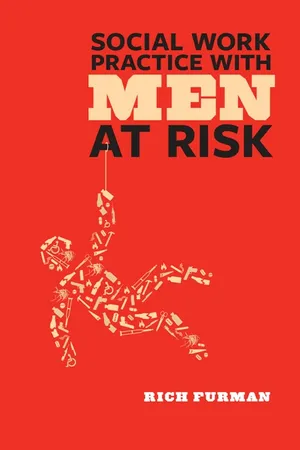
Treating men as a culturally distinct group, Rich Furman integrates key conceptions of masculinity into culturally sensitive social work practice with men. Focusing on veterans, displaced workers, substance abusers, mental health consumers, and other groups that might be unlikely to seek help, Furman deftly explores the psychosocial development of men, along with the globalization of men's lives, alternative conceptions of masculinity, and special dynamics within male relationships.
Furman bolsters his conclusions with case studies and evidence-based interventions. His cutting-edge research merges four key social work theories and explores how they inform practice with mental health issues, compulsive disorders, addiction, and violence. By promoting gender equity and culturally competent practice with men, Furman bridges the gap between clinical and macro practice. Social Work Practice with Men at Risk is a crucial text for educators and practitioners hoping to pursue effective, far-reaching interventions.
- English
- ePUB (mobile friendly)
- Available on iOS & Android
eBook - ePub
Social Work Practice with Men at Risk
About this book
Trusted by 375,005 students
Access to over 1.5 million titles for a fair monthly price.
Study more efficiently using our study tools.
Information
Subtopic
Social WorkIndex
Social SciencesIntroduction | ONE |
This book is about men at risk. It is written by a man for both men and women. As with any practice text, my preferred theories, perspectives, and worldviews are deeply ingrained in the chapters. My professional and personal experiences have shaped the way I see men and what I see as possible for them. Additionally, one can never transcend the influence of one’s gender, race, ethnicity, or class. These influences are especially important when discussing gender. As much as I have attempted to transcend my own history and prejudices in providing a balanced view of the strengths and weaknesses, needs and challenges of men, I am certain you will find many blind spots. I am also sure that at times your own gender biases will clash with mine. Disagreements and debates among social workers about important issues are healthy. We all must learn to accept the diversity of thought that exists within the profession (and in society) and to appreciate perspectives that differ from our own. Additionally, empirical research or current thinking from important theorists may challenge your gender biases. The cognitive dissonance that you may experience is an important part of the process of professional growth and development.
Since my frame of reference is important, and since many of the case examples are in part based upon my own social work practice, I think it is important for the reader to understand a bit about me in order to properly contextualize this book. This is only fair, because I view the reading of a practice book as a dialogue between author and reader. However, writing this section has been difficult. Men often find it difficult to know precisely how to express themselves. Some of our internalized expectations as men preclude the sharing of personal information, and certainly the sharing of information about our vulnerabilities. Yet, another aspect of my identity makes it easier for me to be open about who I am. I am a liberal Jewish man from California. Jewish men, even those of us who have been significantly assimilated into the dominant culture, tend to be more comfortable with expressing feelings than those who conform more fully to the hegemonic masculine ideal, a concept I will explore later. I am a 44-year-old heterosexual married man. I am the stepfather of two lovely children aged 12 and 16. I have been with the girls for so long that I often forget that I am not their biological father and usually feel like I am the “real dad.” But I do understand the complex issues with which stepfathers must contend.
My close friends are eclectic and diverse. I have spent considerable time working in Latino communities, and I have worked and traveled throughout Latin America. I also was fortunate to have lived in San Francisco for many years and had the opportunity to understand the impact of homophobia on my relationships with other men. I was able to establish deep friendships with gay and bisexual men; this challenged my own notions of masculinity. In so doing, I was compelled to look at my own developing sense of self, and I have since attempted to expand my own notions of what it means to be a man. However, I also recognize the deep and profound effect that homophobia has had upon my understanding of masculine development; I still can hear myself thinking and even saying things that suggest a continued allegiance to certain masculine ideals. Homophobic messages are deeply ingrained in American life. Although society has become more tolerant of nondominant forms of sexuality and identity, childhood messages are often enduring. It is also important not to overestimate the degree of tolerance and acceptance of other ways of being male, as I will explore later.
Philosophically, I strongly support equal rights for men and women but am concerned at the lack of “space” within many feminist spaces for assertive heterosexual men like me. At times I have felt judged by groups of women for expressing myself emotionally and assertively. I have had to learn to balance an appreciation for how women have been affected and even oppressed by the emotions of men with the acceptance of my own very Jewish way of feeling and expressing. The intersections of gender, ethnicity, and power are rarely simple.
In part because of my own struggles with my father, friendships with other men have been extremely important to my growth and development. I have also been involved in men’s groups and for years have worked at understanding my own sense of masculinity. My experiences as a man have been both typical and atypical. That I have had experiences and hold ideas that are both universal and idiosyncratic is probably true for all men. Understanding the cultural tendencies of any group must be balanced by each individual’s experiences.
While this book is grounded in the empirical and theoretical literature, it is also an outgrowth of my understanding of what it means to be a man, what it means to be a man in social work, and what it means to provide social work services to men. In writing this book I have been forced to grapple with many paradoxes, which I will discuss throughout the book. For instance, how can I write about the risks of a supposedly privileged population? How can I incorporate the valuable analytic lenses of movements that at times have stood in bitter and diametric opposition to each other (for instance, feminism and certain branches of the men’s movement)? What are the social and political ramifications of such a book? Most important, how can I challenge and demonstrate the costs of the hegemonic model of masculinity (a dominant model that is held up as the ideal yet one to which most men do not, and perhaps should not, measure up) while showing acceptance, support, and appreciation for men who embody many of these traits?
Grappling with these questions has been personally and professional valuable and serves as a parallel process for practicing social work with men. Those of you who will work with men in the early twenty-first century (and dare I say that will be nearly all social workers?) must also confront these and similar dilemmas. Each chapter includes exercises that I developed and that are informed by the theoretical and empirical knowledge discussed in the chapter, my social work practice with men, and my experience in teaching undergraduate and graduate social work. The exercises are designed to stimulate self-reflection, which I believe to be one of the most important skills that social workers can possess.
Why a Book on Men?
I firmly believe the profession of social work is ready to explore the problems and concerns of men in an open and critical manner. In May 2008 the University of Alabama School of Social Work hosted the first annual National Conference on Social Work with and for Men. This conference brought together dozens of social workers and social work scholars, as well as other practitioners and academics, to explore what we know about social work practice with men. The conference focused on encouraging dialogue about the strengths of men, as well as the normative developmental challenges that men face. Workshops delved into practitioners’ experiences and challenges in providing services to this too-often-underserved population.
The notion of at-risk men may be troubling for some in the social work community (Kosberg 2002; Böhnisch 2008). Critics may cite statistics about income or other economic disparities that heavily favor men, such as women’s wages averaging only 76.5 percent of men’s in 2004 (DeNavas-Walt, Proctor, and Lee 2005). While both men and women experience workplace stress, women experience additional burdens because of the male-oriented culture of the workplace or disproportionate family responsibilities (Blechman and Brownell 1998; Lundberg and Frankenhaeuser 1999). Other authors may carefully explain the well-documented power differentials between men and women (Andersen 2007), clearly exhibited by the prevalence of men in power (Powell and Owen 2007) and by the number of women abused at the hands of men. According to Tjaden and Thoennes (2000), each year women report more than five million incidents of violence against them by their intimate partners. The Commonwealth Fund (1999) reports that, depending on the definition used, two to three million women per year are abused by their significant others. Women who have been victimized by men deserve protection; to ensure that women are empowered and safe, men and society must respond by changing the behaviors of men and the social structures that reinforce violence. Thus women experience many psychosocial stressors more frequently or more severely than men. Men have much to improve in their treatment of women, and in their understanding of and determination to change social structures and personal traits and habits that support oppression and discrimination. These structures must be dismantled and replaced. Further, as Faludi (1999) observed, how can we explore the disenfranchisement of men when the identity of their oppressor is not clear, and when they themselves have been identified as oppressors.
My purpose here is not to argue that men are somehow more at risk than women; the premise of this book is that, despite being more privileged than women, many men suffer deeply. Whatever the root causes of various psychosocial problems that men face, regardless of the degree to which men are implicated in the cause or perpetuation of their own pains, many men are hurting and are worthy of help. It is also clear that many problems that men experience lead them to the offices of social workers, many of whom are not fully prepared to help men resolve their dilemmas. Further, while many men have not experienced oppression, many have. Men of color, gay men, and men of diverse religions and cultural backgrounds have been historical targets of discrimination and have often been disadvantaged when attempting to interact with mainstream institutions. The American legacy of discrimination and racism toward African American men remains one of our most significant blemishes.
Kosberg (2005) notes that the stories of men have not been fully told in the social work or social science literature. Many theories and practices that have been critiqued as being irrelevant to the lives of women may be equally irrelevant to men; gender-neutral practices may ignore the needs of both populations. While numerous articles and books have addressed this problem as it pertains to women, few have done so for men. Cavanaugh and Cree (1996) note a near invisibility of men within the social work literature. The few books concerning men and social work are largely concerned about subgroups of men (Rasheed and Rasheed 1999) or have been written in the context of British social work (Pringle 1995). No current book has addressed social work with men in the North American context.
The paucity of scholarship about men from a social work perspective is troubling, and not without consequences. Sadly, men are often invisible in social development and social work programs designed for the poorest people in the world. In their landmark book on international development, Bannon and Correia (2006) show how men have been excluded from the majority of social development and international aid programs. The reasons for this are valid: women have been disempowered throughout the developing world and need support and programs to help them achieve gender equality. Yet excluding men from this process may have served only to make the most vulnerable, poorest, and most disenfranchised men feel more powerless and subsequently more likely to engage in reactive violence (Gomez Alcaraz and Garcia Suarez 2006). International social development specialists are beginning to realize that men must become full partners in the social development process. It is essential to help men understand the effects of their own disenfranchisement and how these experiences and their reactions sometimes have contributed to their committing violence against women, children, and themselves. This awareness does not excuse men’s participation in oppressive and violent behavior; it deconstructs it for them, and it must become part of an ongoing process of change. This approach from international social development may have important implications for social work practice.
An analogous situation can be found in the literature on fathering. Some practitioners and scholars fear that the development of fathering programs will come at the expense of programs geared toward women, and that explorations of the benefits of fathering will be used to diminish the success of female-headed single-parent households (Doherty, Kouneski, and Erickson 1998). However, as Doherty, Kouneski, and Erickson contend, “Only an ecologically sensitive approach to parenting, which views the welfare of fathers, mothers, and children as intertwined and interdependent, can avoid a zero-sum approach to parenting in which fathers’ gains become mothers’ losses” (277).
Paradoxically, while men may be a privileged group in many sectors in society, as social work clients they are not. In his discussion of services for men who have been raped, Scarce (1997:9) explores many of the complex nuances of power and privilege:
The more recent gendering of rape as an act of violence against women has occurred for a variety of reasons, not least of which is the fact that approximately 90% of rapes involve female victims. The bulk of political progress and organizational response to rape must be credited to feminist social movement activity since the 1960s, including the understanding that rape is an act of violence and power rather than sexual passion. But where do the 5–10% of rape victims who are male fall in this realm of women-centered knowledge and practice? Very often they may slip through the cracks of an already overburdened and underfunded social service network and a cultural that believes the rape of men to be a laughable impossibility.
Vulnerable men are often misunderstood or pathologized. Men who have a difficult time expressing their feelings are viewed as resistant. Men who express their anger vigorously are accused of being hostile or, worse, abusive. While many angry men are abusive, it is also true that anger serves as a mask for depression for many men (Cochran and Rabinowitz 2000). Men entering treatment are often seen as the generators of their problems and as perpetrators or outsiders. Because traditional male cultural norms make it difficult for many men to seek and receive help, the often not-so-subtle message that men are the problem, or are not wanted as clients, serves only to exacerbate matters. While some men are largely responsible for their pain and that of those around them, it is against the interests of the women and children in these men’s lives for social work to engage in practices that make men less likely to seek services and to begin the process of change. Many men need help, and making services appealing, accessible, and effective for men is in everyone’s best interest. Social work services that do not treat men with empathy, respect, and dignity may fail to prevent or resolve many of the most severe social problems that social workers are dedicated to ameliorating.
Organization of This Book
The chapters of this book explore various at-risk male populations: veterans, displaced workers, substance abusers, consumers of mental heath services, men with health problems, older men, and other groups. Each group is at risk not only because of the psychosocial dilemmas at the heart of their problems but also because men are often less likely than women to seek help (Baum 2004; Brindis et al. 2005; Spector 2006) and are more likely to underreport symptoms they are experiencing (Robertson and Fitzgerald 1992). Further, men do actually experience many psychosocial dilemmas (Courtenay 2003) and health problems (Arras, Ogletree, and Welshimer 2006) with greater frequency or intensity than do women. I will explore these problems in depth throughout this book but will touch on a few briefly here.
When we state that men are at risk, what do we mean? Greene (2007) notes that risk refers to critical life events that will increase the likelihood that an individual will experience future difficulties. Risks contribute to an increase in stress and a decline in one’s capacity for coping. Ephross (2005) contends that people can be placed at risk by a variety of unmet needs and conditions, including discrimination, physical health concerns, personal histories, developmental crises, or acute syndromes. He stresses that what unites these populations is the need for intervention to prevent future harm, pain, or dysfunction. Dudley and Stone (2001:4) provide a simple and useful definition when they define “at risk” as “exposure to loss or harm; a hazard; danger and peril.” Examples of how men meet these criteria are numerous. For instance, men are more likely to be victims of all violent crimes except sexual assault and rape (Bureau of Justice Statistics 2005a). The number of incarcerated men has reached epidemic proportions, with more than two million in state and federal prisons and local jails (Bureau of Justice Statistics 2005b). Returning veterans suffer from health and mental health problems with greater frequency and in greater numbers than previously thought (Hoff and Rosenheck 2000); the confluence of their mental health concerns, substance abuse, and trauma has predisposed male veterans to homelessness (Benda 2006) and work problems (Rosenheck, Frisman, and Sindelar 1995). Even problems that are typically associated with women impact men significantly. For instance, approximately 35 percent of people diagnosed with binge-eating disorders and 5 to 10 percent of those diagnosed with bulimia and anorexia are men (Spitzer et. al. 1993; Andersen 1995). Body image dysfunction and body dysmorphia disorder are also problems that afflict many men (Olivardia 2001; Pope et al. 1999). Most significantly, men die nearly seven years younger than women (Courtenay 2000).
Not only are many men at risk, but many also are not well served by the models and programs that are available to them. Most social work programs are not designed to meet the needs of men. Paradoxically, perhaps the same can be said about services for women. Many services do not consider gender to be an important factor in the design of services. Such “gender-neutral” services often split the difference and do not meet the treatment needs of either men or women. These generic services do not take into account the realities of men, nor are the practitioners who work within them trained to provide services to meet th...
Table of contents
- Cover
- Half title
- Title
- Copyright
- Dedication
- Contents
- Acknowledgments
- 1. Introduction
- Part I: Understanding the Worlds of Men
- Part II: Men at Risk: Problems and Solutions
- Appendix: Resources
- References
- Index
Frequently asked questions
Yes, you can cancel anytime from the Subscription tab in your account settings on the Perlego website. Your subscription will stay active until the end of your current billing period. Learn how to cancel your subscription
No, books cannot be downloaded as external files, such as PDFs, for use outside of Perlego. However, you can download books within the Perlego app for offline reading on mobile or tablet. Learn how to download books offline
Perlego offers two plans: Essential and Complete
- Essential is ideal for learners and professionals who enjoy exploring a wide range of subjects. Access the Essential Library with 800,000+ trusted titles and best-sellers across business, personal growth, and the humanities. Includes unlimited reading time and Standard Read Aloud voice.
- Complete: Perfect for advanced learners and researchers needing full, unrestricted access. Unlock 1.5M+ books across hundreds of subjects, including academic and specialized titles. The Complete Plan also includes advanced features like Premium Read Aloud and Research Assistant.
We are an online textbook subscription service, where you can get access to an entire online library for less than the price of a single book per month. With over 1.5 million books across 990+ topics, we’ve got you covered! Learn about our mission
Look out for the read-aloud symbol on your next book to see if you can listen to it. The read-aloud tool reads text aloud for you, highlighting the text as it is being read. You can pause it, speed it up and slow it down. Learn more about Read Aloud
Yes! You can use the Perlego app on both iOS and Android devices to read anytime, anywhere — even offline. Perfect for commutes or when you’re on the go.
Please note we cannot support devices running on iOS 13 and Android 7 or earlier. Learn more about using the app
Please note we cannot support devices running on iOS 13 and Android 7 or earlier. Learn more about using the app
Yes, you can access Social Work Practice with Men at Risk by Rich Furman in PDF and/or ePUB format, as well as other popular books in Social Sciences & Social Work. We have over 1.5 million books available in our catalogue for you to explore.