Winner of the 2009 Feminist and Women's Studies Association Book Prize
Do you think I can be a feminist mother? Did I make you and your kisses up in my mind? Will you join our military protest at the gate? Will you feed the kids when I'm in prison? Are you able to forgive me for breaking off this correspondence because you are a man?
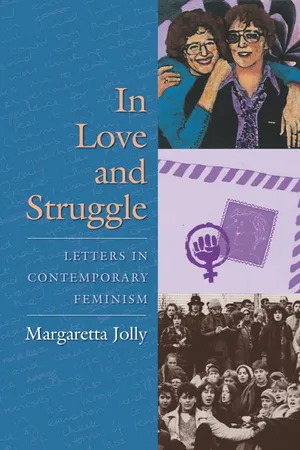
During the women's movement of the 1970s and 1980s, feminists in the United States and Britain reinvented the image of the woman letter writer. Symbolically tearing up the love letter to an absent man, they wrote passionate letters to one another, exploring questions of sexuality, separatism, and strategy. These texts speak of the new interest women began to feel in one another and the new demands—and disappointments—these relationships would create.
Margaretta Jolly provides the first cultural study of these letters, charting the evolution of feminist political consciousness from the height of the women's movement to today's e-mail networks. Jolly uncovers the passionate, contradictory emotions of both politics and letter writing and sets out the theory behind them as a fragile yet persistent ideal of care ethics, women's love, and epistolary art. She follows several compelling feminist relationships sustained through writing and confronts the mixed messages of the "open letter," which complicated political relations between women (such as Audre Lorde's "Open Letter to Mary Daly," which called out white feminists for their implicit racism).
Jolly recovers the unsung literature of lesbianism and feminist romance, examines the ambivalent feelings within mother-daughter correspondences, and considers letter-writing campaigns during the peace movement. She concludes with a discussion of the ethical dilemma surrounding care versus autonomy and the meaning behind the burning or saving of letters. Letters that chart love stories, letters stowed away in attics, letters burnt at the end of romances, bittersweet letters written but never sent... this fascinating glimpse into women's intimate archives illuminates one of feminism's central concerns—that all relationships are political—and uniquely recasts a social movement in very emotional terms.
- English
- ePUB (mobile friendly)
- Available on iOS & Android
eBook - ePub
About this book
Information
Subtopic
Literary CriticismIndex
Social Sciences
PART ONE
Yours in Sisterhood …
CHAPTER ONE
Love Letters to a New Me
On my way home the tears began to fall. Not because I am madly in love with her—I am not mad enough to let myself fall in love with anyone any more before they have begun to fall in love with me—but because I am so lonely and I do so want a lover and I like C very much and think we could have a nice time together. I have got my fingers burnt so many times that I am really reluctant to make the first move with anybody, yet in a way perhaps I ought to, just to put myself out of my misery…. A phone call seems very brazen and my success rate with letters has not been spectacular, but I do seem incapable of bringing things to a head in personal conversation. So I shall have to think more …
—Lorna Hardy, “Exposure”
Seduction is, by nature, a literary challenge. Those who write to a lover wrestle with words’ inadequacy, exaggerating the awareness in all letter writing of physical absence. At the same time, of all genres, love letters most obviously demonstrate writing’s ability to arouse, to prolong, and even, especially in paper form, to fetishize desire. In fiction, love letters dramatize a character’s duplicity or the uncertainty of union. But anyone who has written or received a love letter or e-mail instinctively knows something of the unreliability of writing. Lorna Hardy’s fear that a written proposal would not have much success with “C” is easy to understand.
Yet this woman’s misery presents us with a plot that has been relatively unexplored in literary terms. Hardy (a pseudonym), was a young teacher in the early 1980s. She was brainy, feminist, but socially unconfident and had embraced lesbianism in her early twenties, imagining “complete freedom for sexual and emotional adventures” (“Exposure,” 85). Her problem was that she discovered she was as unable to attract women as she had been men. She had political friends and lesbian and antiracist involvements; she wrote poetry; at work she worried about coming out: but she was punishingly lonely. Literary tradition has enshrined the scenario of a woman writing unrequited love letters to a man unfeelingly elsewhere. But what about the unrequited love for a woman who is in the throes of so-called women’s liberation? What about the difficulties of love when it is attached to sexual identity?
Love letters of those who desire their own sex have only been cryptically part of any public canon. This reflects both the stigmatization and the relatively recent identification of gay and lesbian sexuality. It is heartening to see scholars beginning to challenge this neglect with anthologies and critical studies of gay letters. Several have claimed that the need to be covert in homophobic societies has ironically produced especially artful writing (Hallett, Lesbian Lives; Jones, The Love of Friends; Lister and Liddington, Female Fortune; Turner, Baby Precious Always Shines). No one, however, has explored the ambiguities of love-letter writing between women in the 1970s and 1980s. This chapter begins the task. I will argue that, in contrast to earlier periods, writers during this time are clear about naming their desires and excited about writing them down, as well. In the context of private relationships, women play at being muse to each other, artists of their own sexual stories. Sometimes this can be highly experimental, but even when quite everyday, it dramatically reverses the history of epistolary fiction, which has positioned women as love’s losers, as the dupes and dependents of men. At the same time, this exploration reveals new subtexts and silences. The overlap between coming out and seduction presupposes sexual pride and experience, whose absence could be difficult to admit; it interweaves the lace of desire with the ponderousness self-consciousness of exemplary relationship. These letters register women’s new claims to sexual autonomy at the moment when gay and women’s liberation met. Yet, oddly, they can obscure the ironies, silliness, and disappointment of love.
Women’s Liberation Is a Lesbian Plot
Love letters may seem to be the most private form of writing, but they have played their part in defining lesbian experience. Although not as directly so as “coming out” letters, the intimacy of correspondence has been an important space in which to explore and assert new selves and desires. What is remarkable about women’s love letters to each other after the explosion of sexual liberation in the late 1960s is how explicit and self-conscious they are about identity as much as desire. If coming out to parents or colleagues engendered agonized or defiant announcement, writing to a would-be or already snookered lover was proud in a different way.1 This change in tone grew out of the combined forces of gay and women’s liberation, after the repressive years of the mid-twentieth century, even as these two movements clashed and struggled over what the politics of lesbian desire should mean.
Consider the following exchange between Bertha Harris and Noel Phyllis Birkby. Harris, the novelist best known for Lover (1976), was introduced to the architect Birkby by Kate Millett, in a consciousness-raising group in 1974. Though Harris, like Birkby, had long had relationships with women, Harris chose to send an “audio letter” to avoid the “protectiveness” of traditional letter writing. No more beating around the bushes. The crackling tape begins with Harris saying that if she could “do it with voice” on tape, she could “do it with voice” in person. Comically taping while both smoking and driving noisily to her university in Chapel Hill “for literary chit chat,” she muses on her frighteningly “real” and “intense” feelings for a woman she has just met:
Did I make you up in my mind? … I don’t even know you, but I do know you…. But I would like to know you more than I do already. This sensation of making you up…. The complete coalition between wish and reality…. But I’m just going to assume that you can take it, that it’s ok to do this with you. And that you’ll stop me from doing it when you want me to. Thank you for perfect freedom!2
Anyone writing to a new lover may wonder about how far she is simply “making her up.” But this cheeky “tape-letter” resonates with a wider sense of experiment, in which “wish” and “reality” could magically coalesce. Harris’s stylized stream of consciousness in a roaring car literally animates her assertion of “perfect freedom.” Birkby—who replied on the other side of the cassette—was charmed. Weighty with sighs and pauses as she searches for words to express the “rapport” and “fusion” between them, she confesses she is glad she can’t remember kissing Harris because it feels “already too much.”
Birkby and Harris’s sense of pride and pleasure in the epistolary form suggests the moment of lesbian pride and new feminism that contextualized their meeting. And indeed, Birkby’s coming out fuelled other experiments with love letters in different artistic forms. She produced long, dreamlike erotic missives to the filmmaker Barbara Hammer, who, in turn, sent her dramatic photographic self-portraits, sometimes written upon, as forms of visual correspondence that were also playful statements of her identity. Some time during the same period, she also shot a five-minute autobiographical film titled “Love Letter” that clearly poses the form as a cathartic means to a new self. It begins by panning down a slide of herself to show a life-size outline drawing of her body. This drawing includes a fried egg that is simultaneously crying and smiling inside the head, while “a new head” is inscribed around the outside. Another shot of bell-bottomed legs has one leg saying pain, the other, love. It ends with a graphic of Birkby imprinted over the slide of another woman.3 Hammer’s own later correspondence with Florrie Burke, who has been her partner since 1988, also playfully mixed visual with verbal in what seems to be as much autobiography as address. A photocollage of Hammer’s face shows another woman’s face inset over one of the eyes. A typed address to “Darling mine” over the image reminds her, “My hand reaches out to you, especially when you don’t feel so well.” Hammer annotates it with the explanation “separation inspires me and to keep the connection, I create missives of spontaneous love that often have spelling and punctuation mishaps but are filled with energy like a romantic lover who overlooks defects in her object of desire but lusts after her all the same” (quoted in Kay Turner, Between Us, 155). Hammer frankly compares the letter to the lover: it is her own perversely spontaneous “missives” about which she has romantic delusions and lusts.
A somewhat different intersection of creativity and politics describes the exchange between Joan Nestle and her lover, activist Lee Hudson, who use metaphors of geography and climate “to speak of our passion and fear of drifting apart” in a correspondence from 1989. Lee writes from the “Arctic” and Joan from the “Amazon” even though both of them were actually in New York (quoted in Kay Turner, Between Us, 153). These letters give the flavor of lesbian relationships as powerful, even power-driven, after that decade’s debates over the politics of women’s sex and whether the women’s movement had desexualized it. This is very clear in Lee’s description of an imaginary icy fishing expedition in one letter, which is evidently a flirtatious attempt to “catch” Joan too. Her chase is guided by “Najo,” an obviously technically competent and savvy woman, who shows her how to “cut a hole in the ice with powered auger—not the nostalgic saw many envision.” This careful image suggests Hudson’s determination not to appropriate another’s land even in imagination, yet also suggests another kind of romanticism in populating the world with butch dykes. Najo’s hunting technique is suggestively erotic as well: “Najo flips a perfect circle of ice, thick and frosty, onto the surface nearby with her tonged pole like a large white discus hurled from a giant shoulder” (Between Us, 45). Najo’s expertise, furthermore, is matched by the image of Joan as a pike, a fish known for its power and cunning. Hudson is obviously also happily fishing for words in this fanciful letter: “Buried deep beneath the ice caps are a beautiful little-known species of pike. To catch them is an art—much like a writer casting about for words to reveal the soul and heart to the lover” (Between Us, 45).

Barbara Hammer, letter photocollage to Florrie Burke. Reproduced in Turner, ed., Between Us.
The self-conscious inventiveness of these missives to a degree reflects the fact they are all written by professional writers and artists of some sort. But, despite their differences in origin, I suggest they all share a sense that lesbian relationships were a measure of women’s erotic autonomy. The women’s movement had popularized the hope that lesbian relationships could escape the determinations of heterosexuality, and even as lesbians like Nestle led the argument that lesbians’ and women’s struggles could not be conflated, such letters frame lesbianism as what Katie King has called feminism’s “magical sign” (King, Theory in Its Feminist Travels, 124–37). We see this played out even in quite ordinary, private letters. A letter from Sue, written in 1975, for example, offers a typescript of lesbian feminist fantasies, declaring, “One day not too long ago I fell in love with a woman. I didn’t try to or anything—it just happened”:
So here I am, hanging out in a brand new scene—seeing, feeling, knowing new things. First time I went to an all-woman dance the most impressive thing I felt was the gentle loving energy flowing throughout. Women were dancing, laughing, liking, loving together. It’s beautiful, this women-loving-women.(quoted in Kay Turner, Between Us, 90)
“Sue,” who later went by the name “Acorn” and then “Flame,” explicitly adopts the newly minted language of women’s identification even as she explains that she “didn’t try” to fall in love. The novelty facilitates her sense of “beauty” in the scene, and she seems to need to explain the all-woman dance to her lover, perhaps to herself as well. Beauty brings politics with it. Significantly, the letter ends with the discovery of anger about a new sense of minority status: “In spite of all the positive feelings growing within me, there is outrage sprouting” (90).
Love letters thus turn out to be less private or, at least, less “spontaneous” than we might expect. Alongside new pride, they register new expectations and social minefields, including the very difficulties that ideals of women’s love could engender. We see this in Kay Turner’s anthology, Between Us: A Legacy of Lesbian Love Letters, which provides the only overview of letters from the period to date. On the one hand, Turner foregrounds the “humorous depictions of pot-smoking and pussy-power” characteristic of the 1970s and the personal struggles with the “sex wars” of the 1980s (Between Us, 19). On the other hand, Turner proposes that letter writing itself is the privileged expression of a “feminine code of entrustment”:
Certain of the themes might be found in any love correspondence: passionate outpourings, yearnings for reunion, jealousies, and so on. Other themes, I think, carry a characteristic lesbian sensibility about loving…. The sense of a chosen intimacy—deeply compelling and hard won—is invested with a desire to inhabit a certain way of loving that affirms a unique intersection of the erotic and the ethical. Themes that appear and reappear in the letters articulate a feminine code of entrustment that includes choosing love for itself, not for what it will bring in terms of status; a commitment to a non-hierarchical, reciprocal relationship; alliance and friendship as part of loving; a strong desire for the beloved’s personal self-fulfillment; honesty and respect as determining qualities of love; sex as the expression of intimacy; a feeling of trust, and a dedication to the effort required to express a precision of feeling.(Between Us, 20)
Turner proposes a connection between lesbian relationship and feminist ideals of egalitarian love, even if she tries to avoid saying that lesbianism is essentially different from other sexualities. In this, she reflects a feminist hope that goodness will enable desire, that desire will bring goodness. Letters symbolize not just writing about women but women writing to each other; it takes careful work to find the right words for “feeling.” Women, in this vision, are one another’s best lovers as well as correspondents.
The following two examples show how this “feminine code of entrustment,” and its emphasis on written self-expression, could become its own convention while facilitating a new identification as “woman-identified” lesbian. Eileen Bonner wrote daily to her first woman lover in the context of leaving her marriage and coming out. This was partly because the relationship was clandestine: in the early 1980s she was married with a child and working as a nurse. The sense of a new self in writing emerges from her comment to me that “the letters I wrote to my lover were my first tentative steps into feminism for me. She was my feminist mentor, as it were, and often directed my reading of poetry, books and listening of music that had a strong feminist flavor and exclusively by and for women.”4 Bonner closes her letter with a heart drawn in the shape of kisses, annotated with the words—“as you say inadequate.” But this is matched by new aspirations to write: “I am just sitting here wishing I could write my own poetry so there was something that was really mine to give to just you. Still I can’t be good at everything can I?”5 Bonner did begin writing poetry and taking self-portraits for her lover. Interestingly, today she has combined an arts degree as a mature student with working in social services.
Another woman, S, showed me a book-length letter, written and decorated by her and her lover in turn. The following, dated 10 September 1982, gives a sense of the tone:
S, hello friend, spirit sister—… I loved getting your letter. What a treat, to get your words, warmth and support. I’m up on the roof, as evening falls over a murky city—and the jays screech in the trees … Yes, writing is a wonderful way to get to know each other—I think it’s only just hitting me, that you’re not around the corner, that you really do exist out there in space, that you share so many of the same ideals as I do … and that we are both equally sharing our energy! A treasure, a thrill, a feeling of flying … like one of those funfair swing roundabouts, where the chairs swing out in a wide circle … And, dear stranger, how can I tell you—on that bit of plastic [phone], devoid of your physical, warm, presence that I love you—that it feels so natural to love you. You sing inside my heart! … Do you know—you’re such a good letter-writer, what a joy to follow the threads over the pages! … Your letter has filled me with bubbling giggles—with your rabbiting and twittering, as you call it: and thank you so much for the painting … Getting t...
Table of contents
- Cover
- Half title
- Series Page
- Title
- Copyright
- Dedication
- Contents
- Introduction
- Part I: Yours in Sisterhood …
- Part II: Letter Writing and the Ethics of Care
- Part III: The Right to Be Cared For: Letters and the Life Cycle of a Social Movement
- Part IV: The Afterlife of Letters
- Conclusion
- Notes
- Bibliography
- Acknowledgments
- Index
- Series List
Trusted by 375,005 students
Access to over 1.5 million titles for a fair monthly price.
Study more efficiently using our study tools.
Frequently asked questions
Yes, you can cancel anytime from the Subscription tab in your account settings on the Perlego website. Your subscription will stay active until the end of your current billing period. Learn how to cancel your subscription
No, books cannot be downloaded as external files, such as PDFs, for use outside of Perlego. However, you can download books within the Perlego app for offline reading on mobile or tablet. Learn how to download books offline
Perlego offers two plans: Essential and Complete
- Essential is ideal for learners and professionals who enjoy exploring a wide range of subjects. Access the Essential Library with 800,000+ trusted titles and best-sellers across business, personal growth, and the humanities. Includes unlimited reading time and Standard Read Aloud voice.
- Complete: Perfect for advanced learners and researchers needing full, unrestricted access. Unlock 1.5M+ books across hundreds of subjects, including academic and specialized titles. The Complete Plan also includes advanced features like Premium Read Aloud and Research Assistant.
We are an online textbook subscription service, where you can get access to an entire online library for less than the price of a single book per month. With over 1.5 million books across 990+ topics, we’ve got you covered! Learn about our mission
Look out for the read-aloud symbol on your next book to see if you can listen to it. The read-aloud tool reads text aloud for you, highlighting the text as it is being read. You can pause it, speed it up and slow it down. Learn more about Read Aloud
Yes! You can use the Perlego app on both iOS and Android devices to read anytime, anywhere — even offline. Perfect for commutes or when you’re on the go.
Please note we cannot support devices running on iOS 13 and Android 7 or earlier. Learn more about using the app
Please note we cannot support devices running on iOS 13 and Android 7 or earlier. Learn more about using the app
Yes, you can access In Love and Struggle by Margaretta Jolly in PDF and/or ePUB format, as well as other popular books in Social Sciences & Literary Criticism. We have over 1.5 million books available in our catalogue for you to explore.