This book is the first to provide strategies for effective advocacy and placement within the foster care and kinship care systems. It also takes a rare look at the dynamics of the foster and kinship relationship, not just among children and the agency workers and service providers who intervene on their behalf, but also between children and those who take in and care for them as permanency develops. Drawing on their experience interacting with and writing about the institution of foster care, Mitchell Rosenwald and Beth N. Riley have composed a unique text that helps practitioners, foster parents, and relative caregivers realize successful transitions for youth, especially considering the traumas these children may suffer both before and after placement.
Advocating for a child's best interests must begin early and remain consistent throughout assignment and adjustment. For practitioners, Rosenwald and Riley emphasize the best techniques for assessing a family's capabilities and for guiding families through the challenges of foster care. Part one details the steps potential foster parents and kinship caregivers must take, with the assistance of practitioners, to prepare themselves for placement. Part two describes tactics for successful advocacy within the court system, social service agencies, schools, and the medical and mental health establishments. Part three describes how to lobby for change at the agency and legislative levels, as well as within a given community. The authors illustrate recommendations through real-life scenarios and devote an entire chapter to brokering positive partnerships among practitioners, families, and other teams working to protect and transition children.
eBook - ePub
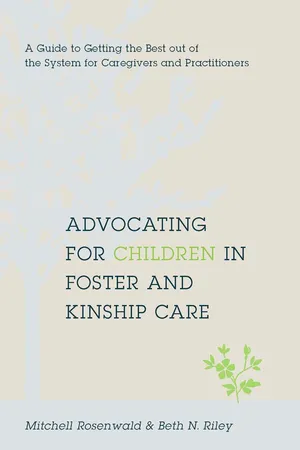
Advocating for Children in Foster and Kinship Care
A Guide to Getting the Best out of the System for Caregivers and Practitioners
- English
- ePUB (mobile friendly)
- Available on iOS & Android
eBook - ePub
Advocating for Children in Foster and Kinship Care
A Guide to Getting the Best out of the System for Caregivers and Practitioners
About this book
Information
Subtopic
Family LawIndex
Social Sciences[Part I]
Preparing for Advocacy
[1]
In the Beginning
Assessing Commitment and Family Resources
Children are our most valuable natural resource.
—Herbert Hoover
Vignette
A couple, Mr. and Mrs. Johnson, are thinking about becoming foster parents. They have raised three children: one son is married, age 24, and on his own; the other son is age 22 and on his own; and their daughter is in college, age 18, and comes home to visit during breaks from college. The Johnsons have been thinking about fostering for some time but wanted to wait until their own children were grown and able to be accepting of the Johnsons’ sharing their love and their lives with additional children. Now seemed like the time to do more research on the topic. They wanted to make sure they were doing this for the right reasons, so they did some soul-searching. Part of this process was to ascertain that they had the emotional commitment, time, money, and physical space that were necessary to foster.
With respect to commitment, they differed. Mrs. Johnson was enthusiastic. She was so excited that she had been researching youth programs that a child might like to join. Mr. Johnson, however, was unsure. He questioned whether he wanted to give up his free time—he had raised three children and was not sure he had the energy for more. He liked having time for his hobbies and time with his own family. Mr. Johnson was concerned, too, because they both worked: she as a receptionist and he as a mechanic at his business. He, then, wanted to consider this decision carefully. Moreover, they both shared some concern about whether they would feel truly comfortable working with children who were ultimately in someone else’s custody. Because they still were finding their answers, they called Mrs. Thomas, a practitioner at their local children’s agency, for guidance in their quest to assess their decision to foster.
Key
Mr. and Mrs. Johnson: potential foster parents.
Mrs. Thomas: foster care worker.
Mrs. Thomas: foster care worker.
Mr. and Mrs. Johnson and Mrs. Thomas have several important considerations to confront. This first chapter provides information that can help them and other potential caregivers explore their readiness to accept children into their care. For practitioners and foster parents, for example, this means ensuring that they can and will give their all to making a foster care placement successful; for foster parents, it specifically means standing by the youth (children and adolescents) in the long term and thereby minimizing any placement disruption. Placement disruptions undermine the efforts of child welfare agencies to promote safety, permanency, and child well-being (Price, Chamberlain et al. 2008). In our vignette, therefore, it was essential for the Johnsons, with Mrs. Thomas’ assistance, to understand the ramifications of the decision before them. Ensuring that foster parents are ready to foster is the first step of advocacy. Advocacy must be completed at each step along the way, and such advocacy requires energy and stamina. If the care providers are not ready, the children may suffer, either because the care providers might change their mind or because their skills might not be sufficient to handle those children’s specific needs.
Advocacy Checklist
- Assess commitment to providing foster/kinship care.
- Examine existing resources.
- Evaluate motivation to foster.
- Understand the precertification process.
Assess Commitment to Providing Foster/Kinship Care
Identify the Need
Choosing to parent a child who is not biologically your own is a huge decision and an even greater commitment. It means committing oneself to the time, attention, and level of care that a young person needs, as well as the time it takes, as the premise of this book suggests, to advocate for that youth. Some children have greater needs than others, which could involve more supervision, coaching, and medical attention. Foster parents must believe that other nontangible rewards exist; financially, no amount of money can adequately compensate for the strife and ache that come with caring about another human being in pain, emotional or physical. Mrs. Thomas, our practitioner, knew that many potential foster parents give up within the first year (Rhodes, Orme et al. 2003). And yet, for those who continue to foster, there is great joy when a small child smiles at you or a teenage youth feels victorious because you have helped her obtain her first job. Committing to fostering or providing kinship care means following through on an obligation to stay with a child long after it becomes emotionally difficult for everyone involved. For a foster or kinship caregiver, that means agreeing to parent the child(ren) until a permanent family can be found. That “permanency” is achieved when the child returns to his or her parents, or after the child’s parents’ rights have been terminated and either an adoptive family has taken over your responsibilities or you yourself have chosen to adopt the child. Other options for a permanent placement can include the youth participating in an independent living (IL) program and becoming emancipated at a state-recognized age.
During an initial information session, prospective foster parents are sometimes asked if they can make this type of commitment. Deciding if one can make a long-term commitment to an unknown child may take some soul-searching. For couples, the question may be: do you both have the same level of commitment? In our vignette, we met the Johnsons, potential foster parents, who are exploring this decision.
Analyze the Context
For our discussion throughout this text, we are defining both sets of caregivers, foster parents and kinship caregivers, as adults who care for youth who have been temporarily or permanently removed, under court order, from their biological parents’ care, typically as the result of maltreatment (physical abuse, sexual abuse, neglect, emotional abuse). To distinguish these two groups further: Foster parents are adults who wish to provide care for youth to whom they are not biologically or legally related. They may or may not end up adopting the child. Kinship caregivers are adults who have some familial relationship to youth other than being his or her biological or legal parent through adoption; they are typically grandparents but can also be great-grandparents, aunts, uncles, and other relatives. Sometimes kinship care providers serve in a temporary role as they step in to care for their “kin” while the child waits for her/his parent(s) to improve their parenting skills and provide a safe and nurturing home. Other times they serve as “permanent” caregivers by adopting the child, serving as a legal guardian, or acting in other court-approved capacities.
During the early assessment of commitment, kinship and foster parents’ perceptions of factors that promote or inhibit successful fostering must be considered (see Buehler, Cox, and Cuddeback 2003). Inclusive in this decision is an assessment of their emotional commitment to this role as well as an assessment of their family resources (spouse/partner, children in home already, finances, household management, physical space, skills) and subsequent commitment of these resources for fostering. Part of this process involves honestly assessing the family’s ability to care for children in specific developmental ranges and children with extremely challenging behaviors and/or challenging birth family members. The job of the practitioners is to assist potential foster and kinship parents in this assessment and in the resulting decision to enter this role and take the initial training.
Let’s first turn specifically to this decision for potential foster parents. Such a decision is first based on having a fundamental knowledge of foster care and the role of foster parents. What is foster care? According to the National Foster Parents Association: “Foster care is the temporary placement of children and youth with families outside of their own home as result of abuse or neglect. The goal is to provide a safe, stable, nurturing environment”(http://www.nfpainc.org/content/?page=FOSTERPARENTINFORMATION).
What is the scope of responsibilities for a foster parent? The National Foster Parent Association states:
A foster parent is a person who cares for children/youth who are not in their custody, children and youth who have entered the foster care system. Foster parents care about children and are willing and able to provide care and nurturing for the duration of the child’s stay in foster care. Foster parents are asked to complete an application, submit to family/ home assessments and attend training. Foster families must demonstrate financial and emotional stability, responsibility and a willingness to work with the agency that supervises their home. (http://www.nfpainc.org/content/?page=BECOMEAFOSTERPARENT)
Potential foster parents mull over fostering for a long time before they finally decide to inquire (Love and Velasco-Nunez 2004:30). Nonkinship foster families make up 75 percent of the caregiver applicants (Orme, Buehler et al. 2004). The need for foster homes, and the wonderful people who fill the roles of foster parents, is immense. For the last two decades or more, a push has occurred to shift treatment for children in care from the “therapist to the caregiver (foster parent) with appropriate training and development programs” (MacLean 1992:62). This means that foster parents are faced with more responsibility than ever before. Likewise, greater attention, commitment, and time must be given to the educational needs of youth in care with disabilities by both education and child welfare professionals (Geenen 2006).
Ethically, we do not want to place a child with a foster parent who will give up at the first sign of adversity, for it would be unfair for a child to become bonded with a foster parent only to have that person decide that fostering is too hard and ask the practitioner to remove the child. Or, worse yet, we would not want a foster parent who decides to foster a child and then finds some characteristic(s) of the child that differs from the foster family (e.g., race, religion, or other cultural factors) too difficult to reconcile and therefore asks for the child to be removed. Such action breaks with the National Foster Parent Association Code of Ethics (2008), which believes in: “Recogniz[ing] the rights of children and youth to safe, nurturing relationships, intended to last a lifetime.”
Here are some comments of foster parents that imply this type of commitment.
Before I took that seventeen year old, my husband was like, “That’s it, no more” and I said “Okay, well [name] wants us to go meet her and just tell her what we think about her,” and we weren’t two minutes out the door when he goes: “Okay, when’s she moving in?”
I spent every day with him on the porch, moving his arms, moving his legs, making him look this way, keeping him alert all the time . . . ’cause I just felt determined that this innocent child was not gonna be brain damaged just because [name] shook him, you know?
It’s like just when you feel like “Ugh, I want to quit,” you know, something sort of miraculous or out of the blue thing happens. (Rosenwald and Bronstein 2008:291)
Commitment involves foster parents not just working with youth, but mentoring birth parents as well. Indeed, partnering with birth parents to work toward the return of the children to their home (“family reunification”), or another permanency plan, is a requirement of many agencies. Birth parents are, of course, a very valuable resource for children in care, children, who despite the circumstances of removal from their family of origin, generally remain very emotionally attached to the birth family. It is the practitioner who informs the potential foster parents that they (both the practitioner and the foster parents) have important roles in assisting the birth parents, who are working toward family reunification. This can be challenging, as birth parents vary on their own motivation and the pace of that motivation in working toward family reunification. As a result, the long-term options, referred to as “permanency” options, range from children in care returning home to safer and more nurturing environments (“reunification”) to being “freed” for adoption after parental rights have been terminated (known legally as TPR).
Now we will consider kinship (relative) caregivers’ commitment to serving in the role of foster parent. Kinship care is a quickly increasing trend among child placement options. Kinship caregivers are more likely to promote contact between the children and their parents than nonrelative foster parents (LeProhn 1994), and children who are cared for by relatives rather than nonrelatives have less behavior problems (Rubin, Downes et al. 2008). While some 6 million youth under 18 are being raised by a nonparent relative (Lugaila and Overturf 2004), when we discuss kinship caregivers, we are specifically referring to those kinship care providers who are caring for youth because they do not want the child to be in the temporary care of “unfamiliar” foster parents and potentially at risk for being permanently removed from family contact.
Aside from facing considerations similar to those of potential foster parents, relative caregivers find that this enormous decision is made more complicated by a factor unique to them—the reality that they are related to the biological parents, who are not viable parent options at the time. Even though kinship caregivers love their children and may be extremely relieved that they are keeping the children ...
Table of contents
- Cover
- Half title
- Title
- Copyright
- Dedication
- Contents
- Foreword
- Preface
- Acknowledgments
- Part I. Preparing for Advdvocacy
- Part II. Advocacy with Service Providers
- Part III. Advocacy for change in Agency Policy, Law , and Communities
- References
- Index
Trusted by 375,005 students
Access to over 1.5 million titles for a fair monthly price.
Study more efficiently using our study tools.
Frequently asked questions
Yes, you can cancel anytime from the Subscription tab in your account settings on the Perlego website. Your subscription will stay active until the end of your current billing period. Learn how to cancel your subscription
No, books cannot be downloaded as external files, such as PDFs, for use outside of Perlego. However, you can download books within the Perlego app for offline reading on mobile or tablet. Learn how to download books offline
Perlego offers two plans: Essential and Complete
- Essential is ideal for learners and professionals who enjoy exploring a wide range of subjects. Access the Essential Library with 800,000+ trusted titles and best-sellers across business, personal growth, and the humanities. Includes unlimited reading time and Standard Read Aloud voice.
- Complete: Perfect for advanced learners and researchers needing full, unrestricted access. Unlock 1.5M+ books across hundreds of subjects, including academic and specialized titles. The Complete Plan also includes advanced features like Premium Read Aloud and Research Assistant.
We are an online textbook subscription service, where you can get access to an entire online library for less than the price of a single book per month. With over 1.5 million books across 990+ topics, we’ve got you covered! Learn about our mission
Look out for the read-aloud symbol on your next book to see if you can listen to it. The read-aloud tool reads text aloud for you, highlighting the text as it is being read. You can pause it, speed it up and slow it down. Learn more about Read Aloud
Yes! You can use the Perlego app on both iOS and Android devices to read anytime, anywhere — even offline. Perfect for commutes or when you’re on the go.
Please note we cannot support devices running on iOS 13 and Android 7 or earlier. Learn more about using the app
Please note we cannot support devices running on iOS 13 and Android 7 or earlier. Learn more about using the app
Yes, you can access Advocating for Children in Foster and Kinship Care by Mitchell Rosenwald,Beth N. Riley in PDF and/or ePUB format, as well as other popular books in Social Sciences & Family Law. We have over 1.5 million books available in our catalogue for you to explore.