Whether depicting humans battling aliens or a brave geologist saving lives as a volcano erupts, science-fiction films are an exciting visual and sensuous introduction to the workings of science and technology. These films explore a range of complex topics in vivid and accessible ways, from space travel and laser technology to genetic engineering, global warming, and the consequences of nuclear weaponry. Though actual scientific lab work might not be as exciting, science fiction is an engaging yet powerful way for a wide audience to explore some of the most pressing issues and ideas of our time.
In this book, a scientist and dedicated film enthusiast discusses the portrayal of science in more than one hundred films, including science fiction, scientific biographies, and documentaries. Beginning with early films like Voyage to the Moon and Metropolis and concluding with more recent offerings like The Matrix, War of the Worlds, A Beautiful Mind, and An Inconvenient Truth, Sidney Perkowitz questions how much faith we can put into Hollywood's depiction of scientists and their work; how accurately these films capture scientific fact and theory; whether cataclysms like our collision with a comet can actually happen; and to what extent these films influence public opinion about science and the future.
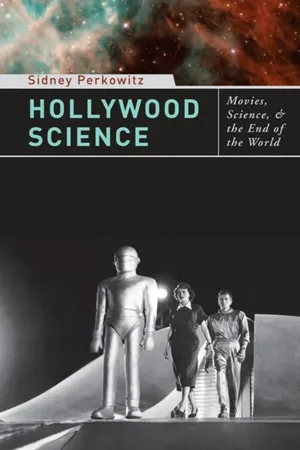
Movies, especially science-fiction films, temporarily remove viewers from the world as they know it and show them the world as it might be, providing special perspective on human nature and society. Yet "Hollywood science" can be erroneous, distorting fact for dramatic effect and stereotyping scientists as remote and nerdy, evil, or noble, doing little to improve the relationship between science and society. Bringing together history, scientific theory, and humorous observation, Hollywood Science features dozens of film stills and a list of the all-time best and worst science-fiction movies. Just as this genre appeals to all types of viewers, this book will resonate with anyone who has been inspired by science-fiction films and would like to learn how fantasy compares to fact.
- English
- ePUB (mobile friendly)
- Available on iOS & Android
eBook - ePub
About this book
Trusted by 375,005 students
Access to over 1.5 million titles for a fair monthly price.
Study more efficiently using our study tools.
Information
Subtopic
Film & Video
PART 1
DANGERS FROM NATURE
Chapter 2

Alien Encounters
SCOTTY: It sounds like … some form of super carrot.… An intellectual carrot. The mind boggles.
—The Thing from Another World (1951)
PALMER [watching the alien scuttle away as a human head with spider legs]: You gotta be f***ing kidding.
—The Thing (1982)
U.S. PRESIDENT WHITMORE [the president’s response to alien invasion]: Let’s nuke the bastards.
—Independence Day (1996)
Probably since humans first saw the stars in the night sky, we have wondered about the universe: What’s out there? How and when did it begin? How big is it? Will it end, and when? What’s our place and purpose in it, if any? And knowing that we live in a huge cosmos with cold, empty spaces between the stars, always there is one last question: Are we alone?
That big question is answered with an equally big “No!” in the many films that employ a classic science fiction theme: human meets alien. Since we have no idea if any kind of life or civilization, primitive or advanced, exists out there, we’re free to imagine who—or what—we might meet and to shape movie aliens to reflect our own hopes and fears. But imagination has constraints. Although we don’t know how life began on Earth, we do know a lot about its physical and chemical basis on our planet. That sets limits, we believe, on what to expect when we meet aliens, if we ever do. As we learn more about the variety of life on our own planet and about conditions in the rest of the universe, however, those limits become broader and more flexible.
Within those limits, movies have run through a gamut of aliens. Some otherworldly beings look just like us. In The Day the Earth Stood Still (1951), there’s Klaatu (Michael Rennie), the human-appearing emissary from an advanced civilization who lands in a flying saucer to warn humanity to be careful with nuclear weapons or face the consequences. Not only is he like us outside and inside (only better, with a longer life span and marvelous powers of recovery), he also looks good in both a futuristic, nicely tailored silver jump suit and ordinary Earthling wear. But also beginning in the early 1950s, some aliens were decidedly different. In The Thing from Another World—also made during the post–World War II flying-saucer craze, when many observers reported seeing fast-moving saucer-shaped aircraft that some believed came from other worlds—the occupants of an Arctic research station find out just how different an alien could be.
The story begins as scientists from the research station and a military team investigate a nearby crash site, where they can dimly make out a saucerlike craft and the remains of an inhuman creature buried in the ice. The lead scientist, Nobel laureate Dr. Arthur Carrington (Robert Cornthwaite), immediately sees the discovery as the key to the stars.
The team salvages the body in a block of ice and brings it back to base, where things take an unfortunate turn. The ice melts, and far from dead, the being (played by James Arness) rises up and looms over a soldier, who shoots it with no effect. Humanoid in shape and seven feet tall, it escapes outside, where sled dogs viciously attack it. After killing three dogs, it runs off, leaving behind a torn-off hand.
The scientists find the hand to be unusual, to say the least. Instead of animal tissue, nerves, and blood, it sports thorn-like barbs and a green fluid like plant sap. This vegetable-like structure, says Carrington, is the reason bullets don’t bother the creature, and he doubts that it can die. Visiting journalist Ned “Scotty” Scott (Douglas Spencer) asks if it’s a super carrot. Yes, says Carrington, “A carrot that can construct a ship beyond our terrestrial intelligence … and guide it sixty million miles or more through space,” implying that it may have come from Mars. On the alien planet, says Carrington, vegetable evolution outdid animal development because it wasn’t handicapped by emotion or sex. These beings experience no pain or plea sure, which in Carrington’s eyes makes them superior to humans. The scientists make one more ominous discovery: this Thing drinks blood for nourishment.
The Thing later returns, killing two scientists and draining their blood. To stop it, the humans try fire, and then a last resort, electricity, triggering a high voltage booby trap as the creature approaches. Huge electrical arcs leap to its head and hands, and in a scene opposite to the electricity-driven birth of the creature in Frankenstein, the Thing sinks down and dissipates to nothing—much like the ending of the Wicked Witch in The Wizard of Oz. After it’s all over, Scotty broadcasts the story over the radio, announcing that an interplanetary invasion may be brewing, and warning the world to “Watch the skies, everywhere! Keep looking. Keep watching the skies!”

The Thing from Another World (1951). Having survived a spaceship crash, Arctic temperatures, gunshots, hostile sled dogs, and fire, this unwelcome alien guest (James Arness) is finally done in by huge electric arcs. The Thing may look manlike, but it’s really a vicious mobile plant. The only way to kill it is to cook it like a big carrot. A Golden Eagle; see chapter 9.
Source:Source: RKO/The Kobal Collection.
The vision of unemotional, plant-based alien life reappears in another classic, Invasion of the Body Snatchers (1956). Physician Miles Bennell (Kevin McCarthy) encounters a rash of odd cases in his California town—a child who says his mother is not his mother, a grown woman who says her uncle is not her uncle. The uncle looks and sounds fine to Bennell, but something is missing, says the niece; authentic emotion has been replaced by simulated emotion.
A psychiatrist friend pooh-poohs the phenomenon, but Bennell suspects that something real and very strange is happening. Sure enough, his friend Jack (King Donovan) soon discovers a replica of his own body. (When it shows signs of life, Jack’s wife Teddy [Carolyn Jones] screams “It’s alive.… It’s alive,” another echo of the creation scene in Frankenstein.) Bennell finds that huge plant pods, bigger than watermelons, are growing into copies of people that replace the originals; the psychiatrist who tried to allay Bennell’s suspicions is himself a replacement.

Invasion of the Body Snatchers (1956). In a small California town, physician Miles Bennell (Kevin McCarthy, center) with Becky Driscoll (Dana Wynter, right), and Jack Belicec and his wife, Teddy (King Donovan and Carolyn Jones, left), discover something bizarre: an apparently living body that is Belicec’s exact duplicate. Later Bennell finds that pods from space are replacing real people with copies that lack all human feeling.
Source: Allied Artists/The Kobal Collection.
These pod people grow and distribute more pods. While the originals sleep, their personhood and memories are put into the replicas, which behave almost like those they replace, but not quite. Bennel is unaware that his girlfriend Becky (Dana Wynter) has been replaced until he kisses her, or it, and senses the lack of human feeling. He realizes that the pods come from seeds drifting through space and turn people into creatures lacking all emotion—no love, desires, ambition, or faith—with only one imperative: to survive. However, the film ends with a glimmer of hope, as Bennell escapes from the town, now full of pod people, he finds authorities who believe his story and spread the alarm.
The 1978 remake of the film, with the same title, follows a similar script, except that instead of a small-town doctor, it features an inspector for the San Francisco Health Department (Donald Sutherland, with Kevin McCarthy in a cameo, still spreading the alarm). This version ends more grimly than the original, suggesting that the pods have utterly won and are turning the human race into lock-step zombies.
In either version of Body Snatchers, we never see alien entities. There are only the pods. Whatever mind or consciousness animates these aliens, it clothes itself in human bodies. In The Thing, for all that the creature is a big carrot, it’s manlike in outline. The War of the Worlds (1953) is different. It gives glimpses of beings truly meant to look alien.
The film begins as a narrator (Sir Cedric Hardwicke), following the original 1898 H. G. Wells story that is the basis for the movie, explains that Mars is the home of an intelligent but dying race, doomed by lack of resources. In the entire solar system, only our lush world offers the possibility of survival. The next scenes show what seem to be meteors flashing through our atmosphere and landing, but they’re not meteors: they’re an armada of cylindrical spaceships. Soon flying ships shaped like devilfish or mantas, each with a ray weapon resembling a striking cobra, emerge from the cylinders and wreak havoc. (This differs from Wells’s story, in which the war machines are tall constructions that walk on three legs). The rays destroy everything they touch, from people and buildings to military tanks, guns, and fighter planes.
Nuclear physicist and astrophysicist Clayton Forrester (Gene Barry) happens to be fishing near a cylinder landing site in the Los Angeles area, and he is the first scientist on the scene. He surmises that the invaders come from Mars, which is relatively close to the Earth at the time. With his scientific colleagues, Forrester concludes that as inhabitants of a smallish planet with a tenuous atmosphere, the Martians would find the Earth’s stronger gravity and thicker atmosphere hard to deal with.
But this doesn’t seem to slow down the invaders, and Clayton flees to an abandoned farmhouse with his companion Sylvia van Buren (Ann Robinson). Unluckily, a Martian spaceship plows right into their hiding place. The aliens search for the two humans, and one puts his hand on Sylvia’s shoulder. As she and Clayton struggle to escape, we get a fleeting look at a Martian. It has a blob of a body and a big knobby head with a large vision organ made of three segments colored red, green, and blue. It also has two arms ending in three-fingered hands. The arms are twiglike, suggesting that these beings are physically delicate. The humans get away with a sample of Martian blood, which later analysis shows to be anemic.
Anemic or not, the invaders tear through Earth’s military forces and destroy the Eiffel Tower in their worldwide rampage. When they prepare to attack Los Angeles, the Army makes a last-ditch effort and drops an atomic bomb on the Martian base. But the aliens throw up a protective force field and emerge through a huge explosion and mushroom cloud without a scratch, ready to march on Los Angeles.
The only hope now is that the scientists can develop a new weapon, but in the chaotic city filled with fleeing people, they can’t reach their laboratory. Clayton and Sylvia become separated as the manta ships wreck Los Angeles in a blaze of destructive rays. Despairing Angelenos gather to pray as the city disintegrates, and Clayton and Sylvia reunite in a church, where Martian ships attack and the roof collapses. To the huddled humans, all seems lost, until a nearby manta ship suddenly grows dark, swerves, and crashes. All over the city the noise of destruction dies away as more ships crash. The humans venture outside and approach the wrecked ship, where a Martian arm sticks out of a hatch. Clayton examines the arm and declares “It’s dead!” Science couldn’t stop the aliens, but a Higher Power could, as the narrator explains in voiceover while joyous crowds gather: “The Martians had no resistance to the bacteria in our atmosphere to which we have long since become immune … the Martians were destroyed and humanity was saved by the littlest things which God in his wisdom had put upon this Earth.”

The War of the Worlds (1953). Although the Martians invading Earth are relatively fragile because they come from a planet with weaker gravity, the touch of a spindly alien hand still gives librarian Sylvia Van Buren (Ann Robinson) quite a turn. Later in the film, scientists examine and discuss other details of Martian physiology, such as their eye structure.
Source:Source: Paramount/The Kobal Collection.
While nobody could call the Martians in The War of the Worlds handsome or attractive, their big eyes and absurdly thin arms made them look more Smurf-like than threatening, even adding a smidgen of pathos. The Martian flying machines, not the creatures themselves, are intimidating. Machines still dominate Steven Spielberg’s 2005 remake (slightly retitled as War of the Worlds), but in a different form, and the aliens, though still fragile, are more horrifying.
The 2005 film also begins with a voiceover, but this time, the invaders aren’t necessarily Martians; they may come from much further away. Another difference from the 1953 film, and a return to Wells’s story, is that the invaders use war machines that operate on land. These tripods, many stories tall and walking on three long tentacles, have been buried underground on our planet for eons. They lurch into life when their alien crews arrive via multiple lightning strikes that destroy electrical systems and telecommunications. The machines emerge with earthquake-like violence and wield ray weapons that destroy everyone and everything in their path.

War of the Worlds (2005). This remake of the 1953 version features aliens attacking humanity with fearsome three-legged war machines, as in the original H. G. Wells story. Today’s special effects generate aliens that are more convincing than in 1953 (see the previous image), but the 2005 version includes no scientists and little scientific exposition about the nature of the invaders.
Source:Source: Dreamworks/Paramount/The Kobal Collection.
The initial scenes are set in New Jersey (probably in homage to Orson Welles’s famous 1938 radio broadcast of the H. G. Wells story, which listeners thought described real aliens landing in New Jersey). Among the fleeing populace are divorced father Ray Ferrier (Tom Cruise) and his children Rachel (Dakota Fanning) and Robbie (Justin Chatwin), trying to reach his ex-wife, Mary Ann (Miranda Otto), the children’s mother, in Boston. Along the way, they encounter panicked, violent crowds as civilization breaks down. They see the tripods defeat the military and kill without mercy, including capsizing a ferry full of refugees. Most horribly, they watch as the machines use dangling tentacles to snatch up humans for their blood, and sow new plant life around the countryside, red weeds fertilized with that blood.
Ray and Rachel meet the aliens directly when they hide in a basement with semicrazed survivalist Harlan Ogilvy (Tim Robbins). In scenes that copy the 1953 film, their hiding place is searched, first by a visual sensor at the end of a tentacle, and then by the aliens themselves. These look vicious and devilish and move in a monkeylike crouch. Although their thin limbs still seem flimsy, they’re infinitely more fearsome than the Martians in the original film.
All seems hopeless for humanity. But when Ray and Rachel (Robbie is off fighting the invaders) wearily enter Boston, they see that some of the red weed is dead, and that a tripod has fallen over. A moment later, another tripod staggers erratically and crashes to the ground. As soldiers surround the machine, a hatch opens and gallons of blood spill out. Another hatch opens, and as in the 1953 version, we see a three-fingered hand move slightly and fall still, followed by the face of an obviously dead alien. Ray and Rachel reunite with Robbie, Mary Ann, and the children’s grandparents (Gene Barry and Ann Robinson, from the original film), and a final voiceover tells us that humanity was saved when the tiniest organisms God put on Earth attacked the aliens. Apparently nothing much has changed from 1898 to 1953 to 2005.
Alien (1979) differs from both versions of The War of the Worlds in presenting alien hostility through the power of the creature itself, not through machines. Like The Thing from Another World, it portrays a being with fearsome natural abilities. The story begins as the crew of the huge mining spaceship Nostromo awakens from long term sleep to find that the ship’s artificial intelligence, “Mother,” has diverted the Nostromo from its course. Instead of heading back to Earth, they’re going to investigate a signal of unknown origin that may be a distress call.
Landing on the planet where the signal arises, the crew explores a wrecked alien spacecraft. Its interior is extraordinarily eerie, more animal or organic construction than machine. As the exploration continues, “Mother” determines something ominous: the unknown s...
Table of contents
- Cover
- Half title
- Title
- Copyright
- Dedication
- Contents
- Preface: A Personal Note
- Introduction
- Part I: Dangers from Nature
- Part II: Dangers from Ourselves
- Part III: The Good, the Bad, and the Real
- Afterword: Finding Real Science in the Movies and Beyond
- Appendix: Alongside Hollywood Science, There’s Popcorn Science
- Further Reading and Viewing
- Filmography
- Acknowledgments
- Index
Frequently asked questions
Yes, you can cancel anytime from the Subscription tab in your account settings on the Perlego website. Your subscription will stay active until the end of your current billing period. Learn how to cancel your subscription
No, books cannot be downloaded as external files, such as PDFs, for use outside of Perlego. However, you can download books within the Perlego app for offline reading on mobile or tablet. Learn how to download books offline
Perlego offers two plans: Essential and Complete
- Essential is ideal for learners and professionals who enjoy exploring a wide range of subjects. Access the Essential Library with 800,000+ trusted titles and best-sellers across business, personal growth, and the humanities. Includes unlimited reading time and Standard Read Aloud voice.
- Complete: Perfect for advanced learners and researchers needing full, unrestricted access. Unlock 1.5M+ books across hundreds of subjects, including academic and specialized titles. The Complete Plan also includes advanced features like Premium Read Aloud and Research Assistant.
We are an online textbook subscription service, where you can get access to an entire online library for less than the price of a single book per month. With over 1.5 million books across 990+ topics, we’ve got you covered! Learn about our mission
Look out for the read-aloud symbol on your next book to see if you can listen to it. The read-aloud tool reads text aloud for you, highlighting the text as it is being read. You can pause it, speed it up and slow it down. Learn more about Read Aloud
Yes! You can use the Perlego app on both iOS and Android devices to read anytime, anywhere — even offline. Perfect for commutes or when you’re on the go.
Please note we cannot support devices running on iOS 13 and Android 7 or earlier. Learn more about using the app
Please note we cannot support devices running on iOS 13 and Android 7 or earlier. Learn more about using the app
Yes, you can access Hollywood Science by Sidney Perkowitz in PDF and/or ePUB format, as well as other popular books in Media & Performing Arts & Film & Video. We have over 1.5 million books available in our catalogue for you to explore.