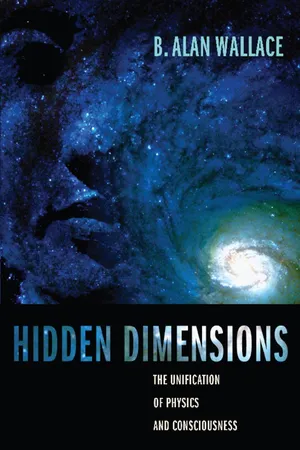
Bridging the gap between the world of science and the realm of the spiritual, B. Alan Wallace introduces a natural theory of human consciousness that has its roots in contemporary physics and Buddhism. Wallace's "special theory of ontological relativity" suggests that mental phenomena are conditioned by the brain, but do not emerge from it. Rather, the entire natural world of mind and matter, subjects and objects, arises from a unitary dimension of reality that is more fundamental than these dualities, as proposed by Wolfgang Pauli and Carl Jung.
To test his hypothesis, Wallace employs the Buddhist meditative practice of samatha, refining one's attention and metacognition, to create a kind of telescope to examine the space of the mind. Drawing on the work of the physicist John Wheeler, he then proposes a more general theory in which the participatory nature of reality is envisioned as a self-excited circuit. In comparing these ideas to the Buddhist theory known as the Middle Way philosophy, Wallace explores further aspects of his "general theory of ontological relativity," which can be investigated by means of vipasyana, or insight, meditation. Wallace then focuses on the theme of symmetry in reference to quantum cosmology and the "problem of frozen time," relating these issues to the theory and practices of the Great Perfection school of Tibetan Buddhism. He concludes with a discussion of the general theme of complementarity as it relates to science and religion.
The theories of relativity and quantum mechanics were major achievements in the physical sciences, and the theory of evolution has had an equally deep impact on the life sciences. However, rigorous scientific methods do not yet exist to observe mental phenomena, and naturalism has its limits for shedding light on the workings of the mind. A pioneer of modern consciousness research, Wallace offers a practical and revolutionary method for exploring the mind that combines the keenest insights of contemporary physicists and philosophers with the time-honored meditative traditions of Buddhism.
- English
- ePUB (mobile friendly)
- Available on iOS & Android
eBook - ePub
About this book
Information
Topic
PhilosophySubtopic
Buddhism1
THE UNNATURAL HISTORY OF SCIENCE
Unnatural Origins
In the four centuries since the scientific revolution, scientists have empirically investigated the objective physical world. Philosophers have primarily resorted to reason, backed by empirical scientific research, in their quest to understand the subjective mental world and its relation to the objective world. And theologians have based their understanding of the transcendent world of divine revelation—including angels, heaven and hell, and the nature of the Trinity—on their faith in God and belief in the veracity of his word as revealed through the Bible.
During those formative centuries of modernity, scientists continually developed effective means of observing physical phenomena, crucial for their extraordinary progress in increasing consensual knowledge of matter, energy, space, and time. Philosophers achieved no comparable success in developing effective means of observing mental phenomena, and this is one reason they have failed to develop any comparable body of consensual knowledge. Nor have theologians devised empirical means to test the articles of their religious faith, and the credibility of religious beliefs has steadily eroded under the onslaught of scientific discoveries.
By the closing decades of the nineteenth century, a growing number of scientists and other intellectuals were coming to the conclusion that only physical phenomena—those successfully observed and understood by science—were real. It was at this point in history that the scientific study of the mind began, a full 300 years after the scientific revolution. Since philosophers and theologians had failed to fathom the nature of the human psyche and spirit, scientists were ready to step in and complete their understanding of the natural world by including the subjective mind that had produced all objective scientific knowledge.
The history of science is marked by competing perspectives on which individuals and traditions of the past are authorities regarding the nature of reality and the distinction between appearances and reality. These two issues have always been closely interrelated. During the late medieval period in Europe, the Bible was widely regarded (under pain of death) as an infallible authority on the whole of reality, Aristotle as infallible on the world of nature, and Euclid as infallible on the axioms and theorems of geometry. Despite the many incompatibilities between the Christian and the scientific worldviews, in the thirteenth century, Thomas Aquinas ingeniously synthesized them into a single, coherent perspective that dominated European thought until the Renaissance.
With regard to celestial phenomena—the sun, moon, planets, and stars—the mainstream intelligentsia of the scholastic era, from the thirteenth century to the sixteenth century, were solidly behind Ptolemaic astronomy, which was based on such Aristotelian principles as the perfect immutability of these objects and their movement in perfect circles. Appearances that corresponded to those principles, such as the apparent movement of the sun around the earth, were accepted at face value, whereas incompatible appearances, such as the occasional retrograde movement of planets, were regarded as misleading. Their true, or essential, movements had to be understood in terms of the perfectly circular motion explained by epicycles and eccentrics.
As more precise empirical observations were gradually made, more and more epicycles and eccentrics had to be conjured up to account for discrepancies between appearances and the Aristotelian principles of nature. Then Copernicus, without making any significant empirical discoveries of his own, suggested a different perspective on the appearances of the relative movements of the sun, earth, and planets. He proposed that the appearance of the sun moving around the earth was an illusion and devised a mathematical theory for a heliocentric configuration of celestial phenomena. His theory accounted for observed phenomena at least as well as the Ptolemaic theory, while shifting the distinction between appearances and reality. But Copernicus was a devout Christian living in an era when his own church was putting heretics to death and condemning them to eternal damnation. When faced with the choice of publish or perish, he opted to perish first and publish later, thereby avoiding scrutiny by the Inquisition and securing his blessed tenure in the hereafter.
Copernicus provided a plausible alternative to the Ptolemaic theory of celestial phenomena that accounted for the same appearances with greater mathematical economy and simplicity. But to many intellectuals of his time, this was insufficient reason for abandoning the safe scholastic fusion of biblical and Aristotelian authority. Prior to Copernicus, there was a striking discrepancy: theorizing about celestial phenomena was done by highly trained professionals—including mathematicians, philosophers, and theologians—while empirical observations of celestial phenomena were left largely to amateur sky gazers relying on their unaided faculty of visual perception. Even Tycho Brahe’s meticulous observations, which provided Johannes Kepler with the empirical data he used to formulate his three laws of planetary motion, were based on naked-eye perception. But there seemed no need to refine the methods of observation, for appearances were thought to be largely misleading. Even if more precise methods were devised, the empirical data would still be illusory, just as the close interrogation of a clever, consistent liar would bring one no closer to the truth.
But not everyone in the sixteenth century was content with such absolute reliance on the received wisdom of past authorities. Tycho Brahe devised a number of ingenious methods for professionally observing the relative movements of the planets. The data he collected were meticulously analyzed by Kepler, who became persuaded of the truth of Copernicus’s heliocentric theory and was forced to the conclusion that the planets moved in elliptical, not circular, orbits around the sun. The beauty and elegance of Aristotelian physics was challenged by empirical data, and the theoretical constructs of the Ptolemaic epicycles and eccentrics, which had won the absolute allegiance of generations of astronomers through the Middle Ages, were discarded as elegant fictions.
Kepler’s findings remained controversial: even Galileo did not rally to his support. But in the scientific revolution that followed, Galileo’s refinement of the telescope and its unprecedented use in precisely examining celestial phenomena were key. Some scholastic philosophers refused to corroborate his findings by gazing through the telescope, but the tide of history was against them. One by one, the long-held beliefs of Aristotle and a literal reading of the Bible were overthrown by researchers professionally trained to observe celestial and terrestrial phenomena. Although appearances in nature are still regarded in many ways as being illusory and misleading, progress in science has relied on the collaboration between professional observers and experimenters and professional theoreticians. This gave rise to the first scientific revolution, in the physical sciences, begun by Copernicus and completed by Isaac Newton.
Newton sought to formulate the physical laws of nature bearing the absolute certainty of Euclidean geometry, but those laws can be discovered only through precise and thorough qualitative and quantitative observations and measurements of physical phenomena. Mathematical theories alone do not define, predict, or explain the emergence of a physical universe. In the language of pure mathematics, such terms as “mass,” “energy,” “space,” and “time” have no meaning. They acquire meaning only as they are used to describe observations of physical phenomena.
Charles Darwin’s careful observations of biological organisms overthrew the literal reading of the Bible, which states that animal species were created by divine intervention within a relatively brief period of time in the recent past and have been fixed ever since. This second scientific revolution was an agonizing conclusion for the intelligentsia of his era, most of whom were devout Christians and Jews who had always relied on biblical authority. It may be said that this first and only revolution in the biological sciences is currently coming to an end with the completion of the Human Genome Project, which explains the mechanisms by which natural selection occurs.
While biologists seek to formulate biological laws of nature with all the credibility of physics, physical theories alone do not define, predict, or explain the emergence of living organisms in the universe. Moreover, biological laws of nature are discovered on the basis of precise and thorough qualitative and quantitative observations and measurements of living organisms, not through a quantitative examination of their physical constituents alone. In the language of physics, terms such as “life,” “death,” “health,” and “illness” have no meaning. They acquire meaning only as they are used to describe observations of biological phenomena.
The Unnatural Emergence of the Mind Sciences
We have yet to achieve even one revolution in the mind sciences comparable to those in the physical and biological sciences. In this regard, science is now facing its greatest challenge since Copernicus. Science can either devise novel methods for rigorously examining mental phenomena or continue to rely primarily on the study of the physical correlates of the mind, while mental phenomena themselves display none of the normal physical characteristics of matter, such as mass, velocity, impenetrability, and spatial extension and location.
It is a natural human tendency to regard only the phenomena we are attending to as real, and things we fail to notice as epiphenomenal or simply nonexistent. Scientists are no exception to this rule. Since science is based on quantitative, objective observation, mental phenomena, which are qualitative and subjective, have largely been overlooked or marginalized. Even when scientists have turned their attention to mental phenomena, they have largely done so by posing questions about their neural causes and behavioral effects. Hardly any progress has been made in observing such phenomena directly, in the only way possible: by means of first-person observation, or introspection.
Scientists acquire empirical evidence according to the kinds of questions they pose and the methods of inquiry they adopt. Until now, the questions and methods have been overwhelmingly objective and quantitative, which inevitably has produced an objective, quantitative view of the universe at large, including the mind. Likewise, since the early twentieth century, the questions and methods used to explore the mind have been almost universally embedded within a materialistic ideology that assumes that all mental phenomena are functions or emergent properties of the brain. This mode of theory-laden inquiry guarantees that the empirical data acquired will conform to the assumptions underlying the research.
The challenge facing modern science is to either discover the laws, or regularities, of mental phenomena in the same way it has explored physical and biological phenomena—by careful examination, with as few ideological assumptions as possible—or continue exploring the mind primarily by examining its physical correlates, which only reinforces the materialistic assumptions held during the late nineteenth century, when the scientific study of the mind began.
A true revolution in the mind sciences has been delayed by an enforced conformity to the unnatural ideological and methodological constraints imposed by the assumptions of scientific materialism, particularly neo-Darwinism. One such assumption is that mental phenomena are equivalent to neurophysiological processes in the brain, an empirically uncorroborated belief. If the first revolution in the mind sciences is to take place, such unsubstantiated ideas must be suspended and new methodologies must be employed that are uniquely suited to the scientific study of mental phenomena, including consciousness. In other words, science can either continue to let its study of the mind be dominated by the metaphysical assumptions of a well-established ideology or pursue the open-minded, empirical investigation of mental phenomena, even if it calls into question some of the most deeply held scientific beliefs based on classical physics and contemporary biology.
The major alternatives we have today as definitions of the nature of consciousness are that it is a supernatural phenomenon that operates according to laws outside of those governing the physical world or that it is a natural phenomenon, an attribute or emergent property of physical processes. In the late nineteenth century, following three centuries of extraordinary success in the quantitative, objective study of physical phenomena, scientists took on the daunting challenge of studying mental phenomena through experimental psychology. After thirty years of ineffectively utilizing introspection in the scientific study of the mind, twentieth-century academic psychology (particularly in the United States) abandoned any attempt to develop rigorous means of observing mental phenomena. Researchers reverted to the time-tested, objective, quantitative methods of the physical and life sciences for studying the behavioral expressions of mental processes. Much can be learned by drawing inferences about causal mental processes on the basis of their resultant modes of behavior and verbal reports, as has been done in behaviorism and psychoanalysis. But radical behaviorists were driven to a more drastic claim stemming from their commitment to a materialist ideology: because mental phenomena, including consciousness, could not be physically measured, they should be deemed nonexistent! And anyone who insisted on affirming their own first-person experience of their thoughts, emotions, dreams, and perceptions was condemned for clinging to ancient superstitions and magic.1
A Blind Spot in the Scientific Vision of Reality
Mental phenomena have always occupied a blind spot in the objective, quantitative scientific vision of reality, and since they could not be detected by the five physical senses or any of the measuring devices developed through advances in technology, behaviorists, equating scientific knowledge with human knowledge, simply denied what they could not observe in the laboratory. In an extraordinary triumph of ideology over experience, some insisted that all subjective terms, including “mind” and “ideas,” be banned from scientific discourse. This categorical refusal to admit the existence of mental phenomena has filtered into mainstream academic philosophy, with some prominent thinkers denying the existence of subjective statements2 and others maintaining that subjectively experienced mental states must be nonexistent, for the descriptions of such states are irreducible to the language of neuroscience.3
Nowadays most philosophers and cognitive scientists have distanced themselves from this extreme ideological commitment to materialism, which so obviously flies in the face of personal experience. Thoughts and mental images, desires and beliefs, emotions and dreams do exist, and somehow their awkward subjective presence must be incorporated into a scientific view of nature. All subjective experiences, including consciousness itself, remain invisible to objective scientific observation. A growing number of scientists and philosophers of mind believe they have the solution: simply declare that conscious states are equivalent to their neurophysiological correlates or to higher-level features of the brain.4 In this view, conscious mental events occupy a unique status among physical phenomena. The physical processes in the brain that are equated with mental processes are believed to have a dual aspect: they are physically measurable processes, consisting of ordinary electrochemical events of a kind quite familiar to physicists and chemists, but somehow, inexplicably, they are also subjective experiences. The rationale for this quasi-dualistic position is that mental phenomena appear to be nonphysical, but this appearance is misleading, for they are realized as neural events, which are their essential nature.5
It is as if mental phenomena, despite their undeniably subjective, nonphysical appearance, are being granted admittance into the world of nature by being equated with well-understood physical phenomena. Scientists have yet to identify the neural correlates of consciousness, so no one even knows yet what those hypothetical neural processes with a dual identity might be. But advocates hold to this position for two reasons, one based on common sense and the other based on four centuries of scientific discoveries: in deference to common sense (which some behaviorists and eliminative materialists abandoned), they admit that mental phenomena do exist; and in light of the widespread scientific assumption that only physical phenomena exist and are causally effective in the natural world, they conclude that mental phenomena must be physical, even if they don’t appear to have any physical attributes and cannot be detected by any scientific instruments designed to measure all known types of physical phenomena. To appreciate this p...
Table of contents
- Cover
- Half title
- Series Page
- Title
- Copyright
- Contents
- Preface and Acknowledgments
- 1. The Unnatural History of Science
- 2. The Many Worlds of Naturalism
- 3. Toward a Natural Theory of Human Consciousness
- 4. Observing the Space of the Mind
- 5. A Special Theory of Ontological Relativity
- 6. High-Energy Experiments in Consciousness
- 7. A General Theory of Ontological Relativity
- 8. Experiments in Quantum Consciousness
- 9. Perfect Symmetry
- Notes
- Bibliography
- Index
Trusted by 375,005 students
Access to over 1.5 million titles for a fair monthly price.
Study more efficiently using our study tools.
Frequently asked questions
Yes, you can cancel anytime from the Subscription tab in your account settings on the Perlego website. Your subscription will stay active until the end of your current billing period. Learn how to cancel your subscription
No, books cannot be downloaded as external files, such as PDFs, for use outside of Perlego. However, you can download books within the Perlego app for offline reading on mobile or tablet. Learn how to download books offline
Perlego offers two plans: Essential and Complete
- Essential is ideal for learners and professionals who enjoy exploring a wide range of subjects. Access the Essential Library with 800,000+ trusted titles and best-sellers across business, personal growth, and the humanities. Includes unlimited reading time and Standard Read Aloud voice.
- Complete: Perfect for advanced learners and researchers needing full, unrestricted access. Unlock 1.5M+ books across hundreds of subjects, including academic and specialized titles. The Complete Plan also includes advanced features like Premium Read Aloud and Research Assistant.
We are an online textbook subscription service, where you can get access to an entire online library for less than the price of a single book per month. With over 1.5 million books across 990+ topics, we’ve got you covered! Learn about our mission
Look out for the read-aloud symbol on your next book to see if you can listen to it. The read-aloud tool reads text aloud for you, highlighting the text as it is being read. You can pause it, speed it up and slow it down. Learn more about Read Aloud
Yes! You can use the Perlego app on both iOS and Android devices to read anytime, anywhere — even offline. Perfect for commutes or when you’re on the go.
Please note we cannot support devices running on iOS 13 and Android 7 or earlier. Learn more about using the app
Please note we cannot support devices running on iOS 13 and Android 7 or earlier. Learn more about using the app
Yes, you can access Hidden Dimensions by B. Alan Wallace in PDF and/or ePUB format, as well as other popular books in Philosophy & Buddhism. We have over 1.5 million books available in our catalogue for you to explore.