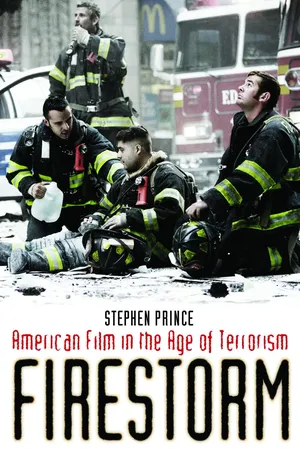
It was believed that September 11th would make certain kinds of films obsolete, such as action thrillers crackling with explosions or high-casualty blockbusters where the hero escapes unscathed. While the production of these films did ebb, the full impact of the attacks on Hollywood's creative output is still taking shape. Did 9/11 force filmmakers and screenwriters to find new methods of storytelling? What kinds of movies have been made in response to 9/11, and are they factual? Is it even possible to practice poetic license with such a devastating, broadly felt tragedy?
Stephen Prince is the first scholar to trace the effect of 9/11 on the making of American film. From documentaries like Fahrenheit 9/11 (2004) to zombie flicks, and from fictional narratives such as The Kingdom (2007) to Mike Nichols's Charlie Wilson's War (2007), Prince evaluates the extent to which filmmakers have exploited, explained, understood, or interpreted the attacks and the Iraq War that followed, including incidents at Abu Ghraib. He begins with pre-9/11 depictions of terrorism, such as Alfred Hitchcock's Sabotage (1936), and follows with studio and independent films that directly respond to 9/11. He considers documentary portraits and conspiracy films, as well as serial television shows (most notably Fox's 24) and made-for-TV movies that re-present the attacks in a broader, more intimate way. Ultimately Prince finds that in these triumphs and failures an exciting new era of American filmmaking has taken shape.
- English
- ePUB (mobile friendly)
- Available on iOS & Android
eBook - ePub
About this book
Trusted by 375,005 students
Access to over 1.5 million titles for a fair monthly price.
Study more efficiently using our study tools.
Information
Subtopic
North American HistoryCHAPTER ONE
THEATER OF MASS DESTRUCTION
FLYING AIRPLANES INTO BUILDINGS on a holy warrant from God is behavior that hungers for apocalypse. Indeed, many terrorists throughout history have shared a desire for apocalypse. The Irish terrorist O’Donovan Rossa, for example, dreamed of destroying a city and launched a “dynamite campaign” in the 1880s that aimed to reduce London to ashes.1 Dynamite alone couldn’t accomplish his epic goal, but more than a century later, expanding technologies of violence promised to give terrorists the means at last of fulfilling grand ambitions. The destruction of the World Trade Center promised terrible things to come—the potential scope and scale of future incidents was now off the charts.
In pursuing visions of epic destruction, filmmakers got there first, well before al Qaeda did. During the decade-and-a-half that preceded September 11, numerous films gave us stories in which terrorists launch grandiose plans for destruction, and many of these movies—Nighthawks, Speed, Broken Arrow, Die Hard 2, Blown Away—picture voluptuous spectacles of fiery death. Others—Die Hard, Executive Decision, True Lies, The Peacemaker, The Siege—seem to anticipate in often eerie ways the events of September 11. In still others—Independence Day, Godzilla, The Day After Tomorrow—filmmakers blew up, burned down, and knocked over beloved public landmarks, including the Empire State Building, the World Trade Center, and the Statue of Liberty. As if it were an obsessive-compulsive disorder, moviemakers repeatedly reduced Manhattan to smoldering ruins. By the time the attacks did occur, they seemed disturbingly entangled with the movie fantasies that Hollywood had spun so regularly. Exclamations that the destruction of the Twin Towers seemed like something out of a movie were common. This helped to give the event what Claire Kahane called “an uncanny ambiguity.”2
To understand where American film went after September 11, we need to see where it was before al Qaeda’s attack, and this chapter surveys terrorism-themed films produced during the 1980s and 1990s, in a period when heightened awareness about terrorism overseas was coupled with an odd complacency about the probability of an attack on American soil. Terrorism seemed for many like something that happened elsewhere and not in the United States. This complacency helps to account for why Hollywood was so slow in making movies on the subject. Before getting to these films, a quick historical overview will show how wrong the idea itself was. One of the things commonly said after September 11 was that now everything had changed because the events of that day showed that America was not immune from terrorism. In fact, for a long time the U.S. had attracted theoreticians and advocates of terrorism and also suffered from terrorist violence. The assassination of President McKinley in 1901 was a local accompaniment of the wave of political violence—bombings and killings of public figures—that swept Europe in the late nineteenth century and that marked the onset in the West of terrorism as a political weapon. McKinley’s killer was an anarchist inspired by the murder of King Leopold I of Italy.
European anarchists immigrated to America and found in the ongoing labor struggles a receptive climate for their advocacy of political violence. In the early 1880s, in the pages of his journal Freiheit, Johann Most published articles providing advice for terrorists and instruction manuals on how to prepare dynamite. “Rescue mankind through blood, iron, poison, and dynamite,” he proclaimed.3 Freiheit also published Karl Heinzen’s terrorist manifesto, “Murder,” in which he explains the imperative for carrying out acts of massive political violence and declares that, “The greatest benefactor of mankind will be he who makes it possible for a few men to wipe out thousands.”4
Luigi Galleani was the most influential Italian anarchist operating in the United States at the beginning of the new century.5 Convinced that capitalism was an oppressive system and needed to be destroyed, he preached the necessity of violent war against the government and its political institutions. A very gifted orator, his rhetoric inspired thousands of followers. Like Most, he published a bomb-making manual, and beginning in 1914 his followers launched an ambitious and extensive bombing campaign directed against financiers, politicians, judges, police officers, and such institutions as banks, courthouses, and churches. This campaign, which aimed to smash the institutions of capitalist power, bears striking similarities to the current threat posed by al Qaeda. Galleani’s followers were secretive, living and operating underground, possessed of a messianic fervor and devoted to the cause of “propaganda by the deed” (i.e., political persuasion achieved through violence), implacably opposed to the capitalist West, and were mobile and capable of striking throughout the country. Their actions, in turn, elicited a government crackdown on civil liberties in an effort to smash the movement. Following Galleani’s arrest in 1917, his followers mobilized for war against police, judges, politicians, and financiers. Bomb plots were carried out in numerous cities from New York to San Francisco.
Enraged by the government’s efforts to deport their members, in April 1919 the Galleanists launched a new plot, sending nearly three dozen bombs through the mail to prominent financiers, mayors, government and city officials, and a Supreme Court justice. Most of these mail bombs were identified before they were delivered, so casualties were few. One month later Galleanists detonated eight bombs simultaneously in Boston, New York, Paterson, Philadelphia, Pittsburgh, Cleveland, and Washington, a feat that demonstrated their powers of organization. (Similarly, al Qaeda’s simultaneous 1988 bombings of U.S. embassies in Kenya and Tanzania were intended to demonstrate its tactical skills.) One of these bombs mostly destroyed the house of Attorney General A. Mitchell Palmer when the bomber inadvertently blew himself up while placing the charge. Enraged, Palmer launched a crackdown marked by the arrest and deportation of aliens that became known as the Palmer Raids, targeting anarchists, socialists, and communists.
The most spectacular attack attributed to Galleanists was the September 16, 1920, bombing of Wall Street, which many in government believed was retribution for the arrest and prosecution of Sacco and Vanzetti, known Galleanists. The perpetrators were never identified, though a resourceful Galleanist named Mario (“Mike”) Buda is believed to have driven the wagon. Shortly after noon, as workers poured into the intersection of Wall and Broad Street on lunch break, Buda parked a horse-drawn wagon in front of the J. P. Morgan bank. The wagon carried 100 pounds of dynamite packed with iron slugs and wired to a timer. The iron was meant to shred and pulverize bystanders in the street, which it did. Forty people were killed, and the bank was damaged. As on 9/11, this attack targeted the symbols of American financial power, and as on 9/11 soldiers formed a protective ring around the financial district because further attacks were feared. Most importantly, this bombing was the kind of modern terrorism that we recognize. As Beverly Gage has written, “The blast on Wall Street … seemed to be purely symbolic, designed to kill as many innocent people as possible in an assault on American power.”6 In a lament whose terms are familiar to us today, the St. Louis Post-Dispatch wrote, “There was no objective except general terrorism. The bomb was not directed against any particular person or property. It was directed against a public, anyone who happened to be near or any property in the neighborhood.”7 Such wholesale targeting of civilians was unusual for the anarchists. As Walter Laqueur has pointed out, they typically targeted official figures—generals, police chiefs, politicians—and aimed to avoid killing women and children, unlike al Qaeda jihadists.8 Galleani was deported in 1919 and by the time of his death in 1931 anarchist terrorism had been crushed in the United States.
In the modern period terrorists have been a familiar feature of American life. The eclipse of the global youth movement of the 1960s spawned several left-wing terrorist groups that plagued Western democracies. Italy saw the Red Brigades and Germany the Baader-Meinhof group and Red Army Faction. Their counterpart in the U.S. was the Weathermen, which went on a very prolific bombing campaign during the 1970s. Also known as the Weather Underground Organization, this group bombed police departments in Berkeley, San Francisco, and New York, a National Guard headquarters in Washington D.C., courthouses in Washington D.C., New York, and California, prison facilities in New York and California, the corporate offices of Gulf Oil, the Kennecott Corporation, and the Anaconda Corporation, the U.S. State Department, the U.S. Capitol, and the Pentagon.
This is an impressive list of targets, and yet the campaign has been largely forgotten today, perhaps because it was mainly directed at property rather than people. Also active in this period was the Black Liberation Army, which specialized in bombings and in gunning for police officers. FALN, an acronym designating the group of guerrillas fighting for the independence of Puerto Rico, set off numerous bombs in Manhattan in 1975, and the following year it bombed the New York office of Mobil Oil and threatened to bomb the World Trade Center. It continued its bombing campaign through the end of the decade. The Unabomber employed mail bombs to wage a Luddite vendetta against engineering and computer science professors, geneticists, and an array of other victims. The campaign lasted from 1978 to 1995. In the 1990s the Army of God launched a campaign of bombings directed at abortion clinics and shootings of abortion providers.
Clearly, then, neither Oklahoma City nor the events of September 11 marked the beginning of terrorism in the United States. The spillover of anarchist philosophy from Europe to America in the 19th century brought with it numerous advocates of political violence, and the 1970s had seen a wave of bombings. But Oklahoma City and September 11 did bring something relatively new, which was the wholesale targeting of people, something not witnessed in the U.S. since the 1920 Wall Street bombing. The Weathermen aimed to end the Vietnam War. The Black Liberation Army and the FALN saw themselves conducting a war for racial or national liberation, which was a predominant political framework in the period, in which the targets for violence were selectively chosen and in which the objective did not include killing people en mass. As Martin Miller has emphasized, the “limited terrorism” of earlier periods has been replaced by the “terrorism without boundaries of our time.”9 As Walter Laqueur has stressed, the old terrorism “was, by and large, discriminate, selecting its victims carefully.” By contrast, “contemporary terrorism has increasingly become indiscriminate in the choice of its victims. Its aim is no longer to conduct propaganda but to effect maximum destruction.”10
This shift was one of the most sinister things that September 11 represented. It compelled U.S. political culture and public life to assimilate the probability of future acts of mass murder. But if this eventuality seemed to become more real after September 11, in the realm of popular culture it already existed. Since the 1980s, movies about terrorism had been offering audiences the promise of mass destruction as a means of providing entertainment. But before the 1980s this was rare—until then few American films focused on terrorism. Indeed, in comparison with literature, where terrorism is a subject that has interested a great many writers, it occupied a small niche in American cinema until recent years. Surveying terrorism as a theme in the two mediums, Walter Laqueur concluded that film producers and directors seemed to feel it was of little audience interest.11 Laqueur was writing in the mid-1980s, just before the big surge in film production on this subject. Nevertheless, the disparity between the wealth of literature that he analyzes and the relatively paltry number of films is striking. From the world’s greatest authors—Dostoyevsky (The Possessed), Joseph Conrad (The Secret Agent), André Malraux (The Human Condition), Jean-Paul Sartre (Dirty Hands)—to the countless writers of popular fiction (Thomas Harris, Frederick Forsythe, Alistair MacLean), the topic has retained an enduring interest.
HOLLYWOOD’S INITIAL FLIRTATIONS WITH THE TOPIC
Hollywood had remained uninterested in terrorism, except for the odd production such as John Ford’s The Informer (1935), based on a novel by Liam O’Flaherty, who had fought with the IRA. A number of films dealt with subjects that, with a nudge here or there, could have encompassed a terrorist theme. In Suddenly (1954), Frank Sinatra leads a determined group of men planning to ambush and assassinate the President of the United States. Elia Kazan’s Panic in the Streets (1950) is a crime film about the threat of bubonic plague being spread in a city, except in this case it isn’t deliberate. The killer on the loose doesn’t know that he carries the disease. In The Manchurian Candidate (1962), agents of a foreign power (Red China) plot to assassinate a Presidential candidate using a “sleeper,” a sniper whose subconscious mind has been programmed to carry out the plot, but the portrait carries no terrorist inflection. Nor do the portraits of crazed, lone snipers in Targets (1968) and Two Minute Warning (1976), even though in the latter film the killer sets up his gear in a football stadium during a big league game.
The Satan Bug (1965), directed by John Sturges from a novel by Alistair MacLean, got much closer to the mark in its story about the theft of a secret, government-manufactured super-toxin and the threat it poses if unleashed in American cities. In Rollercoaster (1977), a bomber extorts money from amusement parks by threatening to blow up their roller coasters. And in Juggernaut (1974), a bomber places seven explosive devices aboard a luxury ocean liner and threatens to detonate them unless he’s paid a huge sum. Although this is an extortion plot more than a politically motivated act of terrorism, the template that it offered of a mad bomber or extortionist threatening massive violence proved to be very durable and influenced numerous films in the 1980s and 1990s.
In The FBI Story (1959) a killer blows up a passenger airliner carrying his mother because he wants her insurance money. It’s an act of mass murder but not terrorism. Threats of violence against airplanes could be found in Skyjacked (1972) and in the popular hit, Airport (1970), wherein a madman played by Van Heflin detonates a bomb on board a Boeing 707. Were this movie made today, it would be inflected more strongly as a terrorist narrative, but in 1970 terrorism wasn’t on Hollywood’s radar. Airport, Juggernaut, Rollercoaster, and others were part of a genre in the period known as “disaster movies.” The disaster film emphasized extraordinary physical calamity befalling a cross-section of characters, often played by aging Hollywood stars (Ava Gardner, Fred Astaire, Jennifer Jones) then in the twilight of their careers. In many instances, the disasters were natural calamities rather than ones that today look like terrorism. Earthquake depicts the destruction of Los Angeles. A tidal wave upends an ocean liner in The Poseidon Adventure. An out-of-control train carries plague in The Cassandra Crossing. A midair collision cripples a 747 in Airport 1975. A fire rages through a high-rise in The Towering Inferno.
The disaster movie was a prominent genre in the 1970s, and while it might be inflected to include bomb threats against public targets, these were not emphasized with the kind of self-consciousness that would be routine today. One simply doesn’t find a terrorist focus very often in American cinema before the 1980s. In addition to some of the disaster movies, Hollywood’s spy films occasionally seemed to broach the subject of terrorism, but always in an outlandish fashion. Some of the James Bond movies, for example, such as You Only Live Twice (1967), feature megalomaniac villains bent on either world domination or world destruction, and they aim to achieve their goals by threatening massive violence. And spy movies inspired by Bond’s popularity, such as Our Man Flint (1966), which features a cabal of eco-terrorists bent on world domination, did the same. On occasion, Hollywood’s international coproductions took up the subject of terrorism. Hennessy (1975), for example, produced by American International Pictures, starred Rod Steiger as an IRA bomber who journeys to London intending to blow up Parliament. In the climax, he wears a suicide vest laced with explosives, much like a modern jihadist might do.
Ironically, one of Hollywood’s best-known directors—Alfred Hitchcock—provided the most indelible, powerful, and literal image of terrorist violence in early cinema, and yet this was before he joined the American film industry. In Sabotage (1936), made during his British period, young Steve (Desmond Tester), son of the film’s heroine (Sylvia Sidney), unwittingly carries a bomb to Piccadilly Circus. Verloc (Oscar Holmolka), the anarchist agent who gave him the bomb, insists that the package must be delivered before 1:30 that afternoon, but, alas, poor Steve is delayed by a passing parade which he pauses to watch and is also corralled by a street peddler selling toothpaste and hair tonic. When Steve does get free of the peddler and the parade, he boards a double-decker bus, which becomes bogged down in heavy traffic. And time grows late, too late. At 1:45, the bomb explodes, killing Steve and the other passengers on the bus.
Hitchcock later said that he felt it was a mistake to have killed the boy because audiences hated that turn of events. He told interviewer François Truffaut that “when the bomb exploded and he was killed, the public was resentful.”12 All th...
Table of contents
- Cover
- Half title
- Title
- Copyright
- Dedication
- Contents
- Acknowledgments
- Introduction
- Chapter 1. Theater of Mass Destruction
- Chapter 2. Shadows Once Removed
- Chapter 3. Ground Zero in Focus
- Chapter 4. Battleground Iraq
- Chapter 5. Terrorism on the Small Screen
- Chapter 6. No End in Sight
- Appendix 1: Historical Timeline
- Appendix 2: Filmography
- Notes
- Bibliography
- Index
Frequently asked questions
Yes, you can cancel anytime from the Subscription tab in your account settings on the Perlego website. Your subscription will stay active until the end of your current billing period. Learn how to cancel your subscription
No, books cannot be downloaded as external files, such as PDFs, for use outside of Perlego. However, you can download books within the Perlego app for offline reading on mobile or tablet. Learn how to download books offline
Perlego offers two plans: Essential and Complete
- Essential is ideal for learners and professionals who enjoy exploring a wide range of subjects. Access the Essential Library with 800,000+ trusted titles and best-sellers across business, personal growth, and the humanities. Includes unlimited reading time and Standard Read Aloud voice.
- Complete: Perfect for advanced learners and researchers needing full, unrestricted access. Unlock 1.5M+ books across hundreds of subjects, including academic and specialized titles. The Complete Plan also includes advanced features like Premium Read Aloud and Research Assistant.
We are an online textbook subscription service, where you can get access to an entire online library for less than the price of a single book per month. With over 1.5 million books across 990+ topics, we’ve got you covered! Learn about our mission
Look out for the read-aloud symbol on your next book to see if you can listen to it. The read-aloud tool reads text aloud for you, highlighting the text as it is being read. You can pause it, speed it up and slow it down. Learn more about Read Aloud
Yes! You can use the Perlego app on both iOS and Android devices to read anytime, anywhere — even offline. Perfect for commutes or when you’re on the go.
Please note we cannot support devices running on iOS 13 and Android 7 or earlier. Learn more about using the app
Please note we cannot support devices running on iOS 13 and Android 7 or earlier. Learn more about using the app
Yes, you can access Firestorm by Stephen Prince in PDF and/or ePUB format, as well as other popular books in Media & Performing Arts & North American History. We have over 1.5 million books available in our catalogue for you to explore.