Family life has been radically transformed over the past three decades. Half of all households are unmarried, while only a quarter of all married households have kids. A third of the nation's births are to unwed mothers, and a third of America's married men earn less than their wives. With half of all women cohabitating before they turn thirty and gay and lesbian couples settling down with increasing visibility, there couldn't be a better time for a book that tracks new conceptions of marriage and family as they are being formed.
The editors of this volume explore the motivation to marry and the role of matrimony in a diverse group of men and women. They compare empirical data from several emerging family types (single, co-parent, gay and lesbian, among others) to studies of traditional nuclear families, and they consider the effect of public policy and recent economic developments on the practice of marriage and the stabilization—or destabilization—of family. Approaching this topic from a variety of perspectives, including historical, cross-cultural, gendered, demographic, socio-biological, and social-psychological viewpoints, the editors highlight the complexity of the modern American family and the growing indeterminacy of its boundaries. Refusing to adhere to any one position, the editors provide an unbiased account of contemporary marriage and family.
eBook - ePub
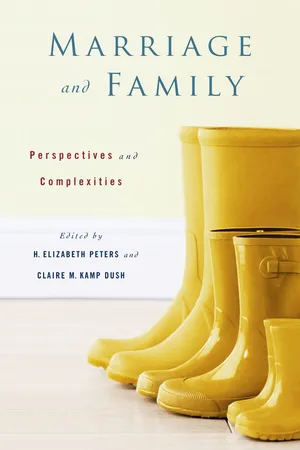
Marriage and Family
Perspectives and Complexities
- English
- ePUB (mobile friendly)
- Available on iOS & Android
eBook - ePub
Marriage and Family
Perspectives and Complexities
About this book
Trusted by 375,005 students
Access to over 1.5 million titles for a fair monthly price.
Study more efficiently using our study tools.
Information
Subtopic
Social WorkIndex
Social Sciences| Perspectives on Marriage | PART 1 |
| Historical and Cross-Cultural Perspectives on Marriage | ONE |
| ARLAND THORNTON |
This chapter discusses the place of marriage and family in the lives of individuals and societies from cross-cultural and historical perspectives—considering similarities and differences across time and across culture. I begin with cross-cultural perspectives and a discussion of some of the many features of marriage and family life that have been nearly universal. I then share my awe at the incredible number of different ways in which people in different societies have organized and experienced marriage and family life. Of great importance to understanding American family life are the numerous ways in which marriage in northwestern Europe and its overseas populations have differed from experiences in other societies. Given that a single chapter is too short to discuss in detail cross-cultural differences, I focus on some of the central aspects of marriage and family life in the history of northwestern Europe—and contrast these elements with those in other regions. Readers are referred to the references cited here for more in-depth detail on cross-cultural differences.
Turning next to matters of history and marriage and family change, I observe that students of social change have always been plagued with data of insufficient quality and quantity from ordinary people to answer their questions about change in the general population. This has led scholars for hundreds of years to use data from one country in proxy for the past circumstances in another country and data from the aristocracy to describe marriage and family practices among ordinary people. I show that these practices have produced many beliefs about marriage and family change in the general population in the Western world that were later discovered to be incorrect. I then review some of the central elements of what we know from the historical archives about marriage and family change during the past two centuries in northwestern Europe and its overseas populations in the United States. The changes in marriage and family life in recent decades have been dramatic, as the introduction to this book documents, but there have also been important long-term continuities, and there have been changes that are contrary to what many assume.
I must paint with a very broad brush, providing only the briefest of details. Readers who wish a fuller discussion of these issues and additional references to the relevant literature are invited to refer to more extensive treatments of these topics elsewhere (Axinn, Emens, and Mitchell 2008; Thornton 2005; Thornton, Axinn, and Xie 2007).
UNIVERSAL IMPORTANCE OF FAMILY AND MARRIAGE AMONG HISTORICAL SOCIETIES
I begin this section with the observation that historically family units have been central organizations for all—or almost all—societies (see, for example, Lee and Wang 1999; Sanderson 1990; Thornton and Fricke 1987; Thornton and Lin 1994; Todd 1985; Wright 1899). Indeed, in most societies of the past family units were the loci of many—if not most—of the central activities of human life. The primary residential units were usually composed of family members. Babies were usually born into family units and were reared and educated by relatives. Families were the loci of companionship, love, and affection as well as quarreling, conflict, and even violence. Information and protection were largely obtained through family members. Family authority was very important in the lives of both children and adults. Family units were also the primary locus of economic activity, as most production and consumption occurred within them.
Just as the family was a central organization structuring social and economic life in most populations of the past, the husband-wife dyad and the parent-child dyad were the central units structuring family life. Companionship and love were important elements of the husband-wife relationship, but indifference and dislike could also emerge. It was husbands and wives who formed the primary unit for sexual expression and the bearing, rearing, and socialization of children. Although the roles of the marital dyad in the activities of the family and economy often varied by gender, cultural settings, and the ages of the wife and husband, this couple usually played leadership and management roles in the family economy and household.
Because of the centrality of marriage in people’s lives, marriage in virtually all societies in the past was viewed as both one of the most important events between birth and death and as part of the natural progression of the life course for both women and men. Most of the world’s population married, but those who did not were usually expected to live as dependents in households headed by other family members. Given the centrality of marriage, it is not surprising that its importance in virtually all societies was not limited to the individuals involved but also to their families and communities. In addition, marriage had religious or spiritual significance in many societies of the world.
Obtaining knowledge of people’s motivations for marriage is difficult, and our ignorance of people’s motivations for marriage in the past is extremely large. Yet, from descriptions of marriage and family life around the world, we can assume that for centuries most people of the world have married for a variety of reasons, ranging from economic well-being to affection and companionship, from religion to sex, and from the desire for social support to the bearing and rearing of children. People almost everywhere probably married because it was the “natural” thing to do, brought social prestige, and immediately or eventually turned girls and boys into women and men and mistresses and masters of their own households and family economies.
VARIATIONS IN FAMILY AND MARRIAGE AMONG HISTORICAL SOCIETIES
Despite, or perhaps because of, the centrality of family and marriage units in most societies of the past, there has historically been enormous variation in the ways in which different groups have organized marital and family units (for a more extensive discussion and references to the literature, see Thornton 2005, esp. 47–61; see also Broude 1994; Burguière and Lebrun 1986; Goody 1990). In fact, the differences across groups have been so large that it has been difficult even to define what is meant by family and marriage (Coontz 1988; Gough 1959; Yanagisako 1979). For example, marriage in some groups was strictly monogamous with one wife and one husband, in others a man could have multiple wives, and in yet others a wife could have multiple husbands. In some societies households often consisted of elderly parents, multiple married children and in-laws, and numerous grandchildren, while in other societies households usually consisted of just a married couple and their children. And, in some groups a newly married couple would live with or near the husband’s parents, in other groups with or near the wife’s parents, and in others away from both parents. Similarly, marital practices could vary from the marriage being decided almost entirely by the parents of the couple with no premarital contact between the prospective bride and groom to the marriage being arranged almost entirely by the prospective bride and groom, with substantial premarital courtship, companionship, affection, and sometimes even sex and pregnancy. In some places marriage occurred primarily during the teenage years or earlier, while in others marriage was postponed into the twenties or later.
There were enormous variations in family and marriage patterns between the regions of the world—for example, between Asia and Africa and between Europe and Africa and Asia. In addition, there were important differences within regions—for example, between East Asia and West Asia, and between North Africa and Africa south of the Sahara. Important differences even existed between the family systems in northwestern Europe and the family systems in eastern and southern Europe. Because of the importance of the differences between northwestern Europe (and its overseas populations in North America) and other places, it is useful to understand some of the central elements of those differences.
COMMON HISTORICAL FAMILY AND MARRIAGE PATTERNS OUTSIDE NORTHWESTERN EUROPE
Given the enormous variation in family and marriage patterns outside northwestern Europe, it is impossible to cover that variation in a brief chapter. Consequently, I provide a stylized or composite version of a complex of attributes from multiple societies rather than a description of patterns at any specific time in any particular non-Western country. At the same time, I note that many features of this stylized or composite description roughly fit the situations in many places outside northwestern Europe (for more information and references, see Thornton 2005, esp. 47–61; see also Broude 1994; Thornton and Fricke 1987; and Westermarck 1891).
One of the attributes that contrasted societies outside of northwestern Europe with those within it was the stronger reliance on family units for social organization in the former. Although many people outside of northwestern Europe had important nonfamily experiences and relationships, the family mode of organization in many of these societies was especially widespread. Emphasis on the community rather than the individual has also been particularly important in societies outside of northwestern Europe.
In many societies outside of northwestern Europe, households were frequently large and extended, consisting of grandparents, multiple married children and their spouses, and grandchildren. It was common in such societies for newly married couples to live with one set of parents, at least during the initial years of marriage. These societies also had considerable authority in the hands of parents and the elders, with older parents having extensive authority over their children well into adulthood. In addition, men frequently had extensive authority over women.
Marriage was frequently universal in these societies and was often contracted during the teenage years and earlier in some places. Arranged marriages were frequently the norm, with parents deciding who their children would marry, sometimes with the assistance of a matchmaker. In such arranged-marriage societies there was often very little, or no, opportunity for interaction, courtship, and the creation of love between the prospective husband and wife before marriage. Companionship and affection were meant to be the result of the marriage and not its precursor. The virginity of the prospective bride was often an essential qualification for marriage, a condition which early marriage and parental control of the marriage process helped to ensure.
COMMON HISTORICAL NORTHWESTERN EUROPEAN FAMILY AND MARRIAGE PATTERNS
I now turn to a discussion of the situation in northwestern Europe, with my time frame being the several hundred years preceding the nineteenth century (for more general discussions, including references, see Thornton 2005, esp. 47–61 and 81–95; Thornton, Axinn, and Xie 2007, esp. 27–44; see also Demos 1970; Fleming 2001; Gillis 1985; Gottlieb 1993; Hajnal 1965, 1982; Laslett 1984; Macfarlane 1986; McSheffrey 1995; O’Hara 2000; and Sheehan 1971, 1978). In discussing common marriage and family patterns in northwestern Europe and its overseas populations in North America, it is important to distinguish between the patterns of the aristocracy and the patterns of ordinary people because the patterns of the upper classes varied substantially from those of the common people (see Gottlieb 1993 and Ribordy 2001). My focus here is on ordinary people, not the aristocracy.
Although there were important variations within northwestern Europe, the typical patterns there varied sharply in many respects from the patterns existing in many other places. One important contrast is that although family relationships were generally important for organizing the activities and authority of society, there were especially important nonfamily organizations as well. These included schools, the market, the church, the state, and the military. Many young people also worked and lived in households where they had no family relations. In addition, at the same time that family and community solidarity was important in this region, there was also considerable emphasis on the individual.
Another crucial contrast between northwestern Europe and many other parts of the world is that households in northwestern Europe were usually not large and complex with a diverse number of relatives, but composed primarily of a married couple and their dependent children. A relatively modest number of newlywed couples shared a household with both the mother and father, although many lived in the same area and others lived with a widowed mother or widowed father. Very few married siblings shared the same household. Within these nuclear or weak-stem households, the husband and wife were usually the master and mistress of the household and its many activities, including those of economic production. Marriage also brought individuals socially across the threshold of adulthood and into manhood and womanhood.
Because northwestern European couples usually had to have their own means for providing their economic necessities, marriage could not be entered until the couple had established its own economic and household unit. This meant that marriage was very late by international standards, with women usually not marrying until they were in their early twenties and men frequently waiting until their late twenties. This system also resulted in a relatively high incidence of women and men remaining unmarried throughout life.
In addition, before marriage, large fractions of young people in northwestern Europe left their parental homes—frequently as teenagers—to live and work in the homes and economic units of unrelated families. Consequently, living apart from parents for several years prior to marriage was a common experience for many young people.
As in other societies, marriage was important not only to the couple involved, but to their parents and the larger community. However, the arranged marriage system of other societies did not exist among the ordinary people of northwestern Europe. Instead, despite parental interest and influence, young people had exceptional freedom in mate selection, with the choice of a spouse primarily being determined by the relatively mature prospective couple. Free consent of the prospective bride and groom was an essential element in marriage—a principle endorsed by the Catholic Church.
Mate selection in northwestern Europe often involved extensive periods of courtship between mature women and men who understood that marriage was based on love and companionship, as well as shared residence, economics, and children. It was in the interactions and companionship of courtship that young couples found and nurtured love and affection—in preparation for making marital promises to love, cherish, and honor each other, as the Book of Common Prayer (1552) put it.
Local communities in northwestern Europe provided considerable opportunities for couples to meet and interact with each other—including markets, fairs, religious meetings, work groups, farm buildings, and the houses of neighbors and relatives. Courting couples spent time together, visiting and going on walks or rides. The frequency of visiting increased as the courtship became more serious, with the visits often occurring at the woman’s residence. Sometimes these visits involved substantial distances and the man might spend the night at the woman’s house.
This courtship system involved sexual attraction and physical affection. Yet significant boundaries were drawn around sexual expressiveness, and premarital sexual intercourse was discouraged. The normative restrictions against nonmarital intercourse were apparently quite effective, although there were deviations from the norms, and sex and even pregnancy sometimes occurred. Such viol...
Table of contents
- Cover
- Half title
- Title
- Copyright
- Dedication
- Contents
- List of Illustrations
- List of Tables
- Acknowledgments
- Introduction
- Part I: Perspectives on Marriage
- Part II: Contemporary Families
- Part III: Strengthening Marriage
- Part IV: The Future of Marriage
- List of Contributors
- Index
Frequently asked questions
Yes, you can cancel anytime from the Subscription tab in your account settings on the Perlego website. Your subscription will stay active until the end of your current billing period. Learn how to cancel your subscription
No, books cannot be downloaded as external files, such as PDFs, for use outside of Perlego. However, you can download books within the Perlego app for offline reading on mobile or tablet. Learn how to download books offline
Perlego offers two plans: Essential and Complete
- Essential is ideal for learners and professionals who enjoy exploring a wide range of subjects. Access the Essential Library with 800,000+ trusted titles and best-sellers across business, personal growth, and the humanities. Includes unlimited reading time and Standard Read Aloud voice.
- Complete: Perfect for advanced learners and researchers needing full, unrestricted access. Unlock 1.5M+ books across hundreds of subjects, including academic and specialized titles. The Complete Plan also includes advanced features like Premium Read Aloud and Research Assistant.
We are an online textbook subscription service, where you can get access to an entire online library for less than the price of a single book per month. With over 1.5 million books across 990+ topics, we’ve got you covered! Learn about our mission
Look out for the read-aloud symbol on your next book to see if you can listen to it. The read-aloud tool reads text aloud for you, highlighting the text as it is being read. You can pause it, speed it up and slow it down. Learn more about Read Aloud
Yes! You can use the Perlego app on both iOS and Android devices to read anytime, anywhere — even offline. Perfect for commutes or when you’re on the go.
Please note we cannot support devices running on iOS 13 and Android 7 or earlier. Learn more about using the app
Please note we cannot support devices running on iOS 13 and Android 7 or earlier. Learn more about using the app
Yes, you can access Marriage and Family by H. Elizabeth Peters,Claire Kamp Dush,Claire M. Kamp Dush in PDF and/or ePUB format, as well as other popular books in Social Sciences & Social Work. We have over 1.5 million books available in our catalogue for you to explore.