Japanese Zen often implies that textual learning (gakumon) in Buddhism and personal experience (taiken) in Zen are separate, but the career and writings of the Chinese Tang dynasty Chan master Guifeng Zongmi (780-841) undermine this division. For the first time in English, Jeffrey Broughton presents an annotated translation of Zongmi's magnum opus, the Chan Prolegomenon, along with translations of his Chan Letter and Chan Notes.
The Chan Prolegomenon persuasively argues that Chan "axiom realizations" are identical to the teachings embedded in canonical word and that one who transmits Chan must use the sutras and treatises as a standard. Japanese Rinzai Zen has, since the Edo period, marginalized the sutra-based Chan of the Chan Prolegomenon and its successor text, the Mind Mirror (Zongjinglu) of Yongming Yanshou (904-976). This book contains the first in-depth treatment in English of the neglected Mind Mirror, positioning it as a restatement of Zongmi's work for a Song dynasty audience.
The ideas and models of the Chan Prolegomenon, often disseminated in East Asia through the conduit of the Mind Mirror, were highly influential in the Chan traditions of Song and Ming China, Korea from the late Koryo onward, and Kamakura-Muromachi Japan. In addition, Tangut-language translations of Zongmi's Chan Prolegomenon and Chan Letter constitute the very basis of the Chan tradition of the state of Xixia. As Broughton shows, the sutra-based Chan of Zongmi and Yanshou was much more normative in the East Asian world than previously believed, and readers who seek a deeper, more complete understanding of the Chan tradition will experience a surprising reorientation in this book.
- English
- ePUB (mobile friendly)
- Available on iOS & Android
eBook - ePub
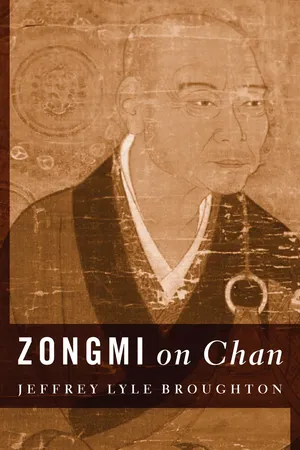
Zongmi on Chan
About this book
Trusted by 375,005 students
Access to over 1.5 million titles for a fair monthly price.
Study more efficiently using our study tools.
Information
Topic
Theology & ReligionSubtopic
Chinese History1 Translation of the Chan Letter
CHART OF THE MASTER-DISCIPLE SUCCESSION OF THE CHAN GATE THAT TRANSMITS THE MIND GROUND IN CHINA1
ZONGMI, THE MONK [OFFICIATING AT MEMORIAL] SERVICES AT THE INNER PRACTICE SITE2 [WITHIN THE IMPERIAL PALACE], ANSWERS MINISTER PEI’S INQUIRY
[ALTERNATE TITLE: IMPERIAL REDACTOR PEI XIU’S INQUIRY3]
The layman Pei Xiu sends a letter to Zongmi asking the master for a statement on the Chan lineages. Pei requests synopses of their genealogical histories; expositions of their teachings; and a critical ranking. Zongmi answers that it is necessary, first of all, to know which Chan transmissions are collateral, that is, branch offshoots [bang], and which one is the central/orthodox line [zheng]. Each Chan house has compiled a genealogical record that illustrates only its one line of descent, without paying attention to the other lines. Once the houses are ranked, Pei will see that the direct inheritor of the mind teaching of Bodhidharma is the Heze lineage.
1. Minister Pei Xiu inquires: The Chan dharma is widely practiced. The followers of each lineage are different and slander one another. They are unwilling to merge into identity. It is urgently necessary to distinguish their origins and histories [that is, genealogies] and come to know which are profound and which shallow. Even though I have devoted attention to this, I have not yet attained clarity. I dread making a mistake when composing a record [of Chan].4 I respectfully hope that you will compose a brief piece on a few sheets of paper that will differentiate the various histories and in broad terms arrange in order the Northern lineage, the Southern lineage, the Heze and Hongzhou lineages within the Southern lineage, the Niutou lineage, and so forth. It would fully treat the essentials, that is, which are shallow and which profound, which all-at-once and which step-by-step, and which hit the mark and which miss it. It would serve me as a tortoise or mirror [that is, a divination guidebook] until the end of my life. Xiu bows a second time.5
Chan Master Zongmi answers: What Bodhidharma transmitted from the outset was a dharma of non-duality. Because of changes [introduced by later] followers, there seem to be different roads [in Chan]. If you close the locking bar on the gate to this, then all [the roads] are wrong. If you understand this, then they are all correct. Transmission records6 compiled by our predecessors just discuss [their own] single line of direct descent. If you wish to distinguish the succession of masters in the various lineages, then you must come to know which are collateral [that is, collateral offshoots] and which is central/orthodox. Now, I will present the collateral and orthodox master-disciple [transmissions], but when I later relate the relative depth of their oral teachings,7 you will spontaneously see that the mind of Bodhidharma [that is, his teaching of the intrinsically pure mind or buddha-in-embryo] has flowed down to the Heze [lineage].
The Niutou lineage is a separate lineage outside the Northern-Southern dichotomy. Its founder, Huiyong (also read Huirong), was a student of voidness (sunyata) teachings who was sanctioned by the fifth patriarch, Hongren. This house is now in its sixth generation.
2. The Niutou lineage is a collateral offshoot from the fourth patriarch [Daoxin].8 At its root there is Chan Master Huiyong [also read Huirong],9 whose nature was lofty and divine wisdom [prajna] sharp. As a result of having previously studied the various sections of the [Perfection of] Wisdom [Sutras] for many years, he had already awakened to the realization that all dharmas from the outset are void and that deluded feelings are grasping of the unreal. Later he encountered the fourth patriarch [Daoxin], who sealed his understanding of the principle of voidness [sunyata]. Because he dwelt in the locus of voidness and yet openly showed the nature of excellence of the non-void, his awakening-understanding was clear without the need of lengthy training. The fourth patriarch told him: “This dharma from ancient times has been entrusted to only one person [at each generation]. I have already handed it over to my disciple Hongren (that is, the fifth patriarch). You may set yourself up separately.” Subsequently, [Huiyong] set up a separate lineage on Mt. Niutou [in the southern outskirts of Jinling, that is, Nanjing] and served as its first patriarch. It has unfolded up to and including the sixth generation. (Later, the fifth patriarchal master, Zhiwei,10 had a disciple, Masu.11 Su had a disciple, Daoqin, that is, Jingshan.12) This particular lineage has no connection at all with the Southern and Northern lineages. The Southern and Northern lineages derive from disciples of the fifth patriarch [Hongren]. Before the fifth patriarch, the designations Southern and Northern did not even exist.
The Northern lineage is a collateral house coming down from the fifth patriarch. In the generation after Shenxiu, one of the major disciples of the fifth patriarch, it called itself the “Bodhidharma lineage.”
3. The Northern lineage is a collateral offshoot from the fifth patriarch. It is said that there were ten people, including Shenxiu, who were equally disciples of the fifth patriarch, the Great Master [Hong]ren. Because the Great Master sanctioned each of them as worthy to be the master of one direction [that is, as a regional teacher], the people of the time said: “Ren produced ten sons.”13 (Preceptor [Hui]neng was the direct, legitimate successor. He is not among these ten.) Among them [Shen]xiu, Lao’an and Zhishen were the best known for their virtue, and they were all revered as masters by Emperor Gaozong [r. 649–683]. Their heirs [continue] unbroken down to the present. Among them, the transforming work of Xiu’s disciple Puji was even more flourishing [than that of his master].14 He became the “Dharma Ruler of Two Capitals” and “Master of Three Emperors.” It just called [itself] the “Bodhidharma lineage” and did not use the designations “Southern” and “Northern.”
The Southern lineage is the basic lineage deriving from the sixth patriarch, Huineng. It gained its name in opposition to the flourishing of Shenxiu’s gradualist teaching in the North. I will now give the story of Huineng’s transmission to Shenhui according to the Patriarch Lineage Transmission Record.
4. The Southern lineage is the basic lineage that has transmitted the robe and dharma [of Bodhidharma] for generation upon generation since the Great Master Caoqi [Hui]neng received Bodhidharma’s spoken purport. Later, in opposition to Shenxiu’s great dissemination of the step-by-step teaching in the North, it came to be called the “Southern lineage.” Because the history of this transmission is known throughout the world, I will not present it. Later, when [Huineng] was about to die, he handed the dharma seal over to Heze and made him his successor. I have in the past presented a version of the story of this succession.15 However, it is very incomplete, and now that I have received your inquiry, I will expand it somewhat, in conformity with the Patriarch Lineage Transmission Record inherited from the past.16 In the midst of the Preceptor Neng section presented in the Transmission it says: “There was a monk of Xiangyang, Shenhui. His family name was Gao, his age fourteen. (That is, Heze. Heze is the name of the monastery [in Luoyang] where he was dwelling when he transmitted dharma.) He came to visit Preceptor [Huineng]. The Preceptor asked: ‘Good friend, you come from afar. You have suffered greatly. Did you bring the fundamental thing or not?’ He answered: ‘I have brought it.’ [Huineng said:] ‘If you have the fundamental thing, then you should truly know the master element.’ He answered: ‘I, Shenhui, take non-abiding as the basis. Seeing is the master element.’ The Great Master [Huineng] said: ‘How dare this novice make such a grandstand play!’17 He immediately took his staff and thrashed him. Beneath the staff, Shenhui meditated: ‘Through successive eons it is hard to meet a great, good friend. Now that I have managed to encounter one, how can I begrudge my life?’ The Great Master was testing [Shenhui], having recognized that the conditions for [Shenhui’s] deep awakening had arrived (like Yao’s coming to know Shun through testing him in various difficulties18).” At the end of [the Neng section of] the Transmission, it further says: “When Preceptor [Neng] was about to enter nirvana, he silently conferred a secret oral transmission [miyu] upon Shenhui. The words were: ‘From the past within our transmission it has been fixed that one hands over only to one person. Within, I transmit the dharma seal and thereby seal your own mind. Without, I transmit the robe and thereby mark the axiom purport. However, I almost lost my life several times for the sake of this robe.’” (That the robe was stolen several times by the Northern lineage appears in the first portion of this Transmission. At present I cannot record [these incidents].) [The Transmission continues: “Huineng said:] ‘The Great Master Bodhidharma made a prediction: “After six generations, a life will be like a dangling thread.” You are the one.’” (This [Bodhidharma] saying [also] appears in the Transmission, where it presents Bodhidharma.) “‘Therefore this robe should be kept in the mountains. Your karmic nexus will be in the North, and so you must cross over the mountain range. After twenty years you will spread this dharma and widely cross over sentient beings.’19 When Preceptor [Neng] was on the verge of death, his disciples, Xingtao, Chaosu and Fahai20 asked: ‘To whom will the Preceptor hand over his dharma?’ The Preceptor said: ‘The one to whom I have entrusted it will spread it in the North after twenty years.’ They asked: ‘Who is it?’ He answered: ‘If you wish to know him, catch him with a net on Mount Dayu.’” (The Transmission says: “The mountain range is ‘gao/high.’ Heze’s family name was Gao. Therefore it cryptically indicates him.”)
The central/orthodox line of descent within the Southern lineage of Huineng is known as the Heze lineage, a name that distinguishes it from the collateral offshoot from Huineng, known as the Hongzhou lineage. Emperor Dezong in 796 sent down an imperial proclamation making Heze Shenhui the seventh patriarch.
5. The Heze lineage is nothing but the dharma of Caoqi [Huineng] with the purport of no other teaching [mixed in]. It was given this additional lineage designation in opposition to the collateral offshoot Hongzhou. The history of this transmission has already been discussed above. However, after Preceptor Neng died, the step-by-step teaching of the Northern lineage was greatly practiced (also as presented above). Therefore, it constituted a hindrance to the propagation of the all-at-once gate. Because the inscription of the Caoqi tradition was effaced and [another] substituted for it, for twenty years the axiom teaching was hidden. (The myriad hardships that the Great Master encountered are all like that in the abbreviated Transmission presented above. They are given at length in the original Transmission. On another day I will present the details.) At the beginning of the Tianbao era [742–755], Heze [Shenhui] entered [the eastern capital of] Luo[yang] and greatly spread this [all-at-once] gate. He then revealed that the lineage of [Shen]xiu’s disciples was collateral and that their dharma gate was step-by-step. Since the two lineages were being practiced side by side, and the people of the time wanted to differentiate them, the labels “Southern” and “Northern” began from this time.
[Pei Xiu] asks: Since Heze became the seventh patriarch, why was an eighth, up to and including a ninth and tenth, not set up? They were not set up later. What prevented relying on the transmission robe as a standard [of proof]? It just stopped at the sixth.
[Zongmi] answers: According to the real truth, names and numbers are cut off from the outset. If even [the number] one does not exist, how can you speak of [the numbers] six and seven? Now, [if you speak] in conformity with the worldly truth, the transmission from patriarch to disciple within the context of worldly dharmas does have a table of [transmission]. It is like a state’s setting up seven temples.21 Burial is in the seventh month.22 Seven generations wear mourning garments. There are seven patriarchs of good luck. (They are the same for Daoism and Buddhism.) The sutras speak of the seven buddhas.23 The number of circuits in holding to the buddha-recitation,24 [the number of] people on an [ordination] platform,25 [the number of] devices for [monastic] forms,26 [the number of] bows to and circumambulations of a buddha,27 and the limit to the [number of] monks invited [by a donor to a Buddhist feast], all stop at seven. If they go beyond this, it is twice seven, up to and including seven times seven, but it does not stop at six or go on to eight or nine. At present, the ritual forms transmitted to us accord with the world and produce faith. What is there to doubt about them? Therefore, the Emperor Dezong in Zhenyuan 12 [796] ordered the crown prince to assemble all the Chan masters, set in order the axiom purport of the Chan gate, and inquire into which transmissions are collateral and which is central/orthodox.28 Subsequently, an imperial proclamation came down setting up the Great Master Heze as the seventh patriarch. The inscription [installed] within Shenlong Monastery can be seen [today]. Furthermore, an encomium to t...
Table of contents
- Cover
- Half title
- Series Page
- Title
- Copyright
- Dedication
- Epigraph
- Contents
- Transliteration Systems
- Abbreviations
- Introduction
- Biographical Sketch of Guifeng Zongmi: An Erudite Chan Monk
- Zongmi’s Four Works on Chan
- Influence of the Chan Prolegomenon and Chan Letter in Song China, the Kingdom of Xixia, Koryo Korea, and Kamakura- Muromachi Japan
- Guifeng Chan: An Assessment
- 1. Translation of the Chan Letter
- 2. Translation of the Chan Prolegomenon
- 3. Translation of the Chan Notes
- Appendix 1. Editions Used in the Translations
- Appendix 2. Pei Xiu’s Preface to the Chan Prolegomenon in the Wanli 4 (1576) Korean Edition
- Appendix 3. Song Dynasty Colophon to the Chan Prolegomenon as Reproduced in the Wanli 4 (1576) Korean Edition
- Notes
- Glossary of Chinese Characters
- Bibliography
- Index
Frequently asked questions
Yes, you can cancel anytime from the Subscription tab in your account settings on the Perlego website. Your subscription will stay active until the end of your current billing period. Learn how to cancel your subscription
No, books cannot be downloaded as external files, such as PDFs, for use outside of Perlego. However, you can download books within the Perlego app for offline reading on mobile or tablet. Learn how to download books offline
Perlego offers two plans: Essential and Complete
- Essential is ideal for learners and professionals who enjoy exploring a wide range of subjects. Access the Essential Library with 800,000+ trusted titles and best-sellers across business, personal growth, and the humanities. Includes unlimited reading time and Standard Read Aloud voice.
- Complete: Perfect for advanced learners and researchers needing full, unrestricted access. Unlock 1.5M+ books across hundreds of subjects, including academic and specialized titles. The Complete Plan also includes advanced features like Premium Read Aloud and Research Assistant.
We are an online textbook subscription service, where you can get access to an entire online library for less than the price of a single book per month. With over 1.5 million books across 990+ topics, we’ve got you covered! Learn about our mission
Look out for the read-aloud symbol on your next book to see if you can listen to it. The read-aloud tool reads text aloud for you, highlighting the text as it is being read. You can pause it, speed it up and slow it down. Learn more about Read Aloud
Yes! You can use the Perlego app on both iOS and Android devices to read anytime, anywhere — even offline. Perfect for commutes or when you’re on the go.
Please note we cannot support devices running on iOS 13 and Android 7 or earlier. Learn more about using the app
Please note we cannot support devices running on iOS 13 and Android 7 or earlier. Learn more about using the app
Yes, you can access Zongmi on Chan by Jeffrey Broughton,Jeffrey Lyle Broughton in PDF and/or ePUB format, as well as other popular books in Theology & Religion & Chinese History. We have over 1.5 million books available in our catalogue for you to explore.