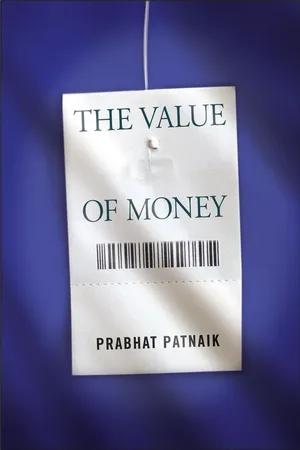
Why is money more valuable than the paper on which it is printed? Monetarists link the value of money to its supply and demand, believing the latter depends on the total value of the commodities it circulates. According to Prabhat Patnaik, this logic is flawed. In his view, in any nonbarter economy, the value we assign to money is determined independently of its supply and demand.
Through an original and provocative critique of monetarism, Patnaik advances a revolutionary understanding of macroeconomics that highlights the "propertyist" position of Karl Marx and John Maynard Keynes. Unlike the usual division between "classical" economists (e.g., David Ricardo and Marx) and the "marginalists" (e.g., Carl Menger, William Stanley Jevons, and Léon Walras), Patnaik places "monetarists," including Ricardo, on one side, while grouping propertyist writers like Marx, Keynes, and Rosa Luxemburg on the other. This second group subscribes to the idea that the value of money is given from outside the realm of supply and demand, therefore making money a form in which wealth is held. The fact that money is held as wealth in turn gives rise to the possibility of deficiency of aggregate demand under capitalism.
It is no accident that this possibility was highlighted by Marx and Keynes while going largely unrecognized by Ricardo and contemporary monetarists. At the same time, Patnaik points to a weakness in the Marx-Keynes tradition—namely, its lack of any satisfactory explanation of why the value of money, determined from outside the realm of supply and demand, remains relatively stable over long stretches of time. The answer to this question lies in the fact that capitalism is not a self-contained system but is born from a precapitalist setting with which it interacts and where it creates massive labor reserves that, in turn, impart stability to the value of money. Patnaik's theory of money, then, is also a theory of imperialism, and he concludes with a discussion of the contemporary international monetary system, which he terms the "oil-dollar" standard.
eBook - PDF
The Value of Money
About this book
Information
Subtopic
Economic HistoryIndex
HistoryTable of contents
- Table of Contents
- Preface
- Introduction
- 1. The Great Divide in Economics
- Part I. The Infirmity of Monetarism
- 2. The Monetarist Theory
- 3. Equilibrium and Historical Time
- 4. The Modus Operandi of Monetarist Theory
- 5. The Cash Transactions Approach to Monetarism
- 6. An Excursus on Rational-Expectation Equilibria
- 7. An Excursus on Methodological Individualism
- 8. An Excursus on Walrasian Equilibrium and Capitalist Production
- Part II. The Superiority of Propertyism
- 9. A Critique of Ricardo’s Theory of Money
- 10. Marx on the Value of Money
- 11. An Excursus on Marx’s Theory of Value
- 12. Marx’s Solution to a Dilemma
- 13. Alternative Interpretations of Keynes
- 14. A Digression on a Keynesian Dilemma
- 15. Marx, Keynes, and Propertyism
- Part III. The Incompleteness of Propertyism
- 16. The Incompleteness of Propertyism
- 17. A Solution to the Incompleteness
- 18. Capitalism as a Mode of Production
- 19. Money in the World Economy
- 20. Capitalism and Imperialism
- Notes
- Bibliography
- Index
Trusted by 375,005 students
Access to over 1.5 million titles for a fair monthly price.
Study more efficiently using our study tools.
Frequently asked questions
Yes, you can cancel anytime from the Subscription tab in your account settings on the Perlego website. Your subscription will stay active until the end of your current billing period. Learn how to cancel your subscription
No, books cannot be downloaded as external files, such as PDFs, for use outside of Perlego. However, you can download books within the Perlego app for offline reading on mobile or tablet. Learn how to download books offline
Perlego offers two plans: Essential and Complete
- Essential is ideal for learners and professionals who enjoy exploring a wide range of subjects. Access the Essential Library with 800,000+ trusted titles and best-sellers across business, personal growth, and the humanities. Includes unlimited reading time and Standard Read Aloud voice.
- Complete: Perfect for advanced learners and researchers needing full, unrestricted access. Unlock 1.5M+ books across hundreds of subjects, including academic and specialized titles. The Complete Plan also includes advanced features like Premium Read Aloud and Research Assistant.
We are an online textbook subscription service, where you can get access to an entire online library for less than the price of a single book per month. With over 1.5 million books across 990+ topics, we’ve got you covered! Learn about our mission
Look out for the read-aloud symbol on your next book to see if you can listen to it. The read-aloud tool reads text aloud for you, highlighting the text as it is being read. You can pause it, speed it up and slow it down. Learn more about Read Aloud
Yes! You can use the Perlego app on both iOS and Android devices to read anytime, anywhere — even offline. Perfect for commutes or when you’re on the go.
Please note we cannot support devices running on iOS 13 and Android 7 or earlier. Learn more about using the app
Please note we cannot support devices running on iOS 13 and Android 7 or earlier. Learn more about using the app
Yes, you can access The Value of Money by Prabhat Patnaik in PDF and/or ePUB format, as well as other popular books in History & Economic History. We have over 1.5 million books available in our catalogue for you to explore.