Spanning thousands of years, this new collection brings together writings and teachings about sex, marriage, and family from the Jewish, Christian, Islamic, Hindu, Buddhist, and Confucian traditions. The volume includes traditional texts as well as contemporary materials showing how the religions have responded to the changing conditions and mores of modern life. It reveals the similarities and differences among the various religions and the development of ideas and teachings within each tradition. Selections shed light on each religion's views on a range of subjects, including sexuality and sexual pleasure, the meaning and purpose of marriage, the role of betrothal, the status of women, the place of romance, grounds for divorce, celibacy, and sexual deviance.
Separate chapters devoted to each religion include introductions by leading scholars that contextualize the readings. The selections are drawn from a variety of genres including ritual, legal, theological, poetic, and mythic texts. The volume contains such diverse examples as the Zohar on conjugal manners, a contemporary Episcopalian liturgy for same-sex unions, Qur'anic passages on the equality of the sexes, the Ka–masu–tra on husbands, wives, and lovers, Buddhist writings on celibacy, and Confucian teachings on filial piety.
Contributors include: Michael S. Berger, Emory University; Azizah Y. al-Hibri, Richmond School of Law; Alan Cole, Lewis and Clark College; Paul B. Courtright, Emory University; Patricia Buckley Ebrey, University of Washington; Raja M. El-Habti, Muslim Women Lawyers for Human Rights; Luke Timothy Johnson, Emory University; Mark D. Jordan, Emory University
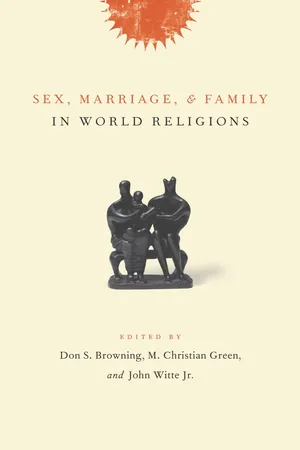
eBook - ePub
Sex, Marriage, and Family in World Religions
- English
- ePUB (mobile friendly)
- Available on iOS & Android
eBook - ePub
Sex, Marriage, and Family in World Religions
About this book
Information
Chapter 1
JUDAISM
INTRODUCTION
Judaism, like other millennia-old world religions, has within it many voices and opinions on such core human subjects as sexuality, marriage, and family. Unlike other world religions, however, Judaism has been, for most of its history, the tradition of a minority—a powerless, stateless, and oftentimes persecuted, minority. To be sure, an early period of independence, roughly coeval with the Bible, produced the literature (or its antecedents) that would become the foundational text of Judaism. But beginning with the destruction of Solomon’s Temple in 586 BCE and the consequent exile of Judeans to Babylonia and Egypt, minority status became the norm for Jews, with few exceptions, all the way up to the modern period.
This reality had a profound impact on every facet of Judaism. Survival was the constant call, and the tradition mustered all of its resources—theological, legal, social, and economic—to meet the challenge. The family was, in many cases, the primary vehicle for preserving distinctiveness from the majority culture, and so the tradition used law, custom, and lore to govern its formation and maintenance. Indeed, from the Bible forward the Jewish people is portrayed at its core as a large extended family descended from the patriarch Jacob, and from the Second Temple period forward Jews increasingly insisted on endogamy to ensure a common heritage.
Practically speaking, however, boundaries were far more permeable than was claimed; the forces preserving distinctiveness were always offset by those promoting accommodation. Jews were in regular contact with their neighbors, producing a startling array of Jewish thought and practice in all areas, including marriage and family. Indeed, some of the most significant alterations in the form and content of Jewish marriage, such as the emphasis on documents or the switch to monogamy, can be understood in this light. Therefore, the history of Jewish views on sex, marriage, and family can be most helpfully understood as the oscillation between the two poles of continuity, with the Jewish covenant on the one hand and correlation with one’s surroundings on the other.
SEX, MARRIAGE, AND FAMILY IN THE HEBREW BIBLE
While the majority of the Hebrew Bible, known as TaNaKh, recounts the period of Israelite settlement in the land of Canaan, most scholars insist that the majority of canonical texts reached their current form in the Persian period (sixth to fourth century BCE) when Jews lived as a minority population both in the province of Yehud in the Land of Israel and elsewhere in Mesopotamia and Egypt. Out of their minority perspective this collection of texts came to be the main scripture of the Jewish people because virtually all its books are about the Jewish people—or, more specifically, its covenant with God.
Given the portrayal of the Jewish people as an extended family, one might think that such a parochial story would begin with, or would quickly reach, the story of the nation’s progenitor, Abraham. However, the first eleven chapters of Genesis speak of God’s relationship with the world, beginning with the creation of a highly ordered and differentiated world. Each creature is part of a species, a group that is meant to know its place in the world and maintain its boundaries and functions. Man and woman are both informed and blessed to procreate, to “be fruitful and multiply” and assert stewardship over the created order. This state, termed “very good” in divine eyes (Gen. 1:31), is presented somewhat differently in chapter 2, which offers the creation of woman as a response to the first man’s loneliness: “Therefore a man leaves his father and mother, clings to his wife, and becomes one flesh” (Gen. 2:24). Thus, between the first two chapters, there emerges a sense that the union of man and woman was inherently good, intended since creation for the purposes of procreation and companionship (whether practical or emotional). But this idyllic state collapses as the first couple eats from forbidden fruit, with the consequence that they sense, for the first time, sexual shame (Gen. 3:7). Painful childbirth, female sexual passion, and male domination of the female are all presented as punishment for the woman’s submission to temptation and her insistence that her husband join her in the sin (Doc. 1–1).
Humanity’s decline continues until God chooses Abraham, promising him that his descendants would become abundant, great, and would receive the Land of Canaan as an inheritance (Gen. 12:1–3). This divine blessing, later symbolized through circumcision (Gen. 17), comes to be the reward of a covenant whereby Abraham’s descendants must obey God’s law as it was revealed to Moses at Sinai and during the wilderness wanderings. The people’s status as God’s “special treasure among all the nations . . . a kingdom of priests, a holy nation” (Ex. 19:5–6) is predicated on their living according to demanding standards, including a host of sexual norms (Doc. 1–2). These are deemed the idolatrous and abominable practices of the local tribes, and the Jews must maintain their purity and holiness—or suffer a similar fate of displacement and exile.
The TaNaKh’s presentation of the history of the Jewish people as that of an extended family—twelve tribes, the descendants of the sons of Jacob, settling on ancestrally allotted land—highlights the text’s assumption that the covenant is meant to be lived out in the context of large, agrarian patriarchal families, with very specific division of labor between men, women and children and traditions passed from parents to children. The consequences of this orientation for our subjects cannot be overstated, yet virtually all have a “covenantal overlay” as well. Strict rules of endogamy and exogamy, including the prohibitions against incest mentioned above, controlled marriage with the aim of producing legitimate heirs; yet the text often adds the importance of these rules in maintaining allegiance to God: alien, non-Israelite women will lead men astray (Docs. 1–3, 1–4) unless, like Ruth, they accept the God of Israel. Polygamy is allowed (concubinage seemed to be the preserve of the aristocracy) so long as primogeniture is not disrupted; yet grave spiritual dangers accompany the pursuit of women other than one’s wife, and monogamous marriage becomes the metaphor of the God-Israel covenant (Docs. 1–5 to 1–7). The ideal woman, extolled in Proverbs’ famous poem in chapter 31, is both a competent manager of the household, overseeing food and cloth production, as well as a God-fearer (Doc. 1–8). To maintain order and preserve tradition in these agrarian hierarchies, respect of parents is demanded in the Decalogue; incorrigibly disobedient children are to be publicly executed. At the same time, parents must educate children and pass on the tale of the nation’s birth and Sinaitic covenant with God, so that they may fear the Lord as well (Docs. 1–9 to 1–13).
As we enter the Persian period, during which much of the TaNaKh reached its current form, the process of marriage in particular seems to have undergone greater formalization. Based on the evidence of fragmentary papyri from Elephantine, a Jewish garrison in Egypt, we may conclude that marriage was a multistaged process: the bridegroom first asked the woman’s male guardian for the bride and then declared “she is my wife and I am her husband.” A dowry was set and a written contract was then drawn up (Doc. 1–14). This contractualizing trend in marriage would continue through the Greco-Roman period and into Rabbinic Judaism.
It is likely that over the course of the Biblical period, as Jews became a dispersed minority and came into close contact with other peoples (even in Yehud itself), greater emphasis was placed on endogamy as critical to preserving the covenant—as exemplified in the fifth-century BCE account of the expulsion of foreign women and their children by Ezra the Scribe and his renewal of the covenant with the Jews of Jerusalem (Ezra 9–10). A close connection between living the covenant and endogamous marriage, however, may not yet be inferred: the Elephantine papyri attest to exogamous marriage, so we may have here a parallel tradition to that in Jerusalem or a more exceptional situation given the lack of Jewish females in the garrison. In any event, it appears that both the more conservative agricultural society in which Jews lived and the growing sense of Jewish exclusiveness and covenantal status as they carved out a minority identity contributed to emerging Jewish attitudes towards sex, marriage, and family.
SEX, MARRIAGE, AND FAMILY IN THE INTERTESTAMENTAL PERIOD
The establishment of Alexander’s empire in the fourth century BCE brought Jews into direct and sustained contact with Hellenism, although the extent of that influence is very hard to gauge and was likely diverse across the empire. Jews generally remained in rural settings, although Jerusalem and other cities in Judea (as the Greek province was now called) grew in size and importance, and had substantial Jewish populations. During this time a substantial Jewish population lived in the “diaspora,” the world outside the land of Israel, in contact with local Gentiles and other groups created by the cosmopolitan character of Greek cities. Nevertheless, within the multiethnic environment of the Greco-Roman and Sassanian Babylonian empires, Jews shared several practices—circumcision, dietary restrictions, and Sabbath observance—that they were able to regard themselves, and be regarded by others, as a distinct people.
On the intellectual level the consequences of contact with Hellenism were felt in many circles, but most keenly among Egyptian Jewry. Philosophical ideas penetrated deeply into Jewish self-understanding, producing an entire genre of wisdom literature that emphasized virtuous conduct, including respect for one’s parents, the marriage ideal with the proper behavior of husbands and wives, sexual temperance, and the importance of educating and disciplining one’s children. The Wisdom of Ben Sira, known more commonly by its apocryphal title Ecclesiasticus, is paradigmatic of this literature (Doc. 1–15). In contrast to the covenantal context of the Biblical sources, these texts linked familiar Jewish values to wisdom as an expression of divine illumination independently worthy of human pursuit. Biblical notions of purity, including restrictions on food and sex, found natural analogues in certain Greek notions of ascetic discipline and moral wisdom and were so interpreted by Jewish philosophers such as the first-century CE Egyptian allegorist Philo of Alexandria. Such efforts were no doubt intended both to strengthen religious observances among Jews and to defend Judaism against its pagan detractors. This literature, all in Greek, entered the legacy of early Christianity, which embraced these ideas and their language of expression as its own.
On the social level, in the absence of a central institution to impose a single pattern of behavior, various types of Jewish communities evolved in this period. As we noted, common custom united “natural communities” of Jews (that is, those born to Jewish parents), who were rather open to “God-fearers” and other non-Jews participating in communal life. At the same time, “intentional Judaic communities” grew up, particularly in Judea but elsewhere as well, that had what they took to be “correct” interpretations of Jewish Scripture and stricter standards of behavior, which helped determine insiders and exclude others. These communities, such as Qumran, which we know from the Dead Sea Scrolls, saw themselves...
Table of contents
- Cover
- Half title
- Title
- Copyright
- Contents
- Preface and Acknowledgments
- About the Contributors
- Introduction
- 1. Judaism
- 2. Christianity
- 3. Islam
- 4. Hinduism
- 5. Buddhism
- 6. Confucianism
- Index
Trusted by 375,005 students
Access to over 1.5 million titles for a fair monthly price.
Study more efficiently using our study tools.
Frequently asked questions
Yes, you can cancel anytime from the Subscription tab in your account settings on the Perlego website. Your subscription will stay active until the end of your current billing period. Learn how to cancel your subscription
No, books cannot be downloaded as external files, such as PDFs, for use outside of Perlego. However, you can download books within the Perlego app for offline reading on mobile or tablet. Learn how to download books offline
Perlego offers two plans: Essential and Complete
- Essential is ideal for learners and professionals who enjoy exploring a wide range of subjects. Access the Essential Library with 800,000+ trusted titles and best-sellers across business, personal growth, and the humanities. Includes unlimited reading time and Standard Read Aloud voice.
- Complete: Perfect for advanced learners and researchers needing full, unrestricted access. Unlock 1.5M+ books across hundreds of subjects, including academic and specialized titles. The Complete Plan also includes advanced features like Premium Read Aloud and Research Assistant.
We are an online textbook subscription service, where you can get access to an entire online library for less than the price of a single book per month. With over 1.5 million books across 990+ topics, we’ve got you covered! Learn about our mission
Look out for the read-aloud symbol on your next book to see if you can listen to it. The read-aloud tool reads text aloud for you, highlighting the text as it is being read. You can pause it, speed it up and slow it down. Learn more about Read Aloud
Yes! You can use the Perlego app on both iOS and Android devices to read anytime, anywhere — even offline. Perfect for commutes or when you’re on the go.
Please note we cannot support devices running on iOS 13 and Android 7 or earlier. Learn more about using the app
Please note we cannot support devices running on iOS 13 and Android 7 or earlier. Learn more about using the app
Yes, you can access Sex, Marriage, and Family in World Religions by Don S. Browning,M. Christian Green,John Witte Jr., Don Browning, M. Christian Green, John Witte Jr. in PDF and/or ePUB format, as well as other popular books in Teología y religión & Sexualidad y género en la religión. We have over 1.5 million books available in our catalogue for you to explore.