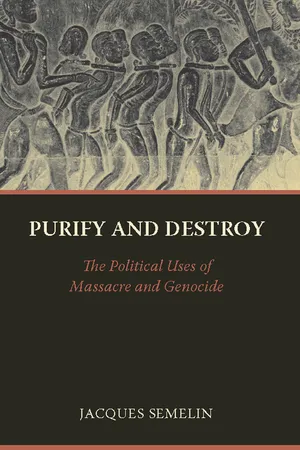
How can we comprehend the sociopolitical processes that give rise to extreme violence, ethnic cleansing, or genocide? A major breakthrough in comparative analysis, Purify and Destroy demonstrates that it is indeed possible to compare the Holocaust, the Rwandan genocide, and ethnic cleansing in Bosnia-Herzegovina while respecting the specificities of each appalling phenomenon. Jacques Semelin achieves this, in part, by leading his readers through the three examples simultaneously, the unraveling of which sometimes converges but most often diverges.
Semelin's method is multidisciplinary, relying not only on contemporary history but also on social psychology and political science. Based on the seminal distinction between massacre and genocide, Purify and Destroy identifies the main steps of a general process of destruction, both rational and irrational, born of what Semelin terms "delusional rationality." He describes a dynamic structural model with, at its core, the matrix of a social imaginaire that, responding to fears, resentments, and utopias, carves and recarves the social body by eliminating "the enemy." Semelin identifies the main stages that can lead to a genocidal process and explains how ordinary people can become perpetrators. He develops an intellectual framework to analyze the entire spectrum of mass violence, including terrorism, in the twentieth century and before. Strongly critical of today's political instrumentalization of the "genocide" notion, Semelin urges genocide research to stand back from legal and normative definitions and come of age as a discipline in its own right in the social sciences.
- 461 pages
- English
- PDF
- Available on iOS & Android
eBook - PDF
About this book
Trusted by 375,005 students
Access to over 1.5 million titles for a fair monthly price.
Study more efficiently using our study tools.
Information
Subtopic
Criminal LawIndex
Social SciencesTable of contents
- Contents
- Foreword by Stanley Hoffmann
- Acknowledgements
- Introduction: Understand?
- I. The Imaginary Constructs of Social Destructiveness
- II. From Inflammatory Discourse to Sacrificial Violence
- III. International Context, War and the Media
- IV. The Dynamics of Mass Murder
- V. The Vertigo of Impunity
- VI. The Political Uses of Massacre and Genocide
- Conclusion: The ‘Never Again’ refrain
- Appendixes
- Bibliography
- Notes
- Name Index
- Subject Index
Frequently asked questions
Yes, you can cancel anytime from the Subscription tab in your account settings on the Perlego website. Your subscription will stay active until the end of your current billing period. Learn how to cancel your subscription
No, books cannot be downloaded as external files, such as PDFs, for use outside of Perlego. However, you can download books within the Perlego app for offline reading on mobile or tablet. Learn how to download books offline
Perlego offers two plans: Essential and Complete
- Essential is ideal for learners and professionals who enjoy exploring a wide range of subjects. Access the Essential Library with 800,000+ trusted titles and best-sellers across business, personal growth, and the humanities. Includes unlimited reading time and Standard Read Aloud voice.
- Complete: Perfect for advanced learners and researchers needing full, unrestricted access. Unlock 1.5M+ books across hundreds of subjects, including academic and specialized titles. The Complete Plan also includes advanced features like Premium Read Aloud and Research Assistant.
We are an online textbook subscription service, where you can get access to an entire online library for less than the price of a single book per month. With over 1.5 million books across 990+ topics, we’ve got you covered! Learn about our mission
Look out for the read-aloud symbol on your next book to see if you can listen to it. The read-aloud tool reads text aloud for you, highlighting the text as it is being read. You can pause it, speed it up and slow it down. Learn more about Read Aloud
Yes! You can use the Perlego app on both iOS and Android devices to read anytime, anywhere — even offline. Perfect for commutes or when you’re on the go.
Please note we cannot support devices running on iOS 13 and Android 7 or earlier. Learn more about using the app
Please note we cannot support devices running on iOS 13 and Android 7 or earlier. Learn more about using the app
Yes, you can access Purify and Destroy by Jacques Semelin in PDF and/or ePUB format, as well as other popular books in Social Sciences & Criminal Law. We have over 1.5 million books available in our catalogue for you to explore.