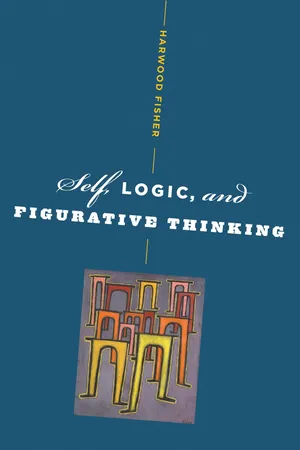
Harwood Fisher argues against neuroscientific and cognitive scientific explanations of mental states, for they fail to account for the gaps between actions in the brain, cognitive operations, linguistic mapping, and an individual's account of experience. Fisher probes a rich array of thought from the primitive and the dream to the artistic figure of speech, and extending to the scientific metaphor. He draws on first-person methodologies to restore the conscious self to a primary function in the generation of figurative thinking.
How does the individual originate and organize terms and ideas? How can we differentiate between different types of thought and account for their origins? Fisher depicts the self as mediator between trope and logical form. Conversely, he explicates the creation and articulation of the self through interplay between logic and icon. Fisher explains how the "I" can step out of scripted roles. The self is neither a discursive agent of postmodern linguistics nor a socially determined entity. Rather, it is a historically situated, dynamically constituted place at the crossroads of conscious agency and unconscious actions and evolving contextual logics and figures.
- 369 pages
- English
- PDF
- Available on iOS & Android
eBook - PDF
Self, Logic, and Figurative Thinking
About this book
Information
Topic
Scienze biologicheSubtopic
LinguisticaTable of contents
- Table of Contents
- Preface
- Introduction: Major Terms, Their Classification, and Their Relation to the Book's Objective
- 1. The Problem of Analogous Forms
- 2. Natural Logic, Categories, and the Individual
- 3. Shift to Individual Categories, Dynamics, and a Psychological Look at Identity
- 4. Form Versus Function
- 5. What Is the Difference Between the Logic Governing a Figure of Speech and the Logic That Is Immature or Unconscious?
- 6. What Are the Role and Function of the Self Vis-à-vis Consciousness?
- 7. Development in the Logic from Immature to Mature Modes
- 8. Pathological and Defensive Logical Forms
- 9. The "I," Identity, and the Part-Whole Resolutions
- 10. The "I," Entropy, and the Trope
- Notes
- References
- Acknowledgments
- Index
Trusted by 375,005 students
Access to over 1.5 million titles for a fair monthly price.
Study more efficiently using our study tools.
Frequently asked questions
Yes, you can cancel anytime from the Subscription tab in your account settings on the Perlego website. Your subscription will stay active until the end of your current billing period. Learn how to cancel your subscription
No, books cannot be downloaded as external files, such as PDFs, for use outside of Perlego. However, you can download books within the Perlego app for offline reading on mobile or tablet. Learn how to download books offline
Perlego offers two plans: Essential and Complete
- Essential is ideal for learners and professionals who enjoy exploring a wide range of subjects. Access the Essential Library with 800,000+ trusted titles and best-sellers across business, personal growth, and the humanities. Includes unlimited reading time and Standard Read Aloud voice.
- Complete: Perfect for advanced learners and researchers needing full, unrestricted access. Unlock 1.5M+ books across hundreds of subjects, including academic and specialized titles. The Complete Plan also includes advanced features like Premium Read Aloud and Research Assistant.
We are an online textbook subscription service, where you can get access to an entire online library for less than the price of a single book per month. With over 1.5 million books across 990+ topics, we’ve got you covered! Learn about our mission
Look out for the read-aloud symbol on your next book to see if you can listen to it. The read-aloud tool reads text aloud for you, highlighting the text as it is being read. You can pause it, speed it up and slow it down. Learn more about Read Aloud
Yes! You can use the Perlego app on both iOS and Android devices to read anytime, anywhere — even offline. Perfect for commutes or when you’re on the go.
Please note we cannot support devices running on iOS 13 and Android 7 or earlier. Learn more about using the app
Please note we cannot support devices running on iOS 13 and Android 7 or earlier. Learn more about using the app
Yes, you can access Self, Logic, and Figurative Thinking by Harwood Fisher in PDF and/or ePUB format, as well as other popular books in Scienze biologiche & Linguistica. We have over 1.5 million books available in our catalogue for you to explore.