Booker T. Washington has long held an ambiguous position in the pantheon of black leadership. Lauded by some in his own lifetime as a black George Washington, he was also derided by others as a Benedict Arnold. In The Education of Booker T. Washington, Michael West offers a major reinterpretation of one of the most complex and controversial figures in American history. West reveals the personal and political dimensions of Washington's journey "up from slavery." He explains why Washington's ideas resonated so strongly in the post-Reconstruction era and considers their often negative influence in the continuing struggle for equality in the United States. West's work also establishes a groundwork for understanding the ideological origins of the civil rights movement and discusses Washington's views on the fate of race and nation in light of those of Thomas Jefferson, Frederick Douglass, Martin Luther King Jr., and others.
West argues that Washington's analysis was seen as offering a "solution" to the problem of racial oppression in a nation professing its belief in democracy. That solution was the idea of "race relations." In practice, this theory buttressed segregation by supposing that African Americans could prosper within Jim Crow's walls and without the normal levers by which other Americans pursued their interests. Washington did not, West contends, imagine a way to perfect democracy and an end to the segregationist policies of southern states. Instead, he offered an ideology that would obscure the injustices of segregation and preserve some measure of racial peace.
White Americans, by embracing Washington's views, could comfortably find a way out of the moral and political contradictions raised by the existence of segregation in a supposedly democratic society. This was (and is) Washington's legacy: a form of analysis, at once obvious and concealed, that continues to prohibit the realization of a truly democratic politics.
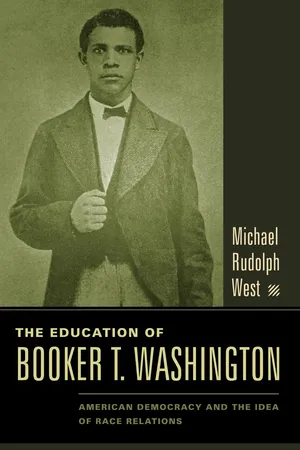
eBook - PDF
The Education of Booker T. Washington
American Democracy and the Idea of Race Relations
- 296 pages
- English
- PDF
- Available on iOS & Android
eBook - PDF
The Education of Booker T. Washington
American Democracy and the Idea of Race Relations
About this book
Information
Topic
GeschichteSubtopic
BildungsbiographienTable of contents
- Table of Contents
- Preface
- Introduction
- 1. “The Great and Intricate Problem”: Democracy, the Negro Problem, and the Idea of Race Relations
- 2. “Negroes Whose Habits You Know”: The Boy, “Booker,” Progress, and “Racial Feeling”
- 3. “They Will Pull Against You the Load Downward”: The Freedpeople’s Failure and Booker Washington’s Rescue
- 4. “Gathered from Miscellaneous Sources”: Democratic Possibilities and Other Kinds of “Racial Feelings”
- 5. “Prepared for the Exercise of These Privileges”: A New Negro and the End of Democracy
- Notes
- Index
Trusted by 375,005 students
Access to over 1.5 million titles for a fair monthly price.
Study more efficiently using our study tools.
Frequently asked questions
Yes, you can cancel anytime from the Subscription tab in your account settings on the Perlego website. Your subscription will stay active until the end of your current billing period. Learn how to cancel your subscription
No, books cannot be downloaded as external files, such as PDFs, for use outside of Perlego. However, you can download books within the Perlego app for offline reading on mobile or tablet. Learn how to download books offline
Perlego offers two plans: Essential and Complete
- Essential is ideal for learners and professionals who enjoy exploring a wide range of subjects. Access the Essential Library with 800,000+ trusted titles and best-sellers across business, personal growth, and the humanities. Includes unlimited reading time and Standard Read Aloud voice.
- Complete: Perfect for advanced learners and researchers needing full, unrestricted access. Unlock 1.5M+ books across hundreds of subjects, including academic and specialized titles. The Complete Plan also includes advanced features like Premium Read Aloud and Research Assistant.
We are an online textbook subscription service, where you can get access to an entire online library for less than the price of a single book per month. With over 1.5 million books across 990+ topics, we’ve got you covered! Learn about our mission
Look out for the read-aloud symbol on your next book to see if you can listen to it. The read-aloud tool reads text aloud for you, highlighting the text as it is being read. You can pause it, speed it up and slow it down. Learn more about Read Aloud
Yes! You can use the Perlego app on both iOS and Android devices to read anytime, anywhere — even offline. Perfect for commutes or when you’re on the go.
Please note we cannot support devices running on iOS 13 and Android 7 or earlier. Learn more about using the app
Please note we cannot support devices running on iOS 13 and Android 7 or earlier. Learn more about using the app
Yes, you can access The Education of Booker T. Washington by Michael Rudolph West in PDF and/or ePUB format, as well as other popular books in Geschichte & Bildungsbiographien. We have over 1.5 million books available in our catalogue for you to explore.