China and South Korea have come a long way since they were adversaries. The arc of their relationship since the late 1970s is an excellent model of East-West cooperation and, at the same time, highlights the growing impact of China's "rise" over its regional neighbors, including America's close allies.
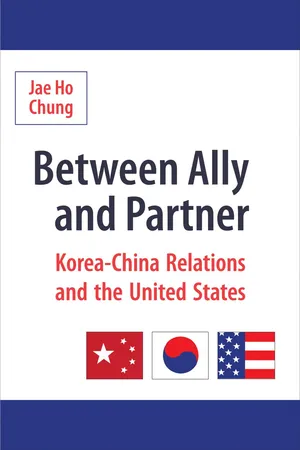
South Korea-China relations have rarely been studied as an independent theme. The accumulation of more than fifteen years of research, Between Ally and Partner reconstructs a comprehensive portrait of Sino-Korean rapprochement and examines the strategic dilemma that the rise of China has posed for South Korea and its alliance with the United States. Jae Ho Chung makes use of declassified government archives, internal reports, and opinion surveys and conducts personal interviews with Korean, Chinese, and American officials. He tackles three questions: Why did South Korea and China reconcile before the end of the cold war? How did rapprochement lay the groundwork for diplomatic normalization? And what will the intersection of security concerns and economic necessity with China mean for South Korea's relationship with its close ally, the United States?
The implications of Sino-Korean relations go far beyond the Korean Peninsula. South Korea was caught largely unprepared, both strategically and psychologically, by China's rise, and the dilemma that South Korea now faces has crucial ramifications for many countries in Asia, where attempts to counterbalance China have been rare. Thoroughly investigated and clearly presented, this book answers critical questions concerning what kept these two countries talking and how enmity was transformed into a zeal for partnership.
- English
- ePUB (mobile friendly)
- Available on iOS & Android
eBook - ePub
About this book
Trusted by 375,005 students
Access to over 1.5 million titles for a fair monthly price.
Study more efficiently using our study tools.
Information
Subtopic
Asian History1
The Rise of Korea-China Relations and the United States
Throughout the summer of 2002, news media in the Republic of Korea (hereafter South Korea) flooded the country with numerous reports and articles on “China fever,” commemorating the tenth anniversary of the normalization of relations between South Korea and the People’s Republic of China (hereafter China). Seoul’s diplomatic circles held lavish receptions, and academic conferences were convened to put this historic event in perspective. At about the same time, South Korea–U.S. relations plummeted to a record low: two schoolgirls were run over by a U.S. army vehicle, which led to candlelight anti-American demonstrations throughout the country. These starkly contrasting themes, that of China fever and of increasing anti-American sentiment, foretold a daunting strategic dilemma that Seoul would soon be facing.
The “rise” of China is already a phenomenon of global interest and import. And the pace at which China has increased its cooperation with Asia at large is beyond anyone’s best guess.1 The enormous amount of bilateral trade, investment, tourism, and educational exchanges highlight—but at the same time understate—the “comprehensive cooperative partnership for the twenty-first century” (mianxiang ershiyi shiji de quanmian hezuoxing huoban guanxi) forged between China and South Korea in particular.2 The relationship between Seoul and Beijing has come a long way in the last few decades, from adversaries to cooperative partners.
When South Korea and China normalized diplomatic relations on August 24, 1992, more than four decades after the outbreak of the Korean War, it was seen by many as the accomplishment of something nearly inconceivable, if not impossible. In retrospect, however, the historic event was the natural culmination of what had been going on between Seoul and Beijing since the late 1970s. In Europe, the end of the cold war was heralded by the reunification of Germany and the demise of state socialism in Eastern Europe; its East Asian counterpart was South Korea’s normalizing its diplomatic ties with the Soviet Union and China. The remarkable success of nordpolitik, as it was then called, was also projected to lead to a thaw in relations between the Democratic People’s Republic of Korea (hereafter, North Korea), on the one hand, and Japan and the United States, on the other.
South Korea’s “northern diplomacy” in general and engagement with China in particular were no doubt a great success. But the “rise” of China came so suddenly that South Korea was not quite aware of or fully prepared for what was coming. In fact, Seoul had never thought that the very success of its full engagement with China would come back to haunt it as a strategic dilemma. At that point, neither the United States nor Japan fully comprehended the crucial ramifications of the Sino–South Korean normalization of relations and their postnormalization improvements.
This book tackles three questions related to the rise of China over South Korea. The first concerns why South Korea and China came to accommodate each other by ending their adversarial relationship even before the end of the cold war. The second relates to how the political economy of Sino–South Korean rapprochement laid the ground for diplomatic normalization and the “comprehensive cooperative partnership” between the two nations. The final question deals with what sort of strategic dilemma is posed for South Korea and its alliance with the United States, given South Korea’s ever-expanding ties with China.
The book posits the following arguments: While, due to high levels of secrecy, we knew little about the two decades of prenormalization relations between Beijing and Seoul, the actual story reveals more and earlier progress in relations. While both realism (strategic considerations) and liberalism (economic interests) were important, the coincidence of domestic interests, the artificial nature of ninety-seven years of separation, and favorable perceptual undercurrents generated the specific context for Sino–South Korean rapprochement. The lack of attention to noneconomic dimensions of relations since 1992 has left South Korea—and the United States, for that matter—unprepared for the strength of South Korea–China relations and the challenges they pose. Given the premise that it is in Seoul’s best interest to be on good terms with both Washington and Beijing, South Korea must walk a tightrope between China and the United States.
The “Rise” of China and Its Impact on Neighbors
China is indeed rising at a very rapid pace. Although the rise is at least the fourth of its kind—after that of the Han, Tang, and Qing—its effects this time around seem bigger than ever.3 The rise of China—and the success of its reforms—can be substantiated by several key indicators. With the annual growth rate of over 9 percent for the last quarter century, China’s economy became the fourth largest in terms of gross national product in 2005. In 2004, China also became the world’s third-largest trading nation, after the United States and Germany. In terms of foreign-currency reserves, in 2005, China ranked first. China is also the world’s largest consumer of raw materials and is the top producer of steel, coal, chemical fertilizer, televisions, air conditioners, and telephones.4
Economics is not the only realm where China’s rapidly growing presence is felt. Correctly or not, China is viewed as a rising challenger to the U.S.-centered international order. If Mearsheimer is correct in saying that “great powers fear each other…. They regard each other with suspicion, and they worry that war might be in the offing,” the United States is increasingly concerned about the rise of China and its adverse effects on America’s regional posture in Asia.5 Various policy announcements of the U.S. government are indicative of such perceptions and, in some cases, China is already seen as America’s “regional peer competitor” in East Asia.6
In the context of Asia, China’s diplomacy has been particularly proactive. Since the early 1990s, despite the tenet of “maintaining a low profile while waiting for the right time to surge” (taoguang yanghui), China’s dealings with Asia changed significantly. Under the new framework of “good neighborly policy” (mulin youhao zhengce), Beijing has actively sought cooperation with its Asian neighbors. China has become a strong voice in the ASEAN Plus Three, founded the Shanghai Cooperation Organization, laid the groundwork for the Six-Party Talks, and forged a strategic partnership with India.7
The process of China becoming a “great power” in Asia will most likely confront America’s desire to retain its hegemonic influence in the region.8 Given that America’s dealings with the region have been predominantly dyadic in nature, Beijing’s recent, more direct links with Washington—thanks to the contraction of Moscow’s influence—has much potential for friction. China’s proactive diplomacy toward Asia could simply be its standard policy of peripheral control. Yet these policies might be interpreted and taken otherwise by the United States.9 For the countries in the region, most of which wish to sustain good relations with both the United States and China, these potentials for conflict generate a serious strategic dilemma.
Other opinions argue that Sino-American confrontation in Asia is not predestined. Some suggest that China’s mode of engaging with Asia is sophisticated enough to dispel the prospect of a confrontation with the United States.10 Others believe China’s rise will not be able to replace the United States in Asia and therefore the “imminent-confrontation thesis” is faulty.11 Still others contend that Asia will not be reduced to a mere chessboard for the United States, as its nations will never choose to balance against China.12
One thing is clear, however. As China’s economic prowess grows over time, national security and economic logic in Asia will become increasingly complicated and multivalent, weakening America’s predominant position.13 In the face of such a change in the regional balance of influence, different countries are bound to respond differently. Overall, Asia has thus far seen very few acts of explicit positioning against China.14 While engagement has been the principal modus operandi, some variations are nevertheless discernible. Japan, Taiwan, India, and Mongolia are certainly on the side of guarded suspicion, if not tacit containment. Australia, Indonesia, the Philippines, Thailand, and Singapore appear to prefer hedging their bets. Myanmar and Malaysia welcome China’s rise and seek to capitalize on it.15 Briefly put, while there is no uniform answer to the question of what to do with China, the emergence of China as a great power undoubtedly poses a serious question to its neighbors.
Such dilemmas are perhaps more acute with regard to the countries that maintain formal security ties with the United States, most notably South Korea and Japan. Unlike Tokyo, which has explicitly chosen to stand by Washington by designating Beijing as a potential security threat, Seoul’s stance is still up in the air.16 South Korea–China rapprochement and their rapidly expanding cooperative partnership on virtually all fronts have not only become another main pillar of Seoul’s diplomacy but have also introduced an additional key variable to the “Korean equation.” Added to that is America’s global strategic reconfiguration after the events of September 11, 2001, which inevitably affects the U.S.–South Korea alliance. Given the complexities involved with Seoul’s efforts to strike a balance between Washington and Beijing, South Korea is not alone in needing to ponder the magnitude of the challenges posed by the rise of China.
From Confrontation to Cooperation: The Case of South Korea–China Relations
The rapprochement and normalization of relations between China and South Korea denotes more than improved bilateral ties between the two countries. The highly clandestine process in which the rapprochement was initiated and matured into diplomatic normalization represents a remarkable model of East-West cooperation—both economic and otherwise—blocked for so long by elements of the cold war regime, such as the Coordinating Committee for Multilateral Export Controls (COCOM).17 The post–cold war mitigation of ideological frictions and military confrontations paved the way for genuine cooperation between the East and West in general and between China and South Korea in particular.18 In the long run, understanding the politics of East-West rapprochement may also hold crucial implications for the strategies of cooperative engagement vis-à-vis the so-called rogue states and failed states.19
The war on terrorism notwithstanding, the primacy of economics and pragmatism appears to remain intact.20 The “end of ideology”—and of the cold war—has provided fertile soil for extensive cooperation in various issues and areas, by actors hitherto almost inconceivable.21 The burgeoning of Seoul-Beijing bilateralism has effectively demonstrated the powerful nexus of pragmatism that can link two states with mutually incompatible ideologies. For example, domestic reforms of the socialist state China have precipitated fundamental changes in its foreign-policy behavior, especially regarding South Korea, thereby leading to cooperative ties between the two.22 Equally important was the presence of the capitalist powerhouse of South Korea, willing and eager to capitalize on the window of opportunity created by its socialist neighbor.
South Korea–China ties have also become an important cornerstone of regional cooperation in East Asia. Such institutional frameworks and ideas as the ASEAN Plus Three, the “Greater China,” and a free-trade area encompassing China, Japan, and South Korea were no doubt extensions of this newly emerging logic of regional cooperation.23 Given that the lack of Northeast Asian regionalism or regional identity is attributed in significant part to the prevailing bilateral distrust in the region, the case of Sino–South Korean rapprochement offers an interesting exception.24
In a similar vein, Sino–South Korean cooperation holds a key to the so-called Korean problem. By virtue of history, geopolitics, and of having participated in the Korean War and signing the Armistice Agreement, China has been a principal actor and mediator in the politics of inter-Korean relations. While the ultimate key to reunification lies in the hands of the Korean people, China’s role is crucial, as it has considerably expanded its diplomatic responsibilities, putting it on a par with the United States, as far as the Korean Peninsula is concerned.25
China’s role has been further accentuated with the normalization of relations with South Korea, particularly considering that the United States and Japan have yet to improve their relations with North Korea.26 Both the formal and informal influence that Beijing can wield over Pyongyang—and increasingly over Seoul as well—is a valuable asset. The Sino–South Korean normalization has thus added a crucial edge to China’s overall influence on the Korean Peninsula, particularly compared to—if not at the expense of—that of the United States, Russia, or Japan.27 Of course, China’s desire to maintain amicable and beneficial relationships with both Koreas have often presented intricate dilemmas for Beijing as well.28
As Sino–South Korean relations are gradually moving beyond the realm of economic cooperation and more toward diplomatic and security coordination, a new variable has been added to Northeast Asia’s already complex strategic equation....
Table of contents
- Cover
- Half title
- Title
- Copyright
- Dedication
- Contents
- List of Tables
- Preface
- 1. The Rise of Korea-China Relations and the United States
- 2. A Sketch of Sino-Korean Relations
- 3. Perspectives on the Origins of the South Korea–China Rapprochement
- 4. South Korea–China Relations Before 1988
- 5. The Political Economy of Rapprochement, 1988–1992
- 6. The Politics of Normalization: Actors, Processes, and Issues
- 7. Beyond Normalization: South Korea and China in the Post–Cold War Era
- 8. The Rise of China and the U.S.–South Korean Alliance Under Strain
- 9. Between Dragon and Eagle: Korea at the Crossroads
- Notes
- Index
Frequently asked questions
Yes, you can cancel anytime from the Subscription tab in your account settings on the Perlego website. Your subscription will stay active until the end of your current billing period. Learn how to cancel your subscription
No, books cannot be downloaded as external files, such as PDFs, for use outside of Perlego. However, you can download books within the Perlego app for offline reading on mobile or tablet. Learn how to download books offline
Perlego offers two plans: Essential and Complete
- Essential is ideal for learners and professionals who enjoy exploring a wide range of subjects. Access the Essential Library with 800,000+ trusted titles and best-sellers across business, personal growth, and the humanities. Includes unlimited reading time and Standard Read Aloud voice.
- Complete: Perfect for advanced learners and researchers needing full, unrestricted access. Unlock 1.5M+ books across hundreds of subjects, including academic and specialized titles. The Complete Plan also includes advanced features like Premium Read Aloud and Research Assistant.
We are an online textbook subscription service, where you can get access to an entire online library for less than the price of a single book per month. With over 1.5 million books across 990+ topics, we’ve got you covered! Learn about our mission
Look out for the read-aloud symbol on your next book to see if you can listen to it. The read-aloud tool reads text aloud for you, highlighting the text as it is being read. You can pause it, speed it up and slow it down. Learn more about Read Aloud
Yes! You can use the Perlego app on both iOS and Android devices to read anytime, anywhere — even offline. Perfect for commutes or when you’re on the go.
Please note we cannot support devices running on iOS 13 and Android 7 or earlier. Learn more about using the app
Please note we cannot support devices running on iOS 13 and Android 7 or earlier. Learn more about using the app
Yes, you can access Between Ally and Partner by Jae Ho Chung in PDF and/or ePUB format, as well as other popular books in Politics & International Relations & Asian History. We have over 1.5 million books available in our catalogue for you to explore.