Our self-conception derives mostly from our own experience. We believe ourselves to be conscious, rational, social, ethical, language-using, political agents who possess free will. Yet we know we exist in a universe that consists of mindless, meaningless, unfree, nonrational, brute physical particles. How can we resolve the conflict between these two visions?
In Freedom and Neurobiology, the philosopher John Searle discusses the possibility of free will within the context of contemporary neurobiology. He begins by explaining the relationship between human reality and the more fundamental reality as described by physics and chemistry. Then he proposes a neurobiological resolution to the problem by demonstrating how various conceptions of free will have different consequences for the neurobiology of consciousness.
In the second half of the book, Searle applies his theory of social reality to the problem of political power, explaining the role of language in the formation of our political reality. The institutional structures that organize, empower, and regulate our lives-money, property, marriage, government-consist in the assignment and collective acceptance of certain statuses to objects and people. Whether it is the president of the United States, a twenty-dollar bill, or private property, these entities perform functions as determined by their status in our institutional reality. Searle focuses on the political powers that exist within these systems of status functions and the way in which language constitutes them.
Searle argues that consciousness and rationality are crucial to our existence and that they are the result of the biological evolution of our species. He addresses the problem of free will within the context of a neurobiological conception of consciousness and rationality, and he addresses the problem of political power within the context of this analysis.
A clear and concise contribution to the free-will debate and the study of cognition, Freedom and Neurobiology is essential reading for students and scholars of the philosophy of mind.
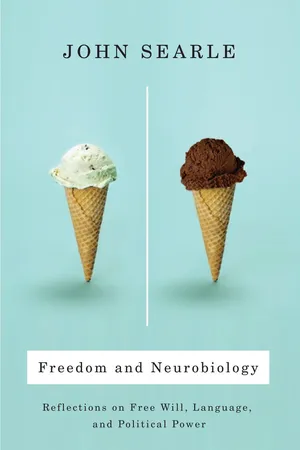
eBook - ePub
Freedom and Neurobiology
Reflections on Free Will, Language, and Political Power
- English
- ePUB (mobile friendly)
- Available on iOS & Android
eBook - ePub
About this book
Trusted by 375,005 students
Access to over 1.5 million titles for a fair monthly price.
Study more efficiently using our study tools.
Information
Topic
PhilosophySubtopic
Philosophy History & TheoryCHAPTER ONE
Free Will as a Problem in Neurobiology1
I. The Problem of Free Will
The persistence of the traditional free will problem in philosophy seems to me something of a scandal. After all these centuries of writing about free will, it does not seem to me that we have made very much progress. Is there some conceptual problem that we are unable to overcome? Is there some fact that we have simply ignored? Why is it that we have made so little advance over our philosophical ancestors?
Typically, when we encounter one of these problems that seems insoluble it has a certain logical form. On the one hand we have a belief or a set of beliefs that we feel we really cannot give up, but on the other hand, we have another belief or set of beliefs that is inconsistent with the first set, and seems just as compelling as the first set. So, for example, in the old mind-body problem we have the belief that the world consists entirely of material particles in fields of force, but at the same time the world seems to contain consciousness, an immaterial phenomenon; and we cannot see how to put the immaterial together with the material into a coherent picture of the universe. In the old problem of skeptical epistemology, it seems, on the one hand, according to common sense, that we do have certain knowledge of many things in the world, and yet, on the other hand, if we really have such knowledge, we ought to be able to give a decisive answer to the skeptical arguments, such as, How do we know we are not dreaming, are not a brain in a vat, are not being deceived by evil demons, etc.? But we do not know how to give a conclusive answer to these skeptical challenges. In the case of free will the problem is that we think explanations of natural phenomena should be completely deterministic. The explanation of the Loma Prieta earthquake, for example, does not explain why it just happened to occur, it explains why it had to occur. Given the forces operating on the tectonic plates, there was no other possibility. But at the same time, when it comes to explaining a certain class of human behavior, it seems that we typically have the experience of acting “freely” or “voluntarily” in a sense of these words that makes it impossible to have deterministic explanations. For example, it seems that when I voted for a particular candidate and did so for a certain reason, well, all the same, I could have voted for the other candidate all other conditions remaining the same. Given the causes operating on me, I did not have to vote for that candidate. So when I cite the reason as an explanation of my action I am not citing causally sufficient conditions. So we seem to have a contradiction. On the one hand we have the experience of freedom, and on the other hand we find it very hard to give up the view that because every event has a cause, and human actions are events, they must have sufficient causal explanations as much as earthquakes or rain storms.
When we at last overcome one of these intractable problems it often happens that we do so by showing that we had made a false presupposition. In the case of the mind-body problem, we had, I believe, a false presupposition in the very terminology in which we stated the problem. The terminology of mental and physical, of materialism and dualism, of spirit and flesh, contains a false presupposition that these must name mutually exclusive categories of reality—that our conscious states qua subjective, private, qualitative, etc. cannot be ordinary physical, biological features of our brain. Once we overcome that presupposition, the presupposition that the mental and the physical naively construed are mutually exclusive, then it seems to me we have a solution to the traditional mind-body problem. And here it is: All of our mental states are caused by neurobiological processes in the brain, and they are themselves realized in the brain as its higher-level or system features. So, for example, if you have a pain, your pain is caused by sequences of neuron firings, and the actual realization of the pain experience is in the brain.2
The solution to the philosophical mind-body problem seems to me not very difficult. However, the philosophical solution kicks the problem upstairs to neurobiology, where it leaves us with a very difficult neurobiological problem. How exactly does the brain do it, and how exactly are conscious states realized in the brain? What exactly are the neuronal processes that cause our conscious experiences, and how exactly are these conscious experiences realized in brain structures?
Perhaps we can make a similar transformation of the problem of free will. Perhaps if we analyze the problem sufficiently, and remove various philosophical confusions, we can see that the remaining problem is essentially a problem about how the brain works. In order to work toward that objective I need first to clarify a number of philosophical issues.
Let us begin by asking why we find the conviction of our own free will so difficult to abandon. I believe that this conviction arises from some pervasive features of conscious experience. If you consider ordinary conscious activities such as ordering a beer in a pub, watching a movie, or trying to do your income tax, you discover that there is a striking difference between the passive character of perceptual consciousness and the active character of what we might call “volitional consciousness”. For example, if I am standing in a park looking at a tree, there is a sense in which it is not up to me what I experience. It is up to how the world is and how my perceptual apparatus is. But if I decide to walk away or raise my arm or scratch my head, then I find a feature of my experiences of free, voluntary actions that was not present in my perceptions. The feature is that I do not sense the antecedent causes of my action in the form of reasons, such as beliefs and desires, as setting causally sufficient conditions for the action; and, which is another way of saying the same thing, I sense alternative courses of action open to me.
You see this strikingly if you consider cases of rational decision making. I recently had to decide which candidate to vote for in a presidential election. Suppose, for the sake of argument, that I voted for George W. Bush. I had certain reasons for voting for Bush, and certain other reasons for not voting for Bush. But, interestingly, when I chose to vote for Bush on the basis of some of those reasons and not others, and later when I actually cast a vote for Bush in a voting booth, I did not sense the antecedent causes of my action as setting causally sufficient conditions. I did not sense the reasons for making the decision as causally sufficient to force the decision, and I did not sense the decision itself as causally sufficient to force the action. In typical cases of deliberating and acting, there is, in short, a gap, or a series of gaps, between the causes of each stage in the processes of deliberating, deciding and acting, and the subsequent stages. If we probe more deeply we can see that the gap can be divided into different sorts of segments. There is a gap between the reasons for the decision and the making of the decision. There is a gap between the decision and the onset of the action, and for any extended action, such as when I am trying to learn German or to swim the English Channel, there is a gap between the onset of the action and its continuation to completion. In this respect, voluntary actions are quite different from perceptions. There is indeed a voluntaristic element in perception. I can, for example, choose to see the ambiguous figure either as a duck or a rabbit, but for the most part my perceptual experiences are causally fixed. That is why we have a problem of the freedom of the will, but we do not have a problem of the freedom of perception. The gap, as I have described it, is a feature of our conscious, voluntary activities. At each stage, the conscious states are not experienced as sufficient to compel the next conscious state. There is thus only one continuous experience of the gap, but we can divide it into three different sorts of manifestations, as I did above. The gap is between one conscious state and the next, not between conscious states and bodily movements or between physical stimuli and conscious states.
This experience of free will is very compelling, and even those of us who think it is an illusion find that we cannot in practice act on the presupposition that it is an illusion. On the contrary, we have to act on the presupposition of freedom. Imagine that you are in a restaurant and you are given a choice between veal and pork, and you have to make up your mind. You cannot refuse to exercise free will in such a case, because the refusal itself is only intelligible to you as a refusal if you take it as an exercise of free will. So if you say to the waiter, “Look, I am a determinist—che sarà sarà, I’ll just wait and see what I order,” that refusal to exercise free will is only intelligible to you as one of your actions if you take it to be an exercise of your free will. Kant pointed this out a long time ago. We cannot think away our free will. The conscious experiences of the gap give us the conviction of human freedom.
If we now turn to the opposing view and ask why we are so convinced of determinism, the arguments for determinism seem just as compelling as the arguments for free will. A basic feature of our relation to the world is that we find the world causally ordered. Natural phenomena in the world have causal explanations, and those causal explanations state causally sufficient conditions. Customarily, in philosophy, we put this point by saying that that every event has a cause. That formulation is, of course, much too crude to capture the complexity of the idea of causation that we are working with. But the basic idea is clear enough. In our dealings with nature we assume that everything that happens occurs as a result of antecedently sufficient causal conditions. And when we give an explanation by citing a cause, we assume that the cause we cite, together with the rest of the context, was sufficient to bring about the event we are explaining. In my earlier example of the earthquake, we assume that the event did not just happen to occur, in that situation it had to occur. In that context the causes were sufficient to determine the event.
An interesting change occurred in the early decades of the twentieth century. At the most fundamental level of physics, nature turns out not to be in that way deterministic. We have come to accept at a quantum mechanical level explanations that are not deterministic. However, so far quantum indeterminism gives us no help with the free will problem, because that indeterminism introduces randomness into the basic structure of the universe, and the hypothesis that some of our acts occur freely is not at all the same as the hypothesis that some of our acts occur at random. I will have more to say about this issue later.
There are a number of accounts that seem to explain consciousness and even free will in terms of quantum mechanics. I have never seen anything that was remotely convincing, but it is important for this discussion that we remember that as far as our actual theories of the universe are concerned, at the most fundamental level we have come to think that it is possible to have explanations of natural phenomena that are not deterministic. And that possibility will be important when we later discuss the problem of free will as a neurobiological problem.
It is important to emphasize that the problem of free will, as I have stated it, is a problem about a certain kind of human consciousness. Without the conscious experience of the gap, that is, without the conscious experience of the distinctive features of free, voluntary, rational actions, there would be no problem of free will. We have the conviction of our own free will because of certain features of our consciousness. The question is: Granted that we have the experience of freedom, is that experience valid or is it illusory? Does that experience correspond to something in reality beyond the experience itself? We have to assume that there are causal antecedents to our actions. The question is: Are those causal antecedents in every case sufficient to determine the action, or are there some cases where they are not sufficient, and, if so, how do we account for those cases?
Let us take stock of where we are. On the one hand we have the experience of freedom, which, as I have described it, is the experience of the gap. The gap between the antecedent causes of our free, voluntary decisions and actions and the actual making of those decisions and the performance of those actions. On the other hand we have the presupposition, or the assumption, that nature is a matter of events occurring according to causally sufficient conditions, and we find it difficult to suppose that we could explain any phenomena without appealing to causally sufficient conditions.
For the purposes of the discussion that follows, I am going to assume that the experiences of the gap are psychologically valid. That is, I am going to assume that for many voluntary, free, rational human actions, the purely psychological antecedents of the action are not causally sufficient to determine the action. This occurred, for example, when I selected a candidate to vote for in the last American presidential election. I realize that a lot of people think that psychological determinism is true, and I have certainly not given a decisive refutation of it. Nonetheless, it seems to me we find the psychological experience of freedom so compelling that it would be absolutely astounding if it turned out that at the psychological level it was a massive illusion, that all of our behavior was psychologically compulsive. There are arguments against psychological determinism, but I am not going to present them in this chapter. I am going to assume that psychological determinism is false, and that the real problem of determinism is not at the psychological level, but at a more fundamental neurobiological level.
Furthermore, there are several famous issues about free will that I will not discuss, and I mention them here only to set them aside. I will have nothing to say about compatibilism, the view that free will and determinism are really consistent with each other. According to the definitions of these terms that I am using, determinism and free will are not compatible. The thesis of determinism asserts that all actions are preceded by sufficient causal conditions that determine them. The thesis of free will asserts that some actions are not preceded by sufficient causal conditions. Free will so defined is the negation of determinism. No doubt there is a sense of these words where free will is compatible with determinism (when, for example, people march in the streets carrying signs that say, “Freedom Now,” they are presumably not interested in physical or neurobiological laws), but that is not the sense of these terms that concerns me. I will also have nothing to say about moral responsibility. Perhaps there is some interesting connection between the problem of free will and the problem of moral responsibility, but if so I will have nothing to say about it in this chapter.
II. How Consciousness Can Move Bodies
Because the problem of free will is a problem about the causal facts concerning certain sorts of consciousness, we need to explain how consciousness in general can function causally to move our bodies. How can a state of human consciousness cause a bodily movement? One of the most common experiences in our lives is that of moving our bodies by our conscious efforts. For example, I now intentionally raise my arm, a conscious effort on my part, and lo and behold, the arm goes up. What could be more common? The fact that we find such a banal occurrence philosophically puzzling suggests that we are making a mistake. The mistake derives from our inherited commitment to the old Cartesian categories of the mental and the physical. Consciousness seems too weightless, ethereal and immaterial ever to move even one of our limbs. But as I tr...
Table of contents
- Cover
- Half title
- Series Page
- Title
- Copyright
- Dedication
- Contents
- Introduction: Philosophy and the Basic Facts
- Chapter 1. Free Will as a Problem in Neurobiology
- Chapter 2. Social Ontology and Political Power
- Index
Frequently asked questions
Yes, you can cancel anytime from the Subscription tab in your account settings on the Perlego website. Your subscription will stay active until the end of your current billing period. Learn how to cancel your subscription
No, books cannot be downloaded as external files, such as PDFs, for use outside of Perlego. However, you can download books within the Perlego app for offline reading on mobile or tablet. Learn how to download books offline
Perlego offers two plans: Essential and Complete
- Essential is ideal for learners and professionals who enjoy exploring a wide range of subjects. Access the Essential Library with 800,000+ trusted titles and best-sellers across business, personal growth, and the humanities. Includes unlimited reading time and Standard Read Aloud voice.
- Complete: Perfect for advanced learners and researchers needing full, unrestricted access. Unlock 1.5M+ books across hundreds of subjects, including academic and specialized titles. The Complete Plan also includes advanced features like Premium Read Aloud and Research Assistant.
We are an online textbook subscription service, where you can get access to an entire online library for less than the price of a single book per month. With over 1.5 million books across 990+ topics, we’ve got you covered! Learn about our mission
Look out for the read-aloud symbol on your next book to see if you can listen to it. The read-aloud tool reads text aloud for you, highlighting the text as it is being read. You can pause it, speed it up and slow it down. Learn more about Read Aloud
Yes! You can use the Perlego app on both iOS and Android devices to read anytime, anywhere — even offline. Perfect for commutes or when you’re on the go.
Please note we cannot support devices running on iOS 13 and Android 7 or earlier. Learn more about using the app
Please note we cannot support devices running on iOS 13 and Android 7 or earlier. Learn more about using the app
Yes, you can access Freedom and Neurobiology by John Searle in PDF and/or ePUB format, as well as other popular books in Philosophy & Philosophy History & Theory. We have over 1.5 million books available in our catalogue for you to explore.