Progressive governments in poor countries fear that if they undertake measures to enhance real wages and working conditions, rising labor costs would cause wealthier countries to import from and invest elsewhere. Yet if the world trading system were designed to facilitate or even reward measures to promote labor standards, poor countries could undertake them without fear.
In this book, Christian Barry and Sanjay G. Reddy propose ways in which the international trading system can support poor countries in promoting the well-being of their peoples. Reforms to the trading system can lessen the collective-action problem among poor countries, increasing their freedom to pursue policy that better serves the interests of their people. Incorporating the right kind of linkage between trading opportunities and the promotion of labor standards could empower countries, allowing them greater effective sovereignty and enabling them to improve the circumstances of the less advantaged.
Barry and Reddy demonstrate how linkage can be made acceptable to all players, and they carefully defend these ideas against those who might initially disagree. Their volume is accessible to general readers but draws on sophisticated economic and philosophical arguments and includes responses from leading labor activists, economists, and philosophers, including Kyle Bagwell, Robert Goodin, Rohini Hensman, and Roberto Mangabeira Unger.
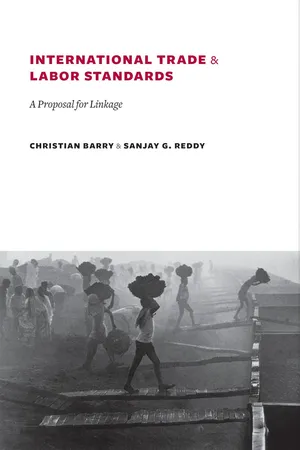
eBook - ePub
International Trade and Labor Standards
A Proposal for Linkage
- English
- ePUB (mobile friendly)
- Available on iOS & Android
eBook - ePub
About this book
Information
Subtopic
International EconomicsIndex
EconomicsCHAPTER ONE
What Is Linkage? Two Propositions
Proposals to promote labor standards can be divided into two types: those that involve linkage and those that do not. Further, all proposals to promote labor standards, whether or not they involve linkage, can be characterized according to how they answer the following two questions:
(Q1) What are the labor standards to be promoted?
(Q2) How should labor standards be promoted?
Disagreements between opponents and proponents of linkage either concern the objectives that should be promoted or the means of promoting them. Both opponents and proponents of linkage seem to affirm the following proposition:1
Proposition O: A very important factor in determining whether an institutional arrangement for the governance of the global economy should be viewed as superior to another is whether it improves the level of advantage of less advantaged persons in the world to a greater extent.
Those who affirm this proposition are committed to the view that improving the level of advantage of less advantaged persons in the world is a very important objective, which we therefore refer to henceforth as “the objective.” Advantage can be understood in various ways.2 We leave it unspecified other than presuming that for members of the labor force advantage is generally enhanced by higher employment, higher real wages, and improved working conditions. We define “labor standards” as the level of real wages and the quality of working conditions. Together with higher employment, the improvement of labor standards is an important way of increasing the level of advantage of less advantaged persons.
We understand basic labor standards to refer to a specified level of attainment of labor standards that is deemed minimally adequate. In order to fix these ideas and render this notion more concrete, the basic labor standards may be thought of in terms of the “core” labor standards promoted by the ILO. The ILO’s core labor standards consist of “freedom of association and the effective recognition of the right to collective bargaining; the elimination of all forms of forced or compulsory labor; the effective abolition of child labor; and the elimination of discrimination in respect of employment and occupation.”3 Although we leave the exact content of the basic labor standards deliberately unspecified (since the argument we present below does not depend on any highly specific conception of them), we think it implausible that an account of basic labor standards would not include some reference, even if minimal, to standards of each of these kinds. We think that any plausible account of basic labor standards will also additionally make reference to a level of real wages that may be deemed minimally adequate in each context, although we do not take a position here as to what that level should be.4
Similarly, our argument assumes the value of the objective identified without relying on any specific interpretation of it (within some reasonable range of variation). We understand an institutional arrangement to be a set of norms or rules (whether formal or informal) that govern the interaction of the participants of a social system (e.g., countries engaged in international trade). Proponents of linkage adhere to the following proposition and opponents of linkage reject it (in relation to the organization of the international economy):
Proposition L: It is desirable to bring about an institutional arrangement in which rights to trade are made conditional upon the promotion of labor standards, and there is reason to believe that such an arrangement can be brought about and sustained.
Proponents of linkage must answer Q2 (at least) in a manner that reflects their adherence to proposition L.5 Opponents of linkage must claim either that it is undesirable to bring about an institutional arrangement in which rights to trade are made conditional upon the promotion of labor standards or that the institutional arrangements of this kind that would be desirable are infeasible.
It is often presumed in discussions of linkage that linkage proponents necessarily favor the application of trade sanctions to countries that fail adequately to promote labor standards. In fact, this is in no way entailed by proposition L, since a system that offers6 countries additional trading opportunities if they promote labor standards adequately—without sanctioning them when they do not—is a form of linkage as defined by proposition L.7 Indeed, we argue below that extending additional opportunities to countries that adequately further labor standards will play an important role in a feasible and effective system of linkage.
CHAPTER TWO
Three Types of Linkage, and What Linkage Proponents Must Show
What is linkage, and what are the conditions under which it is desirable to “link” things? At least three distinct types of linkage can be relevant in designing institutional arrangements.
The first type of linkage arises as a result of the interdependence of different attainments (in health, education, security, and so on) in the process of evaluation. The assessment of an outcome may depend on the extent to which distinct objectives are each attained. When attainments of more than one kind necessarily enter jointly into the evaluative process, we may refer to this as “evaluation linkage.” Evaluation linkage influences the design of institutions, since the desirability of each outcome depends on the extent of all of the attainments that define that outcome. Each institutional arrangement may give rise to different combinations of desirable and undesirable attainments. Moreover, it may sometimes be impossible to assess the desirability of specific attainments without taking due account of other attainments. The choice among different institutional arrangements must be made on the basis of the extent to which the combinations of attainments to which they give rise contribute to some “master-goal.”1
A second type of linkage is that in which the promotion of distinct attainments is taken to be the objective of some agent.2 For example, it might be required that a government agency discharge more than one function, such as the prevention and curing of illness or the health and educational achievements of young children. We may refer to this type of linkage, in which distinct ends are assigned to single agents, as “agency linkage.”
A third type of linkage is that in which the rights of agents are made conditional on their conducting themselves in a specific way. For example, the right to receive certain social benefits may be made conditional on having paid (or on having promised to pay) taxes. We refer to this type of linkage as “rights linkage.”3
Those who affirm proposition L and those who deny it disagree about whether there ought to be rights linkage between trade and labor standards. They need not disagree about either evaluation linkage or agency linkage as defined above. In particular, both proponents and opponents of proposition L appear to accept evaluation linkage between trade and labor standards. However, they disagree about rights linkage between these domains since they differ over whether rights to trade ought to be made conditional on adequately promoting some labor standards.
It is important to note that opponents of rights linkage (in which rights to trade are made conditional upon the promotion of labor standards) need not oppose agency linkage (in which single agents4 are charged with the goals of promoting trade and labor standards). They may find it desirable that some agency aim both to promote trade and the observance of basic labor standards, while opposing the conferral of power to any agency to limit other agents’ rights to trade on the basis of whether or not they have adequately promoted basic labor standards. On the other hand, those who affirm rights linkage must affirm some kind of agency linkage, as they must affirm that some agent(s) ought to be charged with making authoritative determinations regarding whether or not other agents have or have not adequately promoted basic labor standards and how their conduct in this area should affect their rights to participate fully in international trade.
What reasons might there be to affirm or reject evaluation, agency, or rights linkage as defined above? Reasons to affirm or reject evaluation linkage seem perhaps most obvious. Attainments of more than one kind ought necessarily to enter jointly into the evaluative process whenever each type of attainment is deemed important in evaluating outcomes. For example, health and educational achievements ought to be “evaluation linked” for social institutions, because both are important in assessing the outcomes generated by such institutions.
Whether different attainments should be agency linked depends largely on how effectively alternative assignments of aims to agents would promote the desired ends. In some contexts, charging a single agent with promoting more than one attainment may be an effective way to promote the desired attainments, whereas in other contexts they may be better promoted by a more functionally differentiated system in which distinct agents are charged with promoting distinct attainments. The judgment as to whether such functional differentiation is desirable will depend heavily on empirical considerations.
Whether rights linkage is desirable depends on considerations of two kinds. The first consideration, effectiveness, is empirical. Whether rights linkage is effective depends on whether two or more attainments (such as enhanced levels of trade and the attainment of basic labor standards) are achieved more or less by linking rights to participate in trade with the promotion of basic labor standards. The second consideration, appropriateness, concerns additional moral considerations that may be relevant to justifying rights linkage. For example, while some may argue that making the right to vote conditional on not having been found guilty of serious criminal offences is morally appropriate (whether or not such conditionality contributes to desired ends such as voter participation or reductions in crime), others may deny this. Rights confer benefits on agents, and it may or may not be held that an agent should be conferred such benefits if they have failed to abide by specific normative standards. Throughout the rest of this paper, when we refer to proponents and opponents of “linkage” we mean proponents and opponents of proposition L, and therefore of rights linkage only.
It is possible to favor only specific linkage proposals (and then only under specific conditions). For example, certain linkage proponents argue that linking trade and labor standards through the WTO is undesirable because the WTO by its very nature is hostile to labor standards. However, such persons may endorse linkage under an alternative institutional order of world trade. Similarly, those who object to a form of linkage that allows developed countries unilaterally to bring trade sanctions against those countries they deem to have neglected labor standards may not object to a form of linkage that precludes potentially opportunistic misuse of this kind. Furthermore, those who reject the idea that the rights of countries to trade internationally may be made conditional on the extent to which they adequately promote basic labor standards can endorse the idea that those countries that make marked improvements in their promotion of such standards ought to acquire further rights to trade. Our goal in this paper is not merely to defend proposition L but to develop criteria for distinguishing plausible from implausible linkage proposals.
We shall argue that any system for guaranteeing mutual access to markets (a rule-based system of international trade) can potentially be enhanced by making rights to trade conditional on the promotion of those standards in an appropriate way (i.e., through linkage). In doing so, we do not presuppose that the system for guaranteeing mutual market access (in relation to which linkage is being considered) is the WTO, although, for simplicity, we shall often assume in our discussion here that the trading system that we are considering is the WTO. The case that we make here for linkage, therefore, potentially applies to all multilateral trading agreements.
Proponents of linkage hold that there exists at least one proposal for linkage that, all things considered, is desirable to bring about under current conditions. Opponents of linkage contend that there is not even one proposal for linkage that, all things considered, is desirable to bring about (at least under current conditions). To reject this view, it would be sufficient for advocates of linkage to show that there is at least one proposal for linkage that, all things considered, is desirable to bring about (under current conditions). The central task of this paper is to demonstrate this. We do so by showing that there is a class of proposals for linkage that meets all of the objections commonly advanced (and widely held to be plausible) against proposals for linkage and that, moreover, linkage proposals belonging to this class would perform better than nonlinkage proposals in promoting the objective (as defined in proposition O above) we presume is shared by both proponents and opponents of linkage. In doing so, we meet a much stronger test than is strictly necessary in order to sustain proposition L, which depends on the existence of a proposal for linkage that it is desirable to bring about, all things considered.5
CHAPTER THREE
What Linkage Opponents Must Show
Principles commonly espoused with respect to the organization of the domestic economy can be invoked in favor of linkage. Regulations protecting labor standards in the domestic economy effectively condition the right to produce and trade goods and services on the adherence to some standards. Failure to abide by labor regulations protecting basic labor standards breaks fundamental rules governing membership in a cooperative economic union whose members are provided certain economic privileges (...
Table of contents
- Cover
- Half title
- Title
- Copyright
- Contents
- List of Tables
- Preface
- Acknowledgments
- Introduction
- Chapter 1. What Is Linkage? Two Propositions
- Chapter 2. Three Types of Linkage, and What Linkage Proponents Must Show
- Chapter 3. What Linkage Opponents Must Show
- Chapter 4. Arguments Against Linkage
- Chapter 5. Ruling Out Linkage Proposals
- Chapter 6. A Constructive Procedure—Identifying Linkage Proposals That Meet the Standard Objections
- Chapter 7. Sketch of One Possible Linkage System
- Chapter 8. Conclusion
- Appendix: Empirical Evidence on the Likely Effects of Improvements in Labor Standards
- Commentary by Kyle Bagwell: Economic Theory, WTO Rules, and Linkage
- Commentary by Rohini Hensman: Fine-Tuning the Linkage Proposal
- Commentary by Robert E. Goodin: The Ethics of Political Linkage
- Commentary by Roberto Mangabeira Unger: The Transformative Imagination and the World Trading System
- Reply to Commentators
- Notes
- Index
Trusted by 375,005 students
Access to over 1.5 million titles for a fair monthly price.
Study more efficiently using our study tools.
Frequently asked questions
Yes, you can cancel anytime from the Subscription tab in your account settings on the Perlego website. Your subscription will stay active until the end of your current billing period. Learn how to cancel your subscription
No, books cannot be downloaded as external files, such as PDFs, for use outside of Perlego. However, you can download books within the Perlego app for offline reading on mobile or tablet. Learn how to download books offline
Perlego offers two plans: Essential and Complete
- Essential is ideal for learners and professionals who enjoy exploring a wide range of subjects. Access the Essential Library with 800,000+ trusted titles and best-sellers across business, personal growth, and the humanities. Includes unlimited reading time and Standard Read Aloud voice.
- Complete: Perfect for advanced learners and researchers needing full, unrestricted access. Unlock 1.5M+ books across hundreds of subjects, including academic and specialized titles. The Complete Plan also includes advanced features like Premium Read Aloud and Research Assistant.
We are an online textbook subscription service, where you can get access to an entire online library for less than the price of a single book per month. With over 1.5 million books across 990+ topics, we’ve got you covered! Learn about our mission
Look out for the read-aloud symbol on your next book to see if you can listen to it. The read-aloud tool reads text aloud for you, highlighting the text as it is being read. You can pause it, speed it up and slow it down. Learn more about Read Aloud
Yes! You can use the Perlego app on both iOS and Android devices to read anytime, anywhere — even offline. Perfect for commutes or when you’re on the go.
Please note we cannot support devices running on iOS 13 and Android 7 or earlier. Learn more about using the app
Please note we cannot support devices running on iOS 13 and Android 7 or earlier. Learn more about using the app
Yes, you can access International Trade and Labor Standards by Christian Barry,Sanjay G. Reddy in PDF and/or ePUB format, as well as other popular books in Economics & International Economics. We have over 1.5 million books available in our catalogue for you to explore.